It looks like you're using an Ad Blocker.
Please white-list or disable AboveTopSecret.com in your ad-blocking tool.
Thank you.
Some features of ATS will be disabled while you continue to use an ad-blocker.

What are your favorite 9/11 debunking tactics?
page: 19share:
Originally posted by esdad71
reply to post by maxella1
You get off on this, don't you? These are actual answers that are used to defend the DS or Delusional Story as i call is now which is the opposite of the OS. No matter what is asked of one, you can plug this in like a mad lib and you get a conversation....
1. Physics were suspended that day
So build a self supporting physical model that can be completely collapsed by dropping the top 15% or less onto the rest from not more than 20% of the total height of the structure.
Why haven't you or any engineering school done that in TEN YEARS?
psik
Originally posted by esdad71
reply to post by maxella1
You get off on this, don't you? These are actual answers that are used to defend the DS or Delusional Story as i call is now which is the opposite of the OS. No matter what is asked of one, you can plug this in like a mad lib and you get a conversation....
1. Physics were suspended that day
2. This had never happened before
3. There is no precedent
4. 3 buildings have never collapsed at the same time
5. how much did the concrete weigh
6. Northwoods
7. Pearl Harbor
8. NIST never looked for explosives
9. Silverman made money
10. no way a bunch of arabs with boxcutters did this
11. BUsh sucks
12. It was the NWO
13. Cheney sucks
14. the truth is days awake
15 wake up!!!
16. show me the physics
17. explosives
18. thermite
19 . dust proves it!!!
need i go on.......edit on 24-5-2012 by esdad71 because: (no reason given)
Hey what's happening to the north side of this building? AL Qaida jet fuel? Al Qaida air pressure puffs?
What?
And yes please go on, it's very entertaining.

Originally posted by maxella1
Two more questions if you don't mind...
Victims or Vicsims?
All Jews, some Jews?
"Vicsims" is a concept, pushed by disinfo project "September Clues". While maybe some of victims are fake, I do not see reason why would they make it more complex. Real victims are safer.
I am not an expert in Jews. It would be reckless to blame a whole nation on something.
I realized that they are very united. They live among other nations and help each other to gain more control over society.
I have discovered Beilis case recently. It is not a difficult case to solve and does not require Sherlock Holmes' skills. Beilis was guilty indeed. But what is more interesting is the help and cover up he got, and it is still going on. Check the Wikipedia page of him, it is completely biases and claims he is innocent. This story makes me think that Jews have a hidden agenda indeed.
This is, by the way, my favorite method. I find an easy case, that can be by a clever man, and then I watch who takes what side. As I said, in 9/11 this is obvious "no planes" theory.
Also I do not like the fact they are kind of untouchable. Say something bad of them - and it is you who is a bad person instead.
There should be a reason why they are hated over ages and nations. And the fact that Mossad did 9/11 does not make me fall in love with them too. USS Liberty, Bali bombings (used their favorite weapon - micronuke), Lavon Affair... they are masters of false flag operations.
People say it is just an evil group of them, Zionists, and not all Jews agree with their methods.. I do not know. I still have to find at least one Jew who is agree with me on 9/11 and Beilis case.
reply to post by DonJuan
Do you think that maybe they don’t agree with you on 9/11 because your opinion is nuts? You know “No plane” and “nukes”
There should be a reason why they are hated over ages and nations. And the fact that Mossad did 9/11 does not make me fall in love with them too. USS Liberty, Bali bombings (used their favorite weapon - micronuke), Lavon Affair... they are masters of false flag operations. People say it is just an evil group of them, Zionists, and not all Jews agree with their methods.. I do not know. I still have to find at least one Jew who is agree with me on 9/11 and Beilis case.
Do you think that maybe they don’t agree with you on 9/11 because your opinion is nuts? You know “No plane” and “nukes”
Originally posted by esdad71
reply to post by maxella1
You get off on this, don't you? These are actual answers that are used to defend the DS or Delusional Story as i call is now which is the opposite of the OS. No matter what is asked of one, you can plug this in like a mad lib and you get a conversation....
1. Physics were suspended that day
2. This had never happened before
3. There is no precedent
4. 3 buildings have never collapsed at the same time
5. how much did the concrete weigh
6. Northwoods
7. Pearl Harbor
8. NIST never looked for explosives
9. Silverman made money
10. no way a bunch of arabs with boxcutters did this
11. BUsh sucks
12. It was the NWO
13. Cheney sucks
14. the truth is days awake
15 wake up!!!
16. show me the physics
17. explosives
18. thermite
19 . dust proves it!!!
need i go on.......edit on 24-5-2012 by esdad71 because: (no reason given)
20. Toasted cars...
21. almost a tenth of a percent of Americas architects and engineers....
22. Vicsims
23. Buildings may have been fakes
24. Suspicious Hurricane.
25. Bad things happened as a result, and therefore bad intentions are required...
26. I'm an engineer, but can't be bothered to give my testimony in engineering terms.
27. The buildings were all designed to withstand multiple plane strikes.
28. I heard it from a guy....
29. I made a model out of cardboard and it didn't collapse therefore buildings can't collapse.
30. Any evidence the debunkers have is fake.
31. Earwitnesses in the basement.
32. If there were no basement nukes, explain the radiation!
reply to post by DrEugeneFixer
Oh good you're back... maybe you can answer this question?
Oh good you're back... maybe you can answer this question?
Hey what's happening to the north side of this building? AL Qaida jet fuel? Al Qaida air pressure puffs? What? And yes please go on, it's very entertaining.
Originally posted by maxella1
Do you think that maybe they don’t agree with you on 9/11 because your opinion is nuts? You know “No plane” and “nukes”
No, they support the OS.
“No plane” and “nukes” is not my opinion. My opinion is something that may change. Instead this is my knowledge.
As I told, I am not going to propagate it. And I realize, that those 2 theory may sound crazy for common folks. This is, BTW, one of the reasons why it is not possible to sell this truth to the public and the OS will dominate. No one can give a good, easy to understand, alternative theory.
reply to post by The X
Let me see if I can reply to your post.
Yes it is. I stare at I beams all day long. Talking to iron workers and every other construction industry in the field.
Even after sustaining structural damage such as this?
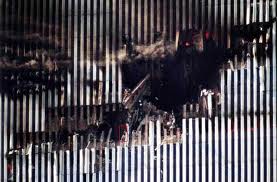
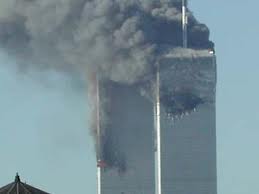
Can you please show me another example of a building at this height that sustained similar structural damage and stood upright? I think that the towers did a good job of absorbing the impact. It is amazing that they still stood for an hour and a half or so.
From your link.
your link
The bottom 9/10th's of the building has an upper floor. This upper floor is held together by connections. As seen in the diagram.
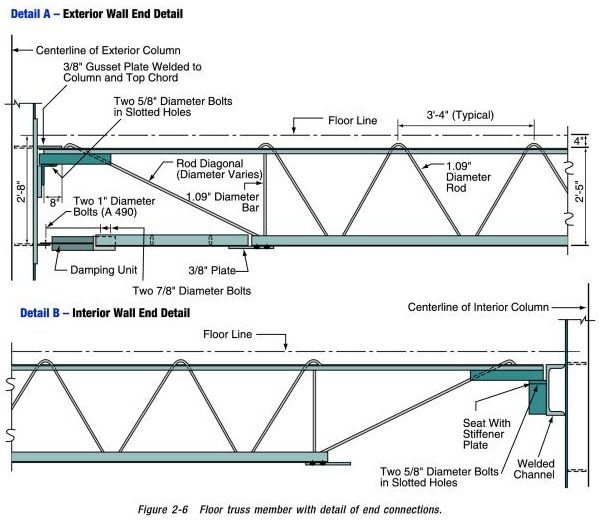
The weight of the upper floor collapsing is not falling on a solid mass. The weight is falling on the truss and beam connections, which are connected to the inner and outer perimeter. These connections of the uper "still intact" portion of the building are the objects absorbing the energy, not the whole lower mass of the building.
Like I stated in my post before. All of the math and "physics" models that like to get thrown around are simply using the total weight and mass of the building, ignoring the connections that hold the building together.
Here is a pic of one of the dampers that was pulled from the wreckage.

This single piece is just a part of the connection that was responsible for taking the brunt of the impact by the weight of the falling debris.
Here is a diagram of an undamaged one.
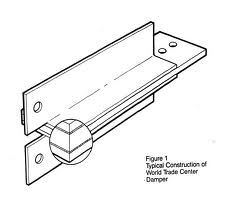
I ask you this.
Can this single part hold up the entire weight of the upper floors? Can a hundred parts hold up the weight?
These parts have a weight and stress limit that they can handle.
It really is simple..........The weight fell on these connections. The outer load bearing wall was designed to withstand the potential load of the building, with added dampers for a determined amount of side to side sway.
The load bearing perimeter and inner core were not designed to withstand, or absorb kenetic energy of a downward motion of collapsing weight. An astounding amount of weight at that.
With all due respect your debunking tactic means nothing. It is just another failed attempt to try to make math and physics a "truther friend".
The buildings are not a solid mass. It is mass that is held up by thousands of connections. This is what the weight of the upper floors is impacting, the connections, not the entire mass of the lower building. One connection at a time, one floor at a time.
It is 3.7 meters to the next connection, and the 4 inches of lightweight concrete sitting on metal decking, which is connected(welded or screwed) to the trusses.
I mean seriously, the link you provided is a one sided argument. That is ok though, I know that even after taking the time to try to explain the complexity of multiple building connections verses solid mass will go upon deaf ears(or blind eyes).
I am used to it around here.
I would love to see how clever you really are, this is an opportunity to earn yourself 1million euros, and, my deepest respect.
Let me see if I can reply to your post.
This is after all your field, is it not?.
Yes it is. I stare at I beams all day long. Talking to iron workers and every other construction industry in the field.
Buildings perform their "Duty" even outside of design specifications as a matter of the structural building codes.
Even after sustaining structural damage such as this?
Can you please show me another example of a building at this height that sustained similar structural damage and stood upright? I think that the towers did a good job of absorbing the impact. It is amazing that they still stood for an hour and a half or so.
Please, show me how clever you are.
From your link.
The bottom part A is the 9/10th bottom of the total structure. It has mass 9 M kilograms. It means A is 9 times bigger than C!
When top part C with mass M impacts bottom part A from above after a free fall drop of 3.7 meters by gravity (g = 9.82 m/s²), it applies 36.334 M Joule energy to the (total) structure with mass 10 M.
Will bottom part A with mass 9 M be crushed into rubble by top part C with mass M? Can 3.63 Joule energy initiate a collapse destruction of 1 kilogram of A?
your link
The bottom 9/10th's of the building has an upper floor. This upper floor is held together by connections. As seen in the diagram.
The weight of the upper floor collapsing is not falling on a solid mass. The weight is falling on the truss and beam connections, which are connected to the inner and outer perimeter. These connections of the uper "still intact" portion of the building are the objects absorbing the energy, not the whole lower mass of the building.
Like I stated in my post before. All of the math and "physics" models that like to get thrown around are simply using the total weight and mass of the building, ignoring the connections that hold the building together.
Here is a pic of one of the dampers that was pulled from the wreckage.
This single piece is just a part of the connection that was responsible for taking the brunt of the impact by the weight of the falling debris.
Here is a diagram of an undamaged one.
I ask you this.
Can this single part hold up the entire weight of the upper floors? Can a hundred parts hold up the weight?
These parts have a weight and stress limit that they can handle.
It really is simple..........The weight fell on these connections. The outer load bearing wall was designed to withstand the potential load of the building, with added dampers for a determined amount of side to side sway.
The load bearing perimeter and inner core were not designed to withstand, or absorb kenetic energy of a downward motion of collapsing weight. An astounding amount of weight at that.
My favourite debunking tactic, put your brains/mouth where the money is.
With all due respect your debunking tactic means nothing. It is just another failed attempt to try to make math and physics a "truther friend".
The buildings are not a solid mass. It is mass that is held up by thousands of connections. This is what the weight of the upper floors is impacting, the connections, not the entire mass of the lower building. One connection at a time, one floor at a time.
It is 3.7 meters to the next connection, and the 4 inches of lightweight concrete sitting on metal decking, which is connected(welded or screwed) to the trusses.
I mean seriously, the link you provided is a one sided argument. That is ok though, I know that even after taking the time to try to explain the complexity of multiple building connections verses solid mass will go upon deaf ears(or blind eyes).
I am used to it around here.
edit on 24-5-2012 by liejunkie01 because: (no reason given)
Originally posted by maxella1
reply to post by liejunkie01
I once was hanging some duct work for a building, I was told to cut a couple of x braces connecting the floor joists above. After I cut the last one an Iron worker came over and started raising hell. I only cut out a couple of braces but they called in the engineer and the architect to make sure this would be structurally sound.
Was that building built the same as WTC? And did the engineer say that It could collapse all the way down to the ground floor ?
I cannot even believe that i am replying to this comment.
That was a simplified example of how one simple part being removed from a structure can put the entire structure integrity at risk.
That was one example of x bracing being removed. The engineer was called in to see if the structure's integrity would not be compromised. If the integrity was compromised enough, then yes the building can collapse.
Now look at all that was removed from the towers.
I hope you get the point I was trying to make.
Originally posted by Varemia
reply to post by scully222
Almost all of your points are either huge exaggerations or completely false. It's really hard to argue with 9/11 conspiracy theorists when they can't even get their facts straight. I mean, it's so bad that I don't even want to waste the energy in going through every single one. An entire thread could be spent bickering on each point and it would get everyone nowhere.
Why don't you just say "I can't refute a single point in any kind of detailed way, so I'll just call the whole thing stupid". You keep talking about facts given to you by others who you obviously trust. I am speaking of common sense and the ability to believe my own eyes. If you except everything your told without question than you truly have completely lost the ability to think for yourself. Here is what I believe: People with an agenda who are trying to spin (create, falsify) a story ALWAYS claim to be on the side of truth and THE FACTS. People who actually have some truth to tell will ask you to listen to their points, do some research, and come to your OWN conclusions. We should all come to our own conclusions on issues. Too many people let others do it for them.
Originally posted by liejunkie01
Originally posted by maxella1
reply to post by liejunkie01
I once was hanging some duct work for a building, I was told to cut a couple of x braces connecting the floor joists above. After I cut the last one an Iron worker came over and started raising hell. I only cut out a couple of braces but they called in the engineer and the architect to make sure this would be structurally sound.
Was that building built the same as WTC? And did the engineer say that It could collapse all the way down to the ground floor ?
I cannot even believe that i am replying to this comment.
That was a simplified example of how one simple part being removed from a structure can put the entire structure integrity at risk.
That was one example of x bracing being removed. The engineer was called in to see if the structure's integrity would not be compromised. If the integrity was compromised enough, then yes the building can collapse.
Now look at all that was removed from the towers.
I hope you get the point I was trying to make.
Oh I get your point. But you don't get my point, let me explain.
First you didn’t say if structure's integrity was compromised due to removal of the x bracing.
And second, why didn't the top portion fall in the direction of the tilt? And even if it somehow found it easier to fall in the direction of the most resistance of the rest of the building which wasn’t compromised, how did it manage to completely destroy the entire building to the ground floor? Why didn’t it slow down?
And maybe you can explain what is happening to the north side of WTC 7 ?
edit on 24-5-2012 by maxella1 because: (no reason given)
Originally posted by Varemia
Originally posted by maxella1
Evidence. lol
Yeah, the photos, the videos, the testimony, and the physics all completely contradict everything you say. You seem to think you know everything, and you think you know what's impossible and possible, yet you can't cite a single example where a plane hit a skyscraper at high speed and the fire was uncontrolled. Buildings have burned, yes. Buildings have been hit by planes (albeit at lower speeds), yes. But never has a building been hit and burned. I can't really think of an instance where a building got hit by a collapsing building and burned uncontrolled for 7 hours either.
Your "impossible" factors are unprovable. I wish you'd provide evidence for those.
This is a perfect example of what I was saying. Thank you. You are presenting this as a totally unique event (plane and FIRE!!!) so how could we possibly know what to expect. The rules don't apply so buildings come down in ways that simply don't look right at all. But it's OK cause these are special circumstances. Explosives in the buildings is no more Unprovable than the OFFICIAL STORY and the pancake theory. They all admit that all they have are theories and they don't know exactly what brought the buildings down. How do you prove that? Explosives in a building will bring it down EXACTLY like that and we have all seen it. It is repeatable and can be tested. Isn't that what science is all about?
reply to post by maxella1
Personally I do not know what the engineer's decision was. I was moved to a different jobsite shortly after this happened. I did'nt hear anything about it.
Why would it? It is not a tree in the forrest.
I would like to say that I do not quote the NIST report or any other corrupt "study" put on from people with an agenda of their own. What I say is strictly from my own experience and education in this type of field. I just wanted to get that out of the way.
You have to have two ends of a truss connected to keep the truss system in optimal operating conditions. If one side of a truss connection fails then there is no way that the opposite side of the truss connection can withstand such sudden release of energy, thus this/these connections will fail. We are talking about an instant release of a massive amount of energy.
The weight and the motion(kinetic energy) of the falling floors on one side of the building do not give the survivng connections any choice but to become compromised, this all happens so fast and the release of energy so great, that the surviving connections are instantly compromised, not giving enough time or side to side energy to make the building fall over.
The enormous weight, amplified by gravity, along with the weight and stress limits of the connections, keeps the debris falling down.
Also when you speak of the most resistance, you are only poeaking of a few 1 inch and 5/8 inch bolts that hold the trusses to the I beams. Which are connected via rhe viscoelastic dampers. It is my opinion that the some of the dampers became compromised first added with the shearing of the bolts that holds the assembly to the I beam.
Each floor is held up by basically the same connections. The connections might be slightly stronger on the lowers floors, but the amount of force rapidly exceeds the rated strength of the connections. These connections cannot and never will hold up to that amount of force. Also as more of the building collapses the weight and force becomes greater.
I believe that it took several seconds to completely collapse. This is not instantly.
Why would it slow down if the force of the weight amplified by gravity becomes greater as more of the building comes down on top of the lower connections? As each floor collapses, we are talking about added tonnes and tonnes of force to the lower connections.
I have seen the videos and the fires raging in the building. Yes, I do believe that fire can compromise the buildings integrity to the point of collapse. People say that the towers fell in their own footprints. I see 16 acres of debris and destruction.
Personally, I stay away from the building 7 issue because I feel that it is a distraction from the real issue which is the towers.
I do not really see any problem with this explanation. I know that it is wikipedia, but I feel that it is just as or more credible than most of the "truther" sites out there.
en.wikipedia.org/wiki/World_Trade_Center_Building_7
ETA: I hope that me getting some info from wikipedia does not contradict my statement about the Nist report. I looked at the references and there are many of them. Just wanted to clarify that for the hounds.
First you didn’t say if structure's integrity was compromised due to removal of the x bracing.
Personally I do not know what the engineer's decision was. I was moved to a different jobsite shortly after this happened. I did'nt hear anything about it.
And second, why didn't the top portion fall in the direction of the tilt?
Why would it? It is not a tree in the forrest.
And even if it somehow found it easier to fall in the direction of the most resistance of the rest of the building which wasn’t compromised,
I would like to say that I do not quote the NIST report or any other corrupt "study" put on from people with an agenda of their own. What I say is strictly from my own experience and education in this type of field. I just wanted to get that out of the way.
You have to have two ends of a truss connected to keep the truss system in optimal operating conditions. If one side of a truss connection fails then there is no way that the opposite side of the truss connection can withstand such sudden release of energy, thus this/these connections will fail. We are talking about an instant release of a massive amount of energy.
The weight and the motion(kinetic energy) of the falling floors on one side of the building do not give the survivng connections any choice but to become compromised, this all happens so fast and the release of energy so great, that the surviving connections are instantly compromised, not giving enough time or side to side energy to make the building fall over.
The enormous weight, amplified by gravity, along with the weight and stress limits of the connections, keeps the debris falling down.
Also when you speak of the most resistance, you are only poeaking of a few 1 inch and 5/8 inch bolts that hold the trusses to the I beams. Which are connected via rhe viscoelastic dampers. It is my opinion that the some of the dampers became compromised first added with the shearing of the bolts that holds the assembly to the I beam.
how did it manage to completely destroy the entire building to the ground floor? Why didn’t it slow down?
Each floor is held up by basically the same connections. The connections might be slightly stronger on the lowers floors, but the amount of force rapidly exceeds the rated strength of the connections. These connections cannot and never will hold up to that amount of force. Also as more of the building collapses the weight and force becomes greater.
I believe that it took several seconds to completely collapse. This is not instantly.
Why would it slow down if the force of the weight amplified by gravity becomes greater as more of the building comes down on top of the lower connections? As each floor collapses, we are talking about added tonnes and tonnes of force to the lower connections.
And maybe you can explain what is happening to the north side of WTC 7 ?
I have seen the videos and the fires raging in the building. Yes, I do believe that fire can compromise the buildings integrity to the point of collapse. People say that the towers fell in their own footprints. I see 16 acres of debris and destruction.
Personally, I stay away from the building 7 issue because I feel that it is a distraction from the real issue which is the towers.
I do not really see any problem with this explanation. I know that it is wikipedia, but I feel that it is just as or more credible than most of the "truther" sites out there.
The original 7 World Trade Center was 47 stories tall, clad in red exterior masonry, and occupied a trapezoidal footprint. An elevated walkway connected the building to the World Trade Center plaza. The building was situated above a Consolidated Edison (Con Ed) power substation, which imposed unique structural design constraints. When the building opened in 1987, Silverstein had difficulties attracting tenants. In 1988, Salomon Brothers signed a long-term lease, and became the main tenants of the building. On September 11, 2001, 7 WTC was damaged by debris when the nearby North Tower of the World Trade Center collapsed. The debris also ignited fires, which continued to burn throughout the afternoon on lower floors of the building. The building's internal fire suppression system lacked water pressure to fight the fires, and the building collapsed completely at 5:21:10 pm.[2] The collapse began when a critical internal column buckled and triggered structural failure throughout, which was first visible from the exterior with the crumbling of a rooftop penthouse structure at 5:20:33 pm.
en.wikipedia.org/wiki/World_Trade_Center_Building_7
ETA: I hope that me getting some info from wikipedia does not contradict my statement about the Nist report. I looked at the references and there are many of them. Just wanted to clarify that for the hounds.
edit on 24-5-2012 by liejunkie01 because: ETA
Originally posted by Varemia
reply to post by maxella1
I really don't see how explosives down the tower would even help with the collapse. Internal collapse as an explanation for the ejections makes more sense.
I believe the firefighters who were there, and the physics of weight, damage, and fire. You believe conspiracy theorist videos and websites. That's your call, but it's not a crime to disbelieve people who are clearly lacking somewhere in the mental faculties.
Hell, I find it amusing that you feel better rejecting respected physicists, engineers, and pilots than you do conspiracy theorists. I guess everyone but you is in on it, eh?
You don't see how explosives would help the collapse? Are you kidding? You obviously have no idea how a building is demolished nowadays. Explosive charges placed on all the buildings support beams on each floor are set off in a synchronized way to cut the beams and bring the building down in a controlled fashion. The charges cut the beams and remove resistance on the lower floors so the upper floors come down at near free fall speed into the buildings footprint.
Did I hear that right? The "physics" of weight, damage, and fire? Do you even know what Physics is? Here is the WIKI:
en.wikipedia.org...
"Physics" says that free fall speeds are impossible with any resistance. Free fall implies no resistance. The floor crushing theory involves lots and lots and lots of resistance. Even if the collapse did start out as explained, the top portion of the building falling 30-50 feet would not provide enough inertia to collapse more than 1-2 stories before losing all its inertia due to resistance. Than it would simply tilt over and fall off the side. That is what Physics says. Read up!
reply to post by liejunkie01
Man I almost fell of my chair when I got to this part.
Yes building 7 is a distraction from the deep sleep some people are in. People see WTC 7 and wake up.
Good one !
Personally, I stay away from the building 7 issue because I feel that it is a distraction from the real issue which is the towers.
Man I almost fell of my chair when I got to this part.
Yes building 7 is a distraction from the deep sleep some people are in. People see WTC 7 and wake up.
Good one !
edit on 24-5-2012 by maxella1 because: (no reason given)
Even if the collapse did start out as explained, the top portion of the building falling 30-50 feet would not provide enough inertia to collapse more than 1-2 stories before losing all its inertia due to resistance.
As I stated above. The force and inertia will increase because of the weight of the debris increasing.
The resistance you speak of is connections, not a solid block. Each floor has only 4 inches of lightweight concrete on top of metal decking connected to trusses which are connected with dampers.
Why are you failing to take into account the connections, after all it is the connections which are offering the resistance?
How would four inches of concrete and some connections by dampers and bolt offer up enough resistance to stop thousands of tonnes of force which is rapidly increasing due to added weight?
When we do multiple floor construction, the engineers will not allw certain scissor lifts on the above decks. They say that the weight cannot exceed 100-200 pounds per square foot. Which we all laugh because I weigh more than that and if I stand on one foot I will exceed the weight limit.
How would 4 inches of concrete offer enough resistance to stop the weight of the upper floors. A weight which is increasing?
Originally posted by liejunkie01
Even if the collapse did start out as explained, the top portion of the building falling 30-50 feet would not provide enough inertia to collapse more than 1-2 stories before losing all its inertia due to resistance.
As I stated above. The force and inertia will increase because of the weight of the debris increasing.
The resistance you speak of is connections, not a solid block. Each floor has only 4 inches of lightweight concrete on top of metal decking connected to trusses which are connected with dampers.
Why are you failing to take into account the connections, after all it is the connections which are offering the resistance?
How would four inches of concrete and some connections by dampers and bolt offer up enough resistance to stop thousands of tonnes of force which is rapidly increasing due to added weight?
When we do multiple floor construction, the engineers will not allw certain scissor lifts on the above decks. They say that the weight cannot exceed 100-200 pounds per square foot. Which we all laugh because I weigh more than that and if I stand on one foot I will exceed the weight limit.
How would 4 inches of concrete offer enough resistance to stop the weight of the upper floors. A weight which is increasing?
Liejunkie #01..... after this....
Personally, I stay away from the building 7 issue because I feel that it is a distraction from the real issue which is the towers.
There is no need for you to say anything else.
Thank you for your service.
Originally posted by maxella1
reply to post by liejunkie01
Personally, I stay away from the building 7 issue because I feel that it is a distraction from the real issue which is the towers.
Man I almost fell of my chair when I to this part.
Yes building 7 is a distraction from the deep sleep some people are in. People see WTC 7 and wake up.
Good one !
Out of all that I typed and the information that I provided, this is the only reply that you can offer
That is my opinion of WTC 7.
I have yet to see anyone post any good info on why they/you think that exposives were needed
Anyone who thinks that an uncontrollable fire raging for hours and hours cannot bring a building down, are the one's that are asleep
Originally posted by liejunkie01
Originally posted by maxella1
reply to post by liejunkie01
Personally, I stay away from the building 7 issue because I feel that it is a distraction from the real issue which is the towers.
Man I almost fell of my chair when I to this part.
Yes building 7 is a distraction from the deep sleep some people are in. People see WTC 7 and wake up.
Good one !
Out of all that I typed and the information that I provided, this is the only reply that you can offer
That is my opinion of WTC 7.
I have yet to see anyone post any good info on why they/you think that exposives were needed
Anyone who thinks that an uncontrollable fire raging for hours and hours cannot bring a building down, are the one's that are asleep
Your opinion is noted.
reply to post by liejunkie01
Okay, lets try one last time.
What is happening to the north side of WTC 7 ?
Okay, lets try one last time.
What is happening to the north side of WTC 7 ?
new topics
-
God's Righteousness is Greater than Our Wrath
Religion, Faith, And Theology: 2 hours ago -
Electrical tricks for saving money
Education and Media: 5 hours ago -
VP's Secret Service agent brawls with other agents at Andrews
Mainstream News: 7 hours ago -
Sunak spinning the sickness figures
Other Current Events: 7 hours ago -
Nearly 70% Of Americans Want Talks To End War In Ukraine
Political Issues: 7 hours ago -
Late Night with the Devil - a really good unusual modern horror film.
Movies: 9 hours ago -
Cats Used as Live Bait to Train Ferocious Pitbulls in Illegal NYC Dogfighting
Social Issues and Civil Unrest: 11 hours ago
top topics
-
VP's Secret Service agent brawls with other agents at Andrews
Mainstream News: 7 hours ago, 9 flags -
Cats Used as Live Bait to Train Ferocious Pitbulls in Illegal NYC Dogfighting
Social Issues and Civil Unrest: 11 hours ago, 8 flags -
Electrical tricks for saving money
Education and Media: 5 hours ago, 4 flags -
Bobiverse
Fantasy & Science Fiction: 17 hours ago, 3 flags -
Sunak spinning the sickness figures
Other Current Events: 7 hours ago, 3 flags -
Nearly 70% Of Americans Want Talks To End War In Ukraine
Political Issues: 7 hours ago, 3 flags -
HORRIBLE !! Russian Soldier Drinking Own Urine To Survive In Battle
World War Three: 15 hours ago, 3 flags -
Late Night with the Devil - a really good unusual modern horror film.
Movies: 9 hours ago, 2 flags -
The Good News According to Jesus - Episode 1
Religion, Faith, And Theology: 12 hours ago, 1 flags -
God's Righteousness is Greater than Our Wrath
Religion, Faith, And Theology: 2 hours ago, 0 flags
active topics
-
New whistleblower Jason Sands speaks on Twitter Spaces last night.
Aliens and UFOs • 55 • : baablacksheep1 -
VP's Secret Service agent brawls with other agents at Andrews
Mainstream News • 40 • : ThatSmellsStrange -
Cats Used as Live Bait to Train Ferocious Pitbulls in Illegal NYC Dogfighting
Social Issues and Civil Unrest • 20 • : Asher47 -
Nearly 70% Of Americans Want Talks To End War In Ukraine
Political Issues • 12 • : Asher47 -
Electrical tricks for saving money
Education and Media • 4 • : Lumenari -
DONALD J. TRUMP - 2024 Candidate for President - His Communications to Americans and the World.
2024 Elections • 514 • : WeMustCare -
The Acronym Game .. Pt.3
General Chit Chat • 7744 • : bally001 -
Truth Social goes public, be careful not to lose your money
Mainstream News • 128 • : Astyanax -
Sunak spinning the sickness figures
Other Current Events • 5 • : glen200376 -
SETI chief says US has no evidence for alien technology. 'And we never have'
Aliens and UFOs • 44 • : MikeDeGrasseTyson