It looks like you're using an Ad Blocker.
Please white-list or disable AboveTopSecret.com in your ad-blocking tool.
Thank you.
Some features of ATS will be disabled while you continue to use an ad-blocker.

Faked Moon Landing - Amazing Documentary
page: 41share:
reply to post by Anunaki10
You don't know that. He said what he said, not what you think he said. It is only your theory that he assumed most people know it is "in relation to Earth." Your theory.
The Moon faces one side towards the Earth because it rotates on its axis in the same amount of time it takes to circle the Earth. According to you, this means that it does not rotate on its axis in relation to Earth, right? Isn't that what you keep saying? The thing is, angular momentum is the product of mass and angular velocity. The Moon still rotates on its axis in relation to the rest of the Universe; this is why the Sun can be seen to rise and set from the surface of the Moon. From Earth, this corresponds to the Moon's phases. Because it rotates on its axis from the frame of reference of the rest of the universe, it has angular momentum. Your wiki is absolutely wrong in stating it has zero angular momentum.
Here are some further clues that the author of this wiki is scientifically illiterate. His thought experiment involves following the Moon in a shuttle. We'll set aside the fact they he clearly has no idea what the operational parameters of the shuttle were, and focus on his obvious lack of knowledge of celestial mechanics. How could a spacecraft "follow" the Moon without orbiting it? The Moon's gravity would attract it; it would crash.
The only place in the Earth-Moon system that would allow a spacecraft to "follow" the Moon in its orbit would be the trailing Lagrangian Point. Let us imagine what that would look like. Let's keep the Earth off to our left, the Moon dead ahead. The Earth would appear to rotate, but we would always see the same side of the Moon, because its rotation is synchronized to its orbit around Earth. We would see the Moon change phases, as it is moving with respect to the Sun, and we would see stars moving from left to right, because we and the Moon are rotating relative to the stars.
Let me repeat this to you since you're STILL STRUGGLING trying to understand what is being posted, Alex Collier don't have to mention "in relation to the Earth", because he assume that at least most people automatically KNOW it is "in relation to the Earth", that's why he didn't think it's necessary to mention "in relation to the Earth"...
You don't know that. He said what he said, not what you think he said. It is only your theory that he assumed most people know it is "in relation to Earth." Your theory.
Does the Moon spin on its axis? No it doesn't ! If it was spinning/ rotating (on its own axis, by definition), and we could somehow stop its orbit around the earth (or even suddenly straighten it into a line), it should then continue spinning. It obviously won't. It will just sit there angularly motionless as it always has.
This ignorant statement not only makes no sense, it contradicts what you yourself said!
Nope, it does not contradict what i said...
The Moon faces one side towards the Earth because it rotates on its axis in the same amount of time it takes to circle the Earth. According to you, this means that it does not rotate on its axis in relation to Earth, right? Isn't that what you keep saying? The thing is, angular momentum is the product of mass and angular velocity. The Moon still rotates on its axis in relation to the rest of the Universe; this is why the Sun can be seen to rise and set from the surface of the Moon. From Earth, this corresponds to the Moon's phases. Because it rotates on its axis from the frame of reference of the rest of the universe, it has angular momentum. Your wiki is absolutely wrong in stating it has zero angular momentum.
Here are some further clues that the author of this wiki is scientifically illiterate. His thought experiment involves following the Moon in a shuttle. We'll set aside the fact they he clearly has no idea what the operational parameters of the shuttle were, and focus on his obvious lack of knowledge of celestial mechanics. How could a spacecraft "follow" the Moon without orbiting it? The Moon's gravity would attract it; it would crash.
The only place in the Earth-Moon system that would allow a spacecraft to "follow" the Moon in its orbit would be the trailing Lagrangian Point. Let us imagine what that would look like. Let's keep the Earth off to our left, the Moon dead ahead. The Earth would appear to rotate, but we would always see the same side of the Moon, because its rotation is synchronized to its orbit around Earth. We would see the Moon change phases, as it is moving with respect to the Sun, and we would see stars moving from left to right, because we and the Moon are rotating relative to the stars.
edit on 30-7-2012 by DJW001 because: (no reason given)
reply to post by Anunaki10
You said in reply to DJW001:
I am going to refute that statement! The Moon DOES rotate on it's axis as it orbits the Earth.
The Moon rotates on it's axis once every 28 days. The Moon also orbits around the Earth once every 28 days. This 1 revolution on it's axis to 1 orbit around the Earth causes one side of the Moon to constantly face the Earth. By definition, the Moon is tidally locked to the Earth.
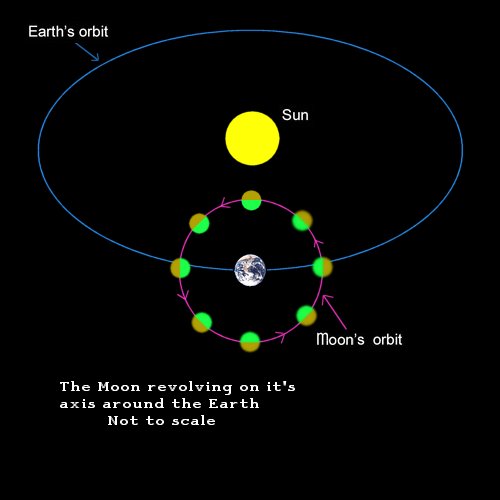
In the above illustration, I am showing how the same side of the Moon always faces the Earth as it orbits the Earth. The Sun is the center of our galaxy and the Earth orbits the Sun. If the Earth was not part of this equation, and the Moon would continue to orbit the Sun, we would see the Moon rotate 13.04 on it's axis in one orbit around the Sun.
This notion that the Moon does not spin on it's axis "in relationship to the Earth" is a mis-statement because the Moon does spin 13.04 times a year. That is why we use the term tidal lock to describe when a planet or moon's face is "locked" to another planet.
In fact, if we really wanted to get technical, the Moon actually causes the Earth to wobble in and out of it's orbit around the Sun. The moon does not orbit the center of the earth, rather, they both revolve around the center of their masses called the barycenter. This out of balance wobble causes both the Earth and the Moon to speed up and slow down as it orbits the Sun. Hmmmmm, now isn't that interesting.
Good Site on Tidal Lock
Good Site on Earth and Moon Relationship
You said in reply to DJW001:
Wrong, the Moon does NOT rotate on it's axis in relation to the Earth...
I am going to refute that statement! The Moon DOES rotate on it's axis as it orbits the Earth.
The Moon rotates on it's axis once every 28 days. The Moon also orbits around the Earth once every 28 days. This 1 revolution on it's axis to 1 orbit around the Earth causes one side of the Moon to constantly face the Earth. By definition, the Moon is tidally locked to the Earth.
In the above illustration, I am showing how the same side of the Moon always faces the Earth as it orbits the Earth. The Sun is the center of our galaxy and the Earth orbits the Sun. If the Earth was not part of this equation, and the Moon would continue to orbit the Sun, we would see the Moon rotate 13.04 on it's axis in one orbit around the Sun.
This notion that the Moon does not spin on it's axis "in relationship to the Earth" is a mis-statement because the Moon does spin 13.04 times a year. That is why we use the term tidal lock to describe when a planet or moon's face is "locked" to another planet.
In fact, if we really wanted to get technical, the Moon actually causes the Earth to wobble in and out of it's orbit around the Sun. The moon does not orbit the center of the earth, rather, they both revolve around the center of their masses called the barycenter. This out of balance wobble causes both the Earth and the Moon to speed up and slow down as it orbits the Sun. Hmmmmm, now isn't that interesting.
Good Site on Tidal Lock
Good Site on Earth and Moon Relationship

Originally posted by jra
I'm sure Anunaki10 will tell us how we're all "STILL STRUGGLING" to understand something that HE clearly has no understanding of.
Here's correction for you, you mean that you have no understanding of
Originally posted by Gibborium
The Sun is the center of our galaxy
Are you really sure that the Sun is the center of this galaxy? I tell you what, i will give you a chance to change YOUR >>The Sun is the center of our galaxy
Originally posted by DJW001
He said what he said, not what you think he said.
It's not just what i think he said, I KNOW that's what he think when he said that. Let me repeat this to you, Alex Collier don't have to mention "in relation to the Earth", because he assume that at least most people automatically KNOW it is "in relation to the Earth", that's why he didn't think it's necessary to mention "in relation to the Earth". Let me guess, YOU NEVER FIGURED THAT OUT!
According to you, this means that it does not rotate on its axis in relation to Earth, right?
So you're still struggling trying to figure that out? I tell you what, on Page 37 ATS member 'jra' finally figured out that the Moon doesn't rotate on it's axis in relation to the Earth when 'jra' said >>Yes, this is true
reply to post by Anunaki10
Are you Alex Collier? If you are not, you do not know what Alex Collier was thinking, unless you are psychic. Otherwise, it's just your theory. HAVEN'T YOU FIGURED THAT OUT YET?
It's not just what i think he said, I KNOW that's what he think when he said that. Let me repeat this to you, Alex Collier don't have to mention "in relation to the Earth", because he assume that at least most people automatically KNOW it is "in relation to the Earth", that's why he didn't think it's necessary to mention "in relation to the Earth". Let me guess, YOU NEVER FIGURED THAT OUT!
Are you Alex Collier? If you are not, you do not know what Alex Collier was thinking, unless you are psychic. Otherwise, it's just your theory. HAVEN'T YOU FIGURED THAT OUT YET?
According to you, this means that it does not rotate on its axis in relation to Earth, right?
So you're still struggling trying to figure that out? I tell you what, on Page 37 ATS member 'jra' finally figured out that the Moon doesn't rotate on it's axis in relation to the Earth when 'jra' said >>Yes, this is true
reply to post by Anunaki10
Well, thank you for pointing that out. I should have written, "The Sun is the center of our 'Solar System".
Regardless, that does not change the fact that the Moon in our Solar System rotates/spins on it axis approximately once every twenty 28 days and it's orbit around the Earth also occurs approximately once every 28 days. If the Moon were to continue orbiting our Sun without the Earth being present, it would still be rotating/spinning on it's axis. In other words, the Moon rotates 13.04 times per Solar year.
Because of this rotation to orbit ratio of our Moon, it is said to be tidally locked to the Earth. And it is not the only celestial body that is tidally locked to another celestial body.
Well, thank you for pointing that out. I should have written, "The Sun is the center of our 'Solar System".
Regardless, that does not change the fact that the Moon in our Solar System rotates/spins on it axis approximately once every twenty 28 days and it's orbit around the Earth also occurs approximately once every 28 days. If the Moon were to continue orbiting our Sun without the Earth being present, it would still be rotating/spinning on it's axis. In other words, the Moon rotates 13.04 times per Solar year.
Because of this rotation to orbit ratio of our Moon, it is said to be tidally locked to the Earth. And it is not the only celestial body that is tidally locked to another celestial body.
edit on 8/5/2012 by Gibborium because: grammar
Originally posted by DJW001
Are you Alex Collier?
Nope, i'm not Alex Collier. Like i said in THIS THREAD www.abovetopsecret.com... (posted on 13-3-2012) and THIS THREAD www.abovetopsecret.com... (posted on 27-2-2012) i have nothing to do with Doty and Bennewitz world, and i have nothing to do with Alex Collier either, but i can tell you that i am another dude, i look almost similar to Jerry Dandridge at the time he played the vampire in the "Fright Night" movie in 1985, my size is about the same size as Jerry Dandridge, i just look a little bit younger and little different than the 1985 Jerry Dandridge, but like i said, almost similar, lot's of girls/women likes to flirt with me on the streets, and yes, I SOMETIMES STEEL OTHERS GIRLFRIEND and do it from time to time, i am not kidding...
Still problems with your English huh, German 'DJW001' ? Would it make it more easy for you to read if i repeat this in bigger English words? Let me repeat this to you since you're STILL STRUGGLING trying to understand what is being posted, it's not just what i think Alex Collier said, I KNOW that's what he think when he said that. Alex Collier don't have to mention "in relation to the Earth", because he assume that at least most people automatically KNOW it is "in relation to the Earth", that's why he didn't think it's necessary to mention "in relation to the Earth". Let me guess, YOU NEVER FIGURED THAT OUT!
Another thing 'DJW001', i don't think you're serious about your so-called >>Are you Alex Collier>Of course not
reply to post by Anunaki10
Another thing 'DJW001', i don't think you're serious about your so-called >>Are you Alex Collier
Originally posted by DJW001
It's called rhetoric. I'm glad you finally figured that out.
Nope, it's called 'DJW001's own ridiculous BULLS!T... I'm glad you finally figured that out...
You live in different cities all over the world at the same time?
Not at the same time. I never said "in every city all over the world", i said "different parts of the world" which means it doesn't necessarily mean i live in every city all over the world. Still problems with your English huh.
No, your trolling is that pathetic.
Here is a correction for you, you mean YOUR trolling is pathetic...
Unless you are Alex Collier, you only know what he said, not what he was thinking.
Oh yeah, i know what he was thinking as well, and you forgot to add >>unless you are psychic>unless you are psychicunless you are psychic
ATTENTION!!!!!!!!!
No screaming.
No yelling.
No personal attacks.
We expect civility and decorum within all topics - Please Review This Link.
Originally posted by Gibborium
reply to post by Anunaki10
You said in reply to DJW001:
Wrong, the Moon does NOT rotate on it's axis in relation to the Earth...
I am going to refute that statement!
You would never be able to refute that statement no matter how hard you try 'Gibborium', get over it... Don't forget that 'jra' finally agree that the Moon does not rotate on it's axis in relation to the Earth, and now even 'DJW001' finally also agree that the Moon does not rotate on it's axis in relation to the Earth when 'DJW001' said >>A simple "yes" would have sufficed>in relation to the stars and the Universe>The Moon still rotates on its axis in relation to the rest of the Universe>we and the Moon are rotating relative to the stars>the Moon rotates in relation to the stars and the UniverseThe Moon does NOT rotate on it's axis in relation to the Earth
reply to post by Anunaki10
And you don't know whether Alex Collier meant the Moon does not rotate in relation to the Earth or not.
You don't know if the Moon is the only celestial body that is tidally locked to another celestial body in this solar system or not.
And you don't know whether Alex Collier meant the Moon does not rotate in relation to the Earth or not.
Originally posted by decisively
reply to post by DoctorMobius
The Russians were doing the same "bad things" in space that the Americans were, weaponizing it, militarizing it. The Russians did not employ a bogus manned moon landing program cover as part of their nefarious activities, obviously did not have to. But they knew we did not land and had no reason to speak up about it. They were doing they same stuff, militarizing space, and covering their mischief, with similar, though not identical pretended peaceful manned space program nonsense.
Eh no really. The Russians were caught in the deceit like much of everyone else an later would not want to admit it. Later they would have little chance to disprove it as it is impossible to disprove it form the Earth. They may know more about the Allen Belt and may have burned a bunch of astonauts there. This still would not let them disprove anything NASA did or didn't do. Another option is they cooperated in scam or simply covered it. Very few people participted in the Russian space program. The russian revoution was fianced from Wall Street. Lend-Lease was a costly transfer. The whole soviet propaganda was built on lies. Part of the russian program also may have been. Enough to keep Russians quiet if needed.
Originally posted by DJW001
And you don't know whether Alex Collier meant the Moon does not rotate in relation to the Earth or not.
You're wrong again, like i previously said, I KNOW that's what he think when he said that. Let me repeat this to you, Alex Collier don't have to mention "in relation to the Earth", because he assume that at least most people automatically KNOW it is "in relation to the Earth", that's why he didn't think it's necessary to mention "in relation to the Earth". Let me guess, YOU NEVER FIGURED THAT OUT!
Beside, i don't think you are serious about your so-called "And you don't know whether Alex Collier meant the Moon does not rotate in relation to the Earth or not"-bullsh!t...
Oh yes, my source is credible because Alex Collier mentioned some facts about 911 in that Moon and Mars Lecture back in 1996, and CONFIRM that the astronauts went to the Moon... Are you able to disprove that 911 happened? GUESS WHAT, YOU'RE NOT ABLE TO DISPROVE THAT! GET OVER IT! Are you able to disprove that the astronauts went to the Moon? GUESS WHAT, YOU'RE NOT ABLE TO DISPROVE THAT! GET OVER IT!
You can not disprove things like that, just like you can not disprove the boogeyman. The only person that can prove it is you to youreself. Evryone elese whatever he tells you could be a liar. Now, multiply it by billions of people. I would consider to update the Webster Dictionary with new words and meanings of the words like "prove" and "evidence" so that people learn how to use it and stop wasting oxygen.
edit on 12-8-2012 by Snakey
because: (no reason given)
edit on 12-8-2012 by Snakey because: (no reason given)
edit on 12-8-2012 by Snakey because:
(no reason given)
reply to post by Snakey
If you keep repeating the same speculation and nonsense over and over again, you will eventually come to believe it. Do some research. Talk to some people who were there. Get out of your own head.
Eh no really. The Russians were caught in the deceit like much of everyone else an later would not want to admit it. Later they would have little chance to disprove it as it is impossible to disprove it form the Earth. They may know more about the Allen Belt and may have burned a bunch of astonauts there. This still would not let them disprove anything NASA did or didn't do. Another option is they cooperated in scam or simply covered it. Very few people participted in the Russian space program. The russian revoution was fianced from Wall Street. Lend-Lease was a costly transfer. The whole soviet propaganda was built on lies. Part of the russian program also may have been. Enough to keep Russians quiet if needed.
If you keep repeating the same speculation and nonsense over and over again, you will eventually come to believe it. Do some research. Talk to some people who were there. Get out of your own head.
reply to post by Anunaki10
How do you know what Alex Collier was thinking? Are you Alex Collier? Are you psychic? You have been screaming that we cannot know that the Moon is the only satellite that is tidally locked because we have not actually visited other satellites. Then you turn around and claim you know what Alex Collier was thinking, even though you are not Alex Collier. That is either illogical or hypocritical OR HAVEN'T YOU FIGURED THAT OUT YET?
You're wrong again, like i previously said, I KNOW that's what he think when he said that. Let me repeat this to you, Alex Collier don't have to mention "in relation to the Earth", because he assume that at least most people automatically KNOW it is "in relation to the Earth", that's why he didn't think it's necessary to mention "in relation to the Earth".
How do you know what Alex Collier was thinking? Are you Alex Collier? Are you psychic? You have been screaming that we cannot know that the Moon is the only satellite that is tidally locked because we have not actually visited other satellites. Then you turn around and claim you know what Alex Collier was thinking, even though you are not Alex Collier. That is either illogical or hypocritical OR HAVEN'T YOU FIGURED THAT OUT YET?
Originally posted by DJW001
reply to post by Snakey
If you keep repeating the same speculation and nonsense over and over again, you will eventually come to believe it. Do some research. Talk to some people who were there. Get out of your own head.
Most of the stuff around the Apollo is speculation. I have learned nothing about the moon gravity despite 6 missions to the moon. That is not speculation. We already knew about the moons rotation cicles and what we didn't we could speculate from the laws of physics. These speculations, especially those concerning the moons gravity and the lack of athmosphere and how a man would behave in such environment.hoped to be resolved with the Apollo missions. The evidence was hoped to be presented in form of interaction of the astronauts on the moon in its specific conditions. The medium were videos and written reports of the astronauts themselfes. Seat back and take a look what has been given. An Astronaut did spread some dust, threw a golf ball and hammer and they all did some modest bunny hopping back and forth. All very obscure and unconvincing. 6 missions to the moon and my knowledge of the moons gravity is the same as it could have been without the missions.
new topics
-
When an Angel gets his or her wings
Conspiracies in Religions: 16 minutes ago -
Comparing the theology of Paul and Hebrews
Religion, Faith, And Theology: 1 hours ago -
Pentagon acknowledges secret UFO project, the Kona Blue program | Vargas Reports
Aliens and UFOs: 2 hours ago -
Boston Dynamics say Farewell to Atlas
Science & Technology: 2 hours ago -
I hate dreaming
Rant: 2 hours ago -
Man sets himself on fire outside Donald Trump trial
Mainstream News: 4 hours ago -
Biden says little kids flip him the bird all the time.
2024 Elections: 4 hours ago -
The Democrats Take Control the House - Look what happened while you were sleeping
US Political Madness: 5 hours ago -
Sheetz facing racial discrimination lawsuit for considering criminal history in hiring
Social Issues and Civil Unrest: 5 hours ago -
In an Historic First, In N Out Burger Permanently Closes a Location
Mainstream News: 7 hours ago
top topics
-
In an Historic First, In N Out Burger Permanently Closes a Location
Mainstream News: 7 hours ago, 14 flags -
The Democrats Take Control the House - Look what happened while you were sleeping
US Political Madness: 5 hours ago, 12 flags -
A man of the people
Medical Issues & Conspiracies: 12 hours ago, 8 flags -
Man sets himself on fire outside Donald Trump trial
Mainstream News: 4 hours ago, 7 flags -
Biden says little kids flip him the bird all the time.
2024 Elections: 4 hours ago, 7 flags -
Pentagon acknowledges secret UFO project, the Kona Blue program | Vargas Reports
Aliens and UFOs: 2 hours ago, 4 flags -
4 plans of US elites to defeat Russia
New World Order: 14 hours ago, 4 flags -
Sheetz facing racial discrimination lawsuit for considering criminal history in hiring
Social Issues and Civil Unrest: 5 hours ago, 3 flags -
Are you ready for the return of Jesus Christ? Have you been cleansed by His blood?
Religion, Faith, And Theology: 10 hours ago, 3 flags -
MH370 Again....
Disaster Conspiracies: 8 hours ago, 2 flags
active topics
-
Candidate TRUMP Now Has Crazy Judge JUAN MERCHAN After Him - The Stormy Daniels Hush-Money Case.
Political Conspiracies • 400 • : Zanti Misfit -
The Democrats Take Control the House - Look what happened while you were sleeping
US Political Madness • 52 • : WeMustCare -
So I saw about 30 UFOs in formation last night.
Aliens and UFOs • 36 • : Arbitrageur -
Thousands Of Young Ukrainian Men Trying To Flee The Country To Avoid Conscription And The War
Other Current Events • 48 • : Consvoli -
12 jurors selected in Trump criminal trial
US Political Madness • 110 • : DontTreadOnMe -
A man of the people
Medical Issues & Conspiracies • 10 • : Astrocometus -
Election Year 2024 - Interesting Election-Related Tidbits as They Happen.
2024 Elections • 65 • : Threadbarer -
When an Angel gets his or her wings
Conspiracies in Religions • 0 • : BrotherKinsMan -
-@TH3WH17ERABB17- -Q- ---TIME TO SHOW THE WORLD--- -Part- --44--
Dissecting Disinformation • 545 • : cherokeetroy -
Man sets himself on fire outside Donald Trump trial
Mainstream News • 31 • : watchitburn