It looks like you're using an Ad Blocker.
Please white-list or disable AboveTopSecret.com in your ad-blocking tool.
Thank you.
Some features of ATS will be disabled while you continue to use an ad-blocker.

WTH is next to the Sun ~ Its HUGE
page: 24share:
Originally posted by butcherguy
reply to post by smarterthanyou
Wouldn't the image be perfectly circular and not have any chunks out of the side of it? And not a small circle in the middle with a mostly formed outside around it? Bokeh would look like this o or a completely filled in circle. I still say the opinion is out on this until we can see other examples of similar "artifacts" that can produce this effect, this does not look like any thing I have seen before that is known.
I believe there have been posts with links in this thread that show polygonal bokeh and explain them. Photographers exploit it for effects in photos.
edit on 14-5-2012 by butcherguy because: (no reason given)
concerning that, what is written about this suggests that it could be a catadioptric lens bokeh effect rather than polygonal which would produce a donut shaped blur from a point of light.
i don't think it is that either as this would be something uniformly seen due to the lens, from whatever point of light was at the right magnitude to create the effect. in other words... you have an image full of light, why are there not donuts all over it? doesn't make sense.
this is more than likely, imo, a reflection of the entire image and then duplicated once more less opaque... something to do with the telescope, yes... but since the entire image has light all over it... to think it was merely a blurring effect of the lens would suggest that we should be seeing a multitude of donuts or polygons.
we see two, one being more transparent than the other because it is a reflection of the first faulty reflection. a duplication of the first glare.
So... what are these "bokehs" everybody keeps talking about? I have never heard this term before.
reply to post by NotAnAspie
If it were an internal reflection it's difficult to explain why it suddenly appeared on May 2.
There are, a number of them. The background subtraction software (which makes details of the corona more visible) subtracts them from the images seen here because they remain stationary in the frame. Just as this one will be when the next background mask is applied.
Here is a raw, unprocessed image. I've adjusted the contrast a bit.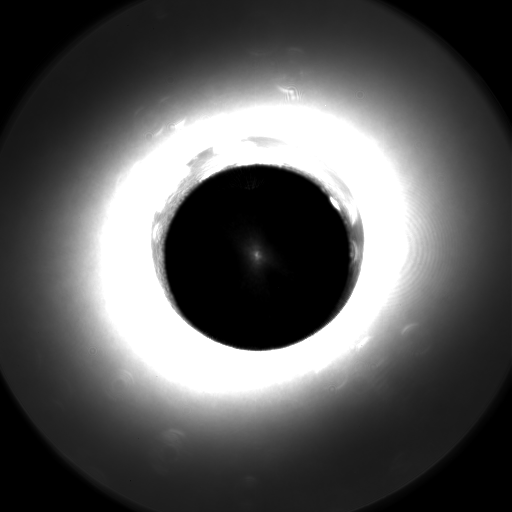
cor1.gsfc.nasa.gov...
I think it could involve perhaps an internal reflection in the telescope.
If it were an internal reflection it's difficult to explain why it suddenly appeared on May 2.
why are there not donuts all over it? doesn't make sense.
There are, a number of them. The background subtraction software (which makes details of the corona more visible) subtracts them from the images seen here because they remain stationary in the frame. Just as this one will be when the next background mask is applied.
Here is a raw, unprocessed image. I've adjusted the contrast a bit.
cor1.gsfc.nasa.gov...
I know one thing, the CME's as of late from the Sun have been playing absolute havoc with long range HF communications. This is supposed to be Cycle
24 for us Amateur Radio Operators and so far it's fallen quite short of it's expectations.
Here's a great website that I use for determining solar propagation forecasts, some of you folks might be interested.
Solarham - Solar Monitoring
Here's a great website that I use for determining solar propagation forecasts, some of you folks might be interested.
Solarham - Solar Monitoring
Originally posted by boncho
It's a giant spaceship, aliens are invading, sell off all your valuables dirt cheap cause you're not gonna need them. u2u me for bank transit numbers where you can deposit funds, and I will send you survival material.
Sarcasm:
Do not u2u me for transit numbers. I am kidding.edit on 5-5-2012 by boncho because: (no reason given)
Reminds me of my dad who told about one of his scams.
He placed an ad where people could send him 100 DKR and in turn they would receive instructions on how to get rich.
For those who replied he sent a letter with a note in it: "Do as I do".
edit on 16-5-2012 by HolgerTheDane2 because: (no reason given)
Originally posted by boncho
Reminds me of my dad who told about one of his scams.
He placed an ad where people could send him 100 DKR and in turn they would receive instructions on how to get rich.
For those who replied he sent a letter with a note in it: "Do as I do".
people would fall for that? which country u r from
can anyone proof one of this claim at least by showing me link from nasa or some space organization?
Originally posted by Phage
reply to post by NotAnAspie
I think it could involve perhaps an internal reflection in the telescope.
If it were an internal reflection it's difficult to explain why it suddenly appeared on May 2.
why are there not donuts all over it? doesn't make sense.
There are, a number of them. The background subtraction software (which makes details of the corona more visible) subtracts them from the images seen here because they remain stationary in the frame. Just as this one will be when the next background mask is applied.
Here is a raw, unprocessed image. I've adjusted the contrast a bit.
cor1.gsfc.nasa.gov...
that's true, but then again any reflections should have been eliminated anyway by the equipment itself.
I'm pretty sure multiple filters of different types are being used here. One is obviously in the center and is likely never removed or altered and a permanent part of the scope itself because that much light through the equipment could damage it I would think, but what if other parts of the equipment and application have some sort of maintenance processes at certain times or what if quite frankly... somebody messed up. Or what if something malfunctioned in the applications but it was rectified shortly thereafter.
I just think it is very strange that if you think about what the object looks like... it is what you would see if the light was coming in minus the colored filtering to see the flares better. I mean without those applications, but still with the permanent center filter... you would see a tunnel of light with a black center. the light around the sun would naturally be much brighter than it appears here...so it would fill up the entire scope, forming nearly a perfect circle with a black center from the permanent black filter.
It's too much of a coincidence... and then it is repeated once again laterally. Exactly laterally.
To me, it still says reflection. Some partially unfiltered reflection that temporarily occurred due to some mistake or flaw in one of the applications and shortly rectified thereafter explaining why it is not constantly seen. It was NEVER supposed to have been there.
it look like something there colecting energy directly from sun if it is an alian space ship running on suns energy that would explain low amounts of
radiation people receve after a direct contact with ufo 3 world war might b over sun just my thought
Originally posted by korgmeister
Originally posted by boncho
Reminds me of my dad who told about one of his scams.
He placed an ad where people could send him 100 DKR and in turn they would receive instructions on how to get rich.
For those who replied he sent a letter with a note in it: "Do as I do".
people would fall for that? which country u r from
DKR is Danish Krone.
Denmark.
Originally posted by Xaphan
So... what are these "bokehs" everybody keeps talking about? I have never heard this term before.
lmgtfy.com...
edit on 2-6-2012 by wirehead because: (no reason given)
Originally posted by YellowRoseTx51
... The term 'dimension' is incorrect. These planes are separated by a barrier that is caused by the Speed of vibratory rate of the Atomic structure. This is seen in the element Iridium, which when heated to 850F, speeds up & blinks out of sight within a test tube. When it cools down again, it shows back up. It did not evaporate or alter state, it moved through that barrier but stayed in the same location. We've known that for some time.
Which is why it is said "Those Above may see Below, but those Below may not see Above". We use examples in explanations such as Energy Waves--radio signals--each overlaying the other and all existing together but separated by different Vibrational Rates of speed.
.....
. We used to have pictorial images of the Exit Gate of Man & the Entrance Gate of God. It is on the degree lines which are doorways through the barrier. That's why ships 'blink' in and out. They are altering their Vibration--
yellowrose- Your description of vibration and the barriers make so much sense to me! Thank you. Can you elaborate further? I'm also intrigued about the images of the Gates. Is there anyway to retrieve those? Would love to see them. Apologies-- don't mean to hijack the thread (unable to send pm's), please carry on everyone.
Originally posted by ladyteeny
i don't buy the dust particle one AT ALL. for one thing since when have dust particles been circular with a hole in the middle, and if it was it'd be there all the time, or at least somewhere on the lens.
i don't know what it is, but my belief is that its more likely to be something we can't explain yet, rather than something we can.
A dust particle that is on the lens will appear out of focus which can make it look circular. It happens to me when I don't clean my camera lenses.
I can also see this being a lens flair which would explain why it was not there all the time.
edit on 6-6-2012 by Sol23 because: (no reason
given)
Originally posted by Xaphan
So... what are these "bokehs" everybody keeps talking about? I have never heard this term before.
Bokeh is a photography term that refers to the blur of an object or portion of a photo.
edit on 6-6-2012 by Sol23 because: (no reason
given)
new topics
-
The US Supreme Court Appears to Side With the January 6th 2021 Capitol Protestors.
Political Conspiracies: 51 minutes ago -
That which the "news" never talks about; Truth about election fraud
Mainstream News: 2 hours ago -
Biden doesnt want the votes of "Death to America" chanters
US Political Madness: 2 hours ago -
Horizon Post office scandal
Regional Politics: 2 hours ago -
Joe Biden and Donald Trump are both traitors
US Political Madness: 5 hours ago -
I'm new here. Avid conspiracy fan.
Introductions: 5 hours ago -
Denmark's Notre-Dame moment - 17th Century Borsen goes up in Flames
Mainstream News: 6 hours ago
top topics
-
Suspected Iranian agent working for Pentagon while U.S. coordinated defense of Israel
US Political Madness: 14 hours ago, 17 flags -
The Baloney aka BS Detection Kit
Social Issues and Civil Unrest: 14 hours ago, 7 flags -
That which the "news" never talks about; Truth about election fraud
Mainstream News: 2 hours ago, 6 flags -
Denmark's Notre-Dame moment - 17th Century Borsen goes up in Flames
Mainstream News: 6 hours ago, 4 flags -
How does my computer know
Education and Media: 17 hours ago, 3 flags -
Joe Biden and Donald Trump are both traitors
US Political Madness: 5 hours ago, 3 flags -
I'm new here. Avid conspiracy fan.
Introductions: 5 hours ago, 3 flags -
Biden doesnt want the votes of "Death to America" chanters
US Political Madness: 2 hours ago, 2 flags -
The US Supreme Court Appears to Side With the January 6th 2021 Capitol Protestors.
Political Conspiracies: 51 minutes ago, 2 flags -
Horizon Post office scandal
Regional Politics: 2 hours ago, 1 flags
active topics
-
That which the "news" never talks about; Truth about election fraud
Mainstream News • 6 • : DBCowboy -
It has begun... Iran begins attack on Israel, launches tons of drones towards the country
World War Three • 760 • : CriticalStinker -
US and Israel Reportedly Conclude Most Hostages Still Held in Gaza Are Dead
War On Terrorism • 152 • : Zairek -
Biden doesnt want the votes of "Death to America" chanters
US Political Madness • 6 • : xuenchen -
Candidate TRUMP Now Has Crazy Judge JUAN MERCHAN After Him - The Stormy Daniels Hush-Money Case.
Political Conspiracies • 246 • : Annee -
Denmark's Notre-Dame moment - 17th Century Borsen goes up in Flames
Mainstream News • 8 • : Hecate666 -
-@TH3WH17ERABB17- -Q- ---TIME TO SHOW THE WORLD--- -Part- --44--
Dissecting Disinformation • 495 • : cherokeetroy -
NYAG Letitia James Prepares to Begin Seizing TRUMP Assets Even Though There Was No Crime.
Above Politics • 286 • : Annee -
Horizon Post office scandal
Regional Politics • 3 • : Hecate666 -
Mandela Effect - It Happened to Me!
The Gray Area • 102 • : DdPoolDude