It looks like you're using an Ad Blocker.
Please white-list or disable AboveTopSecret.com in your ad-blocking tool.
Thank you.
Some features of ATS will be disabled while you continue to use an ad-blocker.

Pictures: Civil War Sub H.L. Hunley Finally Revealed
page: 17
share:
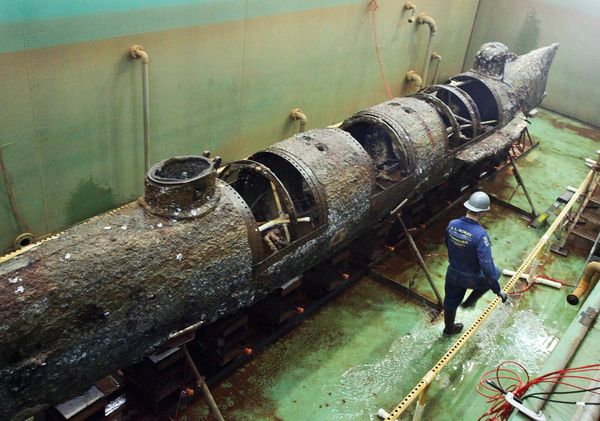
For the first time since the U.S. Civil War, the Confederate vessel H.L. Hunley—the world's first submarine to sink an enemy ship—was revealed on January 12 (pictured) after 11 years of conservation work.
Shown in a South Carolina conservation facility, the Hunley sank the U.S.S. Housatonic off Charleston (map) in 1864. Within minutes the sub itself sank too-killing its eight-man crew and creating an enduring mystery.
This sub was built in 1863 and was the nations first submarine. It was privately funded by Park and Lyons of Mobile, Alabama. The crew consisted of 9 men, 8 for propulsion and 1 for steering. The sub had 2 ballasts for buoyancy and they were hand pumped.
In 1864 the sun was used to attack the USS Housatonic off the coast of S. Carolina.
with spar torpedo packed with explosive powder and attached to a long pole on its bow. The spar torpedo embedded in the sloop's wooden side was detonated by a rope as Hunley backed away. The resulting explosion that sent Housatonic with five crew members to the bottom of Charleston Harbor also sank Hunley with its crew of eight. H.L. Hunley earned a place in the history of undersea warfare as the first submarine to sink a ship in wartime.
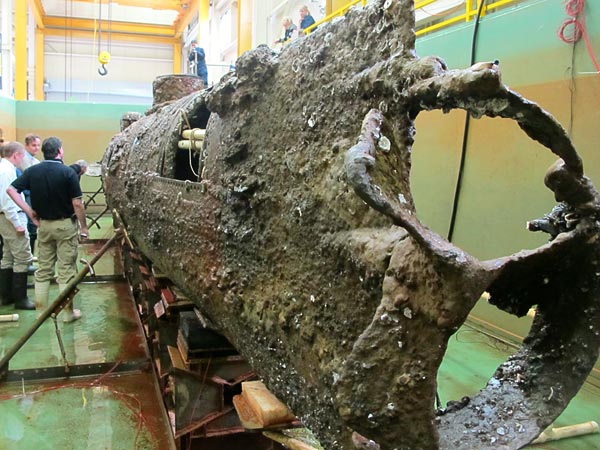
Naval engineers still marvel at the Hunley's design and construction. For example, the ship's knifelike, rolled-iron hull and recessed rivets helped reduce drag as the sub cut through the water.
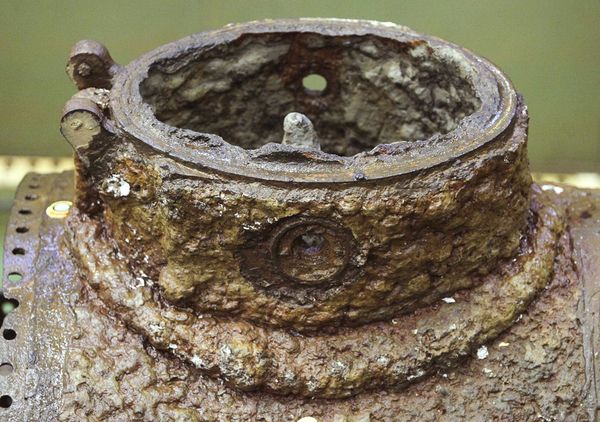
Driven by 136 years of chemical reactions between salt water and the Hunley's iron hull, concretions lend a rough appearance to the rear hatch (pictured with its cap removed) and to much of the rest of the Civil War submarine.
The concretions will provide valuable information about what happened to the submarine after it had sunk in 1864, according to archaeologist Maria Jacobsen. Already the concretions suggest that natural forces alternately covered and uncovered the sunken Hunley with silt.
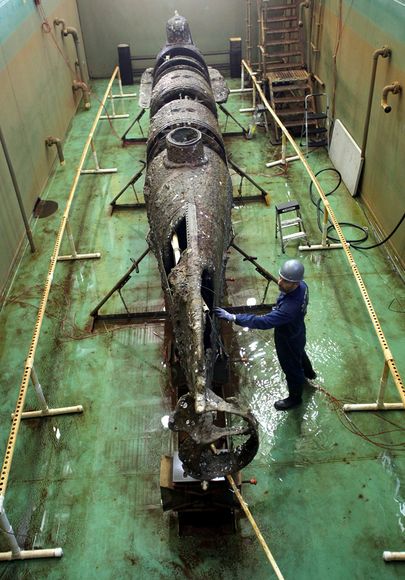
The 40-foot-long (12-meter-long) Hunley had two ballast tanks—one front, one rear—which could be filled with water to submerge the submarine. Crewmen manually pumped out the water to rise again.
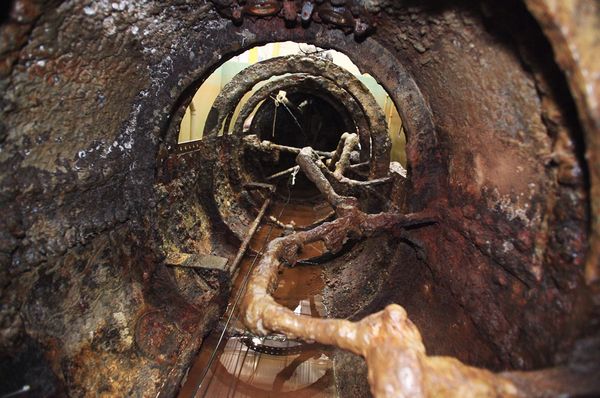
At only about 4 feet (122 centimeters) tall and 2 feet (61 centimeters) wide, the interior of the Hunley was so cramped that its eight crewmen couldn't trade places after they'd taken their stations. (See "Hunley Findings Put Faces on Civil War Submarine.")
During a mission, seven men sat on a long-gone wooden bench on one side of the craft and turned a crankshaft (visible above) to power the Hunley's propeller.
The handles on the crankshaft were arranged in a staggered fashion, so that all crewmen weren't applying maximum force at the same times. The arrangement kept the propeller turning smoothly and kept the Hunley from lurching.
The eighth crewmember was the submarine's commander, who stood at a small conning tower with small glass windows at the front of the Hunley. The commander steered the sub via a rudder and controlled horizontal fins that helped the Hunley dive and surface.
Man, only 34 feet long, can you imagine being in that thing? I thought of the movie Das Boot and the German Uboats(one of the best movies ever btw), but this seems just as frightening for a crew member.
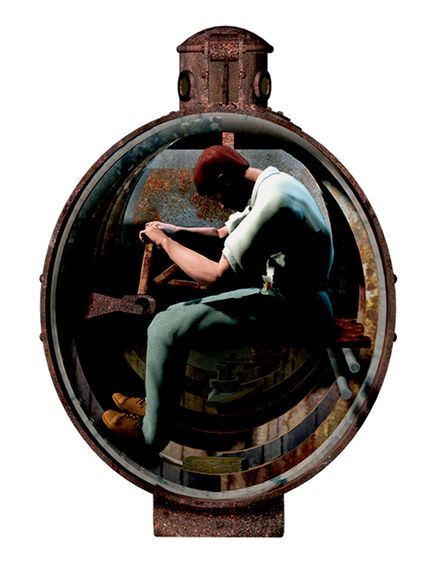
The Hunley's crankshaft operators (such as this one shown in a diagram) entered one by one and crawled or duck-walked through the submarine to take their positions. The commander was the last to enter.
When the submarine was recovered and opened in 2000, archaeologists discovered that the eight crewmen had died at their stations. There was no indication that the crewmen had tried to escape.
Archaeologists think the men passed out and eventually suffocated as the air inside the submarine was used up.
Photographs by Randall Hill, Reuters
Source
spec
Awesome stuff I had heard about this but didn't realise it was as technically advanced as this. All the best inventions really do come from war.
Apart from nuclear war, that won't help things at all s+f
The Civil War is my soft spot)
Nice pics! All I can say is the men who volunteered were some very, very brave souls. The first crew died during trials when it sunk. The second crew to volunteer? - whoa, serious death wish.
Just one more element of modern warfare introduced to the world courtesy of the war between the states, along with trench warfare, the rifled musket, the repeating rifle, gatling gun, landmines, ship mines, aerial observation, armored warships and much more.
Great stuff, thanks!
Nice pics! All I can say is the men who volunteered were some very, very brave souls. The first crew died during trials when it sunk. The second crew to volunteer? - whoa, serious death wish.
Just one more element of modern warfare introduced to the world courtesy of the war between the states, along with trench warfare, the rifled musket, the repeating rifle, gatling gun, landmines, ship mines, aerial observation, armored warships and much more.
Great stuff, thanks!
reply to post by On the level
Yes, for 1863 wow! I wonder what the crew of the U.S.S. Housatonic thought when they saw this thing rise up?!
What an interesting idea too, the 'spar torpedo.' Too bad they were unable to back away in time.
Thanks for the reply,
spec
Yes, for 1863 wow! I wonder what the crew of the U.S.S. Housatonic thought when they saw this thing rise up?!
What an interesting idea too, the 'spar torpedo.' Too bad they were unable to back away in time.
Thanks for the reply,
spec
reply to post by Asktheanimals
Hey there ATA, yea war provides a pretty good 'necessity' for invention I reckon. I wonder if claustrophobia was recognized back then. That would be one hell of a setting to first realize it in!
Thanks for the reply,
spec
Hey there ATA, yea war provides a pretty good 'necessity' for invention I reckon. I wonder if claustrophobia was recognized back then. That would be one hell of a setting to first realize it in!
Thanks for the reply,
spec
first time? i was there when they pulled it out the water, and you could go see it n/e ways :/
reply to post by ZeroUnlmtd
Just following the article, but it is cool you got to see it. Did they honor the crew in any way? I am sure they did, but I hope the families and crew were honored.
Peace,
spec
Just following the article, but it is cool you got to see it. Did they honor the crew in any way? I am sure they did, but I hope the families and crew were honored.
Peace,
spec
The CSS Hunley was a marvel of mid-19th century naval engineering. Moreover, it almost slipped away into history without it ever being known outside
of a lesser and lesser number of history books.
Recognizing anything even notable in regard to the US Civil War that doesn't paint the entire Confederacy and Southerners as abject racists... just doesn't make it anymore.
And, of course, yes; slavery was then, is today and will be forever wrong. This comment does not even suggest otherwise. But in a wide screen view... we can see that the Nazis were very advanced in some technologies even though they attempted genocide. It's just a matter of locating and focusing on a single subdivision that allows us to recognize unique moments in history when they are worth the glance.
Recognizing anything even notable in regard to the US Civil War that doesn't paint the entire Confederacy and Southerners as abject racists... just doesn't make it anymore.
And, of course, yes; slavery was then, is today and will be forever wrong. This comment does not even suggest otherwise. But in a wide screen view... we can see that the Nazis were very advanced in some technologies even though they attempted genocide. It's just a matter of locating and focusing on a single subdivision that allows us to recognize unique moments in history when they are worth the glance.
reply to post by redoubt
Agreed, and seeing this sub for the first time really transports one back to that era and event for a moment, which for me, draws admiration to it's ingenuity, and the men who manned the vessel.
spec
It's just a matter of locating and focusing on a single subdivision that allows us to recognize unique moments in history when they are worth the glance.
Agreed, and seeing this sub for the first time really transports one back to that era and event for a moment, which for me, draws admiration to it's ingenuity, and the men who manned the vessel.
spec
Actually, there's a bit more to the story here. After tests were conducted on the "peephole" and it's seal, it is now thought that the candlelight
within the submarine was spotted by those on deck of the ship above.
Markings suggest a gunshot (yes, weak small arms fire) may have actually broken the seal, slowly flooding the cabin within. As oxygen were lost (exertion from all that cranking), being surrounded by enemy boats and too far from shore, their fate was accepted. Pressure was not equalized, nor was there room for each to move from their seat. No escape could be attempted.
The inventor on board had tried for so long to have his dream realized, only to perish after attaining his goal.
Markings suggest a gunshot (yes, weak small arms fire) may have actually broken the seal, slowly flooding the cabin within. As oxygen were lost (exertion from all that cranking), being surrounded by enemy boats and too far from shore, their fate was accepted. Pressure was not equalized, nor was there room for each to move from their seat. No escape could be attempted.
The inventor on board had tried for so long to have his dream realized, only to perish after attaining his goal.
reply to post by SoulVisions
Thanks for the additional info SV, what a horrible way to go other than sacrificing oneself for a greater cause. But man, packed like sardines with only candlelight and the deep sea beneath you, wow.
spec
Thanks for the additional info SV, what a horrible way to go other than sacrificing oneself for a greater cause. But man, packed like sardines with only candlelight and the deep sea beneath you, wow.
spec
reply to post by SoulVisions
I watched a show on tv today about this.
Great thread but i can't help wondering why tere was no attempt for escape.
I understand what you said in your post but i cant help but wonder why each man was in his exact position when it was uncovered and why only 2 of the crew were confederate soldiers the rest were union or foreign.
I can never know what i would in their place but it seems to me now that i would try to escape.
It seems that at least one of these men would have abandoned their post unless givin to death instantly or held at gunpoint.
Maybe the hatch would not open or maybe they were put in a position of permanent silence and this was a false flag to perpetuate the war.
I'm no history buff but if the first crew that was killed were mostly confederate soldiers and this sub played a role in helping the south along then there is motive.
A very old conspiracy possibly.
I watched a show on tv today about this.
Great thread but i can't help wondering why tere was no attempt for escape.
I understand what you said in your post but i cant help but wonder why each man was in his exact position when it was uncovered and why only 2 of the crew were confederate soldiers the rest were union or foreign.
I can never know what i would in their place but it seems to me now that i would try to escape.
It seems that at least one of these men would have abandoned their post unless givin to death instantly or held at gunpoint.
Maybe the hatch would not open or maybe they were put in a position of permanent silence and this was a false flag to perpetuate the war.
I'm no history buff but if the first crew that was killed were mostly confederate soldiers and this sub played a role in helping the south along then there is motive.
A very old conspiracy possibly.
reply to post by deadeyedick
Maybe it was there noble loyalty that kept them at their position/station to the very end. Of course in a conspiratorial sense, who knows, but I have the impression that servicemen take their job very serious, enough to sacrifice their lives if needed, but that doesn't make it any less scary, imo.
Maybe it was there noble loyalty that kept them at their position/station to the very end. Of course in a conspiratorial sense, who knows, but I have the impression that servicemen take their job very serious, enough to sacrifice their lives if needed, but that doesn't make it any less scary, imo.
new topics
-
Intro once again
Introductions: 4 minutes ago -
University student disciplined after saying veganism is wrong and gender fluidity is stupid
Education and Media: 1 hours ago -
Geddy Lee in Conversation with Alex Lifeson - My Effin’ Life
People: 2 hours ago -
God lived as a Devil Dog.
Short Stories: 2 hours ago -
Police clash with St George’s Day protesters at central London rally
Social Issues and Civil Unrest: 4 hours ago -
TLDR post about ATS and why I love it and hope we all stay together somewhere
General Chit Chat: 5 hours ago -
Hate makes for strange bedfellows
US Political Madness: 7 hours ago -
Who guards the guards
US Political Madness: 9 hours ago -
Has Tesla manipulated data logs to cover up auto pilot crash?
Automotive Discussion: 11 hours ago
top topics
-
Hate makes for strange bedfellows
US Political Madness: 7 hours ago, 14 flags -
Who guards the guards
US Political Madness: 9 hours ago, 13 flags -
whistleblower Captain Bill Uhouse on the Kingman UFO recovery
Aliens and UFOs: 16 hours ago, 11 flags -
Police clash with St George’s Day protesters at central London rally
Social Issues and Civil Unrest: 4 hours ago, 7 flags -
TLDR post about ATS and why I love it and hope we all stay together somewhere
General Chit Chat: 5 hours ago, 5 flags -
University student disciplined after saying veganism is wrong and gender fluidity is stupid
Education and Media: 1 hours ago, 3 flags -
Has Tesla manipulated data logs to cover up auto pilot crash?
Automotive Discussion: 11 hours ago, 2 flags -
God lived as a Devil Dog.
Short Stories: 2 hours ago, 2 flags -
Geddy Lee in Conversation with Alex Lifeson - My Effin’ Life
People: 2 hours ago, 2 flags -
Intro once again
Introductions: 4 minutes ago, 1 flags
active topics
-
Police clash with St George’s Day protesters at central London rally
Social Issues and Civil Unrest • 36 • : FlyersFan -
"We're All Hamas" Heard at Columbia University Protests
Social Issues and Civil Unrest • 249 • : marg6043 -
Europe declares war on Russia?
World War Three • 66 • : Consvoli -
Candidate TRUMP Now Has Crazy Judge JUAN MERCHAN After Him - The Stormy Daniels Hush-Money Case.
Political Conspiracies • 732 • : matafuchs -
Spectrophilia - Women Who Have Had Affairs With Ghosts Say Spooks Are Better Lovers Than Real Men
Paranormal Studies • 28 • : FlyersFan -
Intro once again
Introductions • 0 • : Angrybrewer2 -
University student disciplined after saying veganism is wrong and gender fluidity is stupid
Education and Media • 6 • : Consvoli -
Thousands Of Young Ukrainian Men Trying To Flee The Country To Avoid Conscription And The War
Other Current Events • 119 • : FlyersFan -
-@TH3WH17ERABB17- -Q- ---TIME TO SHOW THE WORLD--- -Part- --44--
Dissecting Disinformation • 626 • : cherokeetroy -
The Superstition of Full Moons Filling Hospitals Turns Out To Be True!
Medical Issues & Conspiracies • 19 • : FloridaManMatty
7