It looks like you're using an Ad Blocker.
Please white-list or disable AboveTopSecret.com in your ad-blocking tool.
Thank you.
Some features of ATS will be disabled while you continue to use an ad-blocker.

Arctic Ocean freshwater bulge detected
page: 15
share:
Arctic Ocean freshwater bulge detected
www.bbc.co.uk
(visit the link for the full news article)
UK scientists have detected a huge dome of fresh water that is developing in the western Arctic Ocean.
The bulge is some 8,000 cubic km in size and has risen by about 15cm since 2002.
The team thinks it may be the result of strong winds whipping up a great clockwise current in the northern polar region called the Beaufort Gyre.
This would force the water together, raising sea surface height, the group tells the journal Nature Geoscience.
The most amazing thing this tell me (a mere layman) is that it is possible that the Arctic Ocean "stores" freshwater.
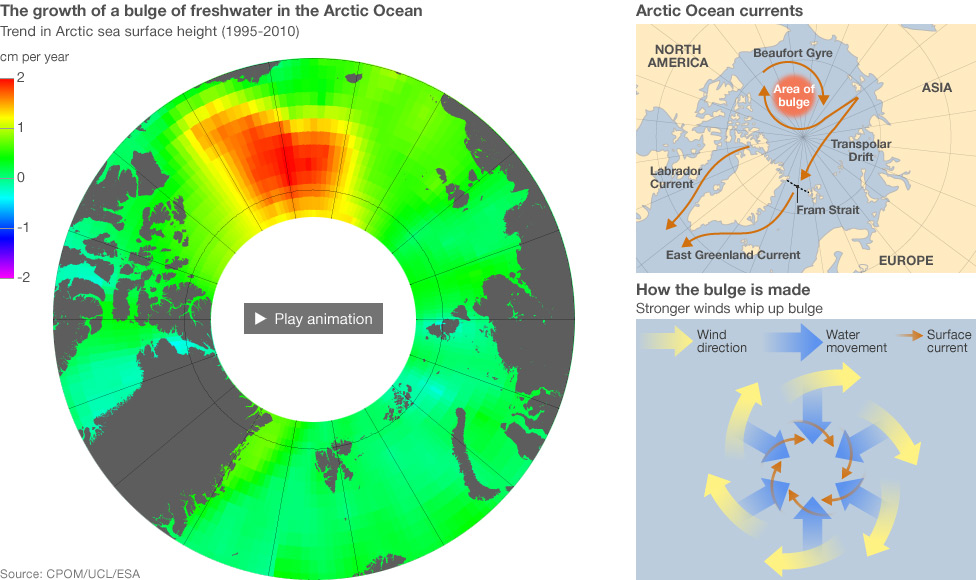
animation only available on the source's site
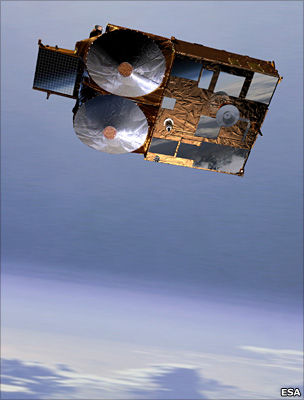
I think kudos are due for the ESA (European Space Agency) for the data it managed to obtain with it's Polar observation satellite, the Cryosat-2:
Well, there is always something to worry about here... those ice caps kept this eventuality contained I suppose.
We live on a planet that's 70% water... is there any doubt that water would be the most vital thing to understand if we want to predict climate effects.
Thanks for reading!
www.bbc.co.uk
(visit the link for the full news article)
animation only available on the source's site
"In the western Arctic, the Beaufort Gyre is driven by a permanent anti-cyclonic wind circulation. It drives the water, forcing it to pile up in the centre of gyre, and this domes the sea surface," explained lead author Dr Katharine Giles from the Centre for Polar Observation and Modelling (CPOM) at University College London.
I think kudos are due for the ESA (European Space Agency) for the data it managed to obtain with it's Polar observation satellite, the Cryosat-2:
"What we seen occurring is precisely what the climate models had predicted," said Dr Giles.
"When you have clockwise rotation - the fresh water is stored. If the wind goes the other way - and that has happened in the past - then the fresh water can be pushed to the margins of the Arctic Ocean.
"If the spin-up starts to spin down, the fresh water could be released. It could go to the rest of the Arctic Ocean or even leave the Arctic Ocean."
If the fresh water were to enter the North Atlantic in large volumes, the concern would be that it might disturb the currents that have such a great influence on European weather patterns. These currents draw warm waters up from the tropics, maintaining milder temperatures in winter than would ordinarily be expected at northern European latitudes.
Well, there is always something to worry about here... those ice caps kept this eventuality contained I suppose.
We live on a planet that's 70% water... is there any doubt that water would be the most vital thing to understand if we want to predict climate effects.
Thanks for reading!
www.bbc.co.uk
(visit the link for the full news article)
edit on 24-1-2012 by Maxmars because: (no reason given)
www.abovetopsecret.com...
this is the same topic ?
this is the same topic ?
edit on 24-1-2012 by haven123 because: (no reason given)
Am I the only one that clicked the "Play Animation" button in the picture in the second post. LOL I actually clicked it a few times before i
realized it was just a screen capture.
Originally posted by NoNameBrand
Am I the only one that clicked the "Play Animation" button in the picture in the second post. LOL I actually clicked it a few times before i realized it was just a screen capture.
Haha, I clicked it too.
Good thread topic though. I was unaware of this strange predicament.
I am really curious about how this system works. Hmmm.
In explanation....
This is a Breaking News item, and many of our members, while interested, do not frequent the Fragile Earth Forum... hence the idea that two threads may exist on the same topic under such circumstances. Had I run across this article next week, i would not have posted it because it is no longer within the 36-hour window of opportunity for breaking News here.
Thanks for the redirect link.... it leads to valuable input for our members who focus on such topics.
This is a Breaking News item, and many of our members, while interested, do not frequent the Fragile Earth Forum... hence the idea that two threads may exist on the same topic under such circumstances. Had I run across this article next week, i would not have posted it because it is no longer within the 36-hour window of opportunity for breaking News here.
Thanks for the redirect link.... it leads to valuable input for our members who focus on such topics.
reply to post by Maxmars
The model showed a raise in water level to 5cm - I would have thought fresh water is due to ice melt - but I am no expert. I know fresh water seperates from sea water due to the salt content - Much salt content is that which has been leached from the land over time.
The model showed a raise in water level to 5cm - I would have thought fresh water is due to ice melt - but I am no expert. I know fresh water seperates from sea water due to the salt content - Much salt content is that which has been leached from the land over time.
Bulge in the Arctic?
Maybe it's just happy to see you!
Just kidding, it is a very interesting find.
I wonder what would happen if all that freshwater made its way into the ocean currents?
Would it really be enough to cause the heating/cooling cycles to stop?
Maybe it's just happy to see you!
Just kidding, it is a very interesting find.
I wonder what would happen if all that freshwater made its way into the ocean currents?
Would it really be enough to cause the heating/cooling cycles to stop?
edit on 24-1-2012 by tvtexan because: (no reason given)
Most of what goes on to create the variety of systems we find man living in and with is a very very complex subject ..The mechanics of it all doesn't
reside under one roof of thought ..Our fairly recent ability to accurately collect data sets still falls short of giving us the answers to the whole
picture.. and yet we have some people like Al Gore that would make a movie and claim the science is settled ...Unified Theory of Climate: Reply to
Comments wattsupwiththat.com... ..So we have a lot of info, and we have a lot of
questions, but I think we fall way short on having enough answers to claim, the science is settled .. thanks op interesting subject ..peace
new topics
-
Geddy Lee in Conversation with Alex Lifeson - My Effin’ Life
People: 21 minutes ago -
God lived as a Devil Dog.
Short Stories: 37 minutes ago -
Happy St George's day you bigots!
Breaking Alternative News: 2 hours ago -
TLDR post about ATS and why I love it and hope we all stay together somewhere
General Chit Chat: 3 hours ago -
Hate makes for strange bedfellows
US Political Madness: 5 hours ago -
Who guards the guards
US Political Madness: 7 hours ago -
Has Tesla manipulated data logs to cover up auto pilot crash?
Automotive Discussion: 9 hours ago
top topics
-
Hate makes for strange bedfellows
US Political Madness: 5 hours ago, 14 flags -
whistleblower Captain Bill Uhouse on the Kingman UFO recovery
Aliens and UFOs: 14 hours ago, 11 flags -
Who guards the guards
US Political Madness: 7 hours ago, 10 flags -
1980s Arcade
General Chit Chat: 16 hours ago, 7 flags -
Deadpool and Wolverine
Movies: 17 hours ago, 4 flags -
TLDR post about ATS and why I love it and hope we all stay together somewhere
General Chit Chat: 3 hours ago, 3 flags -
Has Tesla manipulated data logs to cover up auto pilot crash?
Automotive Discussion: 9 hours ago, 2 flags -
Happy St George's day you bigots!
Breaking Alternative News: 2 hours ago, 2 flags -
God lived as a Devil Dog.
Short Stories: 37 minutes ago, 1 flags -
Geddy Lee in Conversation with Alex Lifeson - My Effin’ Life
People: 21 minutes ago, 0 flags
active topics
-
Hate makes for strange bedfellows
US Political Madness • 31 • : ByeByeAmericanPie -
God lived as a Devil Dog.
Short Stories • 1 • : FlyersFan -
Republican Voters Against Trump
2024 Elections • 285 • : Annee -
Happy St George's day you bigots!
Breaking Alternative News • 13 • : BedevereTheWise -
"We're All Hamas" Heard at Columbia University Protests
Social Issues and Civil Unrest • 243 • : FlyersFan -
Candidate TRUMP Now Has Crazy Judge JUAN MERCHAN After Him - The Stormy Daniels Hush-Money Case.
Political Conspiracies • 725 • : Justoneman -
SC Jack Smith is Using Subterfuge Tricks with Donald Trumps Upcoming Documents Trial.
Dissecting Disinformation • 108 • : Threadbarer -
So this is what Hamas considers 'freedom fighting' ...
War On Terrorism • 226 • : FlyersFan -
-@TH3WH17ERABB17- -Q- ---TIME TO SHOW THE WORLD--- -Part- --44--
Dissecting Disinformation • 616 • : cherokeetroy -
Geddy Lee in Conversation with Alex Lifeson - My Effin’ Life
People • 0 • : gortex
5