It looks like you're using an Ad Blocker.
Please white-list or disable AboveTopSecret.com in your ad-blocking tool.
Thank you.
Some features of ATS will be disabled while you continue to use an ad-blocker.

Report: Tepco sends "emergency" mail about Reactor 4 — Water level decreasing at 5 times normal ra
page: 116
share:
Report: Tepco sends "emergency" mail about Reactor 4 — Water level decreasing at 5 times normal rate
enenews.com
(visit the link for the full news article)
Breaking News: M7 hits Japan and water leakage at reactor4, Fukushima Diary, Jan. 1, 2012:
SOURCE: NHK
[...] It was scale [note: NOT magnitude] 3 ~ 4 in Tokyo, and also Fukushima but the scale of Fukushima nakadori, where Fukushima plant is, is not announced on the page of Japan Meteorological Agency.
Though the connection with this earthquake is not clear, Tepco announced water is leaking from the cooling system of spent fuel pool in reactor 4.
Related News Links:
fukushima-diary.com
Wow... not good.
No fear mongering needed here... I think we all know what this could mean
Noooot good. Lets hope they get this under control!! How big is this reactor compared to the others?
Though the connection with this earthquake is not clear, Tepco announced water is leaking from the cooling system of spent fuel pool in reactor 4.
The water level of the tank to pool overflowed water from spent fuel pool decreased by 8cm from 2PM to 5PM on 1/1/2012.
This tank is to give back the water to the spent fuel pool after purifying the water. Tepco assumes the leakage is at a joint of pipe but it’s not detected yet.
enenews.com
(visit the link for the full news article)
No fear mongering needed here... I think we all know what this could mean
Noooot good. Lets hope they get this under control!! How big is this reactor compared to the others?
Though the connection with this earthquake is not clear, Tepco announced water is leaking from the cooling system of spent fuel pool in reactor 4.
The water level of the tank to pool overflowed water from spent fuel pool decreased by 8cm from 2PM to 5PM on 1/1/2012.
This tank is to give back the water to the spent fuel pool after purifying the water. Tepco assumes the leakage is at a joint of pipe but it’s not detected yet.
enenews.com
(visit the link for the full news article)
When the earthquake hit...I was really hoping this kind of headline would not follow. No. 4 spent fuel pool...tick...tick...tick. Been a worry since
day 1.
reply to post by porschedrifter
Reactor 4 is the one with 1535 spent rods in the cooling pool above it..
Not good !!
Cosmic..
Reactor 4 is the one with 1535 spent rods in the cooling pool above it..
Not good !!
Cosmic..
looks like the new year is starting off with some entertainment for sure. hope they get it under control soon
reply to post by porschedrifter
The odds are there will be more quakes this year..
..how much longer can Fukushima hold up ??
Cosmic..
The odds are there will be more quakes this year..
..how much longer can Fukushima hold up ??
Cosmic..
I find it bizarre that in this day and age, we do not have an answer to nuclear waste management. I also can't believe this is not being handled by
an international team of specialists with the most advanced solutions. Or is it? Here we are invading countries to liberate them, but we ignore the
really important world problems.
I wonder if this new super metal, graphene, could be an answer.
I wonder if this new super metal, graphene, could be an answer.
reply to post by Cosmic4life
Thats what I'm worried about with this latest quake around Tokyo. As shaky as all the reactors are it wouldn't, (at least to me) a direct quake to cause damage to this area. Not good news at all.
Thats what I'm worried about with this latest quake around Tokyo. As shaky as all the reactors are it wouldn't, (at least to me) a direct quake to cause damage to this area. Not good news at all.
This is really bad news, I
wanted to get on board for
further updates - what a
way to start out the year
after the one Japan just had
and is still suffering from.
wanted to get on board for
further updates - what a
way to start out the year
after the one Japan just had
and is still suffering from.
No Problem at all!
Don't believe even a little bit coming from FD,
read Ex-SKF instead
#Fukushima Reactor 4 Skimmer Surge Tank Water Level Update (UPDATE: Again, it is NOT about the water level of the Spent Fuel Pool. There are blogs and tweets that either deliberately or by ignorance blur the distinction between the SFP and the skimmer surge tank and create an impression that the SFP is leaking. As of now, that is simply not true, with what little information available.)
ex-skf.blogspot.com...
edit on 2-1-2012 by Human0815 because: (no reason
given)
Its not the spent fuel pool that is leaking, its the skimmer surge tank for the SFP.
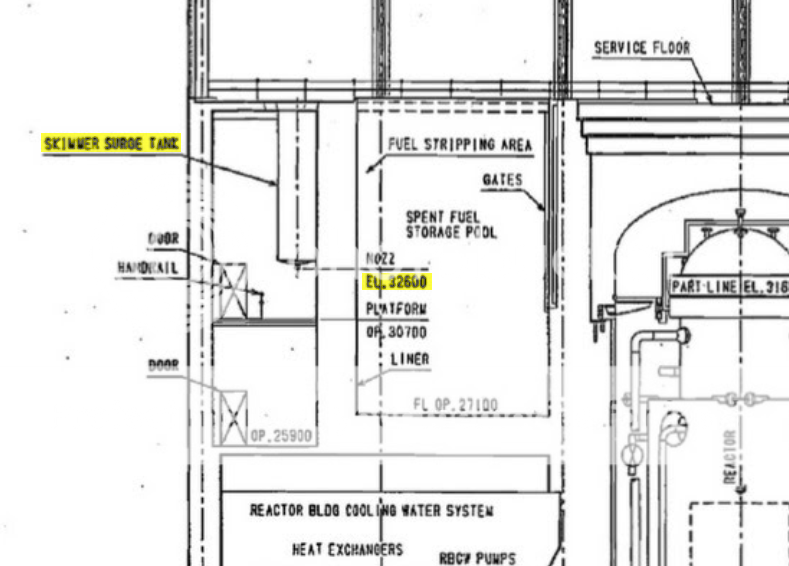
Jeeze, how about some figures much?
This could be serious in terms of contamination of the reactor area so that live humans cannot enter safely....
(i mean worse than already so contaminated which it can hardly help but be )
The water leaking from thos scrubbing device could be very contaminated.....
ie. its the tank that cleans the cooling pool water presumably before reuse.....
Flooding of the immediate area of the reactor housing could cause electrical failures or worse....
These are MY fears but perhaps somebody who knows can evaluate the risks better.....
We aparently have not seen the end of japans nuclear problems yet....
There dont seem to be a lot of reports about other power stations that suffered damage too, though we know some did.....
I begin to wonder.......
This could be serious in terms of contamination of the reactor area so that live humans cannot enter safely....
(i mean worse than already so contaminated which it can hardly help but be )
The water leaking from thos scrubbing device could be very contaminated.....
ie. its the tank that cleans the cooling pool water presumably before reuse.....
Flooding of the immediate area of the reactor housing could cause electrical failures or worse....
These are MY fears but perhaps somebody who knows can evaluate the risks better.....
We aparently have not seen the end of japans nuclear problems yet....
There dont seem to be a lot of reports about other power stations that suffered damage too, though we know some did.....
I begin to wonder.......
I know this is a little off topic but over the new years I watched the series about population zero and then the 2012 one and WOW it really didn't
help me in the least about the fear of a nuclear disaster lol where we live the Texas City Project is literally like 60 miles from us. It sure brings
it all into perspective I just pray everyone will be ok in Japan I have quite a few friends over there and even they are worried with what's coming
out of the bases information, and their info paints a way grimmer picture. I'll see what I can find out years back I worked for the pump division of
tepco still have some high up friends if they will talk.
Be safe everyone....
Be safe everyone....
reply to post by stirling
I hope this is kinda what you are looking for, I don't know how to put the source in a link but its in the
"Asia Pacific journal-Japan focus.
In the immediate aftermath of the March 11 Level 7 earthquake tsunami disaster, the troubled power plants at Fukushima Daiichi released radioactive material that was 15 per cent of that released at Chernobyl (770,000 tera-becquerels), and radioactive fallout of Cesium 137 (half-life 30 years) that is 168.5 times that released by the Hiroshima atomic-bomb. 5 Some 600 square kilometres of land (an area ten times that of Manhattan) has Cesium deposit levels equivalent to the uninhabitable land around Chernobyl even 25 years after the accident. There is an additional 700 square kilometres of land with radiation levels that made evacuation mandatory after Chernobyl, 6 yet tens of thousands of people, including radiation-susceptible children and pregnant women, remain in the area. What particularly distinguishes Fukushima from Chernobyl is the large amount of radioactive material (3,500 tera-becquerels 7 ) released into the ocean, levels unprecedented among all past nuclear attacks, accidents and tests, raising concern about the effect on marine life and seafood. Tokyo Electric Power Company (TEPCO) and the Japanese government, in explaining the failure to prevent such a disaster insist that the scale of the tsunami was “beyond the scope of the imaginable.” Mounting historical evidence points to the contrary, however: a tsunami of Fukushima scale was indeed to be expected, but government and TEPCO chose to ignore it. 8
Hope it helps and if I misunderstood I'm sorry.
I hope this is kinda what you are looking for, I don't know how to put the source in a link but its in the
"Asia Pacific journal-Japan focus.
In the immediate aftermath of the March 11 Level 7 earthquake tsunami disaster, the troubled power plants at Fukushima Daiichi released radioactive material that was 15 per cent of that released at Chernobyl (770,000 tera-becquerels), and radioactive fallout of Cesium 137 (half-life 30 years) that is 168.5 times that released by the Hiroshima atomic-bomb. 5 Some 600 square kilometres of land (an area ten times that of Manhattan) has Cesium deposit levels equivalent to the uninhabitable land around Chernobyl even 25 years after the accident. There is an additional 700 square kilometres of land with radiation levels that made evacuation mandatory after Chernobyl, 6 yet tens of thousands of people, including radiation-susceptible children and pregnant women, remain in the area. What particularly distinguishes Fukushima from Chernobyl is the large amount of radioactive material (3,500 tera-becquerels 7 ) released into the ocean, levels unprecedented among all past nuclear attacks, accidents and tests, raising concern about the effect on marine life and seafood. Tokyo Electric Power Company (TEPCO) and the Japanese government, in explaining the failure to prevent such a disaster insist that the scale of the tsunami was “beyond the scope of the imaginable.” Mounting historical evidence points to the contrary, however: a tsunami of Fukushima scale was indeed to be expected, but government and TEPCO chose to ignore it. 8
Hope it helps and if I misunderstood I'm sorry.
Anyone find anything further on this report? Details are still very light.
new topics
-
This is our Story
General Entertainment: 2 hours ago -
President BIDEN Vows to Make Americans Pay More Federal Taxes in 2025 - Political Suicide.
2024 Elections: 4 hours ago -
Ode to Artemis
General Chit Chat: 5 hours ago -
Ditching physical money
History: 8 hours ago -
One Flame Throwing Robot Dog for Christmas Please!
Weaponry: 9 hours ago -
Don't take advantage of people just because it seems easy it will backfire
Rant: 9 hours ago -
VirginOfGrand says hello
Introductions: 10 hours ago -
Should Biden Replace Harris With AOC On the 2024 Democrat Ticket?
2024 Elections: 10 hours ago
top topics
-
University student disciplined after saying veganism is wrong and gender fluidity is stupid
Education and Media: 13 hours ago, 12 flags -
Police clash with St George’s Day protesters at central London rally
Social Issues and Civil Unrest: 16 hours ago, 9 flags -
President BIDEN Vows to Make Americans Pay More Federal Taxes in 2025 - Political Suicide.
2024 Elections: 4 hours ago, 9 flags -
TLDR post about ATS and why I love it and hope we all stay together somewhere
General Chit Chat: 17 hours ago, 7 flags -
Should Biden Replace Harris With AOC On the 2024 Democrat Ticket?
2024 Elections: 10 hours ago, 6 flags -
Don't take advantage of people just because it seems easy it will backfire
Rant: 9 hours ago, 4 flags -
One Flame Throwing Robot Dog for Christmas Please!
Weaponry: 9 hours ago, 4 flags -
God lived as a Devil Dog.
Short Stories: 14 hours ago, 3 flags -
Ditching physical money
History: 8 hours ago, 3 flags -
VirginOfGrand says hello
Introductions: 10 hours ago, 2 flags
active topics
-
This is our Story
General Entertainment • 1 • : Encia22 -
The Reality of the Laser
Military Projects • 32 • : DronesandUFOs -
whistleblower Captain Bill Uhouse on the Kingman UFO recovery
Aliens and UFOs • 17 • : vance2 -
DerBeobachter - Electric Boogaloo 2
Introductions • 13 • : DerBeobachter2 -
One Flame Throwing Robot Dog for Christmas Please!
Weaponry • 7 • : OzBiker -
University student disciplined after saying veganism is wrong and gender fluidity is stupid
Education and Media • 26 • : DerBeobachter2 -
President BIDEN Vows to Make Americans Pay More Federal Taxes in 2025 - Political Suicide.
2024 Elections • 4 • : 727Sky -
British TV Presenter Refuses To Use Guest's Preferred Pronouns
Education and Media • 128 • : Consvoli -
Terrifying Encounters With The Black Eyed Kids
Paranormal Studies • 70 • : burritocat -
Tucker Carlson UFOs are piloted by spiritual entities with bases under the ocean and the ground
Aliens and UFOs • 42 • : Jukiodone
16