It looks like you're using an Ad Blocker.
Please white-list or disable AboveTopSecret.com in your ad-blocking tool.
Thank you.
Some features of ATS will be disabled while you continue to use an ad-blocker.

Getting the evidence
page: 3share:
Originally posted by ZetaRediculian
I like this idea. Technology that can do this is becoming afordable enough where common folk can do this themselves. I always thought survalance cameras and equipment of all kinds should be in use around the homes of Abductees. Since abductions seem to happen repeatedly and run in families, it would seem like the chances of capturing something would be high. That this is not done is baffling to me.
I know someone who claimed to see strange looking 'people' roaming around outside at night
I asked why don't you photograph these strangers and they gave a look like it never even occurred to them
Now that everyone has a video camera in their pocket it is just a matter of time before somebody produces inalienable evidence
reply to post by xpoq47
xpoq47---- Once you can classify, the nightly power phase intensity color's of an alien starship, you can use the same method to determine the distance to a starship, that three cosmologists use from there discovery; adding that not only is the universe's expansion is speeding up [1998 -- by other scientists;] but cosmic acceleration will continue forever [2011.]
It's an observational tool called "standard candles," which are types of objects that have certain intrinsic brightnesses. Therefore, how bright the object appears depends on your distance from it. Think of automoble headlights. You can estimate how far are you away from a car depending on how bright the headlights appear.
Source: Three cosmologists win the 2011 Noble Prize in physics --- Astronomy magazine, January, 2012
xpoq47---- Once you can classify, the nightly power phase intensity color's of an alien starship, you can use the same method to determine the distance to a starship, that three cosmologists use from there discovery; adding that not only is the universe's expansion is speeding up [1998 -- by other scientists;] but cosmic acceleration will continue forever [2011.]
It's an observational tool called "standard candles," which are types of objects that have certain intrinsic brightnesses. Therefore, how bright the object appears depends on your distance from it. Think of automoble headlights. You can estimate how far are you away from a car depending on how bright the headlights appear.
Source: Three cosmologists win the 2011 Noble Prize in physics --- Astronomy magazine, January, 2012
edit on 1-1-2012 by Erno86 because:
spelling
reply to post by Erno86
That's an interesting point, but the system I proposed enables triangulation. So distance from any of the three cameras, as well as altitude and geographic location, could be calculated with reasonable accuracy from the tracking data generated by the software and used to aim the cameras, effectively imitating the function of theodolites. And in the case of a daylight disc (the target of most interest) size could be estimated with reasonable accuracy from the photographs and data.
In the case of UFOs, we not only don't know the standard brightness of any particular model but brightness has been reported to change before such an object makes a high-speed jump. Even for secret craft in development, ball lightning, etc. we don’t know normal brightness.
About expansion of the universe, accelerating or otherwise, that was called into question in 1999, and the scientific community still hasn't addressed the issue properly. E. A. Valentijn and P. P. van der Werf detected very large amounts of H2 in a galaxy in Andromeda called NGC 891, using the European Space Agency's Infrared Space Observatory (ISO) and published a report in September 1999. And P. Richter, et al. (Nature, November 25, 1999) followed up by reporting discovery of absorption lines of H2 in a high-velocity cloud of the Milky Way halo. When astronomers/ astrophysicists calculate distances in space they use Doppler redshift and compensate by taking into account H1in space, the density of which is known and is readily detectable with radioastronomy, but they don't take H2 into account at all, the density of which is not known but could be 5-15 times greater than that of H1. Cold H2 in space can't be detected with conventional technology, although hot H2 has been in the two cases I cited above. This means that the figures that lead to all this talk about expansion of the universe and many other widely accepted claims were derived from an equation with a missing variable.
The spin structure of H1 makes it easily detectable, using a high-frequency radio signal at 21-cm wavelength, but in H2 that spin is canceled out by the tight coupling of the two electrons. Since we only have technology to detect H2, as in the case I cited above, where it is hot, not where it is cold, the amount is not known and not accounted for in calculating distances of celestial objects. Various astrophysicists have commented that if H2 were taken into account it would change those calculations enough to throw cold water on the notion of the Big Bang, expansion of the universe, etc. Valentijn and van der Werf estimated the amount of H2 in space to be in the range of 5 to 15 times that of H1. But mainstream simply ignores it altogether, and it may be a long time before accurate measurements of cold H2 in space can be made, at which time new calculations might just make a mockery of what is widely believed today.
So on the one hand, scientists can say that there is no proof that there is any H2 in space, despite those observations, but on the other hand the claims they make are based on calculations that assume no H2 in space at all, instead of saying, "We're not sure." And scientists who have pointed this out have probably unfairly been subjected to ad hominem attacks by the scientific community, even though there's a good chance the story will change in the future.
That's an interesting point, but the system I proposed enables triangulation. So distance from any of the three cameras, as well as altitude and geographic location, could be calculated with reasonable accuracy from the tracking data generated by the software and used to aim the cameras, effectively imitating the function of theodolites. And in the case of a daylight disc (the target of most interest) size could be estimated with reasonable accuracy from the photographs and data.
In the case of UFOs, we not only don't know the standard brightness of any particular model but brightness has been reported to change before such an object makes a high-speed jump. Even for secret craft in development, ball lightning, etc. we don’t know normal brightness.
About expansion of the universe, accelerating or otherwise, that was called into question in 1999, and the scientific community still hasn't addressed the issue properly. E. A. Valentijn and P. P. van der Werf detected very large amounts of H2 in a galaxy in Andromeda called NGC 891, using the European Space Agency's Infrared Space Observatory (ISO) and published a report in September 1999. And P. Richter, et al. (Nature, November 25, 1999) followed up by reporting discovery of absorption lines of H2 in a high-velocity cloud of the Milky Way halo. When astronomers/ astrophysicists calculate distances in space they use Doppler redshift and compensate by taking into account H1in space, the density of which is known and is readily detectable with radioastronomy, but they don't take H2 into account at all, the density of which is not known but could be 5-15 times greater than that of H1. Cold H2 in space can't be detected with conventional technology, although hot H2 has been in the two cases I cited above. This means that the figures that lead to all this talk about expansion of the universe and many other widely accepted claims were derived from an equation with a missing variable.
The spin structure of H1 makes it easily detectable, using a high-frequency radio signal at 21-cm wavelength, but in H2 that spin is canceled out by the tight coupling of the two electrons. Since we only have technology to detect H2, as in the case I cited above, where it is hot, not where it is cold, the amount is not known and not accounted for in calculating distances of celestial objects. Various astrophysicists have commented that if H2 were taken into account it would change those calculations enough to throw cold water on the notion of the Big Bang, expansion of the universe, etc. Valentijn and van der Werf estimated the amount of H2 in space to be in the range of 5 to 15 times that of H1. But mainstream simply ignores it altogether, and it may be a long time before accurate measurements of cold H2 in space can be made, at which time new calculations might just make a mockery of what is widely believed today.
So on the one hand, scientists can say that there is no proof that there is any H2 in space, despite those observations, but on the other hand the claims they make are based on calculations that assume no H2 in space at all, instead of saying, "We're not sure." And scientists who have pointed this out have probably unfairly been subjected to ad hominem attacks by the scientific community, even though there's a good chance the story will change in the future.
Although I have no intention of discouraging anyone here to create a system of observation of UFO's or possible E.T. craft....I more so than most
people know that this does little to constitute any solid proof.
We have thousands of pictures and videos of viable....real...possible E.T. craft and still to this day....this has done nothing to enact change or disclosure. I don't care if a person is videoed walking hand in hand with a real E.T. in front of the White House with multiple witnesses....it will not be enough to belay questions of authenticity.
I know many of you already know that I am not in favor of Full Disclosure. I have no problem with people doing what they can by whatever means to gain data....but don't fool yourselves...the Agency will make sure to do what it always has done when proof of this nature arrises....NOTHING.
At one time...before real worthy protocols were developed....USAF specialists and Scientists were used in a fashion to debunk everything and everyone who brought up the E.T. subject. That is no longer so. With the advent of P.C.'s and cut and paste and CGI....they don't get involved as the general poulous neither CARES or are too busy with their own jobs, kids, bills....etc...to have any real interest even if the majority believes in the existance of E.T. They just accept that it will be covered up and as long as they are one....OF AN EXTREMELY SMALL UNFORTUNATE GROUP OF ABDUCTEES....they will live their lifes oblivious to the reality.
If one want's to make a dent in the veil of secrecy...and this plan of action has real dangers involved....the road to proof is in HISTORICAL GOVERMENT DOCUMENTATION of action and containment as well as inter service or Agency rivalry over who gets to control any and all things E.T. This is a viable plan of action to provide real proof.
Do what you will...develop a world wide network of Video and Digital cameras...even use Satellites or Telescopes...but in the end...any data will be as valuless as any other pictures or video on the web....it will make no difference. Split Infinity
We have thousands of pictures and videos of viable....real...possible E.T. craft and still to this day....this has done nothing to enact change or disclosure. I don't care if a person is videoed walking hand in hand with a real E.T. in front of the White House with multiple witnesses....it will not be enough to belay questions of authenticity.
I know many of you already know that I am not in favor of Full Disclosure. I have no problem with people doing what they can by whatever means to gain data....but don't fool yourselves...the Agency will make sure to do what it always has done when proof of this nature arrises....NOTHING.
At one time...before real worthy protocols were developed....USAF specialists and Scientists were used in a fashion to debunk everything and everyone who brought up the E.T. subject. That is no longer so. With the advent of P.C.'s and cut and paste and CGI....they don't get involved as the general poulous neither CARES or are too busy with their own jobs, kids, bills....etc...to have any real interest even if the majority believes in the existance of E.T. They just accept that it will be covered up and as long as they are one....OF AN EXTREMELY SMALL UNFORTUNATE GROUP OF ABDUCTEES....they will live their lifes oblivious to the reality.
If one want's to make a dent in the veil of secrecy...and this plan of action has real dangers involved....the road to proof is in HISTORICAL GOVERMENT DOCUMENTATION of action and containment as well as inter service or Agency rivalry over who gets to control any and all things E.T. This is a viable plan of action to provide real proof.
Do what you will...develop a world wide network of Video and Digital cameras...even use Satellites or Telescopes...but in the end...any data will be as valuless as any other pictures or video on the web....it will make no difference. Split Infinity
reply to post by Truthseeker45
Well, I do have other things I'm supposed to be doing, but I have figured out some details on how to make it fast, smooth, and intuitive. I figure using quaternions to calculate the camera angles will yield the best speed. The code is tricky but fast, successfully used in game programming. For the aiming interface, I'm thinking that displaying the pyramid within an orthographic cube representing the surrounding space should make it intuitive enough as the user moves the apex to try to center the target in the three viewports, and double-buffered display will make that work smoothly without flicker.
For the demo, the apex will represent the point in the sky where the three cameras are pointing, and the user will have to guess where the UFO generated by the program is hovering based what is displayed in the viewports, which will show it centered in all three once the user moves the apex to the right position. So the demo will be nothing but an unusual video game of virtually no use other than trying to spark interest in setting up this type of cooperative skywatch.
But so far there doesn't seem to be much interest in the idea overall--not a peep from MUFON yet.
reply to post by SplitInfinity
Even if having this type of evidence won't lead to disclosure, it would be nice for those people who are interested and do care to have good pictures of whatever it is up there, backed up by scientifically valid triangulation data, even if the general public chose to ignore such evidence. And, of course, such verifiable pictures wouldn't specifically prove ET involvement.
And I agree that many people don't care. I know someone who scoffed when someone mentioned UFOs then years later had his own sighting but even then just seemed to file it away as another tidbit of knowledge. At least I never heard him mention UFOs again, even though he seemed very sure of what he saw.
But if everybody thinks seeking this kind of evidence is a waste of time, nothing will come of this proposal, and we can look forward more of the same: a flood of hoaxes and misidentifications, with anything legit lost in the shuffle.
But I'm curious to know that photos or videos you think are legit. I know of two photos that have high pedigree but don't get much attention (one extremely blurry one accompanied by an official Navy report and the Levittown, Puerto Rico police polaroids) and one video (from USN Warrant Officer Dilbert Newhouse).
Well, I do have other things I'm supposed to be doing, but I have figured out some details on how to make it fast, smooth, and intuitive. I figure using quaternions to calculate the camera angles will yield the best speed. The code is tricky but fast, successfully used in game programming. For the aiming interface, I'm thinking that displaying the pyramid within an orthographic cube representing the surrounding space should make it intuitive enough as the user moves the apex to try to center the target in the three viewports, and double-buffered display will make that work smoothly without flicker.
For the demo, the apex will represent the point in the sky where the three cameras are pointing, and the user will have to guess where the UFO generated by the program is hovering based what is displayed in the viewports, which will show it centered in all three once the user moves the apex to the right position. So the demo will be nothing but an unusual video game of virtually no use other than trying to spark interest in setting up this type of cooperative skywatch.
But so far there doesn't seem to be much interest in the idea overall--not a peep from MUFON yet.
reply to post by SplitInfinity
Even if having this type of evidence won't lead to disclosure, it would be nice for those people who are interested and do care to have good pictures of whatever it is up there, backed up by scientifically valid triangulation data, even if the general public chose to ignore such evidence. And, of course, such verifiable pictures wouldn't specifically prove ET involvement.
And I agree that many people don't care. I know someone who scoffed when someone mentioned UFOs then years later had his own sighting but even then just seemed to file it away as another tidbit of knowledge. At least I never heard him mention UFOs again, even though he seemed very sure of what he saw.
But if everybody thinks seeking this kind of evidence is a waste of time, nothing will come of this proposal, and we can look forward more of the same: a flood of hoaxes and misidentifications, with anything legit lost in the shuffle.
But I'm curious to know that photos or videos you think are legit. I know of two photos that have high pedigree but don't get much attention (one extremely blurry one accompanied by an official Navy report and the Levittown, Puerto Rico police polaroids) and one video (from USN Warrant Officer Dilbert Newhouse).
reply to post by xpoq47
47...I agree that there is nothing wrong with gathering as much data as possible as observation from reliable or viable sources as well as pictures or video...can give people clues as to what exactly is going on as far as the physics and craft capability....I was just trying to inform people that as far as using this type of information as evidence in whatever form of action they intend to confront the powers that be...is useless.
As far as the craft....there is so much out there that are real Advanced U.S. craft....it is near impossible to tell what is E.T. or ours as well as advancements in CGI...but testimony of reliable trained observers...is a good indicator that SOMETHING REAL was flying.
Highly Advanced U.S. craft usually flies at night or at such altitude that no one will see them. A sure sign it is our craft at low level is observing NAV lights.
A good sign that it is a real E.T. craft is the crafts ability to change shape or appear to be in several places simultaniously as well as impossible vector changes at 5000mph plus. As for which one looks real....it could be both or neither....a pictue is just a picture and real E.T. craft in flight have a tendency to become highly bright and seem to exihibit multiple geometric lines. Split Infinity
47...I agree that there is nothing wrong with gathering as much data as possible as observation from reliable or viable sources as well as pictures or video...can give people clues as to what exactly is going on as far as the physics and craft capability....I was just trying to inform people that as far as using this type of information as evidence in whatever form of action they intend to confront the powers that be...is useless.
As far as the craft....there is so much out there that are real Advanced U.S. craft....it is near impossible to tell what is E.T. or ours as well as advancements in CGI...but testimony of reliable trained observers...is a good indicator that SOMETHING REAL was flying.
Highly Advanced U.S. craft usually flies at night or at such altitude that no one will see them. A sure sign it is our craft at low level is observing NAV lights.
A good sign that it is a real E.T. craft is the crafts ability to change shape or appear to be in several places simultaniously as well as impossible vector changes at 5000mph plus. As for which one looks real....it could be both or neither....a pictue is just a picture and real E.T. craft in flight have a tendency to become highly bright and seem to exihibit multiple geometric lines. Split Infinity
reply to post by SplitInfinity
This software would have other uses too. Just recalibrate it to look for meteorites instead of UFOs and it becomes a nice early warning system for space projectiles. This system has the potential to save the human race. Especially if the cameras have powerful magnification lenses and can detect uv light and radio waves
This software would have other uses too. Just recalibrate it to look for meteorites instead of UFOs and it becomes a nice early warning system for space projectiles. This system has the potential to save the human race. Especially if the cameras have powerful magnification lenses and can detect uv light and radio waves
reply to post by Truthseeker45
Well, there is a program called UFOCapture that hobbyists use to photograph meteors. It's automated and has subroutines that allow it to ignore birds, insects, etc. There's even a forum where people discuss their results and various problems. There are some complaints of freeze-ups, etc. Despite the name, it's probably not of much use in capturing anything with the characteristics associated with suspected alien spacecraft. What people get is basically time-lapse streaks that represent the paths of meteors.
And, as C.H.U.D. has pointed out many times, there are networks that track meteors with much better equipment than individuals are likely to have. So those are two things that already exist that deal with meteors.
What I have in mind has to be specialized in capturing zoomed photographic and triangulated tracking data on objects that are more or less hovering rather dealing with meteors or anything else that may pass by at high speed. Every recorded frame would have a caption bar attached at the bottom for the data stamp and be accompanied by two other such frames captured from different angles.
It also has to be coded to be extremely fast and to avoid interference from the operating system. I already know a programming trick that allows a full-screen program to operate continuously without being interrupted by Windows power management.
I don’t really know of any other use for this program. I see no point in modifying it to make some video game. As I've already mentioned, it really comes down to whether or not any major UFO group is interested, since it requires three people with cameras and motorized mounts who live near a “UFO hotspot” with great viewing conditions (like Los Alamos or Sandia) plus online volunteer operators. If not, I probably shouldn't even bother.
Well, there is a program called UFOCapture that hobbyists use to photograph meteors. It's automated and has subroutines that allow it to ignore birds, insects, etc. There's even a forum where people discuss their results and various problems. There are some complaints of freeze-ups, etc. Despite the name, it's probably not of much use in capturing anything with the characteristics associated with suspected alien spacecraft. What people get is basically time-lapse streaks that represent the paths of meteors.
And, as C.H.U.D. has pointed out many times, there are networks that track meteors with much better equipment than individuals are likely to have. So those are two things that already exist that deal with meteors.
What I have in mind has to be specialized in capturing zoomed photographic and triangulated tracking data on objects that are more or less hovering rather dealing with meteors or anything else that may pass by at high speed. Every recorded frame would have a caption bar attached at the bottom for the data stamp and be accompanied by two other such frames captured from different angles.
It also has to be coded to be extremely fast and to avoid interference from the operating system. I already know a programming trick that allows a full-screen program to operate continuously without being interrupted by Windows power management.
I don’t really know of any other use for this program. I see no point in modifying it to make some video game. As I've already mentioned, it really comes down to whether or not any major UFO group is interested, since it requires three people with cameras and motorized mounts who live near a “UFO hotspot” with great viewing conditions (like Los Alamos or Sandia) plus online volunteer operators. If not, I probably shouldn't even bother.
Originally posted by Truthseeker45
reply to post by SplitInfinity
This software would have other uses too. Just recalibrate it to look for meteorites instead of UFOs and it becomes a nice early warning system for space projectiles. This system has the potential to save the human race. Especially if the cameras have powerful magnification lenses and can detect uv light and radio waves
I ABSOLUTELY agree with that! We need a much better early warning system for use to detect rouge asteroids or comets. Good Idea! Split Infinity
Well, watching for hazardous asteroids is supposed to be NASA's job.
Anyway, what I suggested in this thread would have to be done by a group that would make a serious effort, and it would require some expertise on camera equipment, etc.
And, of course, as I mentioned in another thread, any government that has radar and observatories could by presidential executive order get them to cooperate and get photos from multiple angles with the necessary data for triangulation and proper analysis to really nail the question of what's up there. But since they're not doing that, it could be done by private citizens in the way I outlined, but it doesn't look like that's going to happen, either. At least MUFON has expressed no interest, and it would require a group effort, presumably administered by a major UFO organization, and be strictly a volunteer effort, with no money changing hands.
But I'd like to bring up an interesting case at this point, from Peru, where in April 1980 there were 1,800 soldiers standing in formation who had a spectacular UFO sighting. A jet was scrambled, the pilot shot at it, it performed aerial acrobatics beyond the capabilities of any known aircraft in full view of the pilot and the 1,800 soldiers, and the pilot got a close look at it.
You can hear about it in his own words (in Spanish, with an interpreter), here:
Oscar Santa Maria Huertes, Commander, Peruvian Air Force, retired
And you can read about it here:
Peru, 1980
The video linked above is from the 2007 Coalition for Freedom of Information press conference at the National Press Club.
CFI press conference
Anyway, what I suggested in this thread would have to be done by a group that would make a serious effort, and it would require some expertise on camera equipment, etc.
And, of course, as I mentioned in another thread, any government that has radar and observatories could by presidential executive order get them to cooperate and get photos from multiple angles with the necessary data for triangulation and proper analysis to really nail the question of what's up there. But since they're not doing that, it could be done by private citizens in the way I outlined, but it doesn't look like that's going to happen, either. At least MUFON has expressed no interest, and it would require a group effort, presumably administered by a major UFO organization, and be strictly a volunteer effort, with no money changing hands.
But I'd like to bring up an interesting case at this point, from Peru, where in April 1980 there were 1,800 soldiers standing in formation who had a spectacular UFO sighting. A jet was scrambled, the pilot shot at it, it performed aerial acrobatics beyond the capabilities of any known aircraft in full view of the pilot and the 1,800 soldiers, and the pilot got a close look at it.
You can hear about it in his own words (in Spanish, with an interpreter), here:
Oscar Santa Maria Huertes, Commander, Peruvian Air Force, retired
And you can read about it here:
Peru, 1980
The video linked above is from the 2007 Coalition for Freedom of Information press conference at the National Press Club.
CFI press conference
The problem I have with such a project is that it assumes that many of the sightings reported are valid. I don't think they are - I think the actual
% of reliable UFO sightings has remained fairly constant throughout the decades, and I feel this # is quite low. Only with the advent of easily
accessible and affordable portable recording electronics, has this "explosion" of UFO activity appeared. Every balloon, lantern, plane, satellite,
RC toy, bird, cloud or atmospheric event is being recorded and touted as being alien in origin.
So unless someone was exceptionally lucky, I fear this would yield no results at all, and would be a waste of time, money, and create even a larger outcry of "lol ufos are all mundane objects," more so than we have now.
The only other option I would suppose, is to set up shop in one of those spots were there are repeating UFO reports. Gilliland Ranch, Turkey, Niagra Falls, something along those lines. I think that might yield better results than just a random set up of equipment, hoping for the best.
So unless someone was exceptionally lucky, I fear this would yield no results at all, and would be a waste of time, money, and create even a larger outcry of "lol ufos are all mundane objects," more so than we have now.
The only other option I would suppose, is to set up shop in one of those spots were there are repeating UFO reports. Gilliland Ranch, Turkey, Niagra Falls, something along those lines. I think that might yield better results than just a random set up of equipment, hoping for the best.
reply to post by fleabit
Well, at the beginning of this thread I suggested that three backyards a few miles apart surrounding Sandia or Los Alamos would be ideal, because of possible ET interest plus excellent atmospheric conditions for this kind of setup. I also mentioned that each operator would only have to watch in one-hour shifts perhaps once or twice a week, each at a computer distant from the area via the Internet, using software to control all three cameras and their mounts, with the expectation that it might take a year or more to catch the real thing. In the case of Project Twinkle, I think they said there had been 80 sightings in the six months prior to project startup and that there were only eight during in the six months of the project (either because many were misidentifications or because the ETs were wise to what was going on or both). So it would take patience and a serious group of people determined to do it right. And there should be an FOIA request filed immediately for radar data once a good sighting was verified, just to get that kind of additional data, as well as detailed weather data on winds.
I read that a TV station in Ecuador had continuous live TV coverage of an erupting volcano, something that presumably would attract alien observers. For that, one might not need three cameras, since the mountain puts a reference into the shot. Two might be good enough (3D pix with reference). People always say a UFO photo needs reference scenery. Having three cameras aimed skyward and zoomed for triangulation as I proposed is an exception to that, though. The data stamped by the software in the caption bar of each frame substitutes for that, since it allows triangulation, from which exact position and size of the target can be determined.
But I find it hard to believe that people interested in UFOs wouldn’t want synchronized, zoomed video shot from three angles with data stamps enough to make an organized effort.
Well, at the beginning of this thread I suggested that three backyards a few miles apart surrounding Sandia or Los Alamos would be ideal, because of possible ET interest plus excellent atmospheric conditions for this kind of setup. I also mentioned that each operator would only have to watch in one-hour shifts perhaps once or twice a week, each at a computer distant from the area via the Internet, using software to control all three cameras and their mounts, with the expectation that it might take a year or more to catch the real thing. In the case of Project Twinkle, I think they said there had been 80 sightings in the six months prior to project startup and that there were only eight during in the six months of the project (either because many were misidentifications or because the ETs were wise to what was going on or both). So it would take patience and a serious group of people determined to do it right. And there should be an FOIA request filed immediately for radar data once a good sighting was verified, just to get that kind of additional data, as well as detailed weather data on winds.
I read that a TV station in Ecuador had continuous live TV coverage of an erupting volcano, something that presumably would attract alien observers. For that, one might not need three cameras, since the mountain puts a reference into the shot. Two might be good enough (3D pix with reference). People always say a UFO photo needs reference scenery. Having three cameras aimed skyward and zoomed for triangulation as I proposed is an exception to that, though. The data stamped by the software in the caption bar of each frame substitutes for that, since it allows triangulation, from which exact position and size of the target can be determined.
But I find it hard to believe that people interested in UFOs wouldn’t want synchronized, zoomed video shot from three angles with data stamps enough to make an organized effort.
I'm working on it. The latest version of the plan calls for fully automatic operation, in which the control program will center any hovering object
detected by one of the three survey cameras then guide the other two cameras along the aim line of the detecting camera until the object is centered
in all three and zoomed. Narrowing the search in that manner allows quick aiming of the other two cameras. Video will then be recorded on the computer
connected by cable to an individual camera, stamping the pan/tilt values and time on every frame, plus one max-res frame per second, all data-stamped
and simultaneous from three locations a few miles apart.
It's all done with two computer programs, three ordinary camcorders each with a power pan/tilt mount and connected computer (located in three backyards surrounding the target area), and one control computer. The goal is zoomed video and high-res images of a mysterious hovering object, the size of which can be calculated from the data stamped on every frame plus GPS location data and focal length of each camera (it's not necessary for all three cameras to have the same specs.) No references (trees, houses, etc.) need be in frame when shooting from three angles and providing camera data. An ideal location would be a so-called UFO hotspot with excellent viewing conditions, like Los Alamos (or even Pine Gap, Australia?).
Of course, the system will end up capturing probably quite a few hot-air balloons and helicopters before catching a true unknown. But that's okay--more than okay, since that will be totally open for all to see on the project's Web site and even give debunkers something to gloat about (while wondering what to do if it does someday capture something otherworldly).
And the project has to be squeaky-clean, with no money changing hands (participants have to have their own equipment), and totally open to scrutiny. The software will be free and open-source but also will have to be certified valid in methodology and implementation by some university, which will be free to criticize and modify it as much as they like, as long as it still works properly, and even take credit for it--whatever it takes to get that pedigree. The goal here is only to capture a good look at the phenomenon, if there is one, and for the results to be made public, along with ample and credible evidence that the results are scientifically valid and not a hoax.
As for the programming, it turns out that one of the hardest parts is the program's diagnostic facility, which has to simulate a UFO and the views from the three cameras as they are ordered to change pan and tilt by the control program, which is pretty complicated. Of course, it's not used in normal operation but is vital in that it serves to prove that the program works and should be put into operation in the field.
Anyway, it's a WIP (I haven’t even come up with a good name for it), and I'm trying to muddle through, having to research some of the tech aspects of it and deal with scary math. In action, it happens so fast it looks simple, but the program has to do a lot in a fraction of a second, and before that do a lot to prove it should be allowed a turn at bat.
And with fully automatic operation, it won’t be necessary to have a major UFO organization behind it, since one survey area only requires only the three camera owners to participate (no remote operators needed). That makes it many times easier to implement than the original plan.
It's all done with two computer programs, three ordinary camcorders each with a power pan/tilt mount and connected computer (located in three backyards surrounding the target area), and one control computer. The goal is zoomed video and high-res images of a mysterious hovering object, the size of which can be calculated from the data stamped on every frame plus GPS location data and focal length of each camera (it's not necessary for all three cameras to have the same specs.) No references (trees, houses, etc.) need be in frame when shooting from three angles and providing camera data. An ideal location would be a so-called UFO hotspot with excellent viewing conditions, like Los Alamos (or even Pine Gap, Australia?).
Of course, the system will end up capturing probably quite a few hot-air balloons and helicopters before catching a true unknown. But that's okay--more than okay, since that will be totally open for all to see on the project's Web site and even give debunkers something to gloat about (while wondering what to do if it does someday capture something otherworldly).
And the project has to be squeaky-clean, with no money changing hands (participants have to have their own equipment), and totally open to scrutiny. The software will be free and open-source but also will have to be certified valid in methodology and implementation by some university, which will be free to criticize and modify it as much as they like, as long as it still works properly, and even take credit for it--whatever it takes to get that pedigree. The goal here is only to capture a good look at the phenomenon, if there is one, and for the results to be made public, along with ample and credible evidence that the results are scientifically valid and not a hoax.
As for the programming, it turns out that one of the hardest parts is the program's diagnostic facility, which has to simulate a UFO and the views from the three cameras as they are ordered to change pan and tilt by the control program, which is pretty complicated. Of course, it's not used in normal operation but is vital in that it serves to prove that the program works and should be put into operation in the field.
Anyway, it's a WIP (I haven’t even come up with a good name for it), and I'm trying to muddle through, having to research some of the tech aspects of it and deal with scary math. In action, it happens so fast it looks simple, but the program has to do a lot in a fraction of a second, and before that do a lot to prove it should be allowed a turn at bat.
And with fully automatic operation, it won’t be necessary to have a major UFO organization behind it, since one survey area only requires only the three camera owners to participate (no remote operators needed). That makes it many times easier to implement than the original plan.
reply to post by xpoq47
Good luck...on your UFO survey experiment; if it comes to fruition. May I suggest.... that you might need four survey camera theodolites --- one camera pointing north --- the others pointing in their respective directions such as south, east and west. A bluish-white UFO, traveling at full speed in our atmosphere, will be booking at approx. 5,000 mph, so all parts of the sky should be covered. Landing approaches.... for a fiery balled red-orange plasma Foofighter, will be in the 30 to 40 mph range. Both speed estimates are based on my own UFO sighting, one night, back in Nov. 1976, approx. 40 miles west of Washington D.C.
Good luck...on your UFO survey experiment; if it comes to fruition. May I suggest.... that you might need four survey camera theodolites --- one camera pointing north --- the others pointing in their respective directions such as south, east and west. A bluish-white UFO, traveling at full speed in our atmosphere, will be booking at approx. 5,000 mph, so all parts of the sky should be covered. Landing approaches.... for a fiery balled red-orange plasma Foofighter, will be in the 30 to 40 mph range. Both speed estimates are based on my own UFO sighting, one night, back in Nov. 1976, approx. 40 miles west of Washington D.C.
edit on 12-5-2012 by Erno86 because: added a few words
reply to post by Erno86
Actually, the subroutine that determines the home position of each camera circumscribes a circle then a square on the triangle formed by the camera positions to determine a grid with the three cameras on the perimeter, facing not north but however the three camera positions dictate, and each camera's home azimuth position is facing across the grid, and the camera with no opposing partner also homes to higher elevation, such that there is minimum overlap in the FOV (field-of-view) pyramids of the three cameras, since they're more or less pointing past one another until something is detected hovering, at which point they quickly converge dead-center on the object, zoom, and hopefully get UFO pictures of a quality never seen before, plus a wealth of data. The program could actually also issue an alarm so that interested locals can look up and see the object as it's being filmed, in additon to those who can see the frames shot by the three cameras in real time on the project's Web site. Clear pictures usually scream, "Hoax!!." These, if some UFO falls into this trap, won't.
But yes, your point that it could miss something is well taken, and that's the reason for the extra math to maximize coverage with three cameras. I haven't written and tested that subroutine yet, only figured out the math and the steps to make it work. But it should be nearly as good as having a fourth camera, and is definitely far better than having three or even four neatly arranged and converging.
Much work to do. In the meantime, enjoy the stuff on YouTube.
Oh, here's a reduced screenshot of the program doing some test with a simulated target:

Actually, the subroutine that determines the home position of each camera circumscribes a circle then a square on the triangle formed by the camera positions to determine a grid with the three cameras on the perimeter, facing not north but however the three camera positions dictate, and each camera's home azimuth position is facing across the grid, and the camera with no opposing partner also homes to higher elevation, such that there is minimum overlap in the FOV (field-of-view) pyramids of the three cameras, since they're more or less pointing past one another until something is detected hovering, at which point they quickly converge dead-center on the object, zoom, and hopefully get UFO pictures of a quality never seen before, plus a wealth of data. The program could actually also issue an alarm so that interested locals can look up and see the object as it's being filmed, in additon to those who can see the frames shot by the three cameras in real time on the project's Web site. Clear pictures usually scream, "Hoax!!." These, if some UFO falls into this trap, won't.
But yes, your point that it could miss something is well taken, and that's the reason for the extra math to maximize coverage with three cameras. I haven't written and tested that subroutine yet, only figured out the math and the steps to make it work. But it should be nearly as good as having a fourth camera, and is definitely far better than having three or even four neatly arranged and converging.
Much work to do. In the meantime, enjoy the stuff on YouTube.
Oh, here's a reduced screenshot of the program doing some test with a simulated target:
reply to post by xpoq47
Have you checked out the equipment review in Astronomy magazine --- June 2012 --- with the Moonglow Technologies' All Sky Cam
www.moonglowtech.com
Orion StarShoot AllSky Camera
www.telescope.com
The Orion AllSky camera offers a choice of focal lengths and options for both day and night use. Price: $899.99
The Moonglow AllSky Cam ---Price: $419.95 --- The software is Windows based, powerful, and easy to use. It lets you capture All Sky Cam images on your PC as well as assemble time-lapse movies. Purchase of the All Sky Cam Uploader also grants you access to the AllSkyCam.com network, where owners are given space to host their images online for worldwide visibility.
Have you checked out the equipment review in Astronomy magazine --- June 2012 --- with the Moonglow Technologies' All Sky Cam
www.moonglowtech.com
Orion StarShoot AllSky Camera
www.telescope.com
The Orion AllSky camera offers a choice of focal lengths and options for both day and night use. Price: $899.99
The Moonglow AllSky Cam ---Price: $419.95 --- The software is Windows based, powerful, and easy to use. It lets you capture All Sky Cam images on your PC as well as assemble time-lapse movies. Purchase of the All Sky Cam Uploader also grants you access to the AllSkyCam.com network, where owners are given space to host their images online for worldwide visibility.
edit on 19-5-2012 by Erno86 because: spelling
I read various comments on the UFOCapture discussion forum and did notice some minor points I have to keep in mind for what I'm doing. But they are
mostly trying to catch meteors, as streaks in the sky (which the network of professionals actually does better), whereas my focus is strictly on
adjusting three cameras to zoom in on anything detected hovering over a UFO hotspot. Having close-ups and data from three angles obtained with
well-documented methodology would have to make a major difference regarding this whole question of UFOs, not that spoiling a mystery is necessarily a
good thing.
And I've already improved on the coverage scheme over and above what I mentioned above.
And I've already improved on the coverage scheme over and above what I mentioned above.
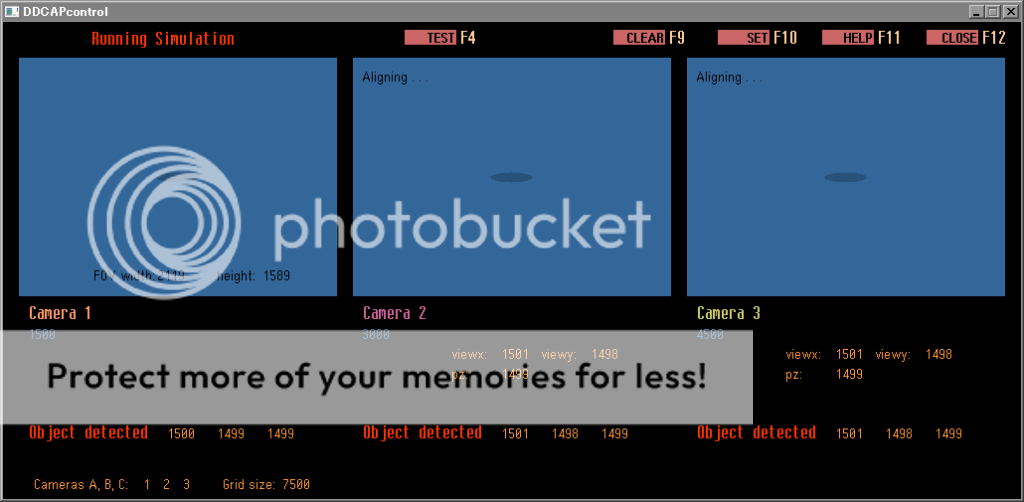
Here’s a screenshot of the latest version of the control program running a simulation, where camera 1 detected a target then cameras 2 and 3 went
through a few thousand trig operations to follow the detecting camera’s line of sight to also capture the target. At that point the local computers
would be ordered to zoom the cameras and start recording. The program still needs many little things, but the core technology works. I have the specs
on the three main camera-control protocols and may support more. Anyway, progress is being made on seeking this kind of evidence.
The project is sort of entering a new phase. I’ve found a certain model of HD CCTV camera that has the right specs yet, since it has been superseded
by a string of subsequent models, is now readily available for less than $50 used. And I’m changing the overall design of the system to require only
two cameras, one computer, and one back yard close to a UFO hotspot, where the system will automatically react only to sizable hovering objects,
adjusting the aim of both cameras in tandem to center the object in frame then zoom in and start recording. This configuration also improves reaction
time in several ways. Once an object appears, the system should be ready to start recording in less than two seconds.
If it captures a UFO in this manner, it will produce shutter-synchronized stereoscopic (camera spacing: at least 20 meters) video guaranteed not fraudulent and backed up by FAA and weather radar data obtained through FOIA requests filed as soon as the object is judged by humans to be truly unknown. But even captures of balloons and helicopters will be shown on the project Web site while waiting for something exotic, just to demonstrate that the system is on the job and functioning properly.
And there may be an automated mobile-phone notification system in place to buzz people in the area when something is detected, although at the time of such notification the nature of the object will not yet be known. That comes later, upon examination of the video by humans.
The hotspot of choice has a long history of several sightings per year, most or all of which may be bunk. But this is a chance to find out. And this new design makes it easier to get the software ready and the project much easier to implement.
If it captures a UFO in this manner, it will produce shutter-synchronized stereoscopic (camera spacing: at least 20 meters) video guaranteed not fraudulent and backed up by FAA and weather radar data obtained through FOIA requests filed as soon as the object is judged by humans to be truly unknown. But even captures of balloons and helicopters will be shown on the project Web site while waiting for something exotic, just to demonstrate that the system is on the job and functioning properly.
And there may be an automated mobile-phone notification system in place to buzz people in the area when something is detected, although at the time of such notification the nature of the object will not yet be known. That comes later, upon examination of the video by humans.
The hotspot of choice has a long history of several sightings per year, most or all of which may be bunk. But this is a chance to find out. And this new design makes it easier to get the software ready and the project much easier to implement.
edit on 6-9-2012 by xpoq47 because: (no reason given)
new topics
-
Meadows, Giuliani Among 11 Indicted in Arizona in Latest 2020 Election Subversion Case
Mainstream News: 17 minutes ago -
Massachusetts Drag Queen Leads Young Kids in Free Palestine Chant
Social Issues and Civil Unrest: 32 minutes ago -
Weinstein's conviction overturned
Mainstream News: 1 hours ago -
Supreme Court Oral Arguments 4.25.2024 - Are PRESIDENTS IMMUNE From Later Being Prosecuted.
Above Politics: 3 hours ago -
Krystalnacht on today's most elite Universities?
Social Issues and Civil Unrest: 3 hours ago -
Chris Christie Wishes Death Upon Trump and Ramaswamy
Politicians & People: 3 hours ago -
University of Texas Instantly Shuts Down Anti Israel Protests
Education and Media: 6 hours ago -
Any one suspicious of fever promotions events, major investor Goldman Sachs card only.
The Gray Area: 8 hours ago
top topics
-
VP's Secret Service agent brawls with other agents at Andrews
Mainstream News: 17 hours ago, 11 flags -
Krystalnacht on today's most elite Universities?
Social Issues and Civil Unrest: 3 hours ago, 7 flags -
Weinstein's conviction overturned
Mainstream News: 1 hours ago, 6 flags -
Sunak spinning the sickness figures
Other Current Events: 17 hours ago, 5 flags -
Electrical tricks for saving money
Education and Media: 15 hours ago, 5 flags -
Supreme Court Oral Arguments 4.25.2024 - Are PRESIDENTS IMMUNE From Later Being Prosecuted.
Above Politics: 3 hours ago, 5 flags -
University of Texas Instantly Shuts Down Anti Israel Protests
Education and Media: 6 hours ago, 3 flags -
Any one suspicious of fever promotions events, major investor Goldman Sachs card only.
The Gray Area: 8 hours ago, 2 flags -
Massachusetts Drag Queen Leads Young Kids in Free Palestine Chant
Social Issues and Civil Unrest: 32 minutes ago, 1 flags -
Chris Christie Wishes Death Upon Trump and Ramaswamy
Politicians & People: 3 hours ago, 1 flags
active topics
-
University of Texas Instantly Shuts Down Anti Israel Protests
Education and Media • 136 • : cherokeetroy -
Graham Hancock being proven right all along about ancient humans in America.
Ancient & Lost Civilizations • 106 • : JonnyC555 -
Supreme Court Oral Arguments 4.25.2024 - Are PRESIDENTS IMMUNE From Later Being Prosecuted.
Above Politics • 47 • : matafuchs -
Candidate TRUMP Now Has Crazy Judge JUAN MERCHAN After Him - The Stormy Daniels Hush-Money Case.
Political Conspiracies • 754 • : Threadbarer -
Massachusetts Drag Queen Leads Young Kids in Free Palestine Chant
Social Issues and Civil Unrest • 2 • : RazorV66 -
Meadows, Giuliani Among 11 Indicted in Arizona in Latest 2020 Election Subversion Case
Mainstream News • 1 • : IndieA -
Nearly 70% Of Americans Want Talks To End War In Ukraine
Political Issues • 84 • : DontTreadOnMe -
VP's Secret Service agent brawls with other agents at Andrews
Mainstream News • 48 • : 5thHead -
-@TH3WH17ERABB17- -Q- ---TIME TO SHOW THE WORLD--- -Part- --44--
Dissecting Disinformation • 673 • : Thoughtful3 -
SETI chief says US has no evidence for alien technology. 'And we never have'
Aliens and UFOs • 66 • : SchrodingersRat