It looks like you're using an Ad Blocker.
Please white-list or disable AboveTopSecret.com in your ad-blocking tool.
Thank you.
Some features of ATS will be disabled while you continue to use an ad-blocker.

The lamassu
page: 1The lamassu is a celestial being from Mesopotamian mythology. Human above the waist and a bull below the waist, it also has the horns and the ears of a bull. It appears frequently in Mesopotamian art, sometimes with wings. The lamassu and shedu were household protective spirits of the common Babylonian people. Later during the Babylonian period they became the protectors of kings as well always placed at the entrance. Statues of the bull-man were often used as gatekeepers. The Akkadians associated the god Papsukkal with lamassu and the god Išum with shedu. From the ninth to the seventh century B.C., the kings of Assyria ruled over a vast empire centered in northern Iraq. The first great Assyrian king was Ashurnasirpal II (r. 883–859 B.C.), who undertook a vast building program at Nimrud, ancient Kalhu. Until it became the capital city under Ashurnasirpal, Nimrud had been no more than a provincial town. The new capital occupied an area of about 900 acres, around which Ashurnasirpal constructed a mud-brick wall 120 feet thick, 42 feet high, and 5 miles long. In the southwest corner of this enclosure was the acropolis, where the temples, palaces, and administrative offices of the empire were located. In 879 B.C
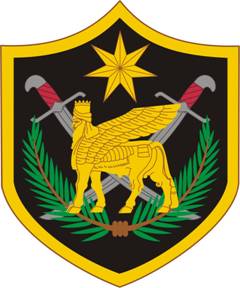
in art, lamassu were depicted as hybrids, winged bulls or lions with the head of a human male. There are still surviving figures of lamassu in bas-relief and some statues in museums, most notably in the British Museum, Musée du Louvre, National Museum of Iraq, Metropolitan Museum of Art and the Oriental Institute, Chicago. They are generally attributed to the ancient Assyrians. The lamassu is at the opening of the city, so that everyone who enters sees it. From the front it appears to be standing and from the side walking. This was intentionally done to make it seem powerful. The lamassu in real life is very tall. In this case the lamassu is being used as a symbol of power. The motif of a winged animal with a human head is common to the near east, first recorded in Ebla, around 3000 BCE. The first distinct lamassu motif appeared in Assyria during the reign of Tilgath Pilser. In a much later period, a winged lion appeared on the flag of the Republic of Venice; however, this refers to Saint Mark the Evangelist, the patron saint of Venice. A winged bull with the head of a bearded man appears on the logo of United States Forces - Iraq in reference to Iraq's ancient past. The lamassu is a celestial being from Mesopotamian mythology. Human above the waist and a bull below the waist, it also has the horns and the ears of a bull. It appears frequently in Mesopotamian art, sometimes with wings. The lamassu and shedu were household protective spirits of the common Babylonian people. Later during the Babylonian period they became the protectors of kings as well always placed at the entrance. Statues of the bull-man were often used as gatekeepers. The Akkadians associated the god Papsukkal with lamassu and the god Isum with shedu. To protect houses, the lamassu were engraved in clay tablets, which were then buried under the door's threshold.They were often placed as a pair at the entrance of palaces. At the entrance of cities, they were sculpted in colossal size, and placed as a pair, one at each side of the door of the city, that generally had doors in the surrounding wall, each one looking towards one of the cardinal points
Originally posted by dogtalesfrom2011
A winged bull with the head of a bearded man appears on the logo of United States Forces - Iraq in reference to Iraq's ancient past.
Source please... oh never mind, I'll get it.
Holy smokes, look at that.
It's true.
I find every individual point in the opening post to be both true and accurate.
However, I find it contains zero emotional impact. I have no idea what the
opening post is supposed to mean to the author, or to any of the readers.
David Grouchy
yea..........huh? what's this all about huh?
also looks like you may have accidentally copied and pasted the first half othe OP into the second half of the OP.
im confused
i dont think anything like that currently exists, but i dont know, i havent even had dreams of monster like that
I might be going off on a tangent here, but it's strange that there are pagan inspired motifs in American and European society. From the Washington Monument, to Cleopatra's Needle (originally the work of Thutmosis III) in New York to roughly 13 obelisks in Rome, especially the Obelisk of Axum which belonged to Ethiopia. In supposedly monotheistic establishments, they have pagan monuments. Even on the Library of Congress (John Adams Building), there is a figure of the ancient Egyptian god Thoth on the door. There are other instances, but these are the first that come to mind.
-
Former NYT Reporter Attacks Scientists For Misleading Him Over COVID Lab-Leak Theory
Education and Media: 1 hours ago -
Why did Phizer team with nanobot maker
Medical Issues & Conspiracies: 1 hours ago -
Pro Hamas protesters at Columbia claim hit with chemical spray
World War Three: 2 hours ago -
Elites disapearing
Political Conspiracies: 4 hours ago -
A Personal Cigar UFO/UAP Video footage I have held onto and will release it here and now.
Aliens and UFOs: 4 hours ago -
Go Woke, Go Broke--Forbes Confirms Disney Has Lost Money On Star Wars
Movies: 6 hours ago -
Freddie Mercury
Paranormal Studies: 6 hours ago -
Nirvana - Immigrant Song
Music: 11 hours ago
-
British TV Presenter Refuses To Use Guest's Preferred Pronouns
Education and Media: 12 hours ago, 16 flags -
Go Woke, Go Broke--Forbes Confirms Disney Has Lost Money On Star Wars
Movies: 6 hours ago, 12 flags -
Pro Hamas protesters at Columbia claim hit with chemical spray
World War Three: 2 hours ago, 9 flags -
Trump To Hold Dinner with President of Poland At Trump Tower Tonight
2024 Elections: 14 hours ago, 8 flags -
Tucker Carlson interviews Christian pastor from Bethlehem.
Middle East Issues: 14 hours ago, 7 flags -
Freddie Mercury
Paranormal Studies: 6 hours ago, 7 flags -
Elites disapearing
Political Conspiracies: 4 hours ago, 7 flags -
A family from Kansas with six children moved to the Moscow region
Other Current Events: 17 hours ago, 6 flags -
A Personal Cigar UFO/UAP Video footage I have held onto and will release it here and now.
Aliens and UFOs: 4 hours ago, 5 flags -
Nirvana - Immigrant Song
Music: 11 hours ago, 4 flags
-
Israel ufo shoot down drones?
Aliens and UFOs • 24 • : Schmoe3755 -
Pro Hamas protesters at Columbia claim hit with chemical spray
World War Three • 7 • : WannabeeAuCourant -
Why did Phizer team with nanobot maker
Medical Issues & Conspiracies • 3 • : Unknownparadox -
AARO/Dr Kirkpatrick-Caught Lying in UAP report.
Aliens and UFOs • 21 • : introufo2 -
Terrifying Encounters With The Black Eyed Kids
Paranormal Studies • 43 • : TheMichiganSwampBuck -
Elites disapearing
Political Conspiracies • 15 • : opethPA -
-@TH3WH17ERABB17- -Q- ---TIME TO SHOW THE WORLD--- -Part- --44--
Dissecting Disinformation • 513 • : fringeofthefringe -
British TV Presenter Refuses To Use Guest's Preferred Pronouns
Education and Media • 48 • : Therealbeverage -
Former NYT Reporter Attacks Scientists For Misleading Him Over COVID Lab-Leak Theory
Education and Media • 2 • : TheMichiganSwampBuck -
Max Loughan Boy Genius Or Something More?
Science & Technology • 67 • : fluctz