It looks like you're using an Ad Blocker.
Please white-list or disable AboveTopSecret.com in your ad-blocking tool.
Thank you.
Some features of ATS will be disabled while you continue to use an ad-blocker.

The Michigan 1966 UFO Flap - Was it Swamp gas?
page: 3share:
reply to post by Pimander
Here are Vallee's recollections from his journal, Forbidden
Science.
You'll have to draw your own conclusions as to how objective/subjective these passages are...
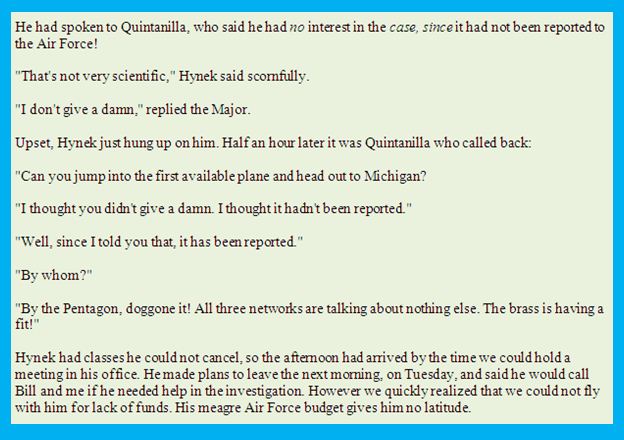
Page 173
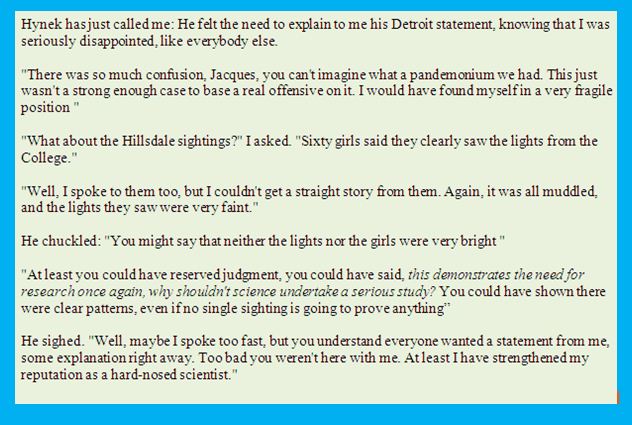
Page 175
They had somewhat of a fractious relationship and this could well colour Vallee's portrayal of Hynek in the book.
I wasn't there so who knows?
You'll have to draw your own conclusions as to how objective/subjective these passages are...
Page 173
Page 175
They had somewhat of a fractious relationship and this could well colour Vallee's portrayal of Hynek in the book.
I wasn't there so who knows?
reply to post by Kandinsky
Kandinsky some truly great posts there mate and thanks for linking the Vallee pages, when it came to Major Hector Quintanilla, I don't think Dr Hynek was too impressed with his (or Sgt Moody's) methods of 'objective' investigation and I can well believe Vallee's claims about the Major not being at all interested in the Michigan sightings and 'not giving a damn':
I've not posted all the interview but there's a relevant part below about the Michigan 'swamp gas' case and Dr Hynek's changing attitudes towards the UFO subject, he discusses the pressure put on him by the USAF to produce conventional explanations and also mentions how the sightings kick-started the Brian O'Brien Committee which eventually led to the now infamous (and hideously agenda based) Condon report.
Cheers.
Kandinsky some truly great posts there mate and thanks for linking the Vallee pages, when it came to Major Hector Quintanilla, I don't think Dr Hynek was too impressed with his (or Sgt Moody's) methods of 'objective' investigation and I can well believe Vallee's claims about the Major not being at all interested in the Michigan sightings and 'not giving a damn':
"When Major Quintanilla came in, the flag of the utter nonsense school was flying at its highest on the mast. Now he had a certain Sgt. Moody assisting him...Moody epitomized the conviction-before-trial method. Anything that he didn't understand or didn't like was immediately put into the psychological category, which meant "crackpot." He would not ever say that the person who reported a case was a fairly respectable person, maybe we should look into it, or maybe we should find out. He was also the master of the possible: possible balloon, possible aircraft, possible birds, which then became, by his own hand (and I argued with him violently at times), the probable; he said, well, we have no category "possible" aircraft. It is therefore either unidentified or aircraft. Well, it is more likely aircraft; therefore it is aircraft.... An "unidentified" to Moody was not a challenge for further research. To have it remain unidentified was a blot... and he did everything to remove it. He went back to cases from Captain Gregory's days and way back in Ruppelt's days and redid the files. A lot that were unidentified in those days he "identified" years and years later".
Dr J Allen Hynek, Chairman of the Department of Astronomy at Northwestern University and scientific consultant for Air Force investigations of UFOs from 1948 until 1969 (Projects Sign, Grudge and Blue Book).
link
I've not posted all the interview but there's a relevant part below about the Michigan 'swamp gas' case and Dr Hynek's changing attitudes towards the UFO subject, he discusses the pressure put on him by the USAF to produce conventional explanations and also mentions how the sightings kick-started the Brian O'Brien Committee which eventually led to the now infamous (and hideously agenda based) Condon report.
STACY: Was there ever any direct pressure applied by the Air Force itself for you to come up with a conventional explanation to these phenomena?
HYNEK: There was an implied pressure, yes, very definitely..
STACY: What began to change your own perception of the phenomenon?
HYNEK: Two things, really. One was the completely negative and unyielding attitude of the Air Force. They wouldn't give UFOs the chance of existing, even if they were flying up and down the street in broad daylight. Everything had to have as explanation. I began to resent that, even though I basically felt the same way, because I still thought they weren't going about it in the right way. You can't assume that everything is black no matter what. Secondly, the caliber of the witnesses began to trouble me. Quite a few instances were reported by military pilots, for example, and I knew them to be fairly well-trained, so this is when I first began to think that, well, maybe there something to all this.
The famous "swamp gas" case which came later on finally pushed me over the edge. From that point on, I began to look at reports from a different angle, which was to say that some of them could be true UFOs..
STACY: Was it the famous Michigan sightings of 1966, explained away as "swamp gas" that finally did lead the Air Force to bring in a reputable university?
HYNEK: Yes, that, as you know, became something of a national joke and Michigan was soon being known as the "Swamp Gas State." Eventually, it resulted in a Congressional Hearing called for by then state Congressman, Gerald Ford, who of course later went on to become President. The investigation was turned over to the Brian O'Brien Committee who did a very good job. Had their recommendations been carried out, things might have turned out much better than they did. The recommended that UFOs be taken away from the Air Force and given to a group of universities, to study the thing in a as wide a way as possible. Well, they didn't go to a group, they went to a university and a man they were certain would be very hard-nosed about it, namely, Dr. Edward Condon at the University of Colorado. That was how the Condon Committee and eventually the Report came to be.
link
Cheers.
edit on 02/10/08 by karl 12 because: (no reason given)
Originally posted by easynow
Was it swamp gas ?
No .... Police officers don't chase swamp gas
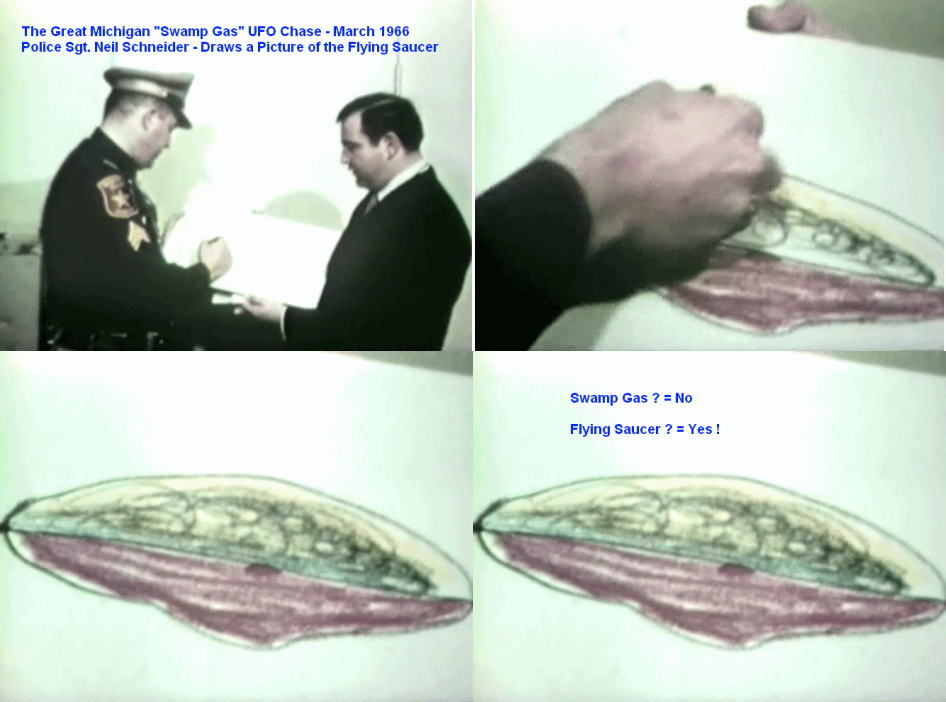
Hey bro, they don't chase Venus either..
"I've seen Venus many times, but I never saw Venus 50 feet above a road and moving from side to side like this was..."
Portage County Sheriff Ross Dustman to United Press International
*Above BlueBook* - Ohio UFO Chase , Portage County April 17, 1966
or Aldebaran and Betelgeuse.
"At this time it was clearly visible to both of us. It was surrounded by a glow making the round or oblong object visible. At each end, or each side of the object, there were definite red lights. At times about five white lights were visible between the red lights.As we watched the object moved again and performed feats that were actually unbelievable."
California Highway Patrol Officers Charles A. Carson and Stanley Scott
Red Bluff Incident, 1960 - Police nearly shoot at UFO
Two other reports from Indiana around the same time:
March 8, 1966:
On March 8th at 2:30 PM there was a good quality daylight disc sighting at Chesterton, Indiana. (Exhibit 6a) The UFO, surrounded by a bright, misty haze, hovered above a cloud bank for 4-5 minutes. It then changed angles and sped away (object sketch found at link)
March 30, 1966
Indiana's Cass County at Lewisburg, Indiana, had a CE2 sighting on the same evening. Five witnesses reported observing an oval object that flew over them making pulsating sounds. The object was in sight for 13 minutes.
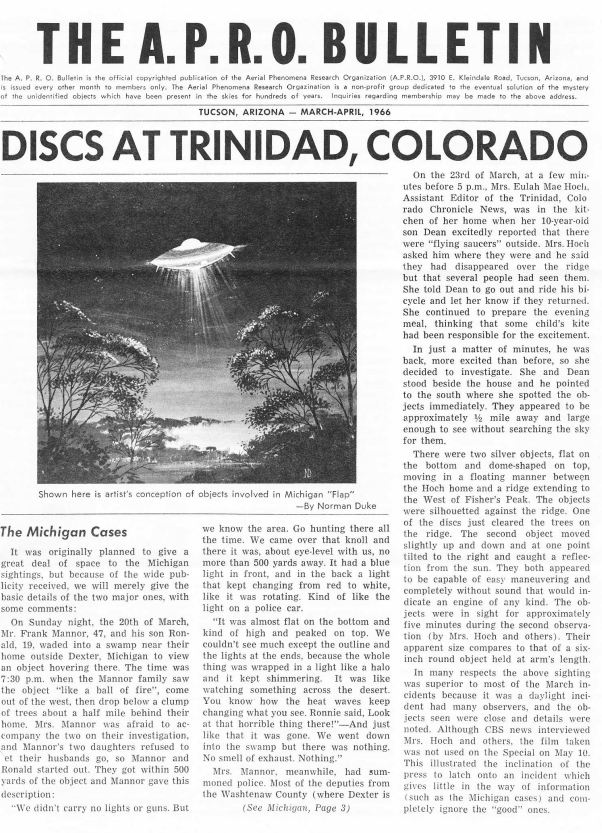
Elsewhere, close encounters in Michigan stirred congressional interest.
Regional Encounters - the FC files. A century of UFO sightings and Close encounters in the Mid West. - Francis Ridge.
Great thread by Isaac giving easy access to searching and cross referencing cases:
Michigan sightings:
FAST searching of major free online collections of UFO journals (or just browse/download them)
Originally posted by MainLineThis
Who cares?
MainLineThis, IgnoreTheFacts, Gameisupman (or whatever username you're using these days), if you don't think the case is important, then simply ignore the thread.
Hopefully you can start a thread one day.. or at least actually address the subject matter in the ones you post in.
reply to post by karl 12
Yeah I'd noticed that too
This case was featured in a documentary on channel 5 last night called Close Encounters of the Third Kind: The True Story , true to form they left out the most interesting bits and didn't even mention Frank Mannor and the problems he had .
They did however reunite two of the police officers and had them witness a reconstruction of the swamp gas theory using methane gas and soapy water to try to recreate it , with them standing where they were when they saw the object .
Both immediately agreed that wasn't what they saw
MainLineThis, IgnoreTheFacts, Gameisupman (or whatever username you're using these days)
Yeah I'd noticed that too
This case was featured in a documentary on channel 5 last night called Close Encounters of the Third Kind: The True Story , true to form they left out the most interesting bits and didn't even mention Frank Mannor and the problems he had .
They did however reunite two of the police officers and had them witness a reconstruction of the swamp gas theory using methane gas and soapy water to try to recreate it , with them standing where they were when they saw the object .
Both immediately agreed that wasn't what they saw
reply to post by gortex
Gortex, thanks for the heads up on the TV programme mate although how a production company can cover the Michigan swamp gas case and not mention Frank Manor is a bit of a shocker - reuniting the police officers for the reconstruction does sound interesting though and Isaac has linked the UFO documentary below...but I can't watch it because of the country I'm in.
Late notice: UFO documentary just started on Channel 5 (UK, 8pm Thursday)
Cheers.
Gortex, thanks for the heads up on the TV programme mate although how a production company can cover the Michigan swamp gas case and not mention Frank Manor is a bit of a shocker - reuniting the police officers for the reconstruction does sound interesting though and Isaac has linked the UFO documentary below...but I can't watch it because of the country I'm in.
Late notice: UFO documentary just started on Channel 5 (UK, 8pm Thursday)
Cheers.
I wittnessed UFOs on 2 seperate ocasions in "66"
One was persued by some type of jet plane that came up out of Selfridge Air Base.
I was full daylight and at least 20 other people observed the same sighting.
Not swamp gas at about 10,000 feet.
One was persued by some type of jet plane that came up out of Selfridge Air Base.
I was full daylight and at least 20 other people observed the same sighting.
Not swamp gas at about 10,000 feet.
Originally posted by azureskys
I wittnessed UFOs on 2 seperate ocasions in "66"
One was persued by some type of jet plane that came up out of Selfridge Air Base.
I was full daylight and at least 20 other people observed the same sighting.
Not swamp gas at about 10,000 feet.
Azureskys, there a report below which sounds similar to your description in 1966, there's also a great link here from Patrick Gross which discusses a radar case from Selfridge Air Force Base in 1950 -sounds like the place has experienced quite a few strange reports.
In 1965 it was common to see strange things flying around the radar dome up on the mountain. Often they did not show up on radar, but were visible just outside the dome itself.
Sometime in the Winter of 66-67 we had a couple of "things" flying over Lake Saint Claire just off Selfridge AFB, near Mt Clemens MI. They scrambled two F-106s and of course they caught nothing.
It is difficult when the other aircraft can suddenly accelerate to high speed and do and 90 degree turn at that speed.
The Air Force said it was swamp gas, and anyone who disagreed could stay in the base confinement (jail) until they realized they saw nothing.
link
Cheers.
Yet more reports of unknown 'red, white, and green flashing objects' from Michigan in March 1966 including news report describing a UFO with red and
blue glowing lights about 25 feet of the grouind.
“Later, the Monroe County, Michigan sheriff’s department received calls from nearly a dozen persons who said that they saw red, white, and green flashing objects over Lake Erie, the Enrico Fermi Atomic Power Plant, and other areas near Monroe."
Google Newspaper Archive
Video: he has a lack of eye contàct and has a tendency of looking down. I think he is lieing. He seems to confident maybe even cocky about what he is
doing. To go a little deeper the way he contorts his face at times gives me an idea he has a control of the situation and even people near him. Over
confidence in some areas doesn't mean it's ok to lie in others.
Originally posted by gortex
to the best of my knowledge a suitable explanation hasn't been found so I guess the ET hypothesis remains a possibility .
Gortex, apparently not mate - here's a news report where the U.S. Defense Secretary categorically denies 'the possibility that UFOs reported in Michigan and elsewhere have extra-terrestrial implications'.
“Pentagon Claims There Aren't Any Flying Saucers”, 31 March 1966
I don't know how he knows that for sure but in the article the Pentagon also assures us that there is no such thing as flying saucers so I guess we can all give up UFO research and go back to bed.
Cheers.
reply to post by karl 12
Was it swamp gas?
You were just being funny. Pulling our leg.
It is one of the better UFO reads, lots of witness and write ups.
Does ATS have an Incident at Exeter too?
Was it swamp gas?
You were just being funny. Pulling our leg.
It is one of the better UFO reads, lots of witness and write ups.
Does ATS have an Incident at Exeter too?
Originally posted by spiritualarchitect
Was it swamp gas?
You were just being funny. Pulling our leg.
Ah ha yes I was mate - sorry about that and I really don't think it was swamp gas.
Here's Dr Hynek's last ever interview where he mentions that the Michigan case finally pushed him over the edge.
STACY: What began to change your own perception of the phenomenon?
HYNEK: Two things, really. One was the completely negative and unyielding attitude of the Air Force. They wouldn't give UFOs the chance of existing, even if they were flying up and down the street in broad daylight. Everything had to have as explanation. I began to resent that, even though I basically felt the same way, because I still thought they weren't going about it in the right way. You can't assume that everything is black no matter what. Secondly, the caliber of the witnesses began to trouble me. Quite a few instances were reported by military pilots, for example, and I knew them to be fairly well-trained, so this is when I first began to think that, well, maybe there something to all this.
The famous "swamp gas" case which came later on finally pushed me over the edge. From that point on, I began to look at reports from a different angle, which was to say that some of them could be true UFOs.
Other Documents
Originally posted by spiritualarchitect
Does ATS have an Incident at Exeter too?
The Exeter, New Hampshire UFO Encounter, Sept. 3, 1965
reply to post by karl 12
Thanks for the link. I still have a lot here left to read. Have not read about either case for years.
Thanks for the link. I still have a lot here left to read. Have not read about either case for years.
reply to post by karl 12
Interesting article , thanks for the link mate
Wow .. well if the Pentagon says it then I guess it must be true then ,kind of interesting that they aren't theirs but they aren't ours either , no mystery there them
Interesting article , thanks for the link mate
Wow .. well if the Pentagon says it then I guess it must be true then ,kind of interesting that they aren't theirs but they aren't ours either , no mystery there them
reply to post by karl 12
This whole event is like a song on the record album, "Flying Saucers Greatest Hits".
This whole event is like a song on the record album, "Flying Saucers Greatest Hits".
Originally posted by gortex
Wow .. well if the Pentagon says it then I guess it must be true then ,kind of interesting that they aren't theirs but they aren't ours either , no mystery there them
Hey Gortex, maybe the Pentagon doesn't know either and everybody's as clueless as each other.
[atsimg]http://files.abovetopsecret.com/images/member/15f68d9aada1.png[/atsimg]
Here's good old Dr Hynek discussing his Michigan Swamp Gas Debunk on The Amazing World of Kreskin, it really is a good watch and he states that about 20 percent of Bluebook cases could not be explained - he also states that the Condon report was a 'travesty on science'.
Historic Film Stock
The Amazing World of Kreskin (1972-1975) Show No. 43
Video Link
Cheers.
Police report surfaces in the swamp gas case:
Report:
WASHTENAW COUNTY SHERIFF'S DEPARTMENT
Dr Harry Willnus.
I investigated the Dexter Michigan, UFO event of March 1966.
This, of course, became known as the "Swamp Gas" case and our
friend Dr. Hynek became a laughing stock. This was unfortunate
as Hynek was thrown into a situation where there appeared to be no
earthly, common sense explanation. And the press wanted an
explanation. I remember those days and everyone here in Michigan
was following the story. Some people were frightened.
I have a copy of the police report from the Washtenaw County
Sheriff's Department from March 20, 1966. There were 10 police
officers, five squad cars, and several detectives there that night at
the Frank Manner farm. Also, a number of neighbors gathered for
the strange light show that went on for a time.
link
Report:
WASHTENAW COUNTY SHERIFF'S DEPARTMENT
new topics
-
Ramblings on DNA, blood, and Spirit.
Philosophy and Metaphysics: 15 minutes ago -
4 plans of US elites to defeat Russia
New World Order: 1 hours ago -
Thousands Of Young Ukrainian Men Trying To Flee The Country To Avoid Conscription And The War
Other Current Events: 5 hours ago -
12 jurors selected in Trump criminal trial
US Political Madness: 7 hours ago -
Iran launches Retalliation Strike 4.18.24
World War Three: 8 hours ago -
Israeli Missile Strikes in Iran, Explosions in Syria + Iraq
World War Three: 8 hours ago
top topics
-
George Knapp AMA on DI
Area 51 and other Facilities: 14 hours ago, 25 flags -
Israeli Missile Strikes in Iran, Explosions in Syria + Iraq
World War Three: 8 hours ago, 16 flags -
Louisiana Lawmakers Seek to Limit Public Access to Government Records
Political Issues: 16 hours ago, 7 flags -
Iran launches Retalliation Strike 4.18.24
World War Three: 8 hours ago, 6 flags -
Not Aliens but a Nazi Occult Inspired and then Science Rendered Design.
Aliens and UFOs: 14 hours ago, 5 flags -
Thousands Of Young Ukrainian Men Trying To Flee The Country To Avoid Conscription And The War
Other Current Events: 5 hours ago, 4 flags -
12 jurors selected in Trump criminal trial
US Political Madness: 7 hours ago, 4 flags -
The Tories may be wiped out after the Election - Serves them Right
Regional Politics: 17 hours ago, 3 flags -
4 plans of US elites to defeat Russia
New World Order: 1 hours ago, 2 flags -
Ramblings on DNA, blood, and Spirit.
Philosophy and Metaphysics: 15 minutes ago, 0 flags
active topics
-
So I saw about 30 UFOs in formation last night.
Aliens and UFOs • 29 • : Encia22 -
12 jurors selected in Trump criminal trial
US Political Madness • 23 • : gspatfound -
Ramblings on DNA, blood, and Spirit.
Philosophy and Metaphysics • 0 • : BrotherKinsMan -
Fossils in Greece Suggest Human Ancestors Evolved in Europe, Not Africa
Origins and Creationism • 62 • : whereislogic -
-@TH3WH17ERABB17- -Q- ---TIME TO SHOW THE WORLD--- -Part- --44--
Dissecting Disinformation • 538 • : cherokeetroy -
4 plans of US elites to defeat Russia
New World Order • 6 • : andy06shake -
Silent Moments --In Memory of Beloved Member TDDA
Short Stories • 44 • : Encia22 -
Mandela Effect - It Happened to Me!
The Gray Area • 110 • : BeTheGoddess2 -
Vogt and the twelve thousand year cycle
Fragile Earth • 27 • : Lanogaxeh -
British TV Presenter Refuses To Use Guest's Preferred Pronouns
Education and Media • 65 • : nugget1