It looks like you're using an Ad Blocker.
Please white-list or disable AboveTopSecret.com in your ad-blocking tool.
Thank you.
Some features of ATS will be disabled while you continue to use an ad-blocker.

Giant spiders
page: 2share:
lived in the panhandle of florida for a bit..did alot of hiking in the woods there.....i was told about the
golden orb spider and that i should look 'up' more often. so, unfourtunatly i began
to look 'up' more often. well talk about being creeped out...once you notice something one tends to notice and pick it out of the scenery more
often...and starting at about a hieght of 10ish feet..i began to notice dozens of these 5 to 6 foot webs with a rather larger spider in them...just
sorta swaying in the breeze fortunatly, they tended to stay off the ground, but talked a being creeped out....egads
reply to post by clearmind
yes!
i lived in FL and they would make webs between trees that were quite wide.
my brother road his horse through one and the spider landed on his back!! lololol!!
almost fell off my horse, laughing! he freaked!
got some biggies here in HK too. got some pics somewhere.
one was in my bathroom and ran out from behind my shelf on the wall next to me at head height, while i was shaving,
almost cut my throat! lol!
got him though, 1/2 a can of roach killer.
sorry, but not in my house, big guy!

yes!
i lived in FL and they would make webs between trees that were quite wide.
my brother road his horse through one and the spider landed on his back!! lololol!!
almost fell off my horse, laughing! he freaked!
got some biggies here in HK too. got some pics somewhere.
one was in my bathroom and ran out from behind my shelf on the wall next to me at head height, while i was shaving,
almost cut my throat! lol!
got him though, 1/2 a can of roach killer.
sorry, but not in my house, big guy!
edit on 2-10-2011 by fooks because: (no reason given)
edit on 2-10-2011 by fooks because: (no reason given)
Originally posted by kimish
Originally posted by Krono
So I thought to myself...how do giraffes, elephants, crocodiles, humans, well large animals breath? how are we able to breath if the oxygen levels are low?
Spiders take in oxygen much differently than mammals and reptilians. THere are sources getting much deeper into it but there is a very good explanation to the question you posed.
Some scientist were trying to explain how insects grew so big back when there were still dinosaurs and stuff. Because insects like spiders absorb oxygen through thier thorax and no cardiovascular system there is a set possible size that are capable of growing to and still ba able to supply oxygen to their internal organs and such.
Insect fossils have been found that are far larger than this method of oxygenating the body would allow. To try and explain this scientists hypothesised that these large insects had cappillaries entering the body from the thorax that used surrounding muscle tissue to pump oxygen into the thorax... Allowing insects to grow larger than previously thought.
I hope that made sence.
Originally posted by Krono
Thank you for your replies. I think scientist have already de-bunked this. They state that spider can't become giants (when I mean giants I don't mean 100ft tall!) due to the low oxygen levels in the air. They said if they were big, they wouldn't be able to breath in enough oxygen to survive.
So I thought to myself...how do giraffes, elephants, crocodiles, humans, well large animals breath? how are we able to breath if the oxygen levels are low?
Insects do not have a circulatory system, nor lungs. We do.
This vid allways makes me laugh. Spiders dont get a lot biger than this. But there are plenty that are heavier.
I told you not to play with the spider...
I told you not to play with the spider...
edit on 2-10-2011 by PhoenixOD because: (no reason given)
reply to post by Krono
I have seen a doco once years ago about a tribe that lived in the amazon who hunted and ate these huge tarantulas that hadn't been seen before, they only ate the eggs I think as a delicacy. They didn't know how dangerous they were, Nut I remember they had to wrap them up to avoid the hairs on the backs of them that they could shot out in a cloud, which was kinda like being hit by the worst case of the itchy's imaginable.They did film one nailing a viper snake ( I think it was a viper, they said it was one of the most poisonous) with one bite which liquified it! These spiders where huge, the stuff of an aracnophobe's worst nightmare. I think it was one of old wheezy's doco's, David Attenborough.
I have seen a doco once years ago about a tribe that lived in the amazon who hunted and ate these huge tarantulas that hadn't been seen before, they only ate the eggs I think as a delicacy. They didn't know how dangerous they were, Nut I remember they had to wrap them up to avoid the hairs on the backs of them that they could shot out in a cloud, which was kinda like being hit by the worst case of the itchy's imaginable.They did film one nailing a viper snake ( I think it was a viper, they said it was one of the most poisonous) with one bite which liquified it! These spiders where huge, the stuff of an aracnophobe's worst nightmare. I think it was one of old wheezy's doco's, David Attenborough.
Originally posted by Krono
Thank you for your replies. I think scientist have already de-bunked this. They state that spider can't become giants (when I mean giants I don't mean 100ft tall!) due to the low oxygen levels in the air. They said if they were big, they wouldn't be able to breath in enough oxygen to survive.
That's a yes&no type answer:
While looking up pre#oric dragonflies...
"We took the beetles to the Argonne National Lab and put the live animals under the x-ray beam," he says. "We took video sequences and x-ray images of the live beetles, then we went back to Tempe and sat down at a computer and measured the tracheal volume, the dimensions of the structures." They found that the larger beetles had to devote a greater proportion of their body mass -- up to 20 percent more -- to the tracheal system than the smaller beetles. It's the proportion of tracheal system to body mass that matters because as the insect grows larger, it must devote more and more of its resources to maintain a tracheal system that is robust enough to deliver enough oxygen to the body's tissues.
They found that the larger beetles had to devote a greater proportion of their body mass -- up to 20 percent more -- to the tracheal system than the smaller beetles. It's the proportion of tracheal system to body mass that matters because as the insect grows larger, it must devote more and more of its resources to maintain a tracheal system that is robust enough to deliver enough oxygen to the body's tissues.
What that means, the scientists say, is the size of the tracheal system makes it possible for some insects to get bigger, but it also limits the maximum size.

These 2 pictures should be models of the the prehistoric ones, but 15x the size of the big ones we've got down here? Pretty darn huge, those things have a wingspan of about 4-5 inches. Imagine the following on a 7 inch long hand:
What is interesting:
Wiki In colder environments, the air is denser--also, the air tends to be far less humid. We think about these things for combustion engines.
Aftermarket cold air intake systems are marketed with claims of increased engine efficiency and performance. The putative principle behind a cold air intake is that cooler air has a higher density, thus containing more oxygen per volume unit than warmer air.
Bergmann's Rule is just a generalised statement that creatures are bigger, the higher the latitude. It has been assumed it has to do with heat retention (which may be part of it). But the really large dragonflies I grew up with are in the swamps with the mosquitoes. The thing is that for most insects, the bigger ones are in warm environments because they do not survive the cold, and have fewer months to get huge. But the size difference in a few of them are subjected to Beregmann's rule--like horseflies.
But at least someone's caught on that nitrogen rich food preferable.
Now, Pennings and Ho report that three different herbivores all grew bigger on a diet of high-latitude plants than on a lower-latitude diet. Pennings says the plants from cold climates appear to have more nitrogen, which makes them more nutritious, and have fewer toxic defense chemicals. They're also softer and easier to eat. And it may be that bigger herbivores make the predators that eat them bigger too. I'm Bob Hirshon for AAAS, the Science Society.
All joking aside this is a very interesting subject. Ive never heard of this kind of spider before (even if it is not proved to be real)
wiki has some info on the subject
wiki has some info on the subject
1938: Congo
Reginald and Margurite Lloyd were driving a Ford truck through a trail when they spotted a spider resembling a tarantula crossing the path ahead of them. The creature's legspan was estimated at 3 feet. Their daughter Miss Maurgurite Lloyd would later relate this story in the 1990s to William Gibbons.
1942: Papua, New Guinea
An Australian soldier at the Kokoda Trail said that he encountered a puppy-sized spider inhabiting a 10 to 15 foot sized web. It was described with having a bulk body, was black, and hairy like a tarantula.
1948: Leesville, Louisiana, United States
William Slaydon and his grandchildren were walking north on Highway 171 to church when he motioned them to stop. After hearing a rustling in the bushes ahead a spider described as being the size of a washtub emerged and crossed the road. One of the grandchildren would later tell this story to his own son, Todd Partain, director of the documentary film "Eyes In The Dark: The Sasquatch Experience."
20th Century: Black Hills, Dakotas, United States
A woman related a similar story of a giant spider crossing a remote road. It is described as being as least as wide as one lane of the road.
1970: Cambodia
A Green Beret says that while on a mission he heard a rustling in the foliage ahead of him. Thinking it was a Viet Cong soldier he got into a firing position and put on night vision goggles. A spider "as big as a small 4 wheel ATV" was visible about ten feet from him. It soon vanished into the forest.
2001: Cameroon
Timbo, chief of the Baka tribe in Cameroon tells Williams Gibbons that in November 2000 a J'ba Fofi had built a nest near their village.
2011: Amazon
British cinematographer Richard Terry travelled to the Amazon to investigate reports of giant spiders in the June 13th episode of Man V Monster. At a remote village he was informed that giant spiders lived in holes deep within the jungle and measured roughly four feet in diameter.
if all spiders were 2 or 3 feet across in size. i don't think that humans would have been able to evolve to the point we are at right now, if at
all... spiders at those sizes would be really, really fast and they are ambush predators...
here's the biggest known spider > en.wikipedia.org...
here's the biggest known spider > en.wikipedia.org...
edit on 2-10-2011 by blocula because: (no reason
given)
I think the fact they have an exoskeleton limits their size...thankfully, even they have to obey the laws of the natural world. I honestly have not
looked to much in to it though so i may be wrong, but i very much doubt spiders could be giant in terms of the sizes you are talking
about.
edit on 2-10-2011 by Solomons because: (no reason given)
Originally posted by blocula
if all spiders were 2 or 3 feet across in size. i don't think that humans would have been able to evolve to the point we are at right now, if at all... spiders at those sizes would be really, really fast and they are ambush predators...
here's the biggest known spider > en.wikipedia.org...edit on 2-10-2011 by blocula because: (no reason given)
Thats the second biggest spider, it says so in the page you linked
The Goliath bird-eater Spider (Theraphosa blondi; also called the Goliath Birdeater) is an arachnid belonging to the tarantula group, Theraphosidae, and is considered to be the second largest spider in the world
but it might be the heaviest.
The largest is the Giant Huntsman . The spider in thevideo above is a huntsman

edit on 2-10-2011 by PhoenixOD because: (no reason given)
if there were millions of those ^^^ spiders,2 or 3 feet across running around,humans would be in bbbbbiiiiiiiigggggg trouble...
Originally posted by fooks
reply to post by clearmind
yes!
i lived in FL and they would make webs between trees that were quite wide.
my brother road his horse through one and the spider landed on his back!! lololol!!
almost fell off my horse, laughing! he freaked!
got some biggies here in HK too. got some pics somewhere.
one was in my bathroom and ran out from behind my shelf on the wall next to me at head height, while i was shaving,
almost cut my throat! lol!
got him though, 1/2 a can of roach killer.
sorry, but not in my house, big guy!
edit on 2-10-2011 by fooks because: (no reason given)edit on 2-10-2011 by fooks because: (no reason given)
Oh, my freaking God! Why is that huge spider walking so close to that person's foot? Your "1/2 can of roach killer" comment cracks me up. I usually call that the "Raid death foam technique." LOL
This thread is creeping me out and you guys are cracking me up.
edit on 2-10-2011 by NightGypsy because: (no reason given)
i was stripping bark off a big tree and revealed a giant huntsman..would of been a bit bigger then my palm
another time i was lifting up pavers and revealed what i think was a giant wolf spider..almost as big as my palm and covered in probably a million tiny babies..
scary stuff
another time i was lifting up pavers and revealed what i think was a giant wolf spider..almost as big as my palm and covered in probably a million tiny babies..
scary stuff
Oh spiders....the scariest thing on the planet to me
All spiders are giant to me, even the small baby ones. I run screaming like I was just attacked....in most cases I FEEL like they are attacking me. I had a huge brown spider crawl on my foot one time and I leaped into my tub and sat there for like 20mins freaking out lol.
I think Australia has the big spiders, everything else there seems to be huge and if it bites you, you die. LOL
I saw that one banana spider I think that ate a bird! NO thanks! That is just too big for me. OH and then you have this one:
Huntsman and babies....OMG RUN!
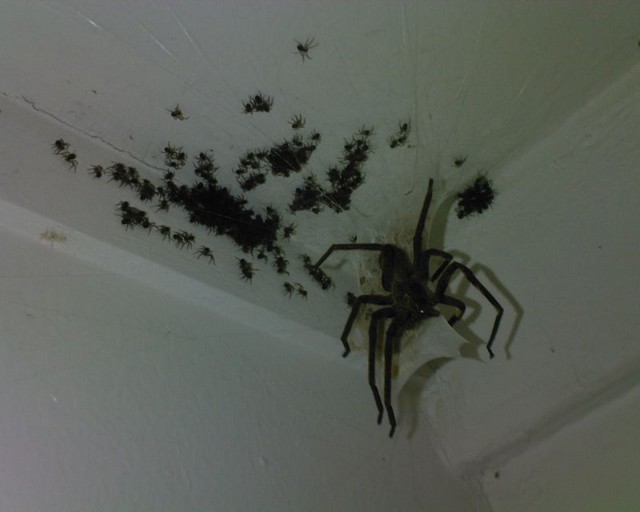
All spiders are giant to me, even the small baby ones. I run screaming like I was just attacked....in most cases I FEEL like they are attacking me. I had a huge brown spider crawl on my foot one time and I leaped into my tub and sat there for like 20mins freaking out lol.
I think Australia has the big spiders, everything else there seems to be huge and if it bites you, you die. LOL
I saw that one banana spider I think that ate a bird! NO thanks! That is just too big for me. OH and then you have this one:
Huntsman and babies....OMG RUN!
Why do i do this to myself!!
Everytime there is a thread on Spiders, i click on it and look through the pics and vids, and give myself nightmares for a week
I'm so glad i live in the UK.
Although to an arachnophobe like me, even smallish spiders turn me white as a sheet.
This time of year the Garden Spiders are out in force. I swear they are getting bigger each year. The one in my friends garden has the fattest body (almost the size of a 10 pence coin) with stubby little legs. I always manage to find myself walking through one of their webs by accident *shudders*
I feel all itchy now *goes and takes a shower*
Everytime there is a thread on Spiders, i click on it and look through the pics and vids, and give myself nightmares for a week
I'm so glad i live in the UK.
Although to an arachnophobe like me, even smallish spiders turn me white as a sheet.
This time of year the Garden Spiders are out in force. I swear they are getting bigger each year. The one in my friends garden has the fattest body (almost the size of a 10 pence coin) with stubby little legs. I always manage to find myself walking through one of their webs by accident *shudders*
I feel all itchy now *goes and takes a shower*
edit on 3-10-2011 by skitzspiricy because: (no reason given)
this ^^^ picture is one of the most disturbing images that i have ever seen.it's hard for me to look at it,even though i know it's only a photo.how can anyone comfortably fall asleep in an area where these larger species live and thrive? i'm in massachusetts and in the last 3 months,the biggest spider that i have seen was about as big as a nickel...i'm not complaining
Originally posted by mblahnikluver
Oh spiders....the scariest thing on the planet to me
All spiders are giant to me, even the small baby ones. I run screaming like I was just attacked....in most cases I FEEL like they are attacking me. I had a huge brown spider crawl on my foot one time and I leaped into my tub and sat there for like 20mins freaking out lol.
I think Australia has the big spiders, everything else there seems to be huge and if it bites you, you die. LOL
I saw that one banana spider I think that ate a bird! NO thanks! That is just too big for me. OH and then you have this one:
Huntsman and babies....OMG RUN!
largest confirmed to the public is 12 inches long 8 wide. Enough venom to kill anything it bites. Im guessing much bigger are out their.
new topics
-
University of Texas Instantly Shuts Down Anti Israel Protests
Education and Media: 4 minutes ago -
Any one suspicious of fever promotions events, major investor Goldman Sachs card only.
The Gray Area: 2 hours ago -
God's Righteousness is Greater than Our Wrath
Religion, Faith, And Theology: 6 hours ago -
Electrical tricks for saving money
Education and Media: 9 hours ago -
VP's Secret Service agent brawls with other agents at Andrews
Mainstream News: 11 hours ago -
Sunak spinning the sickness figures
Other Current Events: 11 hours ago -
Nearly 70% Of Americans Want Talks To End War In Ukraine
Political Issues: 11 hours ago
top topics
-
VP's Secret Service agent brawls with other agents at Andrews
Mainstream News: 11 hours ago, 9 flags -
Cats Used as Live Bait to Train Ferocious Pitbulls in Illegal NYC Dogfighting
Social Issues and Civil Unrest: 15 hours ago, 8 flags -
Electrical tricks for saving money
Education and Media: 9 hours ago, 4 flags -
Nearly 70% Of Americans Want Talks To End War In Ukraine
Political Issues: 11 hours ago, 3 flags -
Sunak spinning the sickness figures
Other Current Events: 11 hours ago, 3 flags -
Late Night with the Devil - a really good unusual modern horror film.
Movies: 13 hours ago, 2 flags -
Any one suspicious of fever promotions events, major investor Goldman Sachs card only.
The Gray Area: 2 hours ago, 2 flags -
The Good News According to Jesus - Episode 1
Religion, Faith, And Theology: 17 hours ago, 1 flags -
God's Righteousness is Greater than Our Wrath
Religion, Faith, And Theology: 6 hours ago, 0 flags -
University of Texas Instantly Shuts Down Anti Israel Protests
Education and Media: 4 minutes ago, 0 flags
active topics
-
God's Righteousness is Greater than Our Wrath
Religion, Faith, And Theology • 20 • : randomuser2034 -
15 Unhealthiest Sodas On The Market
Health & Wellness • 43 • : JPRCrastney -
University of Texas Instantly Shuts Down Anti Israel Protests
Education and Media • 0 • : FlyersFan -
Nearly 70% Of Americans Want Talks To End War In Ukraine
Political Issues • 23 • : andy06shake -
Sunak spinning the sickness figures
Other Current Events • 9 • : Ohanka -
The Acronym Game .. Pt.3
General Chit Chat • 7748 • : bally001 -
HORRIBLE !! Russian Soldier Drinking Own Urine To Survive In Battle
World War Three • 37 • : FlyersFan -
Any one suspicious of fever promotions events, major investor Goldman Sachs card only.
The Gray Area • 3 • : seekshelter -
-@TH3WH17ERABB17- -Q- ---TIME TO SHOW THE WORLD--- -Part- --44--
Dissecting Disinformation • 662 • : F2d5thCavv2 -
SETI chief says US has no evidence for alien technology. 'And we never have'
Aliens and UFOs • 61 • : andy06shake