It looks like you're using an Ad Blocker.
Please white-list or disable AboveTopSecret.com in your ad-blocking tool.
Thank you.
Some features of ATS will be disabled while you continue to use an ad-blocker.

The bright star in our night sky..cannot be venus..what is it??
page: 10share:
reply to post by theAymen
I have to admit, I can sometimes see something simular to what you describe. If I look straight up at vega, then find the constelations Draco cepheus & vulpecula, then I will find what I call the satilite super highway.
In that area a lot of satilites travel from north to south. There is one in particular, that looks to me like a huge mirror pane. If I watch it, I can see it flipping and shining brightly every few seconds. Sometimes If I catch it just right it looks like a stationary star that flares bright, then moves and goes dim. If clouds are out it will look like it just dissapeared, but if it is clear then I can see it tracking towards the south flipping and shining in intervals.
I don't know what it is because it doesn't show up on sat tracking sites, but that doesn't bother me. I'm sure there is plenty of "our" stuff not officially listed.
I have to admit, I can sometimes see something simular to what you describe. If I look straight up at vega, then find the constelations Draco cepheus & vulpecula, then I will find what I call the satilite super highway.
In that area a lot of satilites travel from north to south. There is one in particular, that looks to me like a huge mirror pane. If I watch it, I can see it flipping and shining brightly every few seconds. Sometimes If I catch it just right it looks like a stationary star that flares bright, then moves and goes dim. If clouds are out it will look like it just dissapeared, but if it is clear then I can see it tracking towards the south flipping and shining in intervals.
I don't know what it is because it doesn't show up on sat tracking sites, but that doesn't bother me. I'm sure there is plenty of "our" stuff not officially listed.
Originally posted by Khaaaaaan!!
Sometimes If I catch it just right it looks like a stationary star that flares bright, then moves and goes dim.
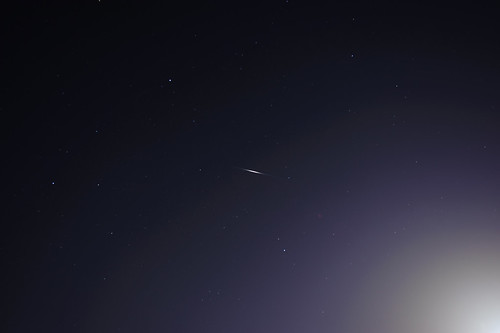
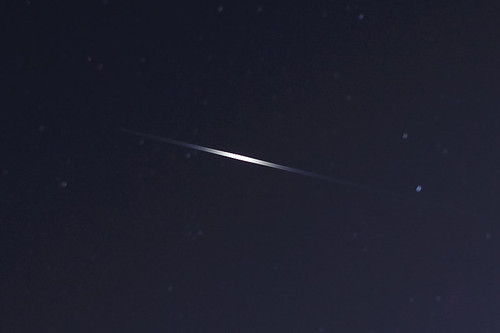
Sounds like an Iridium Flare. Here's one I photographed:
Closeup crop:
reply to post by nataylor
Yes, it does.
And Iridium satellites can be tracked here:
www.heavens-above.com...
Yes, it does.
And Iridium satellites can be tracked here:
www.heavens-above.com...
reply to post by nataylor
Yep that's it...........I take it i'm looking at a long exposure from your camera and I'm seeing the sat flare up and go dim in the same shot?.............nice!!
Yep that's it...........I take it i'm looking at a long exposure from your camera and I'm seeing the sat flare up and go dim in the same shot?.............nice!!
reply to post by Khaaaaaan!!
Yup, that was a 28-second shot. It was my first attempt to capture an Iridium Flare. I'll probably try again soon. It's just too hot and muggy to do it during the summer here in the Houston area.
Yup, that was a 28-second shot. It was my first attempt to capture an Iridium Flare. I'll probably try again soon. It's just too hot and muggy to do it during the summer here in the Houston area.
Originally posted by theAymen
reply to post by LeoVirgo
one day you will see it trust me....its also brighter than venus or jupitor
Yet you now finally agree it IS JupitEr?
Originally posted by luxordelphi
Hard to believe, but, watch: the Cheshire moon, bowl moon, horned moon, boat moon, wet moon etc. doesn't occurr twice a year or twice a century or twice a millenia - it happens once a month on the equator. Since 2003 it happens all over the world - as far north as the U.K.
see what i mean...nasa say it happens twice a year but your explanation makes much, much more sence.
it could only mean that the earths wobble is getting bigger...it might actually flip - north becomes south...south becomes north...but how will we know...deep!
to think
...i saw an italian saying the same thing!!
more smoke and mirrors.
mate i want the answers as well....the only people that could work it out..are ATS users...so thanx for the contribution
If the axial tilt of the earth was changing at any noticeable rate, the equatorially-measured altitude of everything in the sky would change. I guarantee Polaris is always going to be at the same altitude during your life time.
Originally posted by theAymen
see what i mean...nasa say it happens twice a year but your explanation makes much, much more sence.
it could only mean that the earths wobble is getting bigger...it might actually flip - north becomes south...south becomes north...but how will we know...deep!
Yes, the tilt does "wobble" (properly referred to as precession), but it does so over the course of millennia. And it will never charge suddenly, baring some catastrophic outside force, like a massive asteroid impact.
Or perhaps the Earth's rotation slowing down, (and it is slowing down) to some point where the wobble becomes out of control from unequal magnetic forces at the poles, plus the interaction with the Sun's magnetism and all the other planets dynamics and all cosmic events. That leaves the odds on against the Earth as being a habitable place even long before the Sun starts expanding outwards.
Originally posted by nataylor
If the axial tilt of the earth was changing at any noticeable rate, the equatorially-measured altitude of everything in the sky would change. I guarantee Polaris is always going to be at the same altitude during your life time.
Originally posted by theAymen
see what i mean...nasa say it happens twice a year but your explanation makes much, much more sence.
it could only mean that the earths wobble is getting bigger...it might actually flip - north becomes south...south becomes north...but how will we know...deep!
Yes, the tilt does "wobble" (properly referred to as precession), but it does so over the course of millennia. And it will never charge suddenly, baring some catastrophic outside force, like a massive asteroid impact.
The main point is, none of this is going to happen in the lifespan of a person. Even small changes in axial tilt of the earth would be immediately obvious.
Originally posted by smurfy
Or perhaps the Earth's rotation slowing down, (and it is slowing down) to some point where the wobble becomes out of control from unequal magnetic forces at the poles, plus the interaction with the Sun's magnetism and all the other planets dynamics and all cosmic events. That leaves the odds on against the Earth as being a habitable place even long before the Sun starts expanding outwards.
Originally posted by nataylor
If the axial tilt of the earth was changing at any noticeable rate, the equatorially-measured altitude of everything in the sky would change. I guarantee Polaris is always going to be at the same altitude during your life time.
Originally posted by theAymen
see what i mean...nasa say it happens twice a year but your explanation makes much, much more sence.
it could only mean that the earths wobble is getting bigger...it might actually flip - north becomes south...south becomes north...but how will we know...deep!
Yes, the tilt does "wobble" (properly referred to as precession), but it does so over the course of millennia. And it will never charge suddenly, baring some catastrophic outside force, like a massive asteroid impact.
I just want to add an update as i previously went with the OP's opinion and started to believe the bright star / plant was something strange etc
etc.
Well the other night as it was aclear spring night, i unpacked my telescope and decided to look for myself, with my own 2 eyes.
You know what i saw, the most beautiful clear shot of Jupiter and it's moons. I have never seen it like that before and it was amazing. I urge anyone that doubts the bright light is a Jupiter to go and buy a telescope and have a look.
Well the other night as it was aclear spring night, i unpacked my telescope and decided to look for myself, with my own 2 eyes.
You know what i saw, the most beautiful clear shot of Jupiter and it's moons. I have never seen it like that before and it was amazing. I urge anyone that doubts the bright light is a Jupiter to go and buy a telescope and have a look.
I agree with Phage. It's definitely Jupiter. At one point in the middle of this month it was within 10 degrees of the moon, and slowly it's been
moving away. At my vantage point in the world, it is about 60-65 degrees to the West/Southwest of the Moon. I may be a little off, because I'm just
starting to get into astronomy to understand star movements, and measurements when looking up at the sky. Where I am, it's been rising faster in the
sky than the moon lately.
Just my $.02.
Peace be with you.
-truthseeker
Just my $.02.
Peace be with you.
-truthseeker
Just to keep the (celestial) ball rolling:
It seems to have gone all quiet with the 'strange star' threads lately which coincides with Venus being near its closest point to us of 0.27AU but it's essentially disappeared due to the phase of ~0.5% and appearing so close to the sun that it gets swamped out. That very narrow crescent it currently presents is still extremely bright at mag 4.0 but simply never appears against a dark night sky just now but it will be the morning star in about a month's time and just as startling in the eastern morning sky as it was just recently in the western evening sky.
Jupiter reigns supreme right now, rising before sunset and setting after 4AM so it dominates the night sky.
Do the 'mystery star' observations match this description is what I'm interested in
It seems to have gone all quiet with the 'strange star' threads lately which coincides with Venus being near its closest point to us of 0.27AU but it's essentially disappeared due to the phase of ~0.5% and appearing so close to the sun that it gets swamped out. That very narrow crescent it currently presents is still extremely bright at mag 4.0 but simply never appears against a dark night sky just now but it will be the morning star in about a month's time and just as startling in the eastern morning sky as it was just recently in the western evening sky.
Jupiter reigns supreme right now, rising before sunset and setting after 4AM so it dominates the night sky.
Do the 'mystery star' observations match this description is what I'm interested in
Thought I would jump back in and state what I have stated a few times in this thread, the mysterious "star" that is mentioned in the OP is Jupiter,
no doubt, 100%, i'm only an amateur astronomer, but I have a nice 'scope, and I have observed it on many occasions, it is remarkable no doubt, but
its still Jupiter.
reply to post by woogleuk
Absolutely
I just raised the issue again because the next couple of weeks leaves Jupiter as the only possibility which narrows it down somewhat while Venus transits between us and Sol
Absolutely
I just raised the issue again because the next couple of weeks leaves Jupiter as the only possibility which narrows it down somewhat while Venus transits between us and Sol
The asteroid is coming, and it not a star, but a beautiful white reflecting light of human destruction.
I live in Bremerton WA and I have footage of this object. It comes out around 430am. I am posting this on my ghetto ten dollar phone so please youtube
search 'thegemini6180' and check out my vids please. I keep getting told this is venus but im not buying it. The footage is split into 4 parts and
are all of this object.
I know which object in the sky you speak of. I've noticed for the last few years and it seems to be getting brighter. This particular object is now
so bright that you can see it even when it is right next to a bright street light or the chemtrail haze is blocking the rest of the objects in the
sky. This should be the sticking point. Some stars are brighter than others, but when one is so bright that you can see it even when nothing else in
the sky is visible, then we have something to be concerned about.
This falls in the same category as chemtrails though. Even though it's something everyone can see for themselves, most will just look away because the truth is too scary.
This falls in the same category as chemtrails though. Even though it's something everyone can see for themselves, most will just look away because the truth is too scary.
new topics
-
Supreme Court Oral Arguments 4.25.2024 - Are PRESIDENTS IMMUNE From Later Being Prosecuted.
Above Politics: 52 minutes ago -
Krystalnacht on today's most elite Universities?
Social Issues and Civil Unrest: 1 hours ago -
Chris Christie Wishes Death Upon Trump and Ramaswamy
Politicians & People: 1 hours ago -
University of Texas Instantly Shuts Down Anti Israel Protests
Education and Media: 3 hours ago -
Any one suspicious of fever promotions events, major investor Goldman Sachs card only.
The Gray Area: 5 hours ago -
God's Righteousness is Greater than Our Wrath
Religion, Faith, And Theology: 10 hours ago
top topics
-
VP's Secret Service agent brawls with other agents at Andrews
Mainstream News: 14 hours ago, 11 flags -
Nearly 70% Of Americans Want Talks To End War In Ukraine
Political Issues: 15 hours ago, 6 flags -
Sunak spinning the sickness figures
Other Current Events: 15 hours ago, 5 flags -
Electrical tricks for saving money
Education and Media: 13 hours ago, 4 flags -
Late Night with the Devil - a really good unusual modern horror film.
Movies: 17 hours ago, 3 flags -
Krystalnacht on today's most elite Universities?
Social Issues and Civil Unrest: 1 hours ago, 3 flags -
Supreme Court Oral Arguments 4.25.2024 - Are PRESIDENTS IMMUNE From Later Being Prosecuted.
Above Politics: 52 minutes ago, 3 flags -
Any one suspicious of fever promotions events, major investor Goldman Sachs card only.
The Gray Area: 5 hours ago, 2 flags -
University of Texas Instantly Shuts Down Anti Israel Protests
Education and Media: 3 hours ago, 2 flags -
Chris Christie Wishes Death Upon Trump and Ramaswamy
Politicians & People: 1 hours ago, 1 flags
active topics
-
Candidate TRUMP Now Has Crazy Judge JUAN MERCHAN After Him - The Stormy Daniels Hush-Money Case.
Political Conspiracies • 745 • : network dude -
Chris Christie Wishes Death Upon Trump and Ramaswamy
Politicians & People • 4 • : FlyersFan -
University of Texas Instantly Shuts Down Anti Israel Protests
Education and Media • 72 • : CriticalStinker -
Nearly 70% Of Americans Want Talks To End War In Ukraine
Political Issues • 71 • : SchrodingersRat -
British TV Presenter Refuses To Use Guest's Preferred Pronouns
Education and Media • 150 • : FlyersFan -
President BIDEN Vows to Make Americans Pay More Federal Taxes in 2025 - Political Suicide.
2024 Elections • 141 • : Euronymous2625 -
-@TH3WH17ERABB17- -Q- ---TIME TO SHOW THE WORLD--- -Part- --44--
Dissecting Disinformation • 664 • : 777Vader -
Hate makes for strange bedfellows
US Political Madness • 46 • : network dude -
The Reality of the Laser
Military Projects • 48 • : 5thHead -
Supreme Court Oral Arguments 4.25.2024 - Are PRESIDENTS IMMUNE From Later Being Prosecuted.
Above Politics • 1 • : network dude