It looks like you're using an Ad Blocker.
Please white-list or disable AboveTopSecret.com in your ad-blocking tool.
Thank you.
Some features of ATS will be disabled while you continue to use an ad-blocker.

What did the Jews do to make Hitler want to kill them?
page: 12share:
Originally posted by Romantic_Rebel
Why does everyone always associate the Holocaust with just the Jews? More people died in those camps. Even other Germans.
The yellow stars they made the Jews wear, the singling out of the one race, yes mentally challenged, etc Germans were killed, but the bulk were the Jews.
As for the OP, the superficial answer is going to be Hitler believed in Aryanism, to the extreme, why did he believe in this nonsense? It goes deeper than what most have been told, but that is for another thread.
edit on 8-12-2011 by Razimus because: (no reason given)
Originally posted by Razimus
[...]
It goes deeper than what most have been told, but that is for another thread.
Haha, well said.
Isn't it ALWAYS for another thread?
And another? And another?
Threads that never actually make a blanket, because the tailors who run the domains, are the most feeble weavers mankind has ever seen.
Thanks for lessening this thread, I find myself not interested in the future ones you imagine will come.
reply to post by smallpeeps
hello smallpeeps,
i was researching newton just recently. i got the feeling somehow it was mapped out for him. guess any ongoing enquiries into his past activities have just about dried up! perhaps his zeal towards war with iran will have an appealing aroma higher up the ladder.
btw as always a work in progress.
regards fakedirt.
hello smallpeeps,
i was researching newton just recently. i got the feeling somehow it was mapped out for him. guess any ongoing enquiries into his past activities have just about dried up! perhaps his zeal towards war with iran will have an appealing aroma higher up the ladder.
btw as always a work in progress.
regards fakedirt.
Time to bounce this gem of a thread.
Caution! These Israeli sites have many cookies and click-crap so I am sorry for this link, but it's the only one I could find.
Anyway, point is this: The US did not bomb one single concentration camp, though they knew these existed.
So the General's comment above, is funny, because in a way, he's saying "This time we won't preserve concentration camps like we did in WW2" ...And yet, right now, we are creating another WW2 situation with the giant concentration camp called "The Palestine Balfour/Rothschild Protectorate".
Ask yourself: Would Israel have been given their world state, if Hitler's "Transfer Agreement" hadn't been kept secret? Ask yourself: Now that we know the transfer agreement existed, and populated the Rothschildian/Balfour Palestine theft, and since the US didn't stop the horror:revelation of the camps, then doesn't that explain why West Germany ended up funding Rothschild/Balfour-ville?
Seriously, I am an American, but in order to be a General, I guess I'd have to pretend I didn't know history? Thank God nobody's asking me to be a General because I couldn't make ignorant statements like this on a global scale.
I am hoping that if Israel goes suicide against Iran, that our commanders will mutiny against the Zio problem>war>reparations dialectic modality. Israel essentially is saying that if we don't support them, they'll kill not just Americans and Iranians, but the whole world. You really can't blame the US Generals for being scared of what they've built. But face it fellas, JFK is dead and he was the only one who tried to keep nukes from Rothschildian/Balfour-ville. Once they whacked him, none of you had the balls to step up, and so 50 years later we are basically screwed. Yeah thanks for nothing wartards.
www.ynetnews.com...
[...]
During his visit, Dempsey lit the memorial "Eternal Flame" torch and laid a wreath at the Yizkor tent. The US general stated that the US will work together with Israel to make sure that such atrocities never happen again.
Caution! These Israeli sites have many cookies and click-crap so I am sorry for this link, but it's the only one I could find.
Anyway, point is this: The US did not bomb one single concentration camp, though they knew these existed.
So the General's comment above, is funny, because in a way, he's saying "This time we won't preserve concentration camps like we did in WW2" ...And yet, right now, we are creating another WW2 situation with the giant concentration camp called "The Palestine Balfour/Rothschild Protectorate".
Ask yourself: Would Israel have been given their world state, if Hitler's "Transfer Agreement" hadn't been kept secret? Ask yourself: Now that we know the transfer agreement existed, and populated the Rothschildian/Balfour Palestine theft, and since the US didn't stop the horror:revelation of the camps, then doesn't that explain why West Germany ended up funding Rothschild/Balfour-ville?
Seriously, I am an American, but in order to be a General, I guess I'd have to pretend I didn't know history? Thank God nobody's asking me to be a General because I couldn't make ignorant statements like this on a global scale.
I am hoping that if Israel goes suicide against Iran, that our commanders will mutiny against the Zio problem>war>reparations dialectic modality. Israel essentially is saying that if we don't support them, they'll kill not just Americans and Iranians, but the whole world. You really can't blame the US Generals for being scared of what they've built. But face it fellas, JFK is dead and he was the only one who tried to keep nukes from Rothschildian/Balfour-ville. Once they whacked him, none of you had the balls to step up, and so 50 years later we are basically screwed. Yeah thanks for nothing wartards.
Hmm, British-Zio military guerrillas circa 1941?
I guess they were the big winners since they established a new International State.
What did Hitler think, in 1941, as he had been champing at the bit for almost 8 years since the 1933 racial accords which were not expected by him (as I explained). So it's no wonder that by 1941, Hitler kinda almost know he's the sacrificial lamb, because Rothschild has already got UK rebels in Palestine, and Hitler is realizing in 1941 that Turkey won't let him through, so Hitler has to follow Himmler's lead, which is to just massacre the slavs and export (secretly) some of his Jews to Palestine.
It can be said and easily observed, that when Hitler called Rommel's tanks to halt, and allowed the Brits to escape miraculously at Dunkirk, he was cognizant of his weak position in relation to the fact the UK Zio and Attaturk forces would conspire to keep him bottled up. Once Hitler saw that, he was forced down a road, there was no way for him to get through Turkey or over the caucuses though he did try and Naxis forces did reach the summits of the Caucus ranges, they were already bled halfway dry by then.
The key is 1933 when the racialists sniped Hitler and denied him the right to do war at that time. Over time he was used, to create the need for reparations and the dialectical spiltting >< reuniting of Germany during 1945-1995, which Adenauer and his student, oversaw.
It is simple to see that Hitler is nervous in the film from 1933 when he is being filmed just as the uber-Jew-hatred is being stoked up. In the film (see documentary footage of 1933 racial accords) Hitler looks like George Bush reading 'My Pet Goat'. He got bushwhacked and was not allowed to do war in 1933.
So then after that, it's a slow matriculation of Hitler's advantage by UK powers. Hitler was nervous all along that they might set him up but he seems to have held out that maybe he could be the King of the new UK Rothschild state, since UK was run by Habsburgs. But over time he realized that he was doomed to be the fool who creates the Rothschild state on his own grave.
Between 1941 and 1945 Hitler had only one thing he could do, and that was to massacre Poland and the middle countries. Notice that in the end, even after Hitler is gone/dead, Himmler calmly surrenders to the authorities. This man and his Jesuit-raised counterpart Joe Steel, had together, presided over the single greatest five year slaughter in the history of the world. Millions dead. Why would Himmler be so calm at the end? Why did Joe Steel survive so long when clearly he had the Russian people as his own enemy within, and had decapitated his own army prior to WW2? It is the Rome cult and its banker hoffjuden who arranged the 20th Century to be this way. Sorry, but that's the truth.
www.zionism-israel.com...
Palmach - (Hebrew) - (or Palma'h - Plugot Ma'hatz) - A Jewish military force in Palestine created with the cooperation of the British by Yitzhak Sadeh in 1941 to help defend Palestine against the possibility of invasion from Syria, which was under the control of the Vichy French government. Palmach eventually had a few thousand fighters and evolved into the underground spearhead commando force of the Haganah.
I guess they were the big winners since they established a new International State.
What did Hitler think, in 1941, as he had been champing at the bit for almost 8 years since the 1933 racial accords which were not expected by him (as I explained). So it's no wonder that by 1941, Hitler kinda almost know he's the sacrificial lamb, because Rothschild has already got UK rebels in Palestine, and Hitler is realizing in 1941 that Turkey won't let him through, so Hitler has to follow Himmler's lead, which is to just massacre the slavs and export (secretly) some of his Jews to Palestine.
It can be said and easily observed, that when Hitler called Rommel's tanks to halt, and allowed the Brits to escape miraculously at Dunkirk, he was cognizant of his weak position in relation to the fact the UK Zio and Attaturk forces would conspire to keep him bottled up. Once Hitler saw that, he was forced down a road, there was no way for him to get through Turkey or over the caucuses though he did try and Naxis forces did reach the summits of the Caucus ranges, they were already bled halfway dry by then.
The key is 1933 when the racialists sniped Hitler and denied him the right to do war at that time. Over time he was used, to create the need for reparations and the dialectical spiltting >< reuniting of Germany during 1945-1995, which Adenauer and his student, oversaw.
It is simple to see that Hitler is nervous in the film from 1933 when he is being filmed just as the uber-Jew-hatred is being stoked up. In the film (see documentary footage of 1933 racial accords) Hitler looks like George Bush reading 'My Pet Goat'. He got bushwhacked and was not allowed to do war in 1933.
So then after that, it's a slow matriculation of Hitler's advantage by UK powers. Hitler was nervous all along that they might set him up but he seems to have held out that maybe he could be the King of the new UK Rothschild state, since UK was run by Habsburgs. But over time he realized that he was doomed to be the fool who creates the Rothschild state on his own grave.
Between 1941 and 1945 Hitler had only one thing he could do, and that was to massacre Poland and the middle countries. Notice that in the end, even after Hitler is gone/dead, Himmler calmly surrenders to the authorities. This man and his Jesuit-raised counterpart Joe Steel, had together, presided over the single greatest five year slaughter in the history of the world. Millions dead. Why would Himmler be so calm at the end? Why did Joe Steel survive so long when clearly he had the Russian people as his own enemy within, and had decapitated his own army prior to WW2? It is the Rome cult and its banker hoffjuden who arranged the 20th Century to be this way. Sorry, but that's the truth.
Image below: June 7, 1944 "Cromwell" tank named after great UK/Zio tyrant Oliver Cromwell being unloaded onto Sword beach:
Now please observe that the modern Israeli IDF sees the Cromwell tank as being the logical ancestor of what are "Habakkuk's Chariots of Salvation":
IDF medal showing Cromwell tank:
IDF medal showing biblical chariots as ancestor of Cromwell tank:
Website in question, very informative:
...And so therefore the question is this:
Considering that Israel/Rothschild intrigues began prior to 1914 and WW1, then what are we to make of the events in the world, between the time of Habbakuk, and Cromwell? Quite a long span between 612BC and 1645AD
Habbakuk it seems, was a tyrant for the Babylon segment of the rabbinate, it's no wonder that the talmudists of today, see him as one of their great ones, along with Bar Kochba of the post-Jesus failed revolt in AD 132AD. Habbakuk is a voicebox for Chaldean >< Jerusalem connections.
The rabbinate of Habbakuk's time, succeeded in getting the Jerusalem >< Persian temple of 570BC built. This was the beginning of Hillel's line, who was alive at the time of Jesus, and his ancestor Judah Ha-Nasi who compiled the mishnah in Babylon after the Jerusalem-massacre had been completed. Around 400 AD as Rome declined, the talmud was being perfected between Jerusalem and Babylon. This is all easily verifiable at your local library inside a set of books called "Encyclopedia Judaica".
Here are some interesting questions as Homs is thrown into chaos at this time:
1: Homs is near the site of the ancient battle of Kadesh after which the Ramesites made a peace pact with Babylon "for eternity". This peace pact clearly shuns the shasu/amurru/bedouinesque tribes (see "Jethro" of Moses' time) who are NOT included in the great treaty. In effect this agreement after the battle of Kadesh is the first international alliance against bedouin tribes. Remember that Akhenaten had fled (He is Moses) about 60-70 years prior to this accord in 1274bc: Akhenaten is the "seed of Israel" who stood against the priests. He is Osarseph, Moses, as I have explained here.
2: At this battle, were the largest chariot armies ever assembled. What is the origin of the chariot in A: THE BIBLE, and B: EGYPTIAN ARCHAEOLOGY?
3: Further we must ask: In this context, harking back to 1274BC at the Battle of Kadesh and two great chariot (tank) armies facing off there --Who today at Kadesh has the batter tank? Who has the better chariot? And further, who designed the tech that went into the Merkava battle chariot?
ww2db.com...
Now please observe that the modern Israeli IDF sees the Cromwell tank as being the logical ancestor of what are "Habakkuk's Chariots of Salvation":
IDF medal showing Cromwell tank:
IDF medal showing biblical chariots as ancestor of Cromwell tank:
Website in question, very informative:
idf-armor.blogspot.com...
...And so therefore the question is this:
Considering that Israel/Rothschild intrigues began prior to 1914 and WW1, then what are we to make of the events in the world, between the time of Habbakuk, and Cromwell? Quite a long span between 612BC and 1645AD
Habbakuk it seems, was a tyrant for the Babylon segment of the rabbinate, it's no wonder that the talmudists of today, see him as one of their great ones, along with Bar Kochba of the post-Jesus failed revolt in AD 132AD. Habbakuk is a voicebox for Chaldean >< Jerusalem connections.
The rabbinate of Habbakuk's time, succeeded in getting the Jerusalem >< Persian temple of 570BC built. This was the beginning of Hillel's line, who was alive at the time of Jesus, and his ancestor Judah Ha-Nasi who compiled the mishnah in Babylon after the Jerusalem-massacre had been completed. Around 400 AD as Rome declined, the talmud was being perfected between Jerusalem and Babylon. This is all easily verifiable at your local library inside a set of books called "Encyclopedia Judaica".
en.wikipedia.org...
Biblical account
Because the book of Habbakuk consists of five oracles about the Chaldeans (Babylonians), and the Chaldean rise to power is dated circa 612 BCE, it is assumed he was active about that time
[...]
Habakkuk is unique among the prophets in that he openly questions the wisdom of God (1:3a, 1:13b). In the first part of the second chapter, the Prophet sees the injustice among his people and asks why God does not take action: "1:2 Yahweh, how long will I cry, and you will not hear? I cry out to you 'Violence!' and will you not save?" - (World English Bible). The book of Habbakuk consists of five oracles about the Chaldeans (Babylonians) and a song of praise to God.
Here are some interesting questions as Homs is thrown into chaos at this time:
1: Homs is near the site of the ancient battle of Kadesh after which the Ramesites made a peace pact with Babylon "for eternity". This peace pact clearly shuns the shasu/amurru/bedouinesque tribes (see "Jethro" of Moses' time) who are NOT included in the great treaty. In effect this agreement after the battle of Kadesh is the first international alliance against bedouin tribes. Remember that Akhenaten had fled (He is Moses) about 60-70 years prior to this accord in 1274bc: Akhenaten is the "seed of Israel" who stood against the priests. He is Osarseph, Moses, as I have explained here.
www.reshafim.org.il...
"If a great person flees from the country of Egypt and he escapes to the country of Amurru or a city and he comes to the king of Amurru, then Benteshina, king of the country of Amurru, has to take hold of him and take him to the king of the country of Hatti ; and Hattusili, the great king, the king of the country of Hatti, shall have him to be taken to Reamasesa, the great king, the king of the country of Egypt"
-- The peace treaty between Ramses II and Hattusili III
also:
en.wikipedia.org...
The city was captured by the great pharaoh Seti I during his campaign to Syria. Kadesh had been lost to Egypt since the time of Akhenaten. Tutankhamun and Horemheb had both failed to recapture the city from the Hittites. Seti I was successful here and defeated a Hittite army that tried to defend it. He triumphantly entered the city together with his son Ramesses II and erected a victory stela at the site. His success was only temporary. As soon as Seti I returned to Egypt, the Hittite king, Mursilis II, marched south to take Kadesh and make it a stronghold of the Hittite defenses in Syria. The Hittites ruled through a viceroy in Carchemish.
2: At this battle, were the largest chariot armies ever assembled. What is the origin of the chariot in A: THE BIBLE, and B: EGYPTIAN ARCHAEOLOGY?
3: Further we must ask: In this context, harking back to 1274BC at the Battle of Kadesh and two great chariot (tank) armies facing off there --Who today at Kadesh has the batter tank? Who has the better chariot? And further, who designed the tech that went into the Merkava battle chariot?
Originally posted by Razimus
Originally posted by Romantic_Rebel
Why does everyone always associate the Holocaust with just the Jews? More people died in those camps. Even other Germans.
The yellow stars they made the Jews wear, the singling out of the one race, yes mentally challenged, etc Germans were killed, but the bulk were the Jews.
As for the OP, the superficial answer is going to be Hitler believed in Aryanism, to the extreme, why did he believe in this nonsense? It goes deeper than what most have been told, but that is for another thread.
edit on 8-12-2011 by Razimus because: (no reason given)
No false....The bulk were Slavics....from Russian ukraine and every other country nearby.
There were about 6 million jews murdered.....there were more than 8 million salvics murdered.....Russian knows this and says nothing though...
Not sure why.
Yes you can just use propaganda. Also most Germans did not care either way. Even Himmler just set his flag the way the wind blowed. When massmurder
put butter on his bread, he would be a massmurderer. When the Nazis were beaten, he wasnt like oh noes we did not get all zhe jews yargh !! He hoped
to have a second career in being part of the process of reconzilliation between the jews and the germans. Being wanted for being instrumental to the
holocaust got into the way of that.
Also some people are just angry, look at the neonazis. Now that there are no jews around they are angry at the Turkish and Muslims incountry, if those would be gone, they would probably pick on somebody else, nerdy Germans, who knows.
Also some people are just angry, look at the neonazis. Now that there are no jews around they are angry at the Turkish and Muslims incountry, if those would be gone, they would probably pick on somebody else, nerdy Germans, who knows.
edit on 4-2-2012 by Cassius666 because: (no reason
given)
originally posted by: gopher mines
I've heard many stories on why the Holocaust happened, and they all say something like this:
"Hitler blamed the Jews (for some terrible thing)"
Yet I haven't read anything in detail as to why he blamed the Jews. I mean, they _MUST_ have done something for Germany to be OK with what was happening to the Jews at the time. No amount of propaganda is going to make me want to kill off an entire group of people, or even be a part of killing off an entire group of people,, So my question is this: What did the Jews do for Hitler to seem justified in wiping them out? And don't tell me that he was a crazy mad-man.
Hitler blamed the Jews for the Russian revolution and subsequent German revolution. Which led to the Russian Tsar's and German Kaiser's abdication and fall of their empires.
Up to 80-85% of the first Soviet Union government members were Jews.
edit on 14-4-2016 by Ove38 because: link fix
originally posted by: smallpeeps
Hmm, British-Zio military guerrillas circa 1941?
www.zionism-israel.com...
Palmach - (Hebrew) - (or Palma'h - Plugot Ma'hatz) - A Jewish military force in Palestine created with the cooperation of the British by Yitzhak Sadeh in 1941 to help defend Palestine against the possibility of invasion from Syria, which was under the control of the Vichy French government. Palmach eventually had a few thousand fighters and evolved into the underground spearhead commando force of the Haganah.
I guess they were the big winners since they established a new International State.
What did Hitler think, in 1941, as he had been champing at the bit for almost 8 years since the 1933 racial accords which were not expected by him (as I explained). So it's no wonder that by 1941, Hitler kinda almost know he's the sacrificial lamb, because Rothschild has already got UK rebels in Palestine, and Hitler is realizing in 1941 that Turkey won't let him through, so Hitler has to follow Himmler's lead, which is to just massacre the slavs and export (secretly) some of his Jews to Palestine.
It can be said and easily observed, that when Hitler called Rommel's tanks to halt, and allowed the Brits to escape miraculously at Dunkirk, he was cognizant of his weak position in relation to the fact the UK Zio and Attaturk forces would conspire to keep him bottled up. Once Hitler saw that, he was forced down a road, there was no way for him to get through Turkey or over the caucuses though he did try and Naxis forces did reach the summits of the Caucus ranges, they were already bled halfway dry by then.
The key is 1933 when the racialists sniped Hitler and denied him the right to do war at that time. Over time he was used, to create the need for reparations and the dialectical spiltting >< reuniting of Germany during 1945-1995, which Adenauer and his student, oversaw.
It is simple to see that Hitler is nervous in the film from 1933 when he is being filmed just as the uber-Jew-hatred is being stoked up. In the film (see documentary footage of 1933 racial accords) Hitler looks like George Bush reading 'My Pet Goat'. He got bushwhacked and was not allowed to do war in 1933.
So then after that, it's a slow matriculation of Hitler's advantage by UK powers. Hitler was nervous all along that they might set him up but he seems to have held out that maybe he could be the King of the new UK Rothschild state, since UK was run by Habsburgs. But over time he realized that he was doomed to be the fool who creates the Rothschild state on his own grave.
Between 1941 and 1945 Hitler had only one thing he could do, and that was to massacre Poland and the middle countries. Notice that in the end, even after Hitler is gone/dead, Himmler calmly surrenders to the authorities. This man and his Jesuit-raised counterpart Joe Steel, had together, presided over the single greatest five year slaughter in the history of the world. Millions dead. Why would Himmler be so calm at the end? Why did Joe Steel survive so long when clearly he had the Russian people as his own enemy within, and had decapitated his own army prior to WW2? It is the Rome cult and its banker hoffjuden who arranged the 20th Century to be this way. Sorry, but that's the truth.
No, the above is a load of complete and utter bullcrap. By the way, Hitler could not 'do war' as he had no tanks, no planes, an army of just 100,000 men and a navy consisting of badly designed cruisers and some pre-dreadnaughts. Oh and Himmler was not in charge of Germany after Hitler died, Doenitz was. No idea what the rubbish is about Ataturk and getting to Palestine. Good grief, the ignorance of some people...
a reply to: gopher mines
The Aryans where the direct descendants of the Alanteans and the Jewish lineage their enemies.
The Aryans where the direct descendants of the Alanteans and the Jewish lineage their enemies.
There are many things that led to the decision that the Jews were undesirable. This has been around for years.
To look at such, one needs to go back to before the world wars to the dark ages. The Jews were often considered to be pariahs and the church blamed them for the death of Christ. That would be a church message for years to come. Later on during the many reformations, even the later writings of Luther, was considered to be instrumental in such, the vitriolic hatred was there. The German people and soldiers were viewed as being the best in the world, top of the line with the most modern equipment and further along than the rest of the world. Having won many of the battles and wars up until World War I.
World War I, was brutal, seeing the advances in the weapons of war and ultimately the defeat of Germany. The treaty of Versailles was brutal towards Germany, removing much of its assets from its control, along with decimating its economy in ways where many of the German people were hurting economically. Those who had money, or were in professions that made money were Jewish. When a person is hungry or has nothing, envy is a powerful thing, and if you look at much of the propaganda and rhetoric from that time, it started out as light, and mean, then it got to be cruel. Hitler did not have the majority at the time and could not enact any laws, but the rhetoric amped up and the propaganda started to slowly work on the mind of the people.
This also was the time where eugenics were a strong movement in Europe and the rest of the world, those desirable were encouraged to have large families, while others were, well forcefully sterilized or killed.
Consider this, if you are told say every week that one group is bad, how long till that becomes the truth? And if you are starving and the people saying such, would you be more inclined to believe it? One Hitler consolidated power, he started to, like all dictators, consolidate other aspects, from the education to religion and the banking. Then it was a matter of simply making them the scapegoats for all of societies ills and woes, to the point where people hated them, and then came the forced relocations and finally the final solution.
In short, it was a part of Hitler’s quest for control and power, by consolidating things like wealth and the military, he was able to slowly and completely take control over the rest of Germany. And as history will record, then came the conquest of Europe, and to remove all those deemed undesirable by state, and political dissidents, then soon those who spoke out against such.
To look at such, one needs to go back to before the world wars to the dark ages. The Jews were often considered to be pariahs and the church blamed them for the death of Christ. That would be a church message for years to come. Later on during the many reformations, even the later writings of Luther, was considered to be instrumental in such, the vitriolic hatred was there. The German people and soldiers were viewed as being the best in the world, top of the line with the most modern equipment and further along than the rest of the world. Having won many of the battles and wars up until World War I.
World War I, was brutal, seeing the advances in the weapons of war and ultimately the defeat of Germany. The treaty of Versailles was brutal towards Germany, removing much of its assets from its control, along with decimating its economy in ways where many of the German people were hurting economically. Those who had money, or were in professions that made money were Jewish. When a person is hungry or has nothing, envy is a powerful thing, and if you look at much of the propaganda and rhetoric from that time, it started out as light, and mean, then it got to be cruel. Hitler did not have the majority at the time and could not enact any laws, but the rhetoric amped up and the propaganda started to slowly work on the mind of the people.
This also was the time where eugenics were a strong movement in Europe and the rest of the world, those desirable were encouraged to have large families, while others were, well forcefully sterilized or killed.
Consider this, if you are told say every week that one group is bad, how long till that becomes the truth? And if you are starving and the people saying such, would you be more inclined to believe it? One Hitler consolidated power, he started to, like all dictators, consolidate other aspects, from the education to religion and the banking. Then it was a matter of simply making them the scapegoats for all of societies ills and woes, to the point where people hated them, and then came the forced relocations and finally the final solution.
In short, it was a part of Hitler’s quest for control and power, by consolidating things like wealth and the military, he was able to slowly and completely take control over the rest of Germany. And as history will record, then came the conquest of Europe, and to remove all those deemed undesirable by state, and political dissidents, then soon those who spoke out against such.
originally posted by: purplemer
a reply to: gopher mines
The Aryans where the direct descendants of the Alanteans and the Jewish lineage their enemies.
Absolute codswallop. Atlantis never existed. The legend is so full of holes that you can see right through it.
(post by lavatrance removed for a serious terms and conditions violation)
originally posted by: sdcigarpig
There are many things that led to the decision that the Jews were undesirable. This has been around for years.
To look at such, one needs to go back to before the world wars to the dark ages. The Jews were often considered to be pariahs and the church blamed them for the death of Christ. That would be a church message for years to come. Later on during the many reformations, even the later writings of Luther, was considered to be instrumental in such, the vitriolic hatred was there. The German people and soldiers were viewed as being the best in the world, top of the line with the most modern equipment and further along than the rest of the world. Having won many of the battles and wars up until World War I.
World War I, was brutal, seeing the advances in the weapons of war and ultimately the defeat of Germany. The treaty of Versailles was brutal towards Germany, removing much of its assets from its control, along with decimating its economy in ways where many of the German people were hurting economically. Those who had money, or were in professions that made money were Jewish. When a person is hungry or has nothing, envy is a powerful thing, and if you look at much of the propaganda and rhetoric from that time, it started out as light, and mean, then it got to be cruel. Hitler did not have the majority at the time and could not enact any laws, but the rhetoric amped up and the propaganda started to slowly work on the mind of the people.
This also was the time where eugenics were a strong movement in Europe and the rest of the world, those desirable were encouraged to have large families, while others were, well forcefully sterilized or killed.
Consider this, if you are told say every week that one group is bad, how long till that becomes the truth? And if you are starving and the people saying such, would you be more inclined to believe it? One Hitler consolidated power, he started to, like all dictators, consolidate other aspects, from the education to religion and the banking. Then it was a matter of simply making them the scapegoats for all of societies ills and woes, to the point where people hated them, and then came the forced relocations and finally the final solution.
In short, it was a part of Hitler’s quest for control and power, by consolidating things like wealth and the military, he was able to slowly and completely take control over the rest of Germany. And as history will record, then came the conquest of Europe, and to remove all those deemed undesirable by state, and political dissidents, then soon those who spoke out against such.
But you forget one vital little thing here which will probably land me an antisemitist remark........ Jews have always been very good at taking care of their own.... In a very nepotistic way. Couple that with envy from the lower german classes and you have serious issues.
Another thing, all this jewish stuff didnt start with Hitler and his stooges. It had been going on way before the first world war. The first zionist congress, which was more or less a gathering of racist jews carrying all off judaeism om their shoulders for all to see had been doing their works since atleast 1898........... Back then information flowed as fast as the printed press could follow along and therefore propaganda did as well.
There are numerous clips from papers predating both wars when the message is the same over and over..... 6.000.000 jews suffering. Think about that.
At some point, regardless of who it is, you get tired of listening to people "whining"... You get fed up with the whole "oh its so hard on me.... Boohoo", especially if you then look at who are the ones with succesfull businesses and who is having a hard time.
But yes, death camps was taking it way too far, but all you peope who yell "antisemite" in a heartbeat have got to stop and see that theres absolutely nothing wrong with "understanding" Hitler, because its not the same as agreeing with him.
Just like you cant blame judaeism for the human rights violations, attrocities and imposed suffering on the palestinian people by the terror state of Israel.
Im amazed how a peoples that has been trotten upon like the jews of the 2nd world war can behave like they do in Israel and haven been doing since 1947.
Talk about taking the iron boot and putting it on your own foot.
The Russian Tsar and German Kaiser were anti semitic. Even after the fall of their empires (overthrown by the Jews) the German Kaiser
"wrote to Field Marshal August von Mackensen, denouncing his own abdication
as the "deepest, most disgusting shame ever perpetrated by a person in history, the Germans have done to themselves... egged on and misled by the
tribe of Judah ... Let no German ever forget this, nor rest until these parasites have been destroyed and exterminated from German soil!"
Hitler acted on the German Kaiser's words. It was all a revenge on the Jews, packed in some mythological mumbo jumbo.
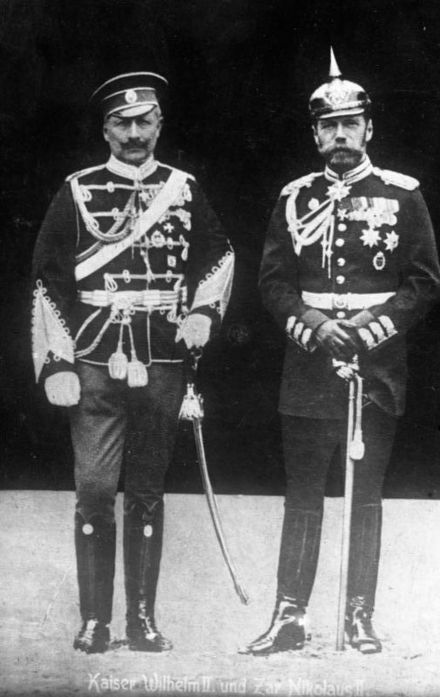
Kaiser Wilhelm II with Tsar Nicholas II wearing the military uniforms of each other's nations
Hitler acted on the German Kaiser's words. It was all a revenge on the Jews, packed in some mythological mumbo jumbo.
Kaiser Wilhelm II with Tsar Nicholas II wearing the military uniforms of each other's nations
edit on 15-4-2016 by Ove38 because: text
fix
a reply to: AngryCymraeg
Was not disputing if Alantis existed or not was simply taking about the nazis occult beliefs. Hitler also believed that drawfs lived in the ground left down there from the last age of man.
and how do you know that Atlantis never existed.
Absolute codswallop. Atlantis never existed. The legend is so full of holes that you can see right through it.
Was not disputing if Alantis existed or not was simply taking about the nazis occult beliefs. Hitler also believed that drawfs lived in the ground left down there from the last age of man.
and how do you know that Atlantis never existed.
(post by UMayBRite! removed for a serious terms and conditions violation)
a reply to: flice
I thought that the mention of the dark ages were a good point. I mean I could have went into how the Jews were often blamed for many of the society woes, like the various plagues that hit and decimated much of the population and then there was the Inquisition, that started out to root out both Muslim and Jews persons to prevent them from owning property and having too much wealth.
The point being, is that the real culture of hating a group based on Religious ideology goes far back before Hitler. He just too those feelings that were present and exploited it. They needed a reason that they lost the war and a group to blame, so it was those who were Jewish. And I was pointing out the main reason why Hitler focused on the Jews and how he was able to do such for so long.
I thought that the mention of the dark ages were a good point. I mean I could have went into how the Jews were often blamed for many of the society woes, like the various plagues that hit and decimated much of the population and then there was the Inquisition, that started out to root out both Muslim and Jews persons to prevent them from owning property and having too much wealth.
The point being, is that the real culture of hating a group based on Religious ideology goes far back before Hitler. He just too those feelings that were present and exploited it. They needed a reason that they lost the war and a group to blame, so it was those who were Jewish. And I was pointing out the main reason why Hitler focused on the Jews and how he was able to do such for so long.
a reply to: sdcigarpig
That time was full of psycho's. Hitler, staljin, those Americans who did genocide on Japan. Did I miss someone?
That time was full of psycho's. Hitler, staljin, those Americans who did genocide on Japan. Did I miss someone?
new topics
-
This is our Story
General Entertainment: 48 minutes ago -
President BIDEN Vows to Make Americans Pay More Federal Taxes in 2025 - Political Suicide.
2024 Elections: 3 hours ago -
Ode to Artemis
General Chit Chat: 3 hours ago -
Ditching physical money
History: 7 hours ago -
One Flame Throwing Robot Dog for Christmas Please!
Weaponry: 7 hours ago -
Don't take advantage of people just because it seems easy it will backfire
Rant: 7 hours ago -
VirginOfGrand says hello
Introductions: 8 hours ago -
Should Biden Replace Harris With AOC On the 2024 Democrat Ticket?
2024 Elections: 9 hours ago -
University student disciplined after saying veganism is wrong and gender fluidity is stupid
Education and Media: 11 hours ago
top topics
-
Hate makes for strange bedfellows
US Political Madness: 17 hours ago, 20 flags -
University student disciplined after saying veganism is wrong and gender fluidity is stupid
Education and Media: 11 hours ago, 12 flags -
Police clash with St George’s Day protesters at central London rally
Social Issues and Civil Unrest: 14 hours ago, 9 flags -
President BIDEN Vows to Make Americans Pay More Federal Taxes in 2025 - Political Suicide.
2024 Elections: 3 hours ago, 8 flags -
TLDR post about ATS and why I love it and hope we all stay together somewhere
General Chit Chat: 15 hours ago, 7 flags -
Should Biden Replace Harris With AOC On the 2024 Democrat Ticket?
2024 Elections: 9 hours ago, 6 flags -
Don't take advantage of people just because it seems easy it will backfire
Rant: 7 hours ago, 4 flags -
One Flame Throwing Robot Dog for Christmas Please!
Weaponry: 7 hours ago, 4 flags -
God lived as a Devil Dog.
Short Stories: 13 hours ago, 3 flags -
Ditching physical money
History: 7 hours ago, 3 flags
active topics
-
Russia Ukraine Update Thread - part 3
World War Three • 5718 • : Freeborn -
Hate makes for strange bedfellows
US Political Madness • 40 • : 19Bones79 -
New whistleblower Jason Sands speaks on Twitter Spaces last night.
Aliens and UFOs • 47 • : Ophiuchus1 -
Lawsuit Seeks to ‘Ban the Jab’ in Florida
Diseases and Pandemics • 29 • : Cre8chaos79 -
TLDR post about ATS and why I love it and hope we all stay together somewhere
General Chit Chat • 8 • : Cre8chaos79 -
This is our Story
General Entertainment • 0 • : BrotherKinsMan -
British TV Presenter Refuses To Use Guest's Preferred Pronouns
Education and Media • 126 • : Asher47 -
Why to avoid TikTok
Education and Media • 17 • : mooncake -
The Superstition of Full Moons Filling Hospitals Turns Out To Be True!
Medical Issues & Conspiracies • 22 • : mooncake -
University student disciplined after saying veganism is wrong and gender fluidity is stupid
Education and Media • 23 • : BigDuckEnergy