It looks like you're using an Ad Blocker.
Please white-list or disable AboveTopSecret.com in your ad-blocking tool.
Thank you.
Some features of ATS will be disabled while you continue to use an ad-blocker.

Controversial New Climate Change Data: Is Earth's Capacity To Absorb CO2 Much Greater Than Expected
page: 1share:
Controversial New Climate Change Data: Is Earth's Capacity To Absorb CO2 Much Greater Than Expected?
www.sciencedaily.com
(visit the link for the full news article)
New data show that the balance between the airborne and the absorbed fraction of carbon dioxide has stayed approximately constant since 1850, despite emissions of carbon dioxide having risen from about 2 billion tons a year in 1850 to 35 billion tons a year now....
The strength of the new study, published online in Geophysical Research Letters, is that it rests solely on measurements and statistical data, including historical records extracted from Antarctic ice, and does not rely on computations with complex climate models.
Here is something that is indeed extremely important to the Climate Summit in Copenhagen and the Cap & Trade bill.
It shows that the balance of absorbed CO2 in the air/earth hasn't changed since 1850, the beginning of the industrialized age. So it seems that the earth can absorb a lot more than the climate change computerized models claim. Who ya gonna believe, hard facts or a computer simulation?
This throws a monkey wrench into formulas that they have been using to come up with caps on emissions. This should be something that causes a rethinking and rewriting of the treaties/bills that they are wanting to be approved. Like maybe they should drop this nonsense!
www.sciencedaily.com
(visit the link for the full news article)
(Edit was for clarification on my stance on this.)
[edit on 11/12/2009 by willow1d]
It shows that the balance of absorbed CO2 in the air/earth hasn't changed since 1850, the beginning of the industrialized age. So it seems that the earth can absorb a lot more than the climate change computerized models claim. Who ya gonna believe, hard facts or a computer simulation?
This throws a monkey wrench into formulas that they have been using to come up with caps on emissions. This should be something that causes a rethinking and rewriting of the treaties/bills that they are wanting to be approved. Like maybe they should drop this nonsense!
www.sciencedaily.com
(visit the link for the full news article)
(Edit was for clarification on my stance on this.)
[edit on 11/12/2009 by willow1d]
To even think that we, as mere humans, can affect something so huge in scope is absurd. Always has been, always will be.
It is like a colony of ants thinking they are moving a mountain after a rockslide occurs. Must stop making those ant tunnels under our square foot of mountain so the whole mountain does not collapse!
Ludicrous.
[edit on 11/12/2009 by Lemon.Fresh]
It is like a colony of ants thinking they are moving a mountain after a rockslide occurs. Must stop making those ant tunnels under our square foot of mountain so the whole mountain does not collapse!
Ludicrous.
[edit on 11/12/2009 by Lemon.Fresh]
Makes sense.
I don't suppose governments will take any notice, as it doesn't fit the Climate Change agenda.
Unfortunately more pressing environmental problems like rainforest deforestation and reduction in biodiversity get overlooked. That's what will really screw us.
I don't suppose governments will take any notice, as it doesn't fit the Climate Change agenda.
Unfortunately more pressing environmental problems like rainforest deforestation and reduction in biodiversity get overlooked. That's what will really screw us.
I hope so.
My thoughts on this are that if we are affecting (or cows or whatever) the earths ecosystem, there is no stopping us naturally. No, people will not drive in carpools, no, we will not change from plastic bags to reusable cloth bags, etc etc etc...and the little steps we take will be so insignificant that it really doesnt matter.
We need to invent our way out of any potential disaster...a nanotech filtration system (mechanical tree) is the only real answer. counter the smokestacks with a damned filter...you might even find some good uses in the recycled carbon to begin with.
There is alot of scientific data showing the destablisation process is rapid, and there are a few tidbits that counter it. Assume the worst case senario and be realistic about it...people are not going to simply give up stuff...we must do what we do best, which is innovation, not sacrifice.
My thoughts on this are that if we are affecting (or cows or whatever) the earths ecosystem, there is no stopping us naturally. No, people will not drive in carpools, no, we will not change from plastic bags to reusable cloth bags, etc etc etc...and the little steps we take will be so insignificant that it really doesnt matter.
We need to invent our way out of any potential disaster...a nanotech filtration system (mechanical tree) is the only real answer. counter the smokestacks with a damned filter...you might even find some good uses in the recycled carbon to begin with.
There is alot of scientific data showing the destablisation process is rapid, and there are a few tidbits that counter it. Assume the worst case senario and be realistic about it...people are not going to simply give up stuff...we must do what we do best, which is innovation, not sacrifice.
Facts can not, and will not, be allowed to influence monetary policy.
We should all know that by now.
The carbon scam is an excuse needed to prop up the cap and trade ponzi scheme.
It was their mistake for pinning the whole thing on the 'carbon' demon. Sorry fools.
It is similar to the early mistake of marketting the phrase "global warming" when they should have used "Global Climate Change". They are greedy morons who only think in terms of revenue flow.
The rest is just 'background details and noise' to them.
You know, nobody would have argued against the idea that we need to reign ourselves in from wanton pollution, but they needed something more specific to vilify.... and here we are ....
I wonder who is going to say this information 'doesn't apply' to UNIVACS' calcualtions - therefore it doesn't count?
[edit on 12-11-2009 by Maxmars]
We should all know that by now.
The carbon scam is an excuse needed to prop up the cap and trade ponzi scheme.
It was their mistake for pinning the whole thing on the 'carbon' demon. Sorry fools.
It is similar to the early mistake of marketting the phrase "global warming" when they should have used "Global Climate Change". They are greedy morons who only think in terms of revenue flow.
The rest is just 'background details and noise' to them.
You know, nobody would have argued against the idea that we need to reign ourselves in from wanton pollution, but they needed something more specific to vilify.... and here we are ....
I wonder who is going to say this information 'doesn't apply' to UNIVACS' calcualtions - therefore it doesn't count?
[edit on 12-11-2009 by Maxmars]
reply to post by willow1d
S & F
We've seen that the Earth heals herself if left alone following local/small scale episodes pollution. Even Chernobyl is being reclaimed far more quickly than "an overwhelming consensus of scientists" had initially "projected!"
It is the most extreme display of hubris for men to believe that they can have ANY significant effect on global climate. As pointed out, we are insignificant parasitic infections, and nothing more. We are TOLERATED by the Earth and should be thankful for it.
The "ant" example is more than apt - our entire biomass is dwarfed by that of the insect Order, or even the annual Antarctic krill bloom!
From your source:
Can we breathe easier now? NO! Will anyone explain to the EPA that ambient CO2 is not "a harmful gas, dangerous to human life" as they "found" last March?
Does it really matter when politics controls over reality?
Deny ignorance!
jw
We've seen that the Earth heals herself if left alone following local/small scale episodes pollution. Even Chernobyl is being reclaimed far more quickly than "an overwhelming consensus of scientists" had initially "projected!"
It is the most extreme display of hubris for men to believe that they can have ANY significant effect on global climate. As pointed out, we are insignificant parasitic infections, and nothing more. We are TOLERATED by the Earth and should be thankful for it.
The "ant" example is more than apt - our entire biomass is dwarfed by that of the insect Order, or even the annual Antarctic krill bloom!
From your source:
This suggests that terrestrial ecosystems and the oceans have a much greater capacity to absorb CO2 than had been previously expected.
...
Dr Wolfgang Knorr at the University of Bristol found that in fact the trend in the airborne fraction since 1850 has only been 0.7 ± 1.4% per decade, which is essentially zero.
Can we breathe easier now? NO! Will anyone explain to the EPA that ambient CO2 is not "a harmful gas, dangerous to human life" as they "found" last March?
Does it really matter when politics controls over reality?
Deny ignorance!
jw
reply to post by jdub297
Your post reminded me of a little quoted fact that seems to elude the mainstream when discussing biomass...
Have you heard that the largest migration - in terms of biomass - occurs.... NIGHTLY
As the sun fades over the Atlantic over two TRILLION tons of creatures come to within 1,000 feet of the surface of the water .... to feast on plankton.
Had you heard that because of the sheer scale of the bottom of the ocean (2/3rds of the globe's surface area) the echinoderms (sea stars and urchins, etc.) that live there are among the most numerous multicelled organisms on the planet? Who knew?
The output of waste by mankind is a problem FOR MANKIND, not for the planet.
Your post reminded me of a little quoted fact that seems to elude the mainstream when discussing biomass...
Have you heard that the largest migration - in terms of biomass - occurs.... NIGHTLY
As the sun fades over the Atlantic over two TRILLION tons of creatures come to within 1,000 feet of the surface of the water .... to feast on plankton.
Had you heard that because of the sheer scale of the bottom of the ocean (2/3rds of the globe's surface area) the echinoderms (sea stars and urchins, etc.) that live there are among the most numerous multicelled organisms on the planet? Who knew?
The output of waste by mankind is a problem FOR MANKIND, not for the planet.
Originally posted by Lemon.Fresh
To even think that we, as mere humans, can affect something so huge in scope is absurd. Always has been, always will be.
It is like a colony of ants thinking they are moving a mountain after a rockslide occurs. Must stop making those ant tunnels under our square foot of mountain so the whole mountain does not collapse!
Even our land-use "mountains" don't seem to count for much. The AGU abstract goes even further:
Several recent studies have highlighted the possibility that the oceans and terrestrial ecosystems have started loosing part of their ability to sequester a large proportion of the anthropogenic CO2 emissions. This is an important claim, because so far only about 40% of those emissions have stayed in the atmosphere, which has prevented additional climate change.
...
The analysis further shows that the statistical model of a constant airborne fraction agrees best with the available data if emissions from land use change are scaled down to 82% or less of their original estimates. Despite the predictions of coupled climate-carbon cycle models, no trend in the airborne fraction can be found.
www.agu.org...
Bottom line, we ain't [stuff], after all.
jw
[edit on 12-11-2009 by jdub297]
Thanks for posting this OP!! S & F
I am not one bit surprised by this. I know the earth can take care of it self with or without us.
All of their efforts to lower CO2 actually worries me. Every time any government interferes they screw things up. I am afraid that if they are able to lower the CO2 by any measurable amount that they could actually cause cooling, because the planet has absorbed CO2 very efficiently over time on it's own. In fact, even after super volcanic eruptions, she was able to recover and has maintained an environment that still sustains life. The earth will do as she pleases, we are merely tenants that are praying she will not evict us anytime soon.
I am not one bit surprised by this. I know the earth can take care of it self with or without us.
All of their efforts to lower CO2 actually worries me. Every time any government interferes they screw things up. I am afraid that if they are able to lower the CO2 by any measurable amount that they could actually cause cooling, because the planet has absorbed CO2 very efficiently over time on it's own. In fact, even after super volcanic eruptions, she was able to recover and has maintained an environment that still sustains life. The earth will do as she pleases, we are merely tenants that are praying she will not evict us anytime soon.
Originally posted by willow1d
Here is something that is indeed extremely important to the Climate Summit in Copenhagen and the Cap & Trade bill.
Why?
Even at the current rate we'll see rapid climate change, with or without failure of ocean and terrestrial sinks. Just even more rapid with failure.
It shows that the balance of absorbed CO2 in the air/earth hasn't changed since 1850, the beginning of the industrialized age. So it seems that the earth can absorb a lot more than the climate change computerized models claim. Who ya gonna believe, hard facts or a computer simulation?'
Doesn't actually show that. It shows that since 1850 the absorption ability of sinks hasn't changed. It's only very recently that a small number of studies have suggested reductions. What the situation is in 50 years is still up in the air.
This article doesn't even go there.
For example, the study the author is actually criticising is Canadell et al (2007). In their paper they show an increase in Airborne Fraction (AF) of 0.25% per year (+/- 0.21%) at only a probability of .89 (11% of false positive). Using the error range for confidence intervals, the actual figure very likely lies between +0.04 to +0.46% per year increases in AF.
In Knorr's paper he finds 0.7% (+/- 1.4%), Again, using error bars the confidence interval would be -0.7% to 2.1%. Due to the high error range, this data says probably no difference as it covers 0.
But the two datasets overlap considerably. The issue with Knorr's article is the very large uncertainty in the data (error) which covers negative to positive trends, but still overlaps with Canadell's data.
ABE: I made a pretty picture for all y'all:
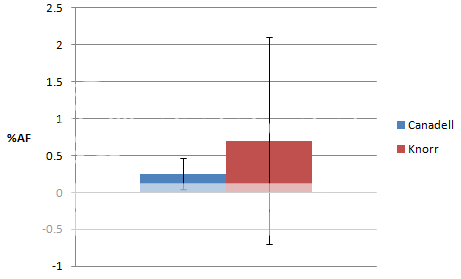
Canadell's article is freely available on the PNAS website, worth a read. As it clearly points out that most models that even include variations in sink activity involve a negative trend in AF during the 20th century, and only turn positive during the 21st century.
And we don't really know for certain that will not be the case. The Knorr article doesn't even go there, being solely based on the carbon cycle in the past. Moreover, his data covers the potential for a large positive trend, and even has a mean which is positive (increasing AF).
This throws a monkey wrench into formulas that they have been using to come up with caps on emissions. This should be something that causes a rethinking and rewriting of the treaties/bills that they are wanting to be approved. Like maybe they should drop this nonsense!
Of course. One study that says absorption by sinks in the recent past might not have altered, even though few have suggested it has (two/three), is just going to magic away our emissions, their accumulation, their future effects, and any potential future changes in the carbon cycle, lol.
The responses to this study are actually very funny. If someone presented a polka-dot banana and said it clashed with AGW, a similar set of responses would likely appear. This paper has no grand impact on AGW, just raises further questions about the future status of the carbon cycle.
[edit on 12-11-2009 by melatonin]
S&F
Global warming is a scam to transfer more wealth and control your behaviour.
It's alway in the name of some emergency that they dismantle freedom piece by piece.
The truth is, if global warming was so life threatining people like Al Gore and hollywood hypocrites would be living in tree houses.
It's not life and death.
It's just easier to say give me your wealth in the name of saving the planet.
Global warming is a scam to transfer more wealth and control your behaviour.
It's alway in the name of some emergency that they dismantle freedom piece by piece.
The truth is, if global warming was so life threatining people like Al Gore and hollywood hypocrites would be living in tree houses.
It's not life and death.
It's just easier to say give me your wealth in the name of saving the planet.
reply to post by melatonin
The ants must stop digging their tunnels. The mountain will fall down as evidenced by the rock slides, and will be the ants' fault.
The ants must stop digging their tunnels. The mountain will fall down as evidenced by the rock slides, and will be the ants' fault.
I'm not surprised really.
I've always suspected it's just a policy the Government is blowing up for its own purposes. I'm guessing the alleged climate change is really:
1) Making people more submissive through fear
- the BBC news presented images showing a large part of the UK underwater
2) A Government policy that is huge business at the moment
- Insulation companies are cashing in on this policy through cavity wall and loft insulation
I'm going to assume instead climate change is a natural occurence. There's evidence that suggests changes in the North Atlantic Current help induce weather change. Scientists think this may help towards explaining the rise of Ancient Egypt and ultimately, the demise. If this is the case, maybe this happens in cycles. Maybe this happens around every 4 thousand years and we're in the midst of another fluctuation? I don't know.
Personally I think Global Warming is a pile of pish tosh.
[edit on 12-11-2009 by IrnBruFiend]
I've always suspected it's just a policy the Government is blowing up for its own purposes. I'm guessing the alleged climate change is really:
1) Making people more submissive through fear
- the BBC news presented images showing a large part of the UK underwater
2) A Government policy that is huge business at the moment
- Insulation companies are cashing in on this policy through cavity wall and loft insulation
I'm going to assume instead climate change is a natural occurence. There's evidence that suggests changes in the North Atlantic Current help induce weather change. Scientists think this may help towards explaining the rise of Ancient Egypt and ultimately, the demise. If this is the case, maybe this happens in cycles. Maybe this happens around every 4 thousand years and we're in the midst of another fluctuation? I don't know.
Personally I think Global Warming is a pile of pish tosh.
[edit on 12-11-2009 by IrnBruFiend]
Why build wind turbine just for power.
Start building wind turbine and drilling wells for growing trees in the desert areas of the US.
With water the desert will turn green and absorb CO2 plus the greening of the desert will also cool the desert.
www.sciencedaily.com...
www.jewishsightseeing.com...
If the water in a area is to salty then add solar distillation to the system.
many fruit crops or fuel crops will grow very will in the desert with water.
Once vast areas are covered with trees or crops the desert would cool and animals would benafit.
I would have no problem setting up a system that would pump water with the large 1 megawatt type wind turbines and using a solar trough type solar plant to distill water. plus sell any excess power from the system to the grid.
You even could grow Vegetables in Desert Greenhouses.
If you compressed most of the waste material from the growing of the plants and bury it so that it would not decompose the carbon would be locked into the buried material. Only a small amount would be needed to make compost for the crops.
desertification.wordpress.com...
www.guardian.co.uk...
qatarvisitor.blogspot.com...
Start building wind turbine and drilling wells for growing trees in the desert areas of the US.
With water the desert will turn green and absorb CO2 plus the greening of the desert will also cool the desert.
www.sciencedaily.com...
www.jewishsightseeing.com...
If the water in a area is to salty then add solar distillation to the system.
many fruit crops or fuel crops will grow very will in the desert with water.
Once vast areas are covered with trees or crops the desert would cool and animals would benafit.
I would have no problem setting up a system that would pump water with the large 1 megawatt type wind turbines and using a solar trough type solar plant to distill water. plus sell any excess power from the system to the grid.
You even could grow Vegetables in Desert Greenhouses.
If you compressed most of the waste material from the growing of the plants and bury it so that it would not decompose the carbon would be locked into the buried material. Only a small amount would be needed to make compost for the crops.
desertification.wordpress.com...
www.guardian.co.uk...
qatarvisitor.blogspot.com...
reply to post by Maxmars
Aw come on Max... you already knew the answer to this.
Obviously any new data is irrelevant, any studies are irrelevant, any competing theories are irrelevant, unless of course they agree with the idea that the human race will not survive life without a Cap & Trade agreement. Then they become heralded as masterpieces of scientific research.
Oh, and just to help poor mel prove his point: I have discovered a polka-dot banana that absolutely disproves AGW. We're saved!
Seriously, though, this study is interesting as it indicates that previous studies may have been off the mark with their calculations in more areas than just carbon sink action. Farther down it states:
This is a further indication that the controversy needs further study before we relegate society back to stone-age existence. Sure, mel was right in that the data sets of this study and prior studies overlap, but this study appears to extend the range much lower than what was previously believed. I have also yet to hear of a single study which addresses the action of photosynthesis in a rising atmospheric concentration of CO2 (an experiment which would be pretty easy to accomplish). I have seen precious little investigation into the heat island effect of cities and extensive highway systems, which act like huge heat reservoirs. In short, this is not about saving the planet; it is about demonizing CO2.
TheRedneck
Originally posted by Maxmars
I wonder who is going to say this information 'doesn't apply' to UNIVACS' calcualtions - therefore it doesn't count?
Aw come on Max... you already knew the answer to this.
Originally posted by melatonin
Of course. One study that says absorption by sinks in the recent past might not have altered, even though few have suggested it has (two/three), is just going to magic away our emissions, their accumulation, their future effects, and any potential future changes in the carbon cycle, lol.
Obviously any new data is irrelevant, any studies are irrelevant, any competing theories are irrelevant, unless of course they agree with the idea that the human race will not survive life without a Cap & Trade agreement. Then they become heralded as masterpieces of scientific research.
Oh, and just to help poor mel prove his point: I have discovered a polka-dot banana that absolutely disproves AGW. We're saved!
Seriously, though, this study is interesting as it indicates that previous studies may have been off the mark with their calculations in more areas than just carbon sink action. Farther down it states:
Source: www.sciencedaily.com...
Another result of the study is that emissions from deforestation might have been overestimated by between 18 and 75 per cent. This would agree with results published in early November in Nature Geoscience by a team led by Guido van der Werf from VU University Amsterdam. They re-visited deforestation data and concluded that emissions have been overestimated by at least a factor of two.
This is a further indication that the controversy needs further study before we relegate society back to stone-age existence. Sure, mel was right in that the data sets of this study and prior studies overlap, but this study appears to extend the range much lower than what was previously believed. I have also yet to hear of a single study which addresses the action of photosynthesis in a rising atmospheric concentration of CO2 (an experiment which would be pretty easy to accomplish). I have seen precious little investigation into the heat island effect of cities and extensive highway systems, which act like huge heat reservoirs. In short, this is not about saving the planet; it is about demonizing CO2.
TheRedneck
Originally posted by TheRedneck
reply to post by Maxmars
Originally posted by Maxmars
I wonder who is going to say this information 'doesn't apply' to UNIVACS' calcualtions - therefore it doesn't count?
Aw come on Max... you already knew the answer to this.
Yeah, I did kind of set myself up on that one.
....
I have also yet to hear of a single study which addresses the action of photosynthesis in a rising atmospheric concentration of CO2 (an experiment which would be pretty easy to accomplish). I have seen precious little investigation into the heat island effect of cities and extensive highway systems, which act like huge heat reservoirs. In short, this is not about saving the planet; it is about demonizing CO2.
TheRedneck
Bravo! I have been wondering about that myself!
Considering the atmospherics is only half the equation.
I know it may sound like an arrogant declaration on my part .....
.... but (you knew it was coming)
I bet dollars to doughnuts the other half of the equation is NOT Cap and Trade
Originally posted by TheRedneck
Obviously any new data is irrelevant, any studies are irrelevant, any competing theories are irrelevant, unless of course they agree with the idea that the human race will not survive life without a Cap & Trade agreement. Then they become heralded as masterpieces of scientific research.
Oh, and just to help poor mel prove his point: I have discovered a polka-dot banana that absolutely disproves AGW. We're saved!
It's not an irrelevant study. I even said in the post, it raises further questions about the future of the carbon cycle.
It's irrelevant in the context people here are trying to apply it.
Seriously, though, this study is interesting as it indicates that previous studies may have been off the mark with their calculations in more areas than just carbon sink action. Farther down it states:Source: www.sciencedaily.com...
Another result of the study is that emissions from deforestation might have been overestimated by between 18 and 75 per cent. This would agree with results published in early November in Nature Geoscience by a team led by Guido van der Werf from VU University Amsterdam. They re-visited deforestation data and concluded that emissions have been overestimated by at least a factor of two.
Fair enough, if that's what you want to focus on.
Only if you reduce land use changes to fit best a potential 0 change in AF, but the study actually produced a best estimate positive AF. TBH, land use changes are viewed as a minimal influence on climate change. It's more a problem for those trying to big up land use changes even more than is currently estimated. Forcing estimates of land use were even negative only a decade of so ago...
For example, Pielke Sr thinks localised land use changes are more important than generally thought, and he consequently downgrades the effect of CO2.
Well, this study would suggest he's wrong. If the study is reliable, land use changes are less important. But he will take solace in the fact the uncertainty in this particular study is massive.
This is a further indication that the controversy needs further study before we relegate society back to stone-age existence. Sure, mel was right in that the data sets of this study and prior studies overlap, but this study appears to extend the range much lower than what was previously believed. I have also yet to hear of a single study which addresses the action of photosynthesis in a rising atmospheric concentration of CO2 (an experiment which would be pretty easy to accomplish). I have seen precious little investigation into the heat island effect of cities and extensive highway systems, which act like huge heat reservoirs. In short, this is not about saving the planet; it is about demonizing CO2.
TheRedneck
lol, I like this sort of comment. We have denialists saying that climate scientists need this idea to keep their jobs and make big moolah. Yet others want to keep them working and studying in an effort to delay action, even when the general message is loud and clear.
This is where the study is irrelevant, RD. It tells us nothing about future trends. Just the present and past, and its implications don't even conflict with the general view for AF. Indeed, models have been predominately assuming negative AF during the 20th century and don't turn positive until well into the 21st century.
It has little effect on future projections - only way is up, baby. But I'm sure Pielke Sr will be seriously peeved about the land use issue.
Also noting the photosynthesis point, I shall now label you 'ATS chief delayer' rather than a denier. Have you actually looked for studies in that area? You are joking?
And in one post are you both arguing that land use changes less important than previously thought, but land use changes are really important? (UHI is pretty well-studied)
"I can’t believe that!” said Alice.
“Can’t you?” the Queen said in a pitying tone. “Try again: draw a long breath, and shut your eyes.”
Alice laughed. “There’s no use trying,” she said: “one can’t believe impossible things.”
“I daresay you haven’t had much practice,” said the Queen. “When I was your age, I always did it for half-an-hour a day. Why, sometimes I’ve believed as many as six impossible things before breakfast.”
[edit on 13-11-2009 by melatonin]
Originally posted by sickofitall2012
The earth will do as she pleases, we are merely tenants that are praying she will not evict us anytime soon.
And there is the largest question, the dinosaurs died out quite quickly for whatever reason, we may kill ourselves through various acts that degrade the environment so that humans become an extinct species but the Earth will eventually re-balance for a new dominant species.
reply to post by prof-rabbit
Exactly. Earth will recover from whatever we throw at it. It may take a while though.
It's humanity we should be concerned about, and what sort of planet we want to live on.
Exactly. Earth will recover from whatever we throw at it. It may take a while though.
It's humanity we should be concerned about, and what sort of planet we want to live on.
new topics
-
God's Righteousness is Greater than Our Wrath
Religion, Faith, And Theology: 3 hours ago -
Electrical tricks for saving money
Education and Media: 7 hours ago -
VP's Secret Service agent brawls with other agents at Andrews
Mainstream News: 8 hours ago -
Sunak spinning the sickness figures
Other Current Events: 9 hours ago -
Nearly 70% Of Americans Want Talks To End War In Ukraine
Political Issues: 9 hours ago -
Late Night with the Devil - a really good unusual modern horror film.
Movies: 11 hours ago
top topics
-
VP's Secret Service agent brawls with other agents at Andrews
Mainstream News: 8 hours ago, 9 flags -
Cats Used as Live Bait to Train Ferocious Pitbulls in Illegal NYC Dogfighting
Social Issues and Civil Unrest: 12 hours ago, 8 flags -
Electrical tricks for saving money
Education and Media: 7 hours ago, 4 flags -
HORRIBLE !! Russian Soldier Drinking Own Urine To Survive In Battle
World War Three: 16 hours ago, 3 flags -
Nearly 70% Of Americans Want Talks To End War In Ukraine
Political Issues: 9 hours ago, 3 flags -
Sunak spinning the sickness figures
Other Current Events: 9 hours ago, 3 flags -
Late Night with the Devil - a really good unusual modern horror film.
Movies: 11 hours ago, 2 flags -
The Good News According to Jesus - Episode 1
Religion, Faith, And Theology: 14 hours ago, 1 flags -
God's Righteousness is Greater than Our Wrath
Religion, Faith, And Theology: 3 hours ago, 0 flags
active topics
-
Sunak spinning the sickness figures
Other Current Events • 6 • : angelchemuel -
HORRIBLE !! Russian Soldier Drinking Own Urine To Survive In Battle
World War Three • 33 • : Degradation33 -
How ageing is" immune deficiency"
Medical Issues & Conspiracies • 34 • : angelchemuel -
Nearly 70% Of Americans Want Talks To End War In Ukraine
Political Issues • 13 • : Freeborn -
Mood Music Part VI
Music • 3101 • : ThatSmellsStrange -
VP's Secret Service agent brawls with other agents at Andrews
Mainstream News • 41 • : ThatSmellsStrange -
New whistleblower Jason Sands speaks on Twitter Spaces last night.
Aliens and UFOs • 55 • : baablacksheep1 -
Cats Used as Live Bait to Train Ferocious Pitbulls in Illegal NYC Dogfighting
Social Issues and Civil Unrest • 20 • : Asher47 -
Electrical tricks for saving money
Education and Media • 4 • : Lumenari -
DONALD J. TRUMP - 2024 Candidate for President - His Communications to Americans and the World.
2024 Elections • 514 • : WeMustCare