It looks like you're using an Ad Blocker.
Please white-list or disable AboveTopSecret.com in your ad-blocking tool.
Thank you.
Some features of ATS will be disabled while you continue to use an ad-blocker.

The liquid and lakes of Mars
page: 1share:
For those whom are not aware of it, there are both water and lakes on Mars. Evidence has been found in Mars images at several locations and taken by
various instruments.
Here are some.
Lakes with vegetation by the shores.
Nozzle shooting water out of tube connected to spherical "blob"/dome
Mars river through the desert:
Mars pole with ice and oceans around
Thats some. Personally I find the liquid nozzle quite interesting, specially considering the tube and spherical "dome" thing it is connected to.
Any other interesting water evidence photos you guys have? Then please post in this thread. Also feel free to discuss your opinion on these.
Here are some.
Lakes with vegetation by the shores.
Nozzle shooting water out of tube connected to spherical "blob"/dome
Mars river through the desert:
Mars pole with ice and oceans around
Thats some. Personally I find the liquid nozzle quite interesting, specially considering the tube and spherical "dome" thing it is connected to.
Any other interesting water evidence photos you guys have? Then please post in this thread. Also feel free to discuss your opinion on these.
Where is the source for your images?
How were they taken? When? And by whom?
This is all very startling photography, but I have to cry wolf here until it can be verified. I've never seen these before.
~Keeper
How were they taken? When? And by whom?
This is all very startling photography, but I have to cry wolf here until it can be verified. I've never seen these before.
~Keeper
reply to post by tothetenthpower
Daily photos of Mars taken by Spirit and Opportunity are available at areo.com. As for image number three I think it might be a close up false color image photo of a patch of NASA's "blueberries"... stange small round formations that are found on the Martian surface.
[edit on 10/31/2009 by MissSmartypants]
Daily photos of Mars taken by Spirit and Opportunity are available at areo.com. As for image number three I think it might be a close up false color image photo of a patch of NASA's "blueberries"... stange small round formations that are found on the Martian surface.
[edit on 10/31/2009 by MissSmartypants]
All images are official NASA photos, they can be found on their websites.
The ones hosted at MarsAnomalyResearch can be checked from that site as all images there have the link to original source on NASAs servers.
For the rest I will have to look it up a but which I dont have time to right now, but I can rest you assure all are real NASA released photos as I have checked and seen all these before. I simply did a quick search using google images to find the ones I wanted to show as I remembered them, but I do not remember the exact nasa catalog numbers etc.
-M
The ones hosted at MarsAnomalyResearch can be checked from that site as all images there have the link to original source on NASAs servers.
For the rest I will have to look it up a but which I dont have time to right now, but I can rest you assure all are real NASA released photos as I have checked and seen all these before. I simply did a quick search using google images to find the ones I wanted to show as I remembered them, but I do not remember the exact nasa catalog numbers etc.
-M
Oh and Image number 3 is not the blueberries, it is a water sediment, that is the official explanation by NASA at least as far I remember. The
blueberries are completely different and easy to tell apart as they consist of tons of small marbles.
For a comparison, check the below link to see the blueberries of Mars:
images.google.com...
[edit on 31-10-2009 by IX-777]
For a comparison, check the below link to see the blueberries of Mars:
images.google.com...
[edit on 31-10-2009 by IX-777]
reply to post by IX-777
Ok then, I take back my wolf comment lol.
Very nice find, I am looking forward to seeing what other members think these are.
The pole one is ridiculous if you ask me. I mean that's proof of a LIQUID ocean on mars is not?
~Keeper
Ok then, I take back my wolf comment lol.
Very nice find, I am looking forward to seeing what other members think these are.
The pole one is ridiculous if you ask me. I mean that's proof of a LIQUID ocean on mars is not?
~Keeper
A great site that goes into much detail about photos such as these are:
www.marsanomalyresearch.com...
The website owner links with sources the photo's he submits. You should check it out. He does some really interesting research.
www.marsanomalyresearch.com...
The website owner links with sources the photo's he submits. You should check it out. He does some really interesting research.
Originally posted by IX-777
Lakes with vegetation by the shores.
Okay you have got to be kidding me? You bring this to the table??
Originally posted by IX-777
Nozzle shooting water out of tube connected to spherical "blob"/dome
looks like a bunch of shale and possible finer grand sand on top of rock.. ever see the Canadian Rockies from above, youll see this all the time.
Originally posted by IX-777
Please quote the pic from nasa's website without the colour enhancement, please?
Originally posted by IX-777
Mars pole with ice and oceans around
Okay, you got me here
Amazing picture dude, wow!!
I know Mars skies are blue and have clouds, but I still dont think there is currently liquid water on mars?...
Trust me, if NASA knew that for sure it would be a big deal and would only EXPAND their funding.
Originally posted by CanadianDream420
Trust me, if NASA knew that for sure it would be a big deal and would only EXPAND their funding.
The thing is that when it comes to matters of "national security" NASA doesn't call the shots, the DOD does.
And the existance of life on Mars, even just microbial, could upset a LOT of people, especially religious ones. Therefore it could easily be considered a matter of national security.
Much more is going on on Mars than simple knowledge of water. The "secret missions" are performed under the disguise of the "official missions" -
the latter being what they present for the public, and the former being what they do not tell you but carried out often similtaneously to make it
easier to hide the true agenda while at same time satisfy the masses by giving them something for their tax money.
Even NASA have stated water exists in liquid form on Mars so that is not even a secret, something several of the above photos show. One of the most famous photo evidence of this is the following:
www.jpl.nasa.gov...
Regarding the "nozzle" I mentioned above, it is almost no doubt to me we are looking at some sort of liquid squirting out at high pressure. Geysirs have already been observed on Mars as well, so that itself is not very spectactular or strange. The formations however is rather interesting, with the tube, and the round spherical object it seems to be connected to. Looks nothing like Canadian Rockies from above as an previous poster suggested. Feel free to present me any remotely similar photos if you feel you can from that area.
-M
Even NASA have stated water exists in liquid form on Mars so that is not even a secret, something several of the above photos show. One of the most famous photo evidence of this is the following:
www.jpl.nasa.gov...
Regarding the "nozzle" I mentioned above, it is almost no doubt to me we are looking at some sort of liquid squirting out at high pressure. Geysirs have already been observed on Mars as well, so that itself is not very spectactular or strange. The formations however is rather interesting, with the tube, and the round spherical object it seems to be connected to. Looks nothing like Canadian Rockies from above as an previous poster suggested. Feel free to present me any remotely similar photos if you feel you can from that area.
-M
Originally posted by MrVertigo
Originally posted by CanadianDream420
Trust me, if NASA knew that for sure it would be a big deal and would only EXPAND their funding.
The thing is that when it comes to matters of "national security" NASA doesn't call the shots, the DOD does.
And the existance of life on Mars, even just microbial, could upset a LOT of people, especially religious ones. Therefore it could easily be considered a matter of national security.
Not true at all....
They admitted water on The Moon over the last 3 months.
What's stopping them from saying Water on Mars???
Factual Proof. lol
Trust me, scientists will have no problem upsetting the religious world.
It's what they do best.
ahh frig it, ill S&F this thread
reply to post by IX-777
I'm surprised this thread hasn't recieved more attention. The first photo seems to be the best evidence I have seen of standing water on mars, even if it does appear frozen. Since it does appear to be vegetation, then the climate must get somewhat mild at some point during the year. Great find.
I'm surprised this thread hasn't recieved more attention. The first photo seems to be the best evidence I have seen of standing water on mars, even if it does appear frozen. Since it does appear to be vegetation, then the climate must get somewhat mild at some point during the year. Great find.
Not if the photo has a resolution of 25 cm per pixel and the "small marbles" are 1 cm wide.
Originally posted by IX-777
The blueberries are completely different and easy to tell apart as they consist of tons of small marbles.
And Mars, even when seen from Earth, has mostly three colours, the famous red, a darkish blue and the white of the ice on the poles, and that blue (either dust or blueberries) is common on Mars and appears in many photos.
The "lakes" on you photo, if they are lakes then they are not water lakes, because they are near the south pole (I think it's the south pole, I didn't check) and the temperatures there are very low.
Oh, and I don't trust a thing from MarsAnomalyReasearch, specially since he said that he did not used the best version of an image because most people would not look at that version and only at the small, more compressed JPEG version. That's not the best way to get to the truth but it's the best way to get site hits.
PS: I have yet to see even one photo that shows any liquid on Mars.
ArMaP:
The "river" in question, which you theorize to be blueberries, is a high resolution photo and if I remember correctly it covers a few meters at most. Its from Mars Reconnaissance Orbiter.
Look carefully and you'll see flow lines on the bed and also what look like waves....could be a photo of most rivers on Earth.
Some more high resolution photos of the same, clearly showing strong evidence of water/liquid motion having formed this - and since liquid water is even established fact admitted by NASA already being on Mars, it is not such a surprise if there is some lakes, rivers and perhaps even larger oceans there.
Also regarding the poles and cold, remember that the poles are coldest at their centers just as on earth, and liquid water can exist around the poles and under the ice as well, just as it does on earth.
Some examples from Earth from the North Pole:
And Antarctica, south pole - notice blue around the ice is water and rather similar to my previously posted Mars pole photo with similar attributes:

The "river" in question, which you theorize to be blueberries, is a high resolution photo and if I remember correctly it covers a few meters at most. Its from Mars Reconnaissance Orbiter.
Look carefully and you'll see flow lines on the bed and also what look like waves....could be a photo of most rivers on Earth.
Some more high resolution photos of the same, clearly showing strong evidence of water/liquid motion having formed this - and since liquid water is even established fact admitted by NASA already being on Mars, it is not such a surprise if there is some lakes, rivers and perhaps even larger oceans there.
Also regarding the poles and cold, remember that the poles are coldest at their centers just as on earth, and liquid water can exist around the poles and under the ice as well, just as it does on earth.
Some examples from Earth from the North Pole:
And Antarctica, south pole - notice blue around the ice is water and rather similar to my previously posted Mars pole photo with similar attributes:
reply to post by IX-777
The original image is here: hirise.lpl.arizona.edu...
The resolution of the image is 165 cm, meaning that the smallest objects which can be identified are about 5.5 feet across.
Skipper is showing a false color image (HIRISE cannot produce true color images) we can't know what the actual colors are.
Wind, dust and sand are perfectly capable of producing "flow lines" and ripples.
On Mars:
And on Earth:
Due to extremely low atmospheric pressure. It is not possible for liquid water to exist on the surface of Mars for long. If exposed the the atmosphere, it would quickly boil away.
[edit on 11/1/2009 by Phage]
The original image is here: hirise.lpl.arizona.edu...
The resolution of the image is 165 cm, meaning that the smallest objects which can be identified are about 5.5 feet across.
Skipper is showing a false color image (HIRISE cannot produce true color images) we can't know what the actual colors are.
Wind, dust and sand are perfectly capable of producing "flow lines" and ripples.
On Mars:
And on Earth:
Due to extremely low atmospheric pressure. It is not possible for liquid water to exist on the surface of Mars for long. If exposed the the atmosphere, it would quickly boil away.
[edit on 11/1/2009 by Phage]
I know it's a high resolution photo, it's a 0.5 metres per pixel photo, so it's impossible for us to distinguish things smaller than those 0.5 metres. As the blueberries are much smaller than that (maybe 1 cm diameter, I don't really know) they would not be noticeable as independent small objects in that photo, in the same way we cannot see the independent atoms in any object.
Originally posted by IX-777
The "river" in question, which you theorize to be blueberries, is a high resolution photo and if I remember correctly it covers a few meters at most. Its from Mars Reconnaissance Orbiter.
This is a 100% version of that photo, with the colours as they should be.
(click for full size)
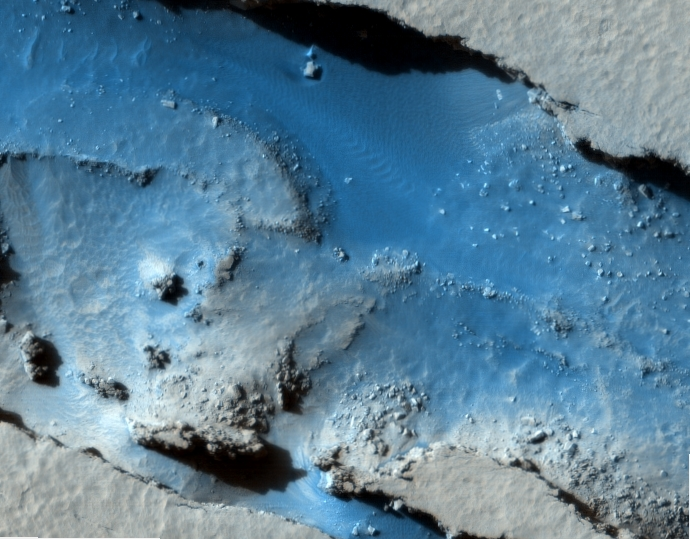
And I remember well this photo, it was one of the first photos taken by HiRISE, and I have seen all the photos in the weakly releases since 2006, besides some of the photos from the PDS releases.
I am not saying that there are no flow lines on the bed, Mars has many, many places where we can see that water (or other liquid) flowed some time ago, what is not visible is a sign that things are moving, signs of damp ground on the margins, etc.
Look carefully and you'll see flow lines on the bed and also what look like waves....could be a photo of most rivers on Earth.
Forget the colour and look for other signs and you will see that they are not there. And remember that dunes and waves are the same thing.
The difference is that the poles on Earth are surrounded by water (or are in the water, in the case of the north pole), while on Mars they are not.
Also regarding the poles and cold, remember that the poles are coldest at their centers just as on earth, and liquid water can exist around the poles and under the ice as well, just as it does on earth.
Saying that the photo of the Martian south pole looks like it has water means nothing if you don't see the rest. Look at a photo of the south pole and then go further north looking at other photos and you will see that there isn't a change like on Earth from water to land, on Mars everything looks the same, either land or ice, without any liquid.
To understand better that area, here is the photo from the west part of that "river", and you can see that it's no river.
(click for full size)
[atsimg]http://files.abovetopsecret.com/files/be8aef4cf100d002.jpg[/atsimg]
Photo PSP_009306_1875
[edit on 1/11/2009 by ArMaP]
No, the resolution of the map-projected image is 50 cm per pixel, not 165 cm.
Originally posted by Phage
The original image is here: hirise.lpl.arizona.edu...
The resolution of the image is 165 cm, meaning that the smallest objects which can be identified are about 5.5 feet across.
reply to post by ArMaP
Have I misunderstood? How can the map projected image have better resolution than the original?
[edit on 11/1/2009 by Phage]
Binning is a process that allows the charge from multiple adjacent pixels to be combined into one pixel. This increases the camera's light sensitivity and improves the signal-to-noise ratio. Binning occurs in the cross-scan and down-scan directions. "Bin 1" means that there has been no binning at all (because it means one pixel equals one pixel). "Bin 2" means that a 2x2 block of pixels were combined into one; this reduces the resolution by half, reduces the data volume by a factor of four, and increases the signal (i.e. light sensitivity) by a factor of four. Also, the signal-to-noise ratio is increased by a factor of two (if the same TDI setting is used for the binned and unbinned images).
Original image scale range: 55.1 cm/pixel (with 2 x 2 binning) so objects ~165 cm across are resolved
Have I misunderstood? How can the map projected image have better resolution than the original?
[edit on 11/1/2009 by Phage]
reply to post by Phage
I think the map-projected version has a slightly higher resolution because it was "stretched" to fit the right place and shape on a virtual Martian surface.
That is probably why sometimes we can notice that the map-projected image is not as sharp as the original, non-mapped version.
I think the map-projected version has a slightly higher resolution because it was "stretched" to fit the right place and shape on a virtual Martian surface.
That is probably why sometimes we can notice that the map-projected image is not as sharp as the original, non-mapped version.
My ultimate evidence of liquid water oceans on Mars:
Notice the above image - it clearly shows snow covering the huge cliffs, and the reflection of the cliffs on the water ice below, as well as broken up ice flakes further away from the shores just as seen on earth. Typical red tint / filter added which makes details harder to see but still obvious.
As comparison, a couple photo from Earth with similar attritbutes:
Notice the above image - it clearly shows snow covering the huge cliffs, and the reflection of the cliffs on the water ice below, as well as broken up ice flakes further away from the shores just as seen on earth. Typical red tint / filter added which makes details harder to see but still obvious.
As comparison, a couple photo from Earth with similar attritbutes:
new topics
-
God's Righteousness is Greater than Our Wrath
Religion, Faith, And Theology: 47 minutes ago -
Electrical tricks for saving money
Education and Media: 3 hours ago -
VP's Secret Service agent brawls with other agents at Andrews
Mainstream News: 5 hours ago -
Sunak spinning the sickness figures
Other Current Events: 5 hours ago -
Nearly 70% Of Americans Want Talks To End War In Ukraine
Political Issues: 6 hours ago -
Late Night with the Devil - a really good unusual modern horror film.
Movies: 7 hours ago -
Cats Used as Live Bait to Train Ferocious Pitbulls in Illegal NYC Dogfighting
Social Issues and Civil Unrest: 9 hours ago -
The Good News According to Jesus - Episode 1
Religion, Faith, And Theology: 11 hours ago
top topics
-
Florida man's trip overseas ends in shock over $143,000 T-Mobile phone bill
Social Issues and Civil Unrest: 16 hours ago, 8 flags -
Cats Used as Live Bait to Train Ferocious Pitbulls in Illegal NYC Dogfighting
Social Issues and Civil Unrest: 9 hours ago, 8 flags -
VP's Secret Service agent brawls with other agents at Andrews
Mainstream News: 5 hours ago, 8 flags -
Bobiverse
Fantasy & Science Fiction: 16 hours ago, 3 flags -
HORRIBLE !! Russian Soldier Drinking Own Urine To Survive In Battle
World War Three: 13 hours ago, 3 flags -
Electrical tricks for saving money
Education and Media: 3 hours ago, 3 flags -
Nearly 70% Of Americans Want Talks To End War In Ukraine
Political Issues: 6 hours ago, 3 flags -
Sunak spinning the sickness figures
Other Current Events: 5 hours ago, 3 flags -
Late Night with the Devil - a really good unusual modern horror film.
Movies: 7 hours ago, 2 flags -
The Good News According to Jesus - Episode 1
Religion, Faith, And Theology: 11 hours ago, 1 flags
active topics
-
VP's Secret Service agent brawls with other agents at Andrews
Mainstream News • 34 • : WeMustCare -
New whistleblower Jason Sands speaks on Twitter Spaces last night.
Aliens and UFOs • 53 • : pianopraze -
Sunak spinning the sickness figures
Other Current Events • 5 • : glen200376 -
SETI chief says US has no evidence for alien technology. 'And we never have'
Aliens and UFOs • 44 • : MikeDeGrasseTyson -
HORRIBLE !! Russian Soldier Drinking Own Urine To Survive In Battle
World War Three • 31 • : budzprime69 -
How ageing is" immune deficiency"
Medical Issues & Conspiracies • 33 • : rickymouse -
The Reality of the Laser
Military Projects • 46 • : Zaphod58 -
God's Righteousness is Greater than Our Wrath
Religion, Faith, And Theology • 0 • : randomuser2034 -
President BIDEN Vows to Make Americans Pay More Federal Taxes in 2025 - Political Suicide.
2024 Elections • 136 • : ImagoDei -
Electrical tricks for saving money
Education and Media • 3 • : Mike72