It looks like you're using an Ad Blocker.
Please white-list or disable AboveTopSecret.com in your ad-blocking tool.
Thank you.
Some features of ATS will be disabled while you continue to use an ad-blocker.

20 9/11 Questions Remain Unanswered over 8 Years Later
page: 27share:
reply to post by exponent
Sure. Look back at my previous post. It's all explained there.
I understand that you're having difficulty seeing it, so take your time and study your claim and the NIST excerpt that you used to try and justify your claim.
It has been shown that NIST did not state that 'only 8 floors were affected by minimal resistance.' Your claim is bunk.
Tell us all, exponent, which of the 8 floors do you claim 'were affected by minimal resitance'? Please list the floor numbers for us.
[edit on 3-11-2009 by tezzajw]
Sure. Look back at my previous post. It's all explained there.
I understand that you're having difficulty seeing it, so take your time and study your claim and the NIST excerpt that you used to try and justify your claim.
Originally posted by exponent
Indeed NISTs results tell us that throughout the entire collapse, only 8 floors were affected by minimal resistance.
It has been shown that NIST did not state that 'only 8 floors were affected by minimal resistance.' Your claim is bunk.
Tell us all, exponent, which of the 8 floors do you claim 'were affected by minimal resitance'? Please list the floor numbers for us.
[edit on 3-11-2009 by tezzajw]
Originally posted by exponent
Originally posted by bsbray11
Again, explain what you are using to quantify "a lot." Being able to differentiate it from absolute free-fall?
Yes.
So in other words they aren't based on any kind of actual verification that this is the right amount of "resistance." Just the fact that you are able to see ANYTHING AT ALL besides free-fall somehow makes you think everything automatically checks out. Gotcha.
That red line represents the rate of acceleration due to gravity. As you can see, WTC7 achieves this acceleration for only a very brief period during its collapse.
Once again, does not matter. I have seen that graph many times, and believe it or not, I do know how to read them.
During that time, the section they measured was not transferring significant kinetic energy, it was in fact converting most if not all (as I've said before, all would be impossible) of its Gravitational Potential Energy into Kinetic Energy.
It was not transferring any kinetic to other forms of energy at all. It was free-falling during that period of time. While theoretically, a "collapse" is supposed to be happening at the same time. You apparently still do not understand the implications of this, or that there is a direct contradiction here.
However, during the rest of the collapse, this energy was being absorbed or redirected somehow (by physical interaction, although I admit that's a bad description).
Exactly, which should have been happening the whole time. Not only that, there is absolutely no reason to believe ANY of the collapse should have been accelerating anywhere NEAR free-fall. I want to see where moments of inertia and all of that are summed and the kinetic energy required to completely destroy the building is calculated.
We could work out just how much energy this is if we had accurate enough information, but this is where NISTs modelling comes in. I will attempt to explain this if needed.
Go ahead.
"normal" and "natural" are bad terms to use here, because we're talking about science rather than 'everyday life'
Everyday reality is disconnected from science for you?
For example, having two eyes is normal, but having only one eye is relatively common, possible, and entirely "natural".
Great analogy. Suddenly a building free-falling into itself makes sense.
Anyway, I would not say I am 100% convinced, any sceptic should admit there is a possibility they are wrong. However, as has been pointed out, to advance an alternate theory, one needs to support it with evidence.
Are you incapable of accepting the fact that you are out of the loop on something like this? Why do you need an immediate replacement theory as a crutch before you can forget a trash theory that is obviously not thought out?
If this period of free fall is proof or indicative of exposive demolition, you have the same questions as you are putting to me, to answer yourself.
Right, and it is a complete mystery to me, but that doesn't put me in a hurry to accept total nonsense, like that a building can free-fall into itself, all while it is supposedly "collapsing" (ie doing work).
What has convinced me is the thoroughness and completeness of NISTs investigation
Are you serious? Not looking at the debris at all is thorough and complete? Not even being able to explain how their theory conforms to the law of conservation of energy, when they are saying the building was being destroyed but free-falling simultaneously? And you admit they do not try to reconcile this clearly in their report, when it has been an issue people have been taking serious issue with for years now?
the accuracy of their simulation and how well it works with the evidence we have. There are few things remaining unexplained in the 'official story'.
And those few things are exactly the things they should have filled in to actually give their theory a solid basis in basic physics and forensic investigation, ie reconciliation of their theory with basic laws and analyzing the debris itself.
I must admit the first time I saw WTC7 I was intrigued. However I did the research
...and you found crutches to hold you up from whatever you would have to face if and when you came to the realization that WTC7 was in fact "aided" to the ground in some way, as demonstrated by the entire upper part of building free-falling into itself below.
'Free fall' really cannot be defined in terms of kinetic energy conservation, as the term is never really used that way.
Bullocks free-fall cannot be defined in terms of kinetic energy. Free-fall means all gravitational energy gained is conserved. And it is extremely predictable and based on the mass (a constant) and the acceleration of gravity (another constant). Thus there is a clear and demonstrable relationship.
In this case, a working definition is irrelevant, we know for a fact that the central roof section of WTC7 accelerated at approximately 9.81m/s/s for a period of slightly over 2 seconds, covering a distance of 8 storeys, or likely 100ft (guesstimate!). This is all we need to know to discuss this, as it describes the events as exactly as possible.
Right, and what I want to know is where the kinetic energy was converted to other forms to destroy the building while it was simultaneously free-falling. Not the times around the free-fall, but during the free-fall itself. The collapse did not halt during the free-fall period. It was still going. Do you see what I am saying yet?
Well the best way to do this is to read NCSTAR 1A which is essentially a summary of the investigation, then to read NCSTAR 1-9 for anything you need more specifically, and then to ask specific questions here, on JREF, on PhysOrg or wherever you like regarding things that you do not agree with or do not understand.
I'm familiar with how both NIST reports and the JREF forum operate, and suffice it to say that the end result is more important to them both than the methodology. The ends justify the means, no matter what data (or lack thereof) they choose to base their claims on. I have seen it time and time again, from NIST, from Bazant, and from Greening, among others, and I can cite specific examples of them all ignoring real data to say their conclusions are justified by superficial resemblances only.
For example, Bazant assumes 50% of the mass of each tower stayed within the footprints at all times simply because if he assumes any less than that (to match real observations), it throws his collapse times off, and he argues that since he can't have his collapse times thrown off in his model, he's justified in assuming totally inaccurate data. And he's a JREF'er.
The audience for the NIST report are expected to be licensed engineers.
You say that like licensed engineers speak a different language and use a different set of physics than I do. I have no trouble navigating the report and understanding it if my questions are even addressed by the report.
Then, once this horizontal progression occurs, the upper section of the building becomes virtually unsupported.
You keep using words like "virtually" and "almost" but to free-fall the amount of support still holding up the building has to be none. It has to all be kicked out at once, in a symmetrical pattern across the building, or else it's going to lean in the direction of least resistance, and it's NOT going to free-fall against solid columns, etc. All of those have to be blown out of the way instantaneously, and yes, I agree, much of the structure had already been compromised even before that had to happen.
We see this in the graph I posted above as the slow initial acceleration as the remaining components are severely overloaded and fail. Once this occurs, because there is significant support damage further down in the building, the whole top section starts to descend rapidly. It is so rapid, simply because the columns are buckled.
Buckled columns still support loads, as per Euler's equation if I'm not mistaken. They obviously don't support as much but it is still greater than none, which is what the free-fall demonstrates. And to exert force on them requires energy.
I am sure you have bent paperclips in your life, and you will have noticed an interesting property. As you bend the paperclip, even if it is only just enough to permanently deform it, the actual part where it is bending becomes brittle. It becomes 'strain hardened'. In this state, it approaches how structural steel columns will perform. They are designed to support huge loads, and so are as hard as is feasible. As a result, once even slightly deformed, they will readily fracture.
And they will still be dead in the way, too. That is dead weight, massive dead weight, in the very heart of the building, going all the way up through it, that has to be "pushed aside" (for a lack of a better term) to allow a complete free-fall. When and how does this all happen before the free-fall period, and how is a whole 2.25-second free-fall period allowed? How are 8-floors worth of columns and other structure all moved out of the way instantaneously?
For another terrible analogy (I apologise, I would normally find a practical demonstration in person for this sort of thing) think of toothpicks. You are aware that when they are perfectly straight, they can do significant damage, and support a lot of load, but as soon as they are slightly bent, any further force will bend them outwards.
You're not allowed to use ANY force from the kinetic energy during the free-fall, remember? Free-fall? All kinetic energy is conserved.
Originally posted by exponent
No, and this is a valid point. NISTs simulation is inaccurate. I have pointed this out before, but this is unfortunately a limitation of anyone's ability to model the collapse. We do not have perfectly accurate information on the building, we know roughly how much weight the office contents contributed, roughly how strong the columns were (we know minimum spec only), roughly how powerful the fires were.
And since the ends justify the means for NIST, they will assume whatever variables will get the job done, no matter how unreasonable or unsupported they may be. That is what they are doing: superficially trying to get any match between their theory, their model, and videos of the collapse, and then using that superficial resemblance to say therefore all their methods are justified.
What is important, is that NIST replicated the general behaviours of the collapse
That is not as important as being able to validate every assumption they make and variable they use. I could come up with a demolition theory the same way, and easily claim that it trumps NIST's report simply because it matches physical features of the collapse better than NIST does. It would all be controlled so of course it would be easier to accomplish intentionally, especially if it's so easy to get the same result without the use of demolition equipment. But then wouldn't you want me to actually prove my assumptions, too, instead of just basing my whole case on appearances that match my theoretical fantasy? I'd like the same.
I could go through and pick apart each of your responses as usual, but I'll cut to the chase even more quickly by pointing out that all of the answers you posted were pure personal speculation and not supported by any of the official investigations.
This is the problem, many of the points I replied with do have evidence to support them, but you are making the mistake of assuming that unanswered questions add doubt to a theory.
In case you haven't noticed, all of my unanswered questions are rhetorical and therefore MEANT to cast doubt on the given explanations.
Just as a single example, you say the eutectic must have formed randomly from various materials. How? Eutectic reactions don't fall off of trees readily formed. You have several components within the eutectic alone that have to not only be available but mixed in the right proportions and at the right particle sizes for a reaction to even be possible in the first place, let alone to melt steel, which is hard enough for even conventional thermite to do. And that's not even taking into account the sulfur. If the sulfur came out of drywall, then how was it separated out and why aren't the other components of drywall also in the corrosive reaction in the right proportions? And again, where did the eutectic come from?
If I throw all the ingredients of a cake into an oven and turn it on... am I going to find a cake later?
If I throw a bunch of aluminum, steel, sulfur together (which is already assuming more order behind this whole thing than NO ONE putting them together), I am STILL not automatically going to get this eutectic reaction. Proportions, particle sizes, and correct distribution are just as important and require just as much order. Even if I have a eutectic reaction and I apply it to steel, I can't even automatically assume that the steel is going to be melted at all!!
In other words, you have NO evidence to support your claim that all this just happened to come together randomly. You can't even fully explain how it could possibly happen even in theory, short of some astronomically insane odds and bizarre coincidences. And that is NOT evidence, it is pure blind conjecture.
For example, what I will refer to as the 'shoot down order' would be devastating to the 'official story' if it was indeed an order to stand down and allow a plane to hit the pentagon. However, without evidence that this is the case, it is pure speculation and what is known as FUD, Fear, Uncertainty and Doubt.
Even if there is no evidence of a stand-down order, you certainly have no evidence that it wasn't, either. So to dismiss it as "fear" is playing directly into your fear, and using it to guide you away from a pursuit of a real answer. What Cheney said or didn't say doesn't strike fear into me one way or another because I was honestly not personally threatened by the 9/11 attacks and never responded emotionally to them.
Originally posted by tezzajw
Sure. Look back at my previous post. It's all explained there.
I understand that you're having difficulty seeing it, so take your time and study your claim and the NIST excerpt that you used to try and justify your claim.
Perhaps you should read my claim more thoroughly first:
Originally posted by exponent
Indeed NISTs results tell us that throughout the entire collapse, only 8 floors were affected by minimal resistance.
Originally posted by tezzajw
It has been shown that NIST did not state that 'only 8 floors were affected by minimal resistance.' Your claim is bunk.
Tezza, I said that NISTs results told us this, not that they explicitly stated it. As I have already explained, their results do indicate this, unless you believe that floors somehow expanded in size, or elsewhere in the collapse the resistance was as small. Evidence for either would be appreciated.
Tell us all, exponent, which of the 8 floors do you claim 'were affected by minimal resitance'? Please list the floor numbers for us.
These are not definitive numbers of course, but floors 7 to 12 or so are major floors of failure lower in the building, there were also upper level failures at floors 33 to 37 or so (from memory). The collapse mechanism is complex, but the descent values speak for themselves.
Originally posted by exponent
Perhaps you should read my claim more thoroughly first
The claim that you made, is quite clearly incorrect. I've read it and disproven it.
Originally posted by exponent
Indeed NISTs results tell us that throughout the entire collapse, only 8 floors were affected by minimal resistance.
Originally posted by exponent
Tezza, I said that NISTs results told us this, not that they explicitly stated it. As I have already explained, their results do indicate this,
Your confusion here is obvious, exponent, as you agree with me that the NIST report did not state that 'only 8 floors were affected by minimal resistance.' explicitly. You incorrectly inferred it.
The NIST report determines the following:
For a continous time period of 2.25 seconds, between t = 1.75 seconds and t = 4.00 seconds (over the three analysed stages), a fixed point on the roofline fell 105 feet with an acceleration equal to g.
The NIST report does not determine your bunk claim that 'only 8 floors were affected by minimal resistance.'
Originally posted by bsbray11
So in other words they aren't based on any kind of actual verification that this is the right amount of "resistance." Just the fact that you are able to see ANYTHING AT ALL besides free-fall somehow makes you think everything automatically checks out. Gotcha.
What makes you think that there is a "right" amount of resistance? The amount the structure provides depends on the damage it has sustained. If NISTs collapse mechanism does not match the observed collapse, then there are obviously problems, but as I have already explained, they actually captured each significant event well.
Once again, does not matter. I have seen that graph many times, and believe it or not, I do know how to read them.
I did not mean to be insulting, but as you can see from my previous post, apparently simple things need explanation quite often.
It was not transferring any kinetic to other forms of energy at all. It was free-falling during that period of time. While theoretically, a "collapse" is supposed to be happening at the same time. You apparently still do not understand the implications of this, or that there is a direct contradiction here.
'free falling' is converting GPE into KE, and no, there is no contradiction here. We understand that the building failed at low levels as I have explained in detail, buckled columns providing negligible resistance is not surprising or contradictory.
Exactly, which should have been happening the whole time. Not only that, there is absolutely no reason to believe ANY of the collapse should have been accelerating anywhere NEAR free-fall. I want to see where moments of inertia and all of that are summed and the kinetic energy required to completely destroy the building is calculated.
The simulation is not carried out on pen and paper, it is done using LS-DYNA (iirc). I do not know if NIST have released their model, but I have already explained why an 8 storey lack of resistance is not unexpected, NISTs model includes the reasons for this behavior.
I'm not sure what you want me to explain about NISTs modelling, i was hoping for a more constructive dialogue regarding what you do not understand.
Everyday reality is disconnected from science for you?
Of course, "Evolution is only a theory" means two different things in two different 'worlds'. The average person does not understand error analysis, every scientist does.
Great analogy. Suddenly a building free-falling into itself makes sense.
Hey, I said it wasn't great, no need for the sarcasm, I am trying to explain this to you after all.
Are you incapable of accepting the fact that you are out of the loop on something like this? Why do you need an immediate replacement theory as a crutch before you can forget a trash theory that is obviously not thought out?
Because this so called 'trash theory' actually explains everything very well, and conforms to our observations. Should we call newtonian mechanics 'trash' and forget it when it does not work when we scale speeds up towards c? No.
Are you serious? Not looking at the debris at all is thorough and complete?
NIST had no access to these samples, I don't expect them to do the impossible.
Not even being able to explain how their theory conforms to the law of conservation of energy, when they are saying the building was being destroyed but free-falling simultaneously?
What needs explaining more than I already have? The 'free fall' was for under 20% of the building, and occured after significant damage had already occured.
And you admit they do not try to reconcile this clearly in their report, when it has been an issue people have been taking serious issue with for years now?
People have also been claiming there are no planes for years now, do you expect NIST to address this? They focus on the science, not the whims and misconceptions of people who admit themselves they do not understand the building's behaviour.
And those few things are exactly the things they should have filled in to actually give their theory a solid basis in basic physics and forensic investigation, ie reconciliation of their theory with basic laws and analyzing the debris itself.
Do you think that somehow they forgot to apply this basic law? It is intrinsic in the calculations they use. You can hardly not apply it. I believe you said you were an electrical engineering student, so perhaps you can show me a calculation for a potential divider that ignores ohm's law? Of course you can't, because the calculation you do is based on that principle!
...and you found crutches to hold you up from whatever you would have to face if and when you came to the realization that WTC7 was in fact "aided" to the ground in some way, as demonstrated by the entire upper part of building free-falling into itself below.
Yet again you advocate an alternate theory, but with no evidence to support it. In the spirit of Tezza above, can you please tell us which floors had controlled demolition charges on them, and when they were detonated? Or, if you believe in an alternate theory, the details of that?
Bullocks free-fall cannot be defined in terms of kinetic energy. Free-fall means all gravitational energy gained is conserved. And it is extremely predictable and based on the mass (a constant) and the acceleration of gravity (another constant). Thus there is a clear and demonstrable relationship.
By this definition, a skydiver at terminal velocity is not in free fall, as his GPE is being reduced while his KE remains constant. Are you happy with this definition?
Right, and what I want to know is where the kinetic energy was converted to other forms to destroy the building while it was simultaneously free-falling. Not the times around the free-fall, but during the free-fall itself. The collapse did not halt during the free-fall period. It was still going. Do you see what I am saying yet?
The structures supporting that part of the building were already destroyed, the reason it free falls is because it has reduced the existing support to practically zero, by massively overloading the remaining columns and forcing them to buckle or fracture. I have already gone through all this.
For example, Bazant assumes 50% of the mass of each tower stayed within the footprints at all times simply because if he assumes any less than that (to match real observations), it throws his collapse times off, and he argues that since he can't have his collapse times thrown off in his model, he's justified in assuming totally inaccurate data. And he's a JREF'er
No he didn't, and no he isn't. I don't think Bazant has ever posted on JREF, I certainly haven't seen it. He is a distinguished professor of engineering with an extensive publishing history. He is an ISI Highly Cited Scientist for god's sake. Perhaps you should read the sensitivity analysis done in the paper, and explain any mechanism whereby more than 50% of the mass could be ejected. I would be intrigued to learn what sort of incredible mechanism could do this, the energy required is extreme at minimum.
You say that like licensed engineers speak a different language and use a different set of physics than I do. I have no trouble navigating the report and understanding it if my questions are even addressed by the report.
Yet you ask for clarifications on things which are obvious to me as a layman.
reply to post by bsbray11
If the measurement NIST made was completely accurate than yes, but it is not. As I have explained, there are error margins involved in the measurement, and it is in these margins that the resistance is felt.
The idea that you could somehow blow 8 floors out of the way and it would not be noticed by people in the surrounding area is ludicrous. Where is the blast damage? Why do we find that in fact the debris is contained to a relatively small area?
Perhaps you are saying that controlled demolition was carried out on those 8 floors, but you must be saying that this was initiated after the east penthouse collapsed?
Please clarify this, because unless you believe that whoever brought down this building designed this collapse method specifically, it would seem quite odd that the building just happened to collapse a few seconds before these charges went off.
I will press you to provide details of your theory, as you have indicated it several times so far.
As explained, it is impossible for no force to have been felt, but the mass of the upper section of WTC7 is large enough that a buckled column will provide extremely minimal resistance. I do not have the figures to hand but either NIST or some other agency did some load supporting tests at some point. I'll see if I can dig that out to add some weight to this, but I doubt you'll care until you understand that NISTs measurement cannot be accurate, for a start because it's slightly greater than g, but because it is also physically impossible.
It is already accelerating downwards at g, we all are, it is the support from underneath that prevents this. Of course some energy does have to be transferred, but you have failed to substantiate it being significant at all.
They are not, the collapse begins once the number of columns remaining is under the weight of the structure. At this point they are already overloaded, and will buckle quickly. This occurs in the second or so before the free-fall period, and of course some will likely occur during it.
Again I reference error margins.
Matching a theoretical fantasy is pretty much proof, of course you'd have to deal with the implications of your fantasy, but NIST does. Would you like to attempt to provide one? Bear in mind there's been a standing challenge open at JREF for a number of years for someone to come up with a coherent demolition hypothesis. I encourage you to try.
For a start, it didn't melt the steel, it eroded it through chemical reaction. Yes, you're right, there do need to be chemicals in the right mixture, but why is it surprising? These chemicals are in ready abundance in the towers, and there was undoubtedly enough heat. Are you this equally shocked at other chemical reactions?
So even though you understand that in fact it is totally possible, the materials are there and indeed the scientists studying it understand that, you deny it because it's unlikely?
edit: This section is inaccurate. Tezza pointed this out below. I actually meant to say 100 numbers between 1 and 10, as there are 10 options there are a total of 10^100 potential combinations. Please ignore the calculation in the paragraph below!
I just picked 10 random numbers between 1 and 100, the chances of me picking the same numbers randomly are 1*10^100, a number 20 or so orders of magnitude greater than protons in the universe. But what a surprise, I did actually pick those numbers! Unlikely things happen all the time, what is your alternate explanation for the formation of this eutectic?
Yes, this is exactly my point, such a question cannot hurt a theory when neither side have evidence, it remains an unanswered question. Of course the 'official story' side of things has a very good explanation of what happened here, and the alternate theory is once again fractured at best.
Now, this is a lot of words I have typed here, and I don't expect to have to repeat "error margins" and my explanation of the horizontal progression again. If you just want to deny them and continue to ask questions you already have the answer to, that's fine by me.
[edit on 4-11-2009 by exponent]
You keep using words like "virtually" and "almost" but to free-fall the amount of support still holding up the building has to be none. It has to all be kicked out at once, in a symmetrical pattern across the building, or else it's going to lean in the direction of least resistance, and it's NOT going to free-fall against solid columns, etc. All of those have to be blown out of the way instantaneously, and yes, I agree, much of the structure had already been compromised even before that had to happen.
If the measurement NIST made was completely accurate than yes, but it is not. As I have explained, there are error margins involved in the measurement, and it is in these margins that the resistance is felt.
The idea that you could somehow blow 8 floors out of the way and it would not be noticed by people in the surrounding area is ludicrous. Where is the blast damage? Why do we find that in fact the debris is contained to a relatively small area?
Perhaps you are saying that controlled demolition was carried out on those 8 floors, but you must be saying that this was initiated after the east penthouse collapsed?
Please clarify this, because unless you believe that whoever brought down this building designed this collapse method specifically, it would seem quite odd that the building just happened to collapse a few seconds before these charges went off.
I will press you to provide details of your theory, as you have indicated it several times so far.
Buckled columns still support loads, as per Euler's equation if I'm not mistaken. They obviously don't support as much but it is still greater than none, which is what the free-fall demonstrates. And to exert force on them requires energy.
As explained, it is impossible for no force to have been felt, but the mass of the upper section of WTC7 is large enough that a buckled column will provide extremely minimal resistance. I do not have the figures to hand but either NIST or some other agency did some load supporting tests at some point. I'll see if I can dig that out to add some weight to this, but I doubt you'll care until you understand that NISTs measurement cannot be accurate, for a start because it's slightly greater than g, but because it is also physically impossible.
And they will still be dead in the way, too. That is dead weight, massive dead weight, in the very heart of the building, going all the way up through it, that has to be "pushed aside" (for a lack of a better term) to allow a complete free-fall.
It is already accelerating downwards at g, we all are, it is the support from underneath that prevents this. Of course some energy does have to be transferred, but you have failed to substantiate it being significant at all.
When and how does this all happen before the free-fall period, and how is a whole 2.25-second free-fall period allowed? How are 8-floors worth of columns and other structure all moved out of the way instantaneously?
They are not, the collapse begins once the number of columns remaining is under the weight of the structure. At this point they are already overloaded, and will buckle quickly. This occurs in the second or so before the free-fall period, and of course some will likely occur during it.
You're not allowed to use ANY force from the kinetic energy during the free-fall, remember? Free-fall? All kinetic energy is conserved.
Again I reference error margins.
But then wouldn't you want me to actually prove my assumptions, too, instead of just basing my whole case on appearances that match my theoretical fantasy? I'd like the same.
Matching a theoretical fantasy is pretty much proof, of course you'd have to deal with the implications of your fantasy, but NIST does. Would you like to attempt to provide one? Bear in mind there's been a standing challenge open at JREF for a number of years for someone to come up with a coherent demolition hypothesis. I encourage you to try.
Just as a single example, you say the eutectic must have formed randomly from various materials. How? Eutectic reactions don't fall off of trees readily formed. You have several components within the eutectic alone that have to not only be available but mixed in the right proportions and at the right particle sizes for a reaction to even be possible in the first place, let alone to melt steel, which is hard enough for even conventional thermite to do.
For a start, it didn't melt the steel, it eroded it through chemical reaction. Yes, you're right, there do need to be chemicals in the right mixture, but why is it surprising? These chemicals are in ready abundance in the towers, and there was undoubtedly enough heat. Are you this equally shocked at other chemical reactions?
In other words, you have NO evidence to support your claim that all this just happened to come together randomly. You can't even fully explain how it could possibly happen even in theory, short of some astronomically insane odds and bizarre coincidences. And that is NOT evidence, it is pure blind conjecture.
So even though you understand that in fact it is totally possible, the materials are there and indeed the scientists studying it understand that, you deny it because it's unlikely?
edit: This section is inaccurate. Tezza pointed this out below. I actually meant to say 100 numbers between 1 and 10, as there are 10 options there are a total of 10^100 potential combinations. Please ignore the calculation in the paragraph below!
I just picked 10 random numbers between 1 and 100, the chances of me picking the same numbers randomly are 1*10^100, a number 20 or so orders of magnitude greater than protons in the universe. But what a surprise, I did actually pick those numbers! Unlikely things happen all the time, what is your alternate explanation for the formation of this eutectic?
Even if there is no evidence of a stand-down order, you certainly have no evidence that it wasn't, either. So to dismiss it as "fear" is playing directly into your fear, and using it to guide you away from a pursuit of a real answer.
Yes, this is exactly my point, such a question cannot hurt a theory when neither side have evidence, it remains an unanswered question. Of course the 'official story' side of things has a very good explanation of what happened here, and the alternate theory is once again fractured at best.
Now, this is a lot of words I have typed here, and I don't expect to have to repeat "error margins" and my explanation of the horizontal progression again. If you just want to deny them and continue to ask questions you already have the answer to, that's fine by me.
[edit on 4-11-2009 by exponent]
Originally posted by tezzajw
The claim that you made, is quite clearly incorrect. I've read it and disproven it.
...
The NIST report does not determine your bunk claim that 'only 8 floors were affected by minimal resistance.'
Tezza, you have not proven anything, you have shown that I did not say something which I never claimed to have said.
NISTs report does tell us this, their results show it clearly. Your inability to understand this does not mean that I am incorrect. If the acceleration was greatest during the period the building was in 'free-fall', and its displacement was 8 floors, what exactly is wrong about what I said?
I'm talking factually here, rather than whether or not the NIST report explicitly says it. Please, disprove me by showing where I am factually wrong. Did the building experience a lower period of resistance? If so, when? How long did it last, and how much did it move?
Originally posted by exponent
I just picked 10 random numbers between 1 and 100, the chances of me picking the same numbers randomly are 1*10^100, a number 20 or so orders of magnitude greater than protons in the universe. But what a surprise, I did actually pick those numbers! Unlikely things happen all the time, what is your alternate explanation for the formation of this eutectic?
Let us examine this off-topic claim of exponent's in greater detail.
We have to assume that exponent was using integers, which is fair enough. exponent did not state that he was selecting integers between and including 1 and 100, so we will use the set of 98 integers, namely [2, 3, 4, ... , 97, 98, 99] as a sample space.
exponent initially 'picked' 10 integers within the sample space, which is fair enough. Without any loss of generality, we can assume that they were 2, 3, 4, 5, 6, 7, 8, 9, 10 and 11.
exponent did not state that the selected order matters. So we shall assume that selection order is not important.
Essentially, we have a lotto problem. exponent's lotto ticket consists of the 10 integers from 2 to 11. He wants to match that selection by drawing 10 random numbers from the sample size of 98.
Using very simple combinatorics, there are (98 C 10) ways to select 10 numbers from a sample of 98. That equates to 14,005,614,014,756 ways.
Casual readers, as you can see, a little over 14 trillion ways is a far cry from exponent's claim that his chances are '20 or so orders of magnitude greater than protons in the universe'.
I'm not suprised that exponent has miscalculated his off-topic claim. His errors permeate through his posts. For example, he still can not see why this claim is bunk:
Originally posted by exponent
"Indeed NISTs results tell us that throughout the entire collapse, only 8 floors were affected by minimal resistance."
The NIST report does not state that and exponent even agreed with me that the NIST report does not state that - yet he clings to it as being something correct?
Astounding.
Casual readers, you do the math...
[edit on 4-11-2009 by tezzajw]
Originally posted by tezzajw
Let us examine this off-topic claim of exponent's in greater detail.
Your criticism is valid, I swapped the numbers around in my head by accident. Sorry about that! Even so, one in several trillion is incredibly unlikely, so the point still stands as far as I am concerned.
I'm not suprised that exponent has miscalculated his off-topic claim. His errors permeate through his posts. For example, he still can not see why this claim is bunk:
You can apparently still not explain it, as I have said, I never claimed that NIST stated it, just that their results told us this. They do.
Originally posted by jthomas
We forced Bsbray11 & Co. into an embarrassing strategic retreat.
You might want to rethink that one, jthomas.
In this thread, you have confused speed with acceleration, showing your lack of fundamntal physics.
Fitzgibbon has tried to distort 30% (his number) of the collapse time for WTC 7 as being 'momentary'.
exponent has woefully miscalculated his off-topic claim about selecting 10 random numbers.
exponent still can't understand why his quote "Indeed NISTs results tell us that throughout the entire collapse, only 8 floors were affected by minimal resistance." is wrong. Yet, he agrees with me that it's not stated in the NIST report!
All that and no one has been able to explain how WTC 7 fell for 2.25 seconds with the same acceleration as g.
Originally posted by exponent
'free falling' is converting GPE into KE, and no, there is no contradiction here. We understand that the building failed at low levels as I have explained in detail, buckled columns providing negligible resistance is not surprising or contradictory.
You keep saying it is "not surprising" but that means absolutely nothing when you say it. Is there a "right" amount of "resistance"? Yes, and it should have been calculated using the buildings' structural documents. Buckled columns can still be taken into account.
I have already explained why an 8 storey lack of resistance is not unexpected
No, you haven't! You keep making an assertion but do you not know what "proof" means?? It does NOT mean measuring the collapse and saying therefore your theory must be right!
Everyday reality is disconnected from science for you?
Of course, "Evolution is only a theory" means two different things in two different 'worlds'.
Sounds like more politicizing bullcrap to me. Science is not hard to understand. It's a tool. It's only when you start taking it as a religion, and looking to "experts" like you would look to a pastor, that problems start arising. I have no problem entertaining and discarding all number of theories as more data presents itself, and have no issues confusing theories with reality.
Are you incapable of accepting the fact that you are out of the loop on something like this? Why do you need an immediate replacement theory as a crutch before you can forget a trash theory that is obviously not thought out?
Because this so called 'trash theory' actually explains everything very well
That's your opinion, which you have failed to justify to me.
Are you serious? Not looking at the debris at all is thorough and complete?
NIST had no access to these samples, I don't expect them to do the impossible.
This is an excuse. Just because they had less to go off of doesn't lend any support to their hypothesis.
Not even being able to explain how their theory conforms to the law of conservation of energy, when they are saying the building was being destroyed but free-falling simultaneously?
What needs explaining more than I already have? The 'free fall' was for under 20% of the building, and occured after significant damage had already occured.
What more needs to be explained about "it doesn't matter"? I can talk JUST about that instant when it was free-falling, and everything I say still applies. It was supposedly doing no work yet it was supposedly "collapsing" (requiring work to be done!) at the same time. That does NOT make sense. You are comparing nothing to a massive steel building that DOES still have supports intact where the "collapse" is happening, and saying the roof line should fall through them in exactly the same amount of time, within the same margin of error.
People have also been claiming there are no planes for years now, do you expect NIST to address this?
I can't imagine how NIST would even be able to settle such a question in the first place given the level of technology that would be required to fake it.
They focus on the science, not the whims and misconceptions of people who admit themselves they do not understand the building's behaviour.
They did NOT focus on science. They focused on getting pre-conceived results. They didn't even investigate any other possibilities as to why the buildings may have collapsed, except in the case of WTC7, and even then they assumed only conventional and asinine cases, and still ignored witness testimony of explosions to insinuate no one heard any. Which would be a lie.
Do you think that somehow they forgot to apply this basic law?
If you can't produce the evidence that they did then I am going to have to assume yes. I am not the first or most credible person to take the same issue with this building. Yet it still has not been addressed. Saying it has been addressed does not mean it has. Just because you don't understand what the problem is doesn't mean there isn't one. You are obviously biased into thinking buildings can free-fall into themselves like nothing but you still haven't proven it, which is what I want to see.
I believe you said you were an electrical engineering student, so perhaps you can show me a calculation for a potential divider that ignores ohm's law? Of course you can't, because the calculation you do is based on that principle!
NIST did not base their WTC7 acceleration curve on conservation of energy laws. They based it on measured acceleration and ignored the implications in terms of kinetic energy not being absorbed.
Yet again you advocate an alternate theory, but with no evidence to support it. In the spirit of Tezza above, can you please tell us which floors had controlled demolition charges on them, and when they were detonated? Or, if you believe in an alternate theory, the details of that?
NIST can't even accurately model what the collapse even looked like, let alone tell you what happened on any given floor, yet you expect me to know what was planted on what specific floors if it was a demolition. Yeah, right. If you can't even tell me what exactly happened on any given floor using your own pet model, you're a hypocrite. Again, you don't need to embrace a new theory right away to realize the one you are looking at is trash.
By this definition, a skydiver at terminal velocity is not in free fall, as his GPE is being reduced while his KE remains constant.
Nope. I said gravitational energy gained, as in the kinetic energy gained by the object that's accelerating. Gravitational potential energy is never gained when the object is falling. Potential energy is only gained when the object is hurled upwards, for example, by a different force than gravity.
Right, and what I want to know is where the kinetic energy was converted to other forms to destroy the building while it was simultaneously free-falling. Not the times around the free-fall, but during the free-fall itself. The collapse did not halt during the free-fall period. It was still going. Do you see what I am saying yet?
The structures supporting that part of the building were already destroyed, the reason it free falls is because it has reduced the existing support to practically zero, by massively overloading the remaining columns and forcing them to buckle or fracture. I have already gone through all this.
And I have repeatedly gone over why it doesn't make sense.
(A) No matter what the stage of the collapse, it is obviously not done collapsing. The global collapse literally just started a couple of seconds earlier.
(B) Therefore there is still intact structure that the building is theoretically collapsing into, somewhere below the free-falling structure.
(C) The still-intact portion of the building (even if it's only the exterior) that is theoretically collapsing down onto the still-intact structure below, must be making contact, and at this contact work must be done as so much mass in the way is being displaced.
Literally, 8-floors worth of mass and columns and all would have to be COMPLETELY out of the way to allow a free-fall. Not just partially, not with some buckled columns and a ton of intact braces. That translates to work being done, meaning kinetic energy spent, meaning acceleration is NOT 32/ft/s/s. To be clear you have NOT explained how 8 floors worth of building (using your own figure) was instantly gone, out of the way. NIST doesn't claim anything like that happened. They are trying to say the building was still crushing itself the whole way down.
No he didn't
Yes, he did. It was his most recent paper trying to calculate the energy required for the towers to have collapsed the way they did. I swear to god, go look it up for yourself and read it. He does exactly what I just described in that paper, and openly admits it himself. These "scientists" are all going about this stuff ass-backwards.
He is a distinguished professor of engineering with an extensive publishing history. He is an ISI Highly Cited Scientist for god's sake.
I could care less when he does his science backwards just to prove his bias. Given that I can prove that he did ignore observable data just to keep his collapse times accurate, would you admit this is bad science?
Perhaps you should read the sensitivity analysis done in the paper, and explain any mechanism whereby more than 50% of the mass could be ejected.
Um, why in the hell should I have to explain how it could have happened when it's obvious from looking at any freaking photo of Ground Zero after the collapses that it DID happen? I don't have to wipe this guy's ass every time he publishes a paper that makes no sense.
I would be intrigued to learn what sort of incredible mechanism could do this, the energy required is extreme at minimum.
Agreed, yet that is exactly what is happening:

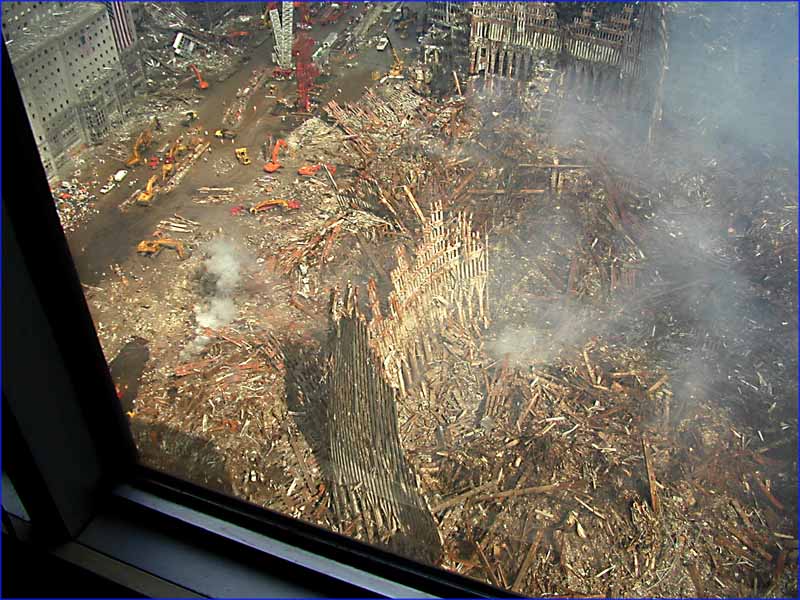
You say that like licensed engineers speak a different language and use a different set of physics than I do. I have no trouble navigating the report and understanding it if my questions are even addressed by the report.
Yet you ask for clarifications on things which are obvious to me as a layman.
What is "obvious" to you is also totally lacking in evidence.
Originally posted by exponent
15) On what 'state secrets' grounds was Sibel Edmonds' FBI whistleblower case barred from court by John Ashcroft?
a) Not a clue, I thought Sibel Edmonds' gag was due to a private company matter, and had very little to do with any 911 related activities. There's obviously a lot of noise here so I am not very confident in this answer!
I suggest you google able danger. Heck, even Joe Biden admitted that not everything concerning Able Danger has been revealed. The youtube video of him stating this has since been taken down, but simply googling "able danger" will get you tons of information.
Originally posted by bsbray11
Originally posted by jthomas
We forced Bsbray11 & Co. into an embarrassing strategic retreat.
What "retreat" is that? I'm still here, you know.
So is Creationism and Holocaust Denial.
Now they have fallen back into the woo of "people heard 'explosions', it must be explosives!", knowing full well that we showed they couldn't support a single one of their claims nor refute NIST at all on the collapse of WTC 7.
You have repeatedly failed to explain what in the hell you are talking about.
Only 9/11 Deniers have your "problem." of "not understanding." That you cannot give us any valid reasons to reject the NIST report on WTC 7 is entirely your problem. And your attempts to shift the burden of proof from your shoulders is laughable.
Deny onwards, bsbray11!
Originally posted by bsbray11
Originally posted by jthomas
Originally posted by bsbray11
If NIST can't answer my question, and you can't find specifically in the report where my question is answered, then that's not my problem.
Try again: www.abovetopsecret.com...
I think one of those "Moonie style interventions" to cure your rampant denial might be just the thing.
Perpetually linking back to your own nonsense is not posting anything from the NIST report, nor is it answering question #6 of the 20 from the OP.
Apparently, you have a hard time finding the NIST report. No wonder you haven't read it. You can't refute it until you read it, bsbray11. Here is the link:
wtc.nist.gov...
Originally posted by richierich
Why waste time and energy on people who are either too thick to comprehend reality and common sense?
Feel free to demonstrate. With evidence, not claims. We've been waiting 8 years, after all.
It is futile to explain over and over to an Official Story Drone any relevant factor because facts and odds and common sense mean nothing to them. their preconceived notions surpass any and all matters of fact.
Sorry, the fallacy of the appeal to OS doesn't work with rational people.
Since they are incapable of comprehending a series of events that are complicated and detailed, they cannot imagione anyone ELSE being detailed and conprehensive either. They simply cannot believe that people can be smart enough to pull off a major series of events...
Sorry, we adhere firmly to the scientific method. We don't give anyone exceptions. You have to provide overwhelming evidence.
You won't. You refuse. You can't.
Any questions?
Originally posted by scott3x
Heck, David Ray Griffin, who is now a pillar of the 9/11 truth movement, believed in the official story for a year or 2.
That just demonstrates how gullible 9/11 "Truthers" have always been. Remember, scott3x, you haven't been able to tell us who "they" are. Shouldn't you be able to easily tell us what your "pillar of the 9/11 truth movement" means?:
[atsimg]http://files.abovetopsecret.com/images/member/d98bae6f8909.jpg[/atsimg]
reply to post by bsbray11
My mistake. I was scanning and not fully reading some of your posts. I thought that you said that you had access to the structural drawings.
I don't think that there was any funny business with the building codes.
Let me explain what I think happened in simple terms.
Lets start by saying that the NYC building code specifies a building's Factor of Safety (FOS) be a 4. This is just a simplified explaination, I don't really know or care what the FOS actually is. Lets say that the original design for the towers had a FOS of 8, again I don't know or care what it actually was. In the middle of construction the towers ran into two problems. One was a shortage of the specified steel and the other was financial. The solution was to use a different, cheaper grade of steel for the rest of the construction. This would result in the FOS for the upper half of the towers being a 6, still above what the building code specified and quite safe.
Now for the conspiracy. The WTC was owned by the Port Authority of New York. The Port Authority was a joint venture between New York City, New York State and the State of New Jersey. All three are on the hook for any liability issues concerning the WTC. Immediately following the collapse of the towers, there were groups of lawyers planning lawsuits against the Port Authority and the airlines involved. The structural prints for the towers were already tightly controlled because of the lawsuits in progress from the 1993 bombing. When you take the sheer numbers of people killed, injured or traumatized on 9-11 the potential number of lawsuits could at worst bankrupt the States of New York and New Jersey and the City of New York. Even though the change in steel kept the towers well within the building code, it would be major ammunition for the Plaintiffs in a lawsuit. This is where the Federal Government stepped in with the Victims Compensation Fund. This would also explain why the steel from the towers was scrapped so fast.
In 1982 my Senior class trip was to New York City. Since I was also enrolled in a VoTech Drafting class at this time, I had to write a paper about something on this trip that related to drafting. After going up to the observation level at the WTC I decided to do my paper on the construction methods used to build the towers and the types of drawings necessary to document those methods. It was when I was doing research for this paper I found out about the change in the steel used in the construction. I have looked in every library that I can get to for one of the books that I used for this paper. I do not have a name for the book, but would recognize it if I saw it.
For those of you who don't think I know what I'm talking about, remember this. A New York jury found the Port Authority 68% liable for the 1993 bombing. This verdict has so far been upheld on appeal.
Port Authority Ruled Liable for 1993 World Trade Center Bombing
My mistake. I was scanning and not fully reading some of your posts. I thought that you said that you had access to the structural drawings.
I don't think that there was any funny business with the building codes.
Let me explain what I think happened in simple terms.
Lets start by saying that the NYC building code specifies a building's Factor of Safety (FOS) be a 4. This is just a simplified explaination, I don't really know or care what the FOS actually is. Lets say that the original design for the towers had a FOS of 8, again I don't know or care what it actually was. In the middle of construction the towers ran into two problems. One was a shortage of the specified steel and the other was financial. The solution was to use a different, cheaper grade of steel for the rest of the construction. This would result in the FOS for the upper half of the towers being a 6, still above what the building code specified and quite safe.
Now for the conspiracy. The WTC was owned by the Port Authority of New York. The Port Authority was a joint venture between New York City, New York State and the State of New Jersey. All three are on the hook for any liability issues concerning the WTC. Immediately following the collapse of the towers, there were groups of lawyers planning lawsuits against the Port Authority and the airlines involved. The structural prints for the towers were already tightly controlled because of the lawsuits in progress from the 1993 bombing. When you take the sheer numbers of people killed, injured or traumatized on 9-11 the potential number of lawsuits could at worst bankrupt the States of New York and New Jersey and the City of New York. Even though the change in steel kept the towers well within the building code, it would be major ammunition for the Plaintiffs in a lawsuit. This is where the Federal Government stepped in with the Victims Compensation Fund. This would also explain why the steel from the towers was scrapped so fast.
In 1982 my Senior class trip was to New York City. Since I was also enrolled in a VoTech Drafting class at this time, I had to write a paper about something on this trip that related to drafting. After going up to the observation level at the WTC I decided to do my paper on the construction methods used to build the towers and the types of drawings necessary to document those methods. It was when I was doing research for this paper I found out about the change in the steel used in the construction. I have looked in every library that I can get to for one of the books that I used for this paper. I do not have a name for the book, but would recognize it if I saw it.
For those of you who don't think I know what I'm talking about, remember this. A New York jury found the Port Authority 68% liable for the 1993 bombing. This verdict has so far been upheld on appeal.
Port Authority Ruled Liable for 1993 World Trade Center Bombing
Originally posted by exponent
If the measurement NIST made was completely accurate than yes, but it is not. As I have explained, there are error margins involved in the measurement, and it is in these margins that the resistance is felt.
How large can the error of margin be? In my last post yesterday I pointed out where, in the very same video in which they demonstrated the first movements downward of the north face, they were taking measurements accurate to within +- 1.8 inches. That doesn't leave too much room for error.
Also they had 3 other videos which they could have confirmed, denied or clarified this 32.2 ft/s^2 number.
So my contention is they had every capability to find a figure like 32.19 ft/s^ or 32.199 ft/s^ but they didn't; they found 32.2 ft/s^2. Thus their use of the terms "This free fall" drop, "at gravitational acceleration," and "equivalent to."
So they find this 32.2, then we're supposed to allow for the "negligible" of air (okay I can buy that), and then we're supposed to allow for at least 17 more "negligibles" for the columns on the north side alone? (not to mention the other 40 external "negligibles")
NIST to me is sort of like the cheating husband who tells his wife "Sorry honey. It took me an hour to travel the 10 miles home. For 59 minutes I was stuck in traffic crawling at 5 mph, but once I got out of traffic I just flew home." The wife would not accept this excuse just because the periods of travel he described averaged out to be technically correct. She would run to the kitchen and grab a knife.
Originally posted by richierich
Why waste time and energy on people who are either too thick to comprehend reality and common sense? It is futile to explain over and over to an Official Story Drone any relevant factor because facts and odds and common sense mean nothing to them. their preconceived notions surpass any and all matters of fact.
Since they are incapable of comprehending a series of events that are complicated and detailed, they cannot imagione anyone ELSE being detailed and conprehensive either. They simply cannot believe that people can be smart enough to pull off a major series of events involved in a common purpose, so the alternative for their tortured logic is to simply deny the truth and throw out silly statements that have nothing to do with refutation of evidence but servce to placate themselves that they have summarized as much as their feeble intellects can muster.
I know, it is sad. but they cannot see it; thats the key to remember. They are incapable of seeing a big picture and so ascribe those same limitations to all people.Even if you produced hard and fast evidence, which has been donw time and again the the 9-11 events, many of these Drones would insist that what they are seeing is not in fact what it is. it comes down at last to: What do you believe, me or your lying eyes?
I prefer to believe the empirical and circumstantial evidence taken as a whole, which leads any thinking person to only ONE conclusion; 9-11 was an inside job.
You bring up an interesting point...
Who are these people that spend so much time with the evidence but fail to recognize all the anomalies and contradictions in the official story?
1. People in denial. They look for evidence to support their preconceived notions but never investigate anything besides the official story. They have never even considered anything besides the OS as a possibility.
2. Disinfo Agents. I'll admit, I never really thought these people existed but certain people do make you wonder. How can you possibly spend so much time with the evidence and not see something so obvious?
Their are a few things that really do make someone seem like a disinfo agent.
1. Claiming their are NO anomalies in the official story. This is just completely absurd.
2. Pretending the Official Story doesn't exist and is simply their own version of the truth after reviewing all the evidence (completely impossibility because all the evidence, like videos, was not released to the public).
3. Saying the truth movement is extremely small and completely useless but they still spend hours a day fighting them...
new topics
-
Israel attacking Iran again.
Middle East Issues: 6 minutes ago -
Michigan school district cancels lesson on gender identity and pronouns after backlash
Education and Media: 10 minutes ago -
When an Angel gets his or her wings
Religion, Faith, And Theology: 1 hours ago -
Comparing the theology of Paul and Hebrews
Religion, Faith, And Theology: 1 hours ago -
Pentagon acknowledges secret UFO project, the Kona Blue program | Vargas Reports
Aliens and UFOs: 2 hours ago -
Boston Dynamics say Farewell to Atlas
Science & Technology: 2 hours ago -
I hate dreaming
Rant: 3 hours ago -
Man sets himself on fire outside Donald Trump trial
Mainstream News: 5 hours ago -
Biden says little kids flip him the bird all the time.
Politicians & People: 5 hours ago -
The Democrats Take Control the House - Look what happened while you were sleeping
US Political Madness: 6 hours ago
top topics
-
The Democrats Take Control the House - Look what happened while you were sleeping
US Political Madness: 6 hours ago, 16 flags -
In an Historic First, In N Out Burger Permanently Closes a Location
Mainstream News: 8 hours ago, 14 flags -
Biden says little kids flip him the bird all the time.
Politicians & People: 5 hours ago, 8 flags -
A man of the people
Medical Issues & Conspiracies: 13 hours ago, 8 flags -
Man sets himself on fire outside Donald Trump trial
Mainstream News: 5 hours ago, 7 flags -
Pentagon acknowledges secret UFO project, the Kona Blue program | Vargas Reports
Aliens and UFOs: 2 hours ago, 5 flags -
4 plans of US elites to defeat Russia
New World Order: 15 hours ago, 4 flags -
Sheetz facing racial discrimination lawsuit for considering criminal history in hiring
Social Issues and Civil Unrest: 6 hours ago, 3 flags -
Boston Dynamics say Farewell to Atlas
Science & Technology: 2 hours ago, 3 flags -
Are you ready for the return of Jesus Christ? Have you been cleansed by His blood?
Religion, Faith, And Theology: 11 hours ago, 3 flags
active topics
-
Israel attacking Iran again.
Middle East Issues • 3 • : Dandandat3 -
Michigan school district cancels lesson on gender identity and pronouns after backlash
Education and Media • 1 • : ImagoDei -
Thousands Of Young Ukrainian Men Trying To Flee The Country To Avoid Conscription And The War
Other Current Events • 50 • : DBCowboy -
I hate dreaming
Rant • 6 • : Hecate666 -
Israeli Missile Strikes in Iran, Explosions in Syria + Iraq
World War Three • 102 • : DumbNut -
The Democrats Take Control the House - Look what happened while you were sleeping
US Political Madness • 61 • : Threadbarer -
Man sets himself on fire outside Donald Trump trial
Mainstream News • 32 • : cherokeetroy -
Pentagon acknowledges secret UFO project, the Kona Blue program | Vargas Reports
Aliens and UFOs • 5 • : Ophiuchus1 -
-@TH3WH17ERABB17- -Q- ---TIME TO SHOW THE WORLD--- -Part- --44--
Dissecting Disinformation • 546 • : MetalThunder -
Boston Dynamics say Farewell to Atlas
Science & Technology • 4 • : Terpene