It looks like you're using an Ad Blocker.
Please white-list or disable AboveTopSecret.com in your ad-blocking tool.
Thank you.
Some features of ATS will be disabled while you continue to use an ad-blocker.

Prove or disprove a Pentagon fly-over.
page: 6share:
Originally posted by Reheat
Show me that it's a part of the "Official Story". No discussion, just show a factual Official Report. According to you, you're off topic. The next time you mention the Taxi Cab, I'll report you as off topic.
This is the problem I have with everything 911. There is no officially released report analyzing the taxi cab being hit by a pole, nor of the pole being hit by the airplane, but officials have had no problem using this, and other unlooked at information, to further spread their generally accepted version of events that day.
How did the officials use the Taxi Cab damage in their version of events? Ladies and gentlemen of the jury I give you exhibit P200027.
www.vaed.uscourts.gov...
Ladies and gentlemen of the jury, though we have no documentary evidence connecting the foreground with the background in this submitted picture we will gladly allow your inference of said photo to speak for itself. We will gladly let said photo influence the accounting of events of that day you may hold, but we will not bother to show that, as we present evidence of the damage caused to the pentagon, the foreground light pole nor the foreground taxi has anything to do with presented evidence of Pentagon damage in the background.
I, being an official prosecutor for the Justice department of the United States (thus OFFICIAL), present these pictures for an accounting (thus STORY) of the terrible damage inflicted upon Washington that fateful day. (thus OFFICIAL STORY). Thank you. Prosecution rests.
Originally posted by tezzajw
Complete bunk, Dave. None of that paragraph helps you to prove your alternate hypothesis that a jet plane hit the light pole and made it puncture the taxi window.
I'm trying to mentally wrap my mind around this ghastly statement but I still don't quite get it. Are you seriously implying that the jet knocking over the light pole is an *alternative* hypothesis and that something else is the accepted explanation?!?
I know the truthers are horribly lax in their research into the events of the day, but THAT goes to the extreme.
The neutral reader to this thread will note that Dave is trying to avoid his alternate hypothesis. Is it that tough for you to prove, Dave?
Since I have no "alternative hypothesis" there is nothign for me to avoid. I merely post the facts as they were presented to me, rather than making up stories out of thin air to suit a specific agenda as the truthers are doing.
Here's one fact as an example- the streetlight that hit the taxi was but one among several that were knocked over. All the other streetlights knocked over are all in a straight line leading toward the spot where the destruction of the Pentagon occurred. If you cannot (or intentionally refuse to) see how knocked over street lights are therefore relevent to the discussion of whether or not there was a fly over, then there is little more I can add to this discussion.
Again, that's the sound of logic dying another death. You're the one who hasn't proved what happened, so how can I accept it? The null hypothesis shows a light pole laying on the road next to a taxi - that's it. That's what I accept until an alternate hypothesis can be proven.
If you're goign to accept that, then you're necessarily goign to have to accept that gravity makes things fall down. If you're going to accept THAT, then you'll necessarily have to accept that a falling object will fall on whatever is beneath it. That's not counting having to accept that light poles are, in fact, near freeways and that taxis are likewise found on freeways.
The argument that a falling lightpole couldn't have hit the taxi is spurious and not worthy of debate, as a falling lightpole would certainly have hit whatever was beneath it at the time, whether it happened to be a taxi, the ground, a trailer truck, or a circus clown. The debate, rather, is what actually caused the lightpole to fall to begin with.
Before I continue, can you accept that premise, at least?
Goooody. So you've got some modelling equations to show me? I can't rely upon your opinion, I need concrete facts that will prove your claim.
Are you seriously suggesting that I need to provide modelling equations to support the claim that gravity causes things to fall down...?
Originally posted by Reheat
This animation was used in a presentation to a NORAD/FAA conference to demonstrate/sell animation software. It IS NOT based on data from ANYONE except the imagination of a software engineer who used it as an example for the demonstration.
Wow- a half-dozen posts from Reheat & Co. about straw, herrings, Fred Astaire, Madonna, etc.
So does Mr. Reheat have any supporting documentation for his "sales conference" assertion? Perhaps he is not aware that animation was released on a FOIA request #2007-6970 of FAA on Sept. 12, 2008. Apparently a John Farmer has a court case against the NTSB, U.S. DoJ, and U.S. DOT (presumably the FAA branch here).
Here is the link where the animation was originally posted:
(You may want to right-click "save as" with this link)
FAA FOIA animation
The website's description states:
FAA September 12, 2008 Release
These are files received in response to the pending Federal Court Complaint on September 12, 2008.
The filename of that animation is listed on page 2 of the FOIA cover letter here:
FOIA cover letter
It certainly looks like an official U.S. DOT/(FAA) letterhead to me.
Also, the STK animation was discussed long ago on this thread here:
Mystery Flt 77 ?Fuselage? Part at Pentagon
www.abovetopsecret.com...
[edit on 26-5-2009 by rhunter]
Originally posted by rhunter
For your information I do have an email from the individual in the Company that produced the animation, but I will not post it as I do not have permission to do so. Would it make any difference anyway? Likely not...... No, I will not seek permission to do so, you can contact the company yourself if you want. Their contact information is available on the 'net. No doubt, you won't as it would destroy the delusion.
I am quite familiar with what was released via the FOIA and to whom. This illustrates a sincere desire for Government Agencies to comply, even if it does take a law suit to do so. That animation likely should not have been released as it was not appropriate for the purpose of the FOIA.
I noted that you didn't address the COMMON SENSE issues I discussed and I don't wonder why. Perhaps you'd like to explain how either NORAD or the FAA had knowledge of this mysterious flight path that is not supported by the NTSB? Also, explain why it is aerodynamically implausible for a transport category aircraft?
Originally posted by Reheat
I noted that you didn't address the COMMON SENSE issues I discussed and I don't wonder why. Perhaps you'd like to explain how either NORAD or the FAA had knowledge of this mysterious flight path that is not supported by the NTSB? Also, explain why it is aerodynamically implausible for a transport category aircraft?
Oh, you didn't know? The FAA apparently also FOIA-released RADAR data from Reagan National DCA, Dulles IAD, Baltimore BWI, and Andrews AFB (ADW) with that animation.
Processed FAA Radar Data
These are files in which the spherical coordinates (latitude and longitude) have been calculated using the polar coordinates (azimuth and range). Each TRACON site has a different azimuth offset and the following values were used to calculate true azimuth.
DCA and ADW = -9.5 degrees
IAD = -10 degrees
BWI = -10.5 degrees
Combined Excel Workbook (37 mb)
DCA Comma-delimited (5 mb)
ADW Comma-delimited (4 mb)
IAD Comma-delimited (3 mb)
BWI Comma-delimited (5 mb)
FOIA page
Andrews ADW
As far as "aerodynamically implausible," aren't you the same Mr. Reheat that came up with these implausible flightpath numbers?
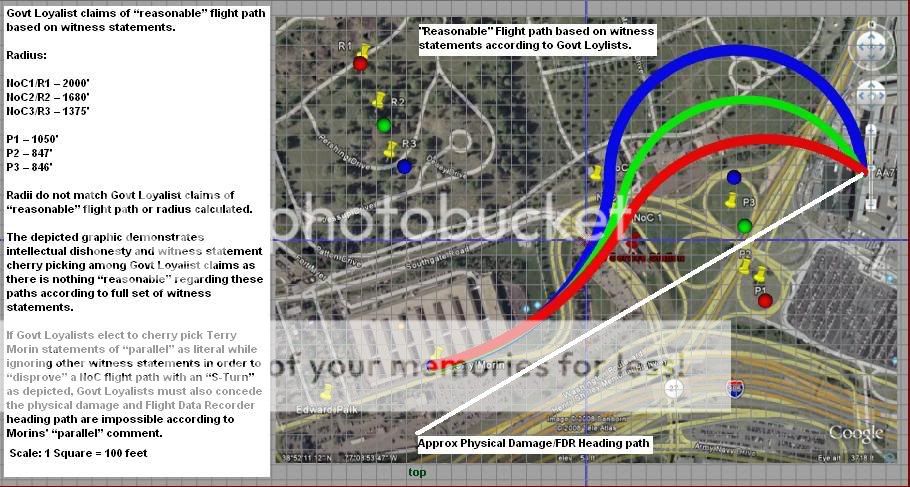
CAD analysis of Reheat drawing
"Exponents' example posted earlier is just an example. He only used two of the witnesses to show the ONLY possible flight path that could be flown North of the Citgo Station."
-Reheat admits NoC flight path is possible. 9/25/2008
www.abovetopsecret.com...
z3.invisionfree.com...
As far as "COMMON SENSE," I mainly see a lot of ALL CAPS and "proof by assertion" fallacies (like "STRAWMAN" repeatedly) from Mr. Reheat and other typical pseudoskeptic posting behavior.
Proof by assertion fallacy
Proof by assertion
Proof by assertion is a logical fallacy in which a proposition is repeatedly restated regardless of contradiction. Sometimes this may be repeated until challenges dry up, at which point it is asserted as fact due to its not being contradicted (argumentum ad nauseam). In other cases its repetition may be cited as evidence of its truth, in a variant of the appeal to authority or appeal to belief fallacies.
This logical fallacy is sometimes used as a form of rhetoric by politicians, or during a debate as a filibuster. In its extreme form, it can also be a form of brainwashing. Modern politics contains many examples of proof by assertions. This practice can be observed in the use of political slogans, and the distribution of "talking points," which are collections of short phrases that are issued to members of modern political parties for recitation to achieve maximum message repetition. The technique is also sometimes used in advertising.[citation needed]
The technique is described in a saying, often attributed to Lenin, as "A lie told often enough becomes the truth", [1] although the user may not be intentionally promoting a lie and may just believe an illogical or faulty proposition.
See also
* Big Lie
* Talking points
* Brainwashing
* Weasel word
* Denialism
Denialism
Denialism is the term used to describe the position of governments, political parties, business groups, interest groups, or individuals who reject propositions on which a scientific or scholarly consensus exists. Such groups and individuals are said to be engaging in denialism when they seek to influence policy processes and outcomes by using rhetorical tactics to give the appearance of argument or legitimate debate, when in actuality there is none.[1][2][3]
Illegitimate methodology and tactics
Denialism is a form of propaganda covering a variety of activities. It can be as simple as like-minded individuals signing letters of dissent, or as elaborate as professional grey or black propaganda campaigns by advertising and marketing agencies.
Denialism can arise from personal ideologies, or desire for profit. Industry groups may seek to protect markets from damaging facts and information. Political groups may work to advance their agendas. Combinations of these may work in concert with interest groups on issues of mutual importance. Despite the disparity between these groups and the motives behind them, the tactics used by denialists are largely similar. Common features include:[13]
# Selectivity - Relying upon discredited or flawed work supporting their idea while dismissing more credible work; presenting discredited or superseded papers to make a field look like it is based on weak research. Inflating favorable 'evidence' while discounting the contradictory, often while misrepresenting the significance of each. The selective use of evidence by denialists includes quote mining and cherry picking.
# False experts - Citing paid, partisan scientists or self-appointed 'experts,' whose credentials are often in an unrelated field.[15][16][17]
# Impossible expectations - Seeking to prevent the implementation of sound policies or acceptance of a theory by citing the absence of 'complete' or 'absolute' knowledge.
Or do you no longer deny that conspiracies exist? [Rejecting conspiracy denial would negate support of the "Saudi boxcutter jihadi" 19 conspiring highjacker theory BTW, just so that you know.] It really can't be both ways- it is a simple question of which conspiracy theory one chooses to defend in a 9/11 context.
Originally posted by rhunter
Oh, you didn't know? The FAA apparently also FOIA-released RADAR data from Reagan National DCA, Dulles IAD, Baltimore BWI, and Andrews AFB (ADW) with that animation.
What does that radar show? Why don't you post the radar data and make your implied point that the animation is based on that?
Originally posted by Reheat
What does that radar show? Why don't you post the radar data and make your implied point that the animation is based on that?
My point was that FAA radar was simultaneously released with that FAA animation as part of the same FOIA package. Perhaps Mr. Reheat should concentrate more on what is stated outright rather than "implications." Guessing games are something of a losing proposition, I have found so far.
There may or may not be a correlation- it remains to be seen/proven, and I haven't seen any documentation either way (but I have been watching since Sept./Oct. 2008 on this FAA release though). I have been waiting for a comprehensive review/write-up of that FAA data, but I haven't seen one anywhere. Do you have any documents for us that you can post here for public review then Mr. Reheat, or must we all proceed with only the documentation and FAA radar data that I already posted a link to above? (edit: "FOIA page" link in my post above, right above the "ADW" link)
FAA RADAR is actually getting a little off-topic here, and I've seen what sticklers some are about that, so maybe it would be better if Mr. Reheat posted something on this existing FAA thread-
FAA or 84RADES data falsified, or both.
www.abovetopsecret.com...
[edit on 27-5-2009 by rhunter]
Originally posted by rhunter
Originally posted by Reheat
What does that radar show? Why don't you post the radar data and make your implied point that the animation is based on that?
My point was that FAA radar was simultaneously released with that FAA animation as part of the same FOIA package. Perhaps Mr. Reheat should concentrate more on what is stated outright rather than "implications." Guessing games are something of a losing proposition, I have found so far.
I'm waiting for YOU to post the radar data that you contend supports the animation. You just said it was released, so post it. Your link is broken now, but I looked at it yesterday and it DOES NOT include radar data, it's merely a listing of what was released.
Originally posted by rhunter
There may or may not be a correlation- it remains to be seen/proven, and I haven't seen any documentation either way (but I have been watching since Sept./Oct. 2008 on this FAA release though). I have been waiting for a comprehensive review/write-up of that FAA data, but I haven't seen one anywhere.
There is no correlation between any radar data and the animation, period. Why do you need someone to interpret it for you, anyway? Not capable yourself? I assure you that all of the radar you've mentioned does exist, yet you won't/can't post it to prove your assertions. THAT SPEAKS VOLUMES!
Originally posted by rhunter
FAA RADAR is actually getting a little off-topic here,
No, it's not off-topic. People are using the animation in an attempt to prove a flight path supporting a fly-over. You contend that it's supported by something, maybe, and I'll telling you it's not. The animation is simply "artistic license" used by a software engineer to demonstrate software capability. You claim the animation is supported, so the burden of proof is on you and you have FAILED, so far.
Originally posted by rhunter
FAA or 84RADES data falsified, or both.
www.abovetopsecret.com...
Funny stuff!!!!! You expect me to read through a thread by a bunch of know nothings with an agenda? Thank again! There is no falsification of any FAA radar data and the 84th Rades data is correct and valid......
[edit on 27-5-2009 by Reheat]
[edit on 27-5-2009 by Reheat]
I guess he's forgetting all the NoC witnesses, FAA animation, FDR data, NTSB animation, aero anomalies of striking the poles/Pentagon, etc.
Any chance you could pop over to my over thread and answer that one,
tiny, teensy question about UA93 while you're here Reheat (you know
the thread you keep avoiding)?
Sorry, back on topic now. Do you believe the C-130 was 'shadowing'
AA77 as some witnesses claim? If not, what you suggest about the
perception/honesty of those witnesses?
Any chance you could pop over to my over thread and answer that one,
tiny, teensy question about UA93 while you're here Reheat (you know
the thread you keep avoiding)?
Sorry, back on topic now. Do you believe the C-130 was 'shadowing'
AA77 as some witnesses claim? If not, what you suggest about the
perception/honesty of those witnesses?
reply to post by turbofan
OK. look....
I, on my own, have researched and provided a lot of info to directly answer much of what you just asked in your latest post, if you will bother to look objectively.
Sorry if it gets uncomfortable, but this THREAD is about, specifically, a Pentagon "fly-over". That is it. Period.
It has been well-discussed, so far --- and any Off Topic obfuscations are unwarranted.
LaBtoP (sorry if I butchered his/her username) has been very compelling, in his/her research....but, I feel I have brought another spectrum of enlightenment to the discourse.
EVERY little bit of data helps....and, it's important that each bit isn't tainted by nonsense.....
Pure, true data, not 'innuendo' nor 'personal opinion' that has been colored by others' should be considered as "facts"....but, all too often, this happens to be the case.
if ANYONE can substantially show how various airplanes as alleged to be the 'drones' or the 'duplicates', or whatever term you wish to use to imply that AAL77 was a "FAKED" instance, as regards the Pentagon damage....then please!!! Describe, in detail, how actual airplanes make turns...please provide specifics.
I am referring to to math -- shouldn't be too difficult -- angle of bank versus airspeed equals radius of turn. EVERYONE should know this already.
Reference: A small airplane, at about 120 knots airspeed...a 30 degree angle of bank, is close to a 'Standard Rate' turn of about 3 degrees per second.
Modern jets, in normal OPS, limited to 25 degrees of bank, and at higher airspeeds, are generally assumed to complete a "half-standard" rate-of-turn, by ATC. Thus, the radius of the turn is accounted for, by Controllers.
Doesn't matter WHO is flying a B757 or B767....the math is the math.
Steeper the angle of bank, in a sustained turn, higher the G-force. Gs can be mitigated by descending during a high-angle-of-bank turn, though....and, of course, airspeed increases in such a maneuver....so, eventually, the added kinetic energy has to be dealt with. BUT, if your intent is suicide, guess you really don't give a hoot, do you??? Just aim at your target, keeping the point in the windshield roughly stable....YOU WILL HIT IT!!!!!
OK. look....
I, on my own, have researched and provided a lot of info to directly answer much of what you just asked in your latest post, if you will bother to look objectively.
Sorry if it gets uncomfortable, but this THREAD is about, specifically, a Pentagon "fly-over". That is it. Period.
It has been well-discussed, so far --- and any Off Topic obfuscations are unwarranted.
LaBtoP (sorry if I butchered his/her username) has been very compelling, in his/her research....but, I feel I have brought another spectrum of enlightenment to the discourse.
EVERY little bit of data helps....and, it's important that each bit isn't tainted by nonsense.....
Pure, true data, not 'innuendo' nor 'personal opinion' that has been colored by others' should be considered as "facts"....but, all too often, this happens to be the case.
if ANYONE can substantially show how various airplanes as alleged to be the 'drones' or the 'duplicates', or whatever term you wish to use to imply that AAL77 was a "FAKED" instance, as regards the Pentagon damage....then please!!! Describe, in detail, how actual airplanes make turns...please provide specifics.
I am referring to to math -- shouldn't be too difficult -- angle of bank versus airspeed equals radius of turn. EVERYONE should know this already.
Reference: A small airplane, at about 120 knots airspeed...a 30 degree angle of bank, is close to a 'Standard Rate' turn of about 3 degrees per second.
Modern jets, in normal OPS, limited to 25 degrees of bank, and at higher airspeeds, are generally assumed to complete a "half-standard" rate-of-turn, by ATC. Thus, the radius of the turn is accounted for, by Controllers.
Doesn't matter WHO is flying a B757 or B767....the math is the math.
Steeper the angle of bank, in a sustained turn, higher the G-force. Gs can be mitigated by descending during a high-angle-of-bank turn, though....and, of course, airspeed increases in such a maneuver....so, eventually, the added kinetic energy has to be dealt with. BUT, if your intent is suicide, guess you really don't give a hoot, do you??? Just aim at your target, keeping the point in the windshield roughly stable....YOU WILL HIT IT!!!!!
posted by weedwhacker
reply to post by turbofan
Reference: A small airplane, at about 120 knots airspeed...a 30 degree angle of bank, is close to a 'Standard Rate' turn of about 3 degrees per second.
Modern jets, in normal OPS, limited to 25 degrees of bank, and at higher airspeeds, are generally assumed to complete a "half-standard" rate-of-turn, by ATC. Thus, the radius of the turn is accounted for, by Controllers.
Doesn't matter WHO is flying a B757 or B767....the math is the math.
Steeper the angle of bank, in a sustained turn, higher the G-force.
Makes sense. So how does the actual aircraft PROVEN Over the Naval Annex and North of the Citgo by multiple living verified eyewitnesses, with the FAA concurring on the flight path, manage to somehow get down to the 5 light poles laying on the ground; requiring two steep banks in less than three seconds?
How does any pilot react so quickly and how do the control surfaces react so quickly in less than three seconds? You are the self-proclaimed expert fantastic super pilot; please enlighten us.
[atsimg]http://files.abovetopsecret.com/images/member/1025b113dbed.jpg[/atsimg]
reply to post by weedwhacker
Not really sure how my post is a dereail? I'm asking about the witnesses
and facts to present a case.
Do you believe the C-130 shadow, or not?
Not really sure how my post is a dereail? I'm asking about the witnesses
and facts to present a case.
Do you believe the C-130 shadow, or not?
Originally posted by turbofan
I guess he's forgetting all the NoC witnesses, FAA animation, FDR data, NTSB animation, aero anomalies of striking the poles/Pentagon, etc.
Any chance you could pop over to my over thread and answer that one,
tiny, teensy question about UA93 while you're here Reheat (you know
the thread you keep avoiding)?
Does anyone else find it ODD that every time this joker shows up in an established thread he WANTS TO CHANGE THE SUBJECT.
Speaking of the subject being discussed, what about the "FAA" animation? Is the FAA into making cartoons? What did they based it on? You call it "FAA" animation, so prove that the FAA endorses the flight path. Psssst, STK made it, not the FAA.
Oh, one more....... since you asked about the word "shadowing" in Keith Wheelhouse's statement, which caused your hero's to liable him and reject him as a valid witness, why didn't the words "the airplane impacted the building" cause your hero's to reject and liable most of the "so called" NOC witnesses? According to your hero's both statements are wrong, so why reject one and not the other? After all, Wheelhouse is just one person. There are what(?) 10 of 13 saying AA 77 impacted the Pentagon? I mean, after all, according to your heros a number of witnesses saying the same thing is scientific corroboration? What's the difference?
[edit on 27-5-2009 by Reheat]
reply to post by weedwhacker
Weedwhacker, your excellent lecture on aerodynamics fell on deaf ears. I'm sure that's not surprising to you.
That little graphic just displayed by SPreston shows:
* A turn radius of 2313.7'
* A bank angle of 82.6 Degrees
* A G force of 7.8 G's
This is at the speed supported by the FDR. Don't you think the wings would fold?
Is it any wonder no one of consequence takes them seriously!
Weedwhacker, your excellent lecture on aerodynamics fell on deaf ears. I'm sure that's not surprising to you.
That little graphic just displayed by SPreston shows:
* A turn radius of 2313.7'
* A bank angle of 82.6 Degrees
* A G force of 7.8 G's
This is at the speed supported by the FDR. Don't you think the wings would fold?
Is it any wonder no one of consequence takes them seriously!
The following was posted in the wrong thread. I'm reposting it here in the appropriate thread.
My reply follows:
Originally posted by rhunter
"Mr. Reheat" started an interesting line of questioning that led to discovery of some "anomalies" on the FAA data being discussed on this thread. The website that originally distributed those FOIA files, AAL77.com has been "up and down" lately. Apparently, it went offline today according to Mr. Reheat- I got this message when I tried it earlier today:
AAL77.COM - Temporarily down
This site is temporarily down while a move takes place in order to more reliably host the contents. Please direct any enquiries to exponent AT 911db....
Original FAA FOIA distribution website, www.aal77.com...
The "ups and downs" were discussed here:
ups and downs
I contacted a person who has most of the FAA FOIA files saved, and we were able to upload the 4 comma separated data files purported to have come from the FAA FOIA release on or about Sept. 12, 2008 (that this thread discusses). The data files are a little large- in the 2-5 Megabyte range, each.
Here are the data files in question, exactly "as released" as they were obtained them from a then-public website:
FOIA cover letter (smaller than data files)
www.datafilehost.com...
ADW TRACON
www.datafilehost.com...
BWI TRACON
www.datafilehost.com...
DCA TRACON
www.datafilehost.com...
IAD TRACON
www.datafilehost.com...
Strangely, there are no comma-separated files (".csv" file extension type) listed in the FOIA cover letter linked above, on any of the 4 pages of filenames that I notices. This is very curious, and now the original source is no longer online...
Since "Mr. Reheat" is so quick to proclaim "can't/won't provide" and the source website has been somewhat "erratic," some screen captures are provided below from when the original source website (aal77.com) was up yesterday:
Website Header
www.pict.com...
FAA ".csv" data section
www.pict.com...
www.pict.com...
Pinnacle Docs
www.pict.com...
My reply follows:
Originally posted by Reheat
reply to post by rhunter
It is hilariously appropriate that you picked THIS thread to reply to my request for radar data to support your assertion that the "FAA" "NORAD" animation is supported by radar.
For other than the Form letters you've linked, you don't understand a darn thing you've posted. It is appropriately posted in a hilarious thread, which has vividly shown that the OP has no clue what he is hyperventilating about.
Let me save us both time as it's certainly not worth my time to continue
"pulling teeth". You have MADE NO POINT and you have not supported the assertion that the FAA radar data supports the animation used in another thread.
The last radar return from AA 77 on it's approach to the Pentagon was from DCA and the return was approximately abeam the Sheraton Hotel on it's known flight path toward the Pentagon. That return supports the FDR RO2 (readout) in terms of position. There are NO OTHER RADAR RETURNS from AA 77 to support the animation.
You can stop wasting time now as you have miserably FAILED.
Originally posted by Reheat
I'm waiting for YOU to post the radar data that you contend supports the animation. You just said it was released, so post it. Your link is broken now, but I looked at it yesterday and it DOES NOT include radar data, it's merely a listing of what was released.
...
There is no correlation between any radar data and the animation, period. Why do you need someone to interpret it for you, anyway? Not capable yourself? I assure you that all of the radar you've mentioned does exist, yet you won't/can't post it to prove your assertions. THAT SPEAKS VOLUMES!
To hopefully shorten an already long (and growing) thread (with all these multiple posts made by some), rather than I guess which post "Mr. Reheat" means, perhaps "Mr. Reheat" can quote where I ever stated "the radar data supports the animation" or even "fly over" specifically. I don't remember doing that. I have noticed that many "Mr. Reheat" posts seem to be based upon implications and assumptions and ...
Critical Thinking mini-lesson 12
false implication
The fallacy of false implication occurs when a statement, which may be clear and even true, implies that something else is true or false when it isn't. For example, if I write in my 30-day evaluation log of an employee that on May 15th she was on time for work, someone reading the log might infer that this was unusual and that usually the employee did not arrive on time. Perhaps she is always on time but by indicating her promptness just once I can give the false impression that she is usually late for work.
False implication fallacy
Mr. Reheat also appears to have a propensity for ALL CAPS, boldface, large text, and sometimes all of the above when he is presumably upset:
www.abovetopsecret.com...
I'm not going to do the BIG & BOLD thing here (or say "FAILED")- I don't crave attention like some apparently do- but just to add in context and for clarification:
Originally posted by rhunter
My point was that FAA radar (edit: data) was simultaneously released with that FAA animation as part of the same FOIA package. Perhaps Mr. Reheat should concentrate more on what is stated outright rather than "implications." Guessing games are something of a losing proposition, I have found so far.
There may or may not be a correlation- it remains to be seen/proven, and I haven't seen any documentation either way (but I have been watching since Sept./Oct. 2008 on this FAA release though). I have been waiting for a comprehensive review/write-up of that FAA data, but I haven't seen one anywhere.
"Mr. Reheat" has apparently assumed all kinds of things about what I know or do not. I'm quite confused as to what he bases any of these assumptions upon. I would like to see "Mr. Reheat" present some supporting documentation for his assumptions sometime soon or "cease and desist." His triple posts (or more on multiple threads apparently) are taking a lot of time for the ATS readers, I'm sure. WOW!
Originally posted by Reheat
No, it's not off-topic. People are using the animation in an attempt to prove a flight path supporting a fly-over. You contend that it's supported by something, maybe, and I'll telling you it's not. The animation is simply "artistic license" used by a software engineer to demonstrate software capability. You claim the animation is supported, so the burden of proof is on you and you have FAILED, so far.
...
Funny stuff!!!!! You expect me to read through a thread by a bunch of know nothings with an agenda? Thank again! There is no falsification of any FAA radar data and the 84th Rades data is correct and valid......
Although I do not expect you to do any particular thing (as you appear to already have "all of" the "answers"), here you go, Mr. Reheat- links to those FAA RADAR data files previously distributed by a "John Farmer:"
www.abovetopsecret.com...
I didn't have the original files, but I was able to get someone to upload those to a server (with the very-thin documentation provided IMO, as I understand the communications loop so far).
Now all ATS members- we need to be very careful not to go "off-topic" here- "weedwhacker" and "Mr. Reheat" are very sensitive about this!
Originally posted by weedwhacker
"EVERY little bit of data helps....and, it's important that each bit isn't tainted by nonsense.....
Pure, true data, not 'innuendo' nor 'personal opinion' that has been colored by others' should be considered as "facts"....but, all too often, this happens to be the case."
www.abovetopsecret.com...
This means that (weedwhacker and) I don't want to see any more unsupported opinions on this thread- or some people might get upset, and for Pete's sake- no more nonsense talk about Fred Astaire and Madonna! Since Reheat has already given me warnings/ultimatums on other threads here about "on topic" off topic," and "wrong thread," I think he might actually believe himself to be part of the Moderating staff here at ATS. Shhhh- we don't want to spoil his fun! He has a wonderful imagination, I have noticed so far, BTW.
P.S. "Mr. Reheat-" did you notice this thread here? It appears to have your cryptic username on it. It looks moderately interesting.
Reheat - Hole in the Ground
www.abovetopsecret.com...
[edit on 27-5-2009 by rhunter]
Let us try first to get something very important cleared, and mutually accepted.
The time from O'Brien's identification of the plane tagged as LOOK as a B757, until impact; and subsequently the speeds involved. And we know quite well how both planes flew, in what pattern, when we just follow the officially given details, be it reluctantly given after FOIA requests and a still pending court case.
That must be cleared, since I have the impression that the aeronautically schooled ones in this thread and in many others, strongly clench to a totally impossible airspeed at different trajectories.
They seem not aware that f.ex. Sean Boger explicitly gave the number of seconds he estimated for the plane to cover the distance from coming in his eyesight from over the Annex building, until impact.
Which does not fit at all the officially stated impact speed of 530 miles per hour.
We know that distance, and the seconds for both cases.
In both cases, the distance is a fixed known, but not the time and thus speed involved.
It turns out that my assumption that the two Farmer audio tapes (DCA and TYSON) started after an introductory by a woman, of 46 and 14 seconds respectively, was erroneous.
Both tapes start at the tape's beginning.
I found my posts back, on the TYSON timeline subject, in this thread,
"FAA or 84RADES data falsified, or both" :
www.abovetopsecret.com...
And found the official TYSON textual timeline back in this link :
aal77.com...
This above PDF-document's TYSON (Washington National tower) timeline gives a time of 13:36:29 = 09:36:29 EST, when ""GOFER06 advised it looked like a B757."" That's the C-130 pilot O'Brien who said it.
The TYSON audio tape excerpt I made gave a (now revised 14 secs by me, see further on) timestamp of 09:37:14 EST.
Tape starts at 09:25:00 , and we hear O'Brien say "a 757" at 12:14 in the tape.
It also had an earlier entry,
09:33:45 Dulles Approach advised TYSON of a fast moving primary target currently 10 miles west of DCA (Reagan Tower).
And a few more entries, which give us an exact time frame to try to calculate an average speed.
"Try", since we have no exact straight line for that trajectory from 10, to 5 miles from DCA, to impact just north of DCA, but we can always assume a straight line first and calculate average speed.
We have to check in the officially released last 757 trajectory, that huge circling around, how far a 10 mile and 5 mile line extends from DCA Reagan International tower. And if part of the circle the 757 made is involved.
Then calculate again the 5 miles trajectory seen by O'Brien at the moment of plane-identification, as a bit longer partly curved trajectory, which consists for a short distance, for that last 90° part of the 390° circle, as a thus minimal-partly curved trajectory, and then a nearly straight line to impact :
09:36:16 GOFER06 issued traffic, eleven o'clock (a bit left of him), 5 miles(from DCA Reagan Airport) northbound, fast moving, type and altitude unknown.
09:36:22 GOFER06 advises traffic in sight at twelve o'clock. (In front of him)
09:36:29 GOFER06 advised it looked like a B757.
09:36:51 GOFER06 states the traffic is still in a descent and rolling out northeast bound (at low altitude).
09:38:00 GOFER06 advised aircraft was down just northwest of DCA (Reagan Airport).
Thus we have 10 miles, if covered in a nearly straight line by a plane in 4:15 minutes = 255 seconds.
That's an average speed of 1 mile in 25.5 secs, which is 141 miles per hour.
Such a B757 would be falling out of the sky, if it flew so slow, I think.
Now let's assume a partly curved trajectory, as in reality this also occurred :
Then we assume 15 miles, covered in the same 255 seconds,
that's an average speed of 1.5 mile in 25.5 seconds,
which is 1 mile in 17 seconds, which is 211 miles per hour.
That is not even near the proposed 530 miles per hour all official sources posted here, as the end speed at impact.
Now let's be more precise, since we also fairly well know the time and distance covered for the 5 mile point.
O'Brien was moving to the west, while the B757 was moving to the north, when it crossed his path in front of him.
At 36:16 O'Brien reports it at 5 miles from DCA, but he is moving away from DCA himself, while the B757 is keeping the same distance to DCA until it makes a slight turn northeast bound, and then flies in a nearly straight line towards the west wall of the Pentagon.
Thus, let us take the 09:36:51 time stamp as the B757 being still 5 miles from DCA Reagan Airport, then straight to the Pentagon where it crashed at 09:38:00.
That's 5 miles in 69 seconds, which is 1 mile in 13.8 seconds and that is an average speed of :
3600 secs (1 hr) divided by 13.8 secs x 1 mile is 265 miles per hour.
Which is still only half the proposed end speed of 530 miles per hour.
Someone will say that the plane only accelerated f.ex. during the last mile to reach that 530 miles per hour impact speed.
Then the plane needed how many seconds to cover that 1 mile?
Well, 3600 / 530 = 6.8 secs if it flew 530 miles/hr the full mile, which it of course did not, it build up speed.
But we still have a full 69 seconds time read out from the TYSON records for the last 5 miles, including that last mile. That means it had in that case, 62.2 seconds to cover the first 4 miles, which lowers the already calculated average speed of 265 miles/hr over the full last 5 miles to 15.55 seconds per every 1 mile of that first 4 miles, which is 231 miles per hour.
So if it instantly accelerated in the last mile to those 530 miles/hr, then the average speed over the first 4 miles goes already considerably down. But it needs much more seconds in reality to build up speed, so that would lower the first 4 miles average speed even more.
And the plane would have fallen from the sky again, before it could have ever accelerated.
The time from O'Brien's identification of the plane tagged as LOOK as a B757, until impact; and subsequently the speeds involved. And we know quite well how both planes flew, in what pattern, when we just follow the officially given details, be it reluctantly given after FOIA requests and a still pending court case.
That must be cleared, since I have the impression that the aeronautically schooled ones in this thread and in many others, strongly clench to a totally impossible airspeed at different trajectories.
They seem not aware that f.ex. Sean Boger explicitly gave the number of seconds he estimated for the plane to cover the distance from coming in his eyesight from over the Annex building, until impact.
Which does not fit at all the officially stated impact speed of 530 miles per hour.
We know that distance, and the seconds for both cases.
In both cases, the distance is a fixed known, but not the time and thus speed involved.
It turns out that my assumption that the two Farmer audio tapes (DCA and TYSON) started after an introductory by a woman, of 46 and 14 seconds respectively, was erroneous.
Both tapes start at the tape's beginning.
I found my posts back, on the TYSON timeline subject, in this thread,
"FAA or 84RADES data falsified, or both" :
www.abovetopsecret.com...
And found the official TYSON textual timeline back in this link :
aal77.com...
This above PDF-document's TYSON (Washington National tower) timeline gives a time of 13:36:29 = 09:36:29 EST, when ""GOFER06 advised it looked like a B757."" That's the C-130 pilot O'Brien who said it.
The TYSON audio tape excerpt I made gave a (now revised 14 secs by me, see further on) timestamp of 09:37:14 EST.
Tape starts at 09:25:00 , and we hear O'Brien say "a 757" at 12:14 in the tape.
It also had an earlier entry,
09:33:45 Dulles Approach advised TYSON of a fast moving primary target currently 10 miles west of DCA (Reagan Tower).
And a few more entries, which give us an exact time frame to try to calculate an average speed.
"Try", since we have no exact straight line for that trajectory from 10, to 5 miles from DCA, to impact just north of DCA, but we can always assume a straight line first and calculate average speed.
We have to check in the officially released last 757 trajectory, that huge circling around, how far a 10 mile and 5 mile line extends from DCA Reagan International tower. And if part of the circle the 757 made is involved.
Then calculate again the 5 miles trajectory seen by O'Brien at the moment of plane-identification, as a bit longer partly curved trajectory, which consists for a short distance, for that last 90° part of the 390° circle, as a thus minimal-partly curved trajectory, and then a nearly straight line to impact :
09:36:16 GOFER06 issued traffic, eleven o'clock (a bit left of him), 5 miles(from DCA Reagan Airport) northbound, fast moving, type and altitude unknown.
09:36:22 GOFER06 advises traffic in sight at twelve o'clock. (In front of him)
09:36:29 GOFER06 advised it looked like a B757.
09:36:51 GOFER06 states the traffic is still in a descent and rolling out northeast bound (at low altitude).
09:38:00 GOFER06 advised aircraft was down just northwest of DCA (Reagan Airport).
Thus we have 10 miles, if covered in a nearly straight line by a plane in 4:15 minutes = 255 seconds.
That's an average speed of 1 mile in 25.5 secs, which is 141 miles per hour.
Such a B757 would be falling out of the sky, if it flew so slow, I think.
Now let's assume a partly curved trajectory, as in reality this also occurred :
Then we assume 15 miles, covered in the same 255 seconds,
that's an average speed of 1.5 mile in 25.5 seconds,
which is 1 mile in 17 seconds, which is 211 miles per hour.
That is not even near the proposed 530 miles per hour all official sources posted here, as the end speed at impact.
Now let's be more precise, since we also fairly well know the time and distance covered for the 5 mile point.
O'Brien was moving to the west, while the B757 was moving to the north, when it crossed his path in front of him.
At 36:16 O'Brien reports it at 5 miles from DCA, but he is moving away from DCA himself, while the B757 is keeping the same distance to DCA until it makes a slight turn northeast bound, and then flies in a nearly straight line towards the west wall of the Pentagon.
Thus, let us take the 09:36:51 time stamp as the B757 being still 5 miles from DCA Reagan Airport, then straight to the Pentagon where it crashed at 09:38:00.
That's 5 miles in 69 seconds, which is 1 mile in 13.8 seconds and that is an average speed of :
3600 secs (1 hr) divided by 13.8 secs x 1 mile is 265 miles per hour.
Which is still only half the proposed end speed of 530 miles per hour.
Someone will say that the plane only accelerated f.ex. during the last mile to reach that 530 miles per hour impact speed.
Then the plane needed how many seconds to cover that 1 mile?
Well, 3600 / 530 = 6.8 secs if it flew 530 miles/hr the full mile, which it of course did not, it build up speed.
But we still have a full 69 seconds time read out from the TYSON records for the last 5 miles, including that last mile. That means it had in that case, 62.2 seconds to cover the first 4 miles, which lowers the already calculated average speed of 265 miles/hr over the full last 5 miles to 15.55 seconds per every 1 mile of that first 4 miles, which is 231 miles per hour.
So if it instantly accelerated in the last mile to those 530 miles/hr, then the average speed over the first 4 miles goes already considerably down. But it needs much more seconds in reality to build up speed, so that would lower the first 4 miles average speed even more.
And the plane would have fallen from the sky again, before it could have ever accelerated.
I thought the DCA tape (Stephenson-SS conversation) started 46 seconds later than tape begin.
I thought the TYSON tape (O'Brien conversation) started 14 seconds later than tape begin.
That was both wrong, they both started directly at the tape begin, and they superimposed the female explanatory voice over the first parts of them. Thus the 46 and 14 seconds I deducted from the official times were faulty, and must be edited back to the real times.
I gave a DCA (Reagan Airport Stephenson) tape time of 09:37:14 EST as the moment that the Secret Service told the Reagan Airport air controller that the blip he saw on his screen was a B757. That's 46 seconds too late however for that tape.
It turns out that the 46 seconds I thought were to subtract from the total tape length as introduction time for the female voice is in error. The time line starts at tape beginning. Illogical, however, so be it.
My DCA tower tape post had a time at first deducted of 09:37:14 EST for the first interference of the Secret Service with the Reagan Airport DCA tower air traffic controller, Chris Stephenson.
But that must be corrected now to 09:38:00 EST, since we must add those 46 seconds intro time to the tape's total time. Tape beginning plus 6:00 minutes, that's 09:32:00 + 06:00 = 09:38:00.
Thus, the first lines of my former posts at page 5 :
www.abovetopsecret.com...
must be changed. I put the corrected times in ( ) :
"" The TYSON O'Brien tape :
1 DCA 108 TYSON 1325-1348.mp3
starts after an intro of 00:14 seconds.
(New: no, it does not, it starts directly at 09:25:00.)
It covers the time from 09:25 to 09:48 EST.
At 12:08 the controller informs O'Brien, that he has traffic at 11 o'clock and asked him if he could identify that traffic.
At 12:14 O'Brien answers : a 757.
That was EST time 09:37:00 (No, it was 09:37:14), and the DCA tape from above (see the one below now) read 09:37:14 ( No, it was 09:38:00) when the Secret Service guy told the Reagan controller that the plane he saw identified on his scope as LOOK was a 757.
That gives the Secret Service which obviously listened in to both controllers, 15 seconds ( No, even more, 46 seconds to be correct) to contact the Reagan Tower.
Both tapes timelines fit. ""
(Perfectly I must even say now; the Secret Service first identified via O'Brien that it was a 757, then informed the Reagan Tower controller Chris Stephenson 46 seconds later that it was a B757.)
And thus this earlier post of mine must be changed to :
The DCA Stephenson Tape:
"" 06:00 was 5 minutes and 14 seconds into the tape (46 seconds intro first), which is
09:32:00 + 5:14 = 09:37:14 EST.
[No, it's "757"conversation started at 09:32:00 + 06:00 = 09:38:00 ]
06:00 :
FAA: I got all departures stop!
06:01 to 06:10 :
? : You see a guy 5-West?
FAA: Yeah.
? : It's a 757.
FAA: That GOPHER guy?
? : No, the LOOK.
FAA: The LOOK is a 757?
? : Right.
06:10: FAA: OK: ""
Lesson learned again for me, and it should be noted by the rest also:
Check and re-check your own calculations and "facts" repeatedly, or you are the start of a lot of misunderstanding.
Btw, this does not affect the data in my above post.
I thought the TYSON tape (O'Brien conversation) started 14 seconds later than tape begin.
That was both wrong, they both started directly at the tape begin, and they superimposed the female explanatory voice over the first parts of them. Thus the 46 and 14 seconds I deducted from the official times were faulty, and must be edited back to the real times.
I gave a DCA (Reagan Airport Stephenson) tape time of 09:37:14 EST as the moment that the Secret Service told the Reagan Airport air controller that the blip he saw on his screen was a B757. That's 46 seconds too late however for that tape.
It turns out that the 46 seconds I thought were to subtract from the total tape length as introduction time for the female voice is in error. The time line starts at tape beginning. Illogical, however, so be it.
My DCA tower tape post had a time at first deducted of 09:37:14 EST for the first interference of the Secret Service with the Reagan Airport DCA tower air traffic controller, Chris Stephenson.
But that must be corrected now to 09:38:00 EST, since we must add those 46 seconds intro time to the tape's total time. Tape beginning plus 6:00 minutes, that's 09:32:00 + 06:00 = 09:38:00.
Thus, the first lines of my former posts at page 5 :
www.abovetopsecret.com...
must be changed. I put the corrected times in ( ) :
"" The TYSON O'Brien tape :
1 DCA 108 TYSON 1325-1348.mp3
starts after an intro of 00:14 seconds.
(New: no, it does not, it starts directly at 09:25:00.)
It covers the time from 09:25 to 09:48 EST.
At 12:08 the controller informs O'Brien, that he has traffic at 11 o'clock and asked him if he could identify that traffic.
At 12:14 O'Brien answers : a 757.
That was EST time 09:37:00 (No, it was 09:37:14), and the DCA tape from above (see the one below now) read 09:37:14 ( No, it was 09:38:00) when the Secret Service guy told the Reagan controller that the plane he saw identified on his scope as LOOK was a 757.
That gives the Secret Service which obviously listened in to both controllers, 15 seconds ( No, even more, 46 seconds to be correct) to contact the Reagan Tower.
Both tapes timelines fit. ""
(Perfectly I must even say now; the Secret Service first identified via O'Brien that it was a 757, then informed the Reagan Tower controller Chris Stephenson 46 seconds later that it was a B757.)
And thus this earlier post of mine must be changed to :
The DCA Stephenson Tape:
"" 06:00 was 5 minutes and 14 seconds into the tape (46 seconds intro first), which is
09:32:00 + 5:14 = 09:37:14 EST.
[No, it's "757"conversation started at 09:32:00 + 06:00 = 09:38:00 ]
06:00 :
FAA: I got all departures stop!
06:01 to 06:10 :
? : You see a guy 5-West?
FAA: Yeah.
? : It's a 757.
FAA: That GOPHER guy?
? : No, the LOOK.
FAA: The LOOK is a 757?
? : Right.
06:10: FAA: OK: ""
Lesson learned again for me, and it should be noted by the rest also:
Check and re-check your own calculations and "facts" repeatedly, or you are the start of a lot of misunderstanding.
Btw, this does not affect the data in my above post.
Originally posted by Reheat
You claim the animation is supported, so the burden of proof is on you and you have FAILED, so far.
In this quote, Reheat has stated that a claim being made needs to be proven.
I agree.
Thanks for making that logically obvious statement, Reheat. Remember, though, that every claim being made needs to be proven...
Originally posted by Reheat
The animation is simply "artistic license" used by a software engineer to demonstrate software capability.
Hey, you made a claim, Reheat. Please prove that it was artistic license?
[edit on 28-5-2009 by tezzajw]
For clarification:
My speed calculations were necessary to counter one little fact necessary to make the following post of Reheat come true, which it apparently does not :
"" Weedwhacker, your excellent lecture on aerodynamics fell on deaf ears. I'm sure that's not surprising to you.
That little graphic just displayed by SPreston shows:
* A turn radius of 2313.7'
* A bank angle of 82.6 Degrees
* A G force of 7.8 G's
This is at the speed supported by the FDR. Don't you think the wings would fold?
Is it any wonder no one of consequence takes them seriously! ""
Many of the other actual day of 9/11 interviewed witnesses I added to the list of CIT interviewed witnesses, who all corroborate in fact those CIT witnesses, explained a much slower flying object than the officially declared speed at impact.
And a very low to the ground flying plane gives the impression of flying much faster than it's actual air speed.
Look up at the passing planes at 10,000 meters high, they appear to fly slow, but we all know their cruising speeds are about 800 km per hour.
If you saw that same plane at near ground level flying at that speed, you would have nearly no change to register any detail of it, so fast it will past your eye sight.
My speed calculations were necessary to counter one little fact necessary to make the following post of Reheat come true, which it apparently does not :
"" Weedwhacker, your excellent lecture on aerodynamics fell on deaf ears. I'm sure that's not surprising to you.
That little graphic just displayed by SPreston shows:
* A turn radius of 2313.7'
* A bank angle of 82.6 Degrees
* A G force of 7.8 G's
This is at the speed supported by the FDR. Don't you think the wings would fold?
Is it any wonder no one of consequence takes them seriously! ""
Many of the other actual day of 9/11 interviewed witnesses I added to the list of CIT interviewed witnesses, who all corroborate in fact those CIT witnesses, explained a much slower flying object than the officially declared speed at impact.
And a very low to the ground flying plane gives the impression of flying much faster than it's actual air speed.
Look up at the passing planes at 10,000 meters high, they appear to fly slow, but we all know their cruising speeds are about 800 km per hour.
If you saw that same plane at near ground level flying at that speed, you would have nearly no change to register any detail of it, so fast it will past your eye sight.
new topics
-
Cats Used as Live Bait to Train Ferocious Pitbulls in Illegal NYC Dogfighting
Social Issues and Civil Unrest: 2 minutes ago -
The Good News According to Jesus - Episode 1
Religion, Faith, And Theology: 1 hours ago -
HORRIBLE !! Russian Soldier Drinking Own Urine To Survive In Battle
World War Three: 4 hours ago -
Bobiverse
Fantasy & Science Fiction: 6 hours ago -
Florida man's trip overseas ends in shock over $143,000 T-Mobile phone bill
Social Issues and Civil Unrest: 6 hours ago -
Former Labour minister Frank Field dies aged 81
People: 9 hours ago -
SETI chief says US has no evidence for alien technology. 'And we never have'
Aliens and UFOs: 10 hours ago
top topics
-
President BIDEN Vows to Make Americans Pay More Federal Taxes in 2025 - Political Suicide.
2024 Elections: 15 hours ago, 18 flags -
Florida man's trip overseas ends in shock over $143,000 T-Mobile phone bill
Social Issues and Civil Unrest: 6 hours ago, 8 flags -
SETI chief says US has no evidence for alien technology. 'And we never have'
Aliens and UFOs: 10 hours ago, 7 flags -
Former Labour minister Frank Field dies aged 81
People: 9 hours ago, 4 flags -
Bobiverse
Fantasy & Science Fiction: 6 hours ago, 3 flags -
Ode to Artemis
General Chit Chat: 16 hours ago, 3 flags -
This is our Story
General Entertainment: 13 hours ago, 3 flags -
HORRIBLE !! Russian Soldier Drinking Own Urine To Survive In Battle
World War Three: 4 hours ago, 1 flags -
Cats Used as Live Bait to Train Ferocious Pitbulls in Illegal NYC Dogfighting
Social Issues and Civil Unrest: 2 minutes ago, 1 flags -
The Good News According to Jesus - Episode 1
Religion, Faith, And Theology: 1 hours ago, 0 flags
active topics
-
President BIDEN Vows to Make Americans Pay More Federal Taxes in 2025 - Political Suicide.
2024 Elections • 81 • : Consvoli -
Cats Used as Live Bait to Train Ferocious Pitbulls in Illegal NYC Dogfighting
Social Issues and Civil Unrest • 0 • : FlyersFan -
The Good News According to Jesus - Episode 1
Religion, Faith, And Theology • 2 • : Springbok -
Bobiverse
Fantasy & Science Fiction • 2 • : Springbok -
HORRIBLE !! Russian Soldier Drinking Own Urine To Survive In Battle
World War Three • 18 • : watchitburn -
Florida man's trip overseas ends in shock over $143,000 T-Mobile phone bill
Social Issues and Civil Unrest • 13 • : Consvoli -
British TV Presenter Refuses To Use Guest's Preferred Pronouns
Education and Media • 137 • : Annee -
Remember These Attacks When President Trump 2.0 Retribution-Justice Commences.
2024 Elections • 54 • : Asher47 -
LaBTop is back at last.
Introductions • 15 • : LaBTopOld -
Russia Ukraine Update Thread - part 3
World War Three • 5727 • : YourFaceAgain