It looks like you're using an Ad Blocker.
Please white-list or disable AboveTopSecret.com in your ad-blocking tool.
Thank you.
Some features of ATS will be disabled while you continue to use an ad-blocker.

The Best 11 9/11 Questions to 'throw back' at 'Official Believers....!
page: 9share:
reply to post by wmd_2008
You are right! My opinion is the WTC were bought down by uses of explosive. However, the Government story (lies) fails to stand up to real science. I know what I see in all the video and what I see is a Hughes EXPLOSIONS! My eyes do not lie to me, only man lies to me. The only way “you” are going to change my mind of what brought the WTC down, is you show me the science that supports the Government story, because I have not found any so far. In addition, do “not” tell me about NIST report because I have read it.
Furthermore, there have been complaints filed against NIST, and I know for a fact a spokes person for NIST said they did not look in to doing any study on demolition bring down the WTC, because there where no eye witness, moreover the whole world knows that is a lie.
Therefore, if you have a way to prove to me with creditable science that the WTC fell down, other than explosions I am all ears.
You are right! My opinion is the WTC were bought down by uses of explosive. However, the Government story (lies) fails to stand up to real science. I know what I see in all the video and what I see is a Hughes EXPLOSIONS! My eyes do not lie to me, only man lies to me. The only way “you” are going to change my mind of what brought the WTC down, is you show me the science that supports the Government story, because I have not found any so far. In addition, do “not” tell me about NIST report because I have read it.
Furthermore, there have been complaints filed against NIST, and I know for a fact a spokes person for NIST said they did not look in to doing any study on demolition bring down the WTC, because there where no eye witness, moreover the whole world knows that is a lie.
Therefore, if you have a way to prove to me with creditable science that the WTC fell down, other than explosions I am all ears.
Originally posted by cashlink
reply to post by wmd_2008
You are right! My opinion is the WTC were bought down by uses of explosive. However, the Government story (lies) fails to stand up to real science. I know what I see in all the video and what I see is a Hughes EXPLOSIONS! My eyes do not lie to me, only man lies to me. The only way “you” are going to change my mind of what brought the WTC down, is you show me the science that supports the Government story, because I have not found any so far. In addition, do “not” tell me about NIST report because I have read it.
Furthermore, there have been complaints filed against NIST, and I know for a fact a spokes person for NIST said they did not look in to doing any study on demolition bring down the WTC, because there where no eye witness, moreover the whole world knows that is a lie.
Therefore, if you have a way to prove to me with creditable science that the WTC fell down, other than explosions I am all ears.
So what is so special about your EYES do you have x-ray VISION you people claim explosives because you cant grasp the magantide of the forces here can you!
Can you PROVE that the STRUCTURE could resist A 40,500+ ton impact dropping 10-12 ft? at least as seen on the video.
CAN you prove someone MANAGED to plant explosives without anyone ever seeing it done or evidence it has been done?
Funny thing as well WHEN people LIKE myself post REAL science YOU guys seem to ignore what is stated.
Freefall speed of collapsing floors YET video evidence shows objects
falling faster than the floors thats impossible is it NOT?
Graph shown tempreture of steel against strength thats REAL!
On the net people with YOUR belief have the following theories!
Holographic planes BECAUSE they cant understand how plane could punch through the wall!
MISSILE PODS! LASER SPOTS! THE SECRET EXPLOSIVES
One site even claims they were planted during construction
I have SHOWN science that supports what is the MOST likely cause
of what happened BECAUSE YOU choose to either ignore or JUST cannot grasp the concept of structural failure or things like dead loads,dynamic loads etc THATS NOT MY PROBLEM.
This was one of the most filmed/ photographed disasters to happen.
The thing is that I think alot of people with your idea of what happened just get to carried away by it and some have been watching to much CSI when they blow up their phone/camera video IT DOESN'T get sharper YOU lose detail you get MPEG/JPEG ARTIFACTS shapes seem to change etc but why let things like that be brought down by ACTUAL SCIENCE is not as exciting if all it was is a plane crash is it.
Take this example I posted before did a destruction test to a componant on the side of a building explained to the guy operating the hoist what I was doing told him what would happen when it failed and when it went BANG! (explosion!?) he thought the hoist had went
His face was a picture can you see what I mean if you have never seen anything like that OR have no idea of the concepts behind it YOU can jump to the wrong conclusion! Even when someone TELLS you what will happen!
but like I have hinted before thats human nature.
[edit on 3-12-2008 by wmd_2008]
[edit on 3-12-2008 by wmd_2008]
Originally posted by wmd_2008
Can you PROVE that the STRUCTURE could resist A 40,500+ ton impact dropping 10-12 ft? at least as seen on the video.
I don't know what video you have seen but I haven't seen a video of the cap suspended in air and then suddenly falls 10-12 feet.
Remember that the floors are distinctly seperate from each other and only connected by the columns. When columns buckle, they still offer resistance (so no freefall impact of 10-12 feet).
Can you tell us how the cap seperated from the rest of the structure to become this 40,500+ ton mass impacting? As the only impact would be the few floors that were in the area of the buckle. The remaining intact columns above this area of bucklng would still be connected to the floors above this area and would still be holding them.
So, the only things that would be affected from the total weight would be the columns themselves. Which, BTW, had been holding this weight up for over 30 years. And if they even did buckle from creep, it wouldn't be a sudden freefall.
So, can you do what NIST can't and explain the global collapse without just saying "and global collapse ensued", "it was inevitable" etc., etc.?
CAN you prove someone MANAGED to plant explosives without anyone ever seeing it done or evidence it has been done?
This question is silly coming from someone in the construction/engineering field.
Funny thing as well WHEN people LIKE myself post REAL science YOU guys seem to ignore what is stated.
Yet, I've been posting physics and engineering facts for 3 years now only to be ignored.
Freefall speed of collapsing floors YET video evidence shows objects
falling faster than the floors thats impossible is it NOT?
I don't see most people calling it freefall speeds. Mostly, I see "near freefall speeds". We could never have total freefall speed unless we lived in a vacuum.
Graph shown tempreture of steel against strength thats REAL!
Yes it is. Now prove the steel reached that temperature and I'll listen.
On the net people with YOUR belief have the following theories!
Holographic planes BECAUSE they cant understand how plane could punch through the wall!
MISSILE PODS! LASER SPOTS! THE SECRET EXPLOSIVES
One site even claims they were planted during construction
And here it is. The lumping of everyone who disagrees with the official story into the looney bin.
[edit on 12/3/2008 by Griff]
reply to post by Griff
Look at this video at about the 1.59 mark watch the South Tower above the impact area DROP (
uk.youtube.com...
Then this picture look at upper part of building still intact but leaning over!
cnparm.home.texas.net...
That happened because the impacted area of the building had steelwork damaged by the impact and then weakend by the fires like I have stated many times the steel DOSEN'T have to melt to be unable to withstand this dynamic load as 40,500 + tons of steel and concrete in the floors above DROP you can see it the video & the pictures thats if certain people want to
I doubt very much if the terrorists thought they could do so much damage but its now history.
[edit on 3-12-2008 by wmd_2008]
Look at this video at about the 1.59 mark watch the South Tower above the impact area DROP (
uk.youtube.com...
Then this picture look at upper part of building still intact but leaning over!
cnparm.home.texas.net...
That happened because the impacted area of the building had steelwork damaged by the impact and then weakend by the fires like I have stated many times the steel DOSEN'T have to melt to be unable to withstand this dynamic load as 40,500 + tons of steel and concrete in the floors above DROP you can see it the video & the pictures thats if certain people want to
I doubt very much if the terrorists thought they could do so much damage but its now history.
[edit on 3-12-2008 by wmd_2008]
I think the best evidence that 9/11 was an inside job, is the Governments disturbing history of initiating conflicts not only in America, but all over
the world, that alone puts SERIOUS question Marks on the day.
My personal opinion as that it was indeed an inside job, it was just too damn convenient at that time to have a "terror" attack on America.
It literally reeks of false flag.
My personal opinion as that it was indeed an inside job, it was just too damn convenient at that time to have a "terror" attack on America.
It literally reeks of false flag.
posted by wmd_2008
Funny thing as well WHEN people LIKE myself post REAL science YOU guys seem to ignore what is stated.
Freefall speed of collapsing floors YET video evidence shows objects
falling faster than the floors thats impossible is it NOT?
Real science? Is that what you call it? We thought it was called 9-11 Special Suspended Physics Laws 21st Century science. No it is not impossible for objects outside the floors to fall faster than the floors falling at near free-fall speeds with the Natural Law of Inertia and resistance violated, if those objects outside the floors were accelerated by explosive forces.
by David S Chandler - Physics-Mathematics Educator - BS-Physics (IPS); MS-Mathematics
Rapid ejection of debris on the northwest corner of the tower. Regular speed & 50% slow motion.
[edit on 12/3/08 by SPreston]
reply to post by wmd_2008
I knew I shouldn't have responded to someone who has managed to accumulate -1993 points in the whole 14 days they have been here. That's an average of -142 points a day.
I am not a points whore, but, to me, this shows a lot about a person's presence here. If you can't keep a positive point score, then it is obvious that you are either a troll or can't follow the forum rules or both. Hence, this will be the last time I speak with you until you show something more than regurgitation. Good day to you.
I knew I shouldn't have responded to someone who has managed to accumulate -1993 points in the whole 14 days they have been here. That's an average of -142 points a day.
I am not a points whore, but, to me, this shows a lot about a person's presence here. If you can't keep a positive point score, then it is obvious that you are either a troll or can't follow the forum rules or both. Hence, this will be the last time I speak with you until you show something more than regurgitation. Good day to you.
posted by wmd_2008
Look at this video at about the 1.59 mark watch the South Tower above the impact area DROP
Did you also notice the molten metal dropping at 1:18 which the cameraman spotted and followed with his camera? What do you suppose that had to do with the top 30 story block toppling? Were the 9-11 perpetrators severing support columns? Melting core columns or something else. This was long after the plane crash, so why would aluminum be melting at this time?
posted by wmd_2008
Then this picture look at upper part of building still intact but leaning over!
That happened because the impacted area of the building had steelwork damaged by the impact and then weakend by the fires like I have stated many times
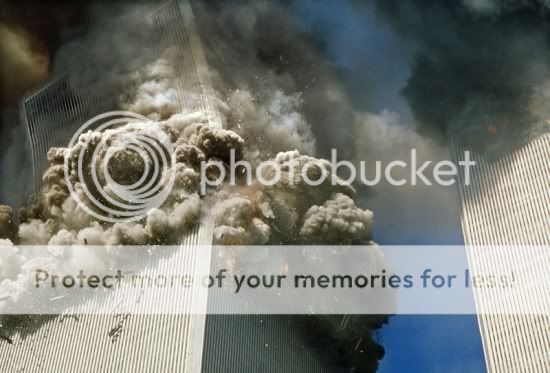
No you are quite mistaken. That top 30 story block of floors fell away from the point of aircraft impact; to the east and not the south. So your assumption is once again incorrect. Don't you ever look at the actual available evidence rather than that specious nonsense you have collected in your brain cells?
Can you explain how that 30 story block of floors SUDDENLY ceased toppling and disintegrated into dust? Since the 30 story block was at the top, what fell on it and crushed it into powder; besides explosives blasting it into powder? Also remember that the core structure would have still been penetrating through that 30 story block, unless the core structure had been severed by explosives at that level.
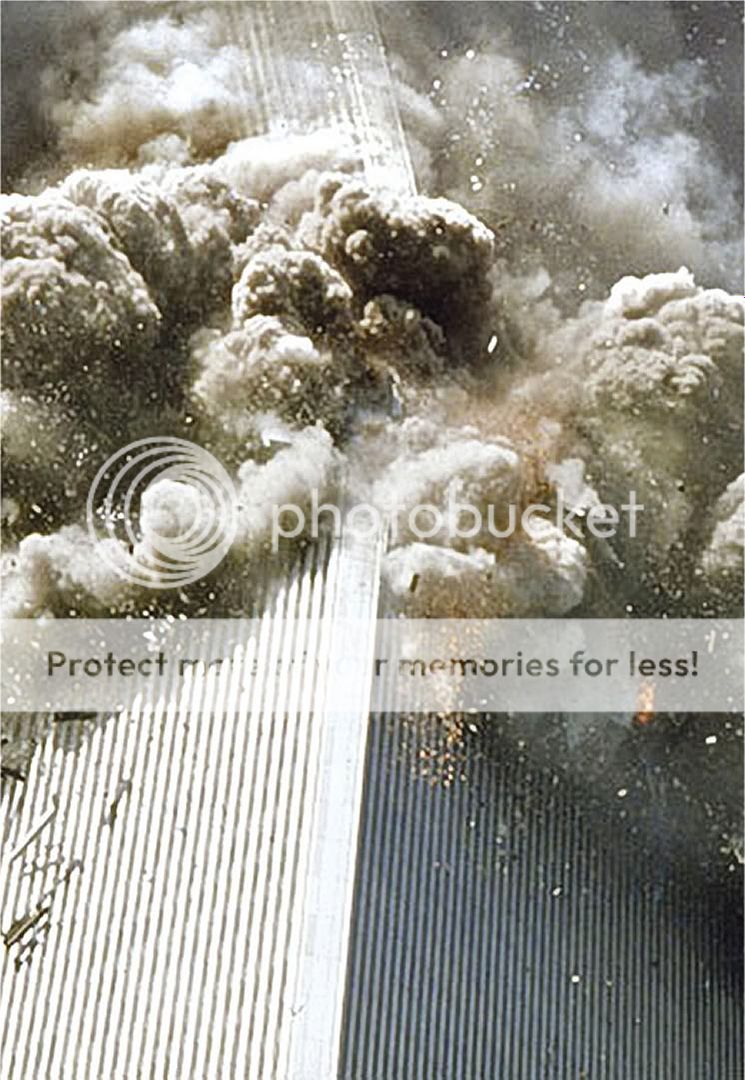
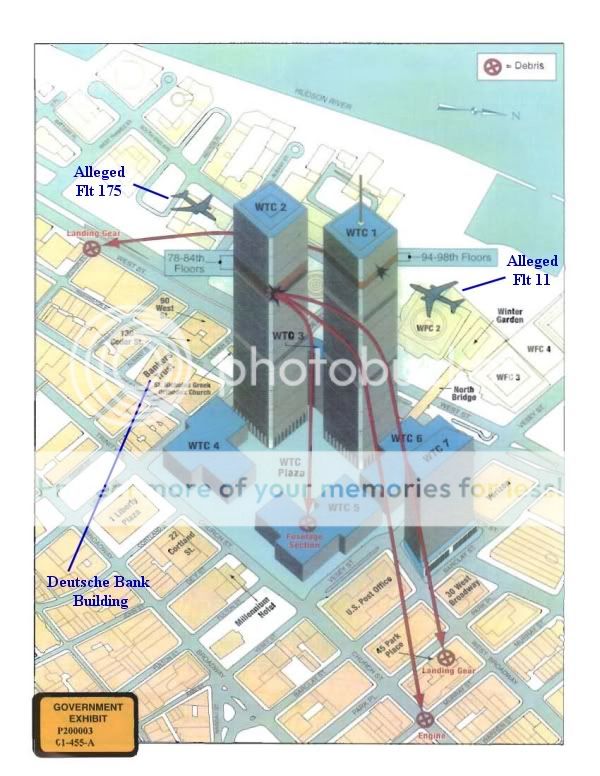
Aso notice how the explosions destroying the core structure are running down the building at the corner at least 7-8 floors ahead of the dropping floors. How do you explain that happening scientifically and HONESTLY?
posted by Griff
reply to post by wmd_2008
I knew I shouldn't have responded to someone who has managed to accumulate -1993 points in the whole 14 days they have been here. That's an average of -142 points a day.
I am not a points whore, but, to me, this shows a lot about a person's presence here. If you can't keep a positive point score, then it is obvious that you are either a troll or can't follow the forum rules or both. Hence, this will be the last time I speak with you until you show something more than regurgitation. Good day to you.
Yes indeed; a troll or disinfo agent or just another desperate pseudoskeptic unable to accept that his government god and savior could do such a thing to the American people. But they have done it before haven't they, in Dallas and Waco and Oklahoma City and numerous other instances of government betrayal of their own citizens?
[edit on 12/3/08 by SPreston]
reply to post by SPreston
Ah you mean the melted plastic or anything else that could have melted in the flames why assume its metal ? because it suits your agenda
I did not SAY it fell to the SOUTH did I? Have you saw the hole were the smoke is escaping what made the hole! WHERE does the collapse start
Cant believe it another guy with x-ray vision you CANT see the top 30 floors disitegrate because its engulfed in dust by the time it gets to 2.02. 3 secs into collapse so think again!
Have you seen the pictures of how the floor structure was supported on the outside walls of the build. How this for an explanation you may have seen the pictues of long lines of columns posted by someone earlier WHAT YOU assume is a explosive shock wave could just as easily be internal structures giving way under the massive dynamic load pushing from above.
Not troll, Not an American and because I spoke my Mind I lost points should have read up on that I suppose.
Points I have made re Impact point the LOADS above that, the effect of temperature on steel, are real STATEMENTS like
I can see its explosives which someone keeps stating is not a fact ITS HIS OPINOIN.
The Empire State building crash which keeps being mentioned
is NOT COMPARABLE smaller plane ,less speed, less mass
into a building of a totally different construction so is a BS statement.
Then when the Pentagon is mentioned its the otherway round with you guys. Its why was there hardly anything left of the plane GUESS
what its designed to take blasts/massive impacts FUNNY THAT!
At least I have a background in the subject I am talking about
as you can see from my previous post I wonder how may of the people who believe the conspiracy nonsense actually have any EXPERIENCE in the subjects they CLAIM to plainly see.
Any real structural engineer that I have spoken to re this always have the same thing to say.
Two Planes struck the towers,compromised the structural integrity of the buildings due to impact and resultant fires and the rest you saw on tv.
On forgot your point re what crushed the top 30 floors HOW about this they crushed themselves because they fell between 1000-1300ft depending on what floor you talk about :
[edit on 3-12-2008 by wmd_2008]
[edit on 3-12-2008 by wmd_2008]
[edit on 3-12-2008 by wmd_2008]
[edit on 3-12-2008 by wmd_2008]
[edit on 3-12-2008 by wmd_2008]
Ah you mean the melted plastic or anything else that could have melted in the flames why assume its metal ? because it suits your agenda
I did not SAY it fell to the SOUTH did I? Have you saw the hole were the smoke is escaping what made the hole! WHERE does the collapse start
Cant believe it another guy with x-ray vision you CANT see the top 30 floors disitegrate because its engulfed in dust by the time it gets to 2.02. 3 secs into collapse so think again!
Have you seen the pictures of how the floor structure was supported on the outside walls of the build. How this for an explanation you may have seen the pictues of long lines of columns posted by someone earlier WHAT YOU assume is a explosive shock wave could just as easily be internal structures giving way under the massive dynamic load pushing from above.
Not troll, Not an American and because I spoke my Mind I lost points should have read up on that I suppose.
Points I have made re Impact point the LOADS above that, the effect of temperature on steel, are real STATEMENTS like
I can see its explosives which someone keeps stating is not a fact ITS HIS OPINOIN.
The Empire State building crash which keeps being mentioned
is NOT COMPARABLE smaller plane ,less speed, less mass
into a building of a totally different construction so is a BS statement.
Then when the Pentagon is mentioned its the otherway round with you guys. Its why was there hardly anything left of the plane GUESS
what its designed to take blasts/massive impacts FUNNY THAT!
At least I have a background in the subject I am talking about
as you can see from my previous post I wonder how may of the people who believe the conspiracy nonsense actually have any EXPERIENCE in the subjects they CLAIM to plainly see.
Any real structural engineer that I have spoken to re this always have the same thing to say.
Two Planes struck the towers,compromised the structural integrity of the buildings due to impact and resultant fires and the rest you saw on tv.
On forgot your point re what crushed the top 30 floors HOW about this they crushed themselves because they fell between 1000-1300ft depending on what floor you talk about :
[edit on 3-12-2008 by wmd_2008]
[edit on 3-12-2008 by wmd_2008]
[edit on 3-12-2008 by wmd_2008]
[edit on 3-12-2008 by wmd_2008]
[edit on 3-12-2008 by wmd_2008]
reply to post by wmd_2008
"So what is so special about your EYES do you have x-ray VISION you people claim explosives because you cant grasp the magantide of the forces here can you!
Can you PROVE that the STRUCTURE could resist A 40,500+ ton impact dropping 10-12 ft? at least as seen on the video.
CAN you prove someone MANAGED to plant explosives without anyone ever seeing it done or evidence it has been done?"
-----------------------------------------------------------------------------
First of all, please cease with the sarcasm. Its not your thing! You ask if anyone can prove that someone managed to plant explosives in the building without being discovered. Can you prove they didn't? Having worked in the security industry and having seen how lacks the security was at the twin towers, there would be plenty of opportunity for people to enter and plant explosives. In fact, in the months leading up to the attacks those working in the towers stated that there were allsorts of strangers wandering about the place who are unaccounted for.
The fact that you are a scientist is very telling. You spend years in university having facts, some of which are usually incorrect, drummed into your head by others who went through the same process. You have curiosity washed out of your head and learn only to believe what you are told to believe. I remember that line from the movie JFK. "Theoretical physice can prove that an elephant can hang from a cliff with it's tail tied to a daisy. Common sense tells you different."
You have fallen in line with the official explanation. For the rest of us, common sense tells us different.
"So what is so special about your EYES do you have x-ray VISION you people claim explosives because you cant grasp the magantide of the forces here can you!
Can you PROVE that the STRUCTURE could resist A 40,500+ ton impact dropping 10-12 ft? at least as seen on the video.
CAN you prove someone MANAGED to plant explosives without anyone ever seeing it done or evidence it has been done?"
-----------------------------------------------------------------------------
First of all, please cease with the sarcasm. Its not your thing! You ask if anyone can prove that someone managed to plant explosives in the building without being discovered. Can you prove they didn't? Having worked in the security industry and having seen how lacks the security was at the twin towers, there would be plenty of opportunity for people to enter and plant explosives. In fact, in the months leading up to the attacks those working in the towers stated that there were allsorts of strangers wandering about the place who are unaccounted for.
The fact that you are a scientist is very telling. You spend years in university having facts, some of which are usually incorrect, drummed into your head by others who went through the same process. You have curiosity washed out of your head and learn only to believe what you are told to believe. I remember that line from the movie JFK. "Theoretical physice can prove that an elephant can hang from a cliff with it's tail tied to a daisy. Common sense tells you different."
You have fallen in line with the official explanation. For the rest of us, common sense tells us different.
question # 1
why was there molten metal in the basement?
question # 2
why are there pictures of rescue units with STEEL/TITANIUM beams cut at perfect 45 angles in the background?
question # 3
why do maintainence workers from the TwinTower say there were explosions in the basement BEFORE the planes hit?
question # 4
can you explain the collapse of WTC building seven? (which was not struck by an airliner![hence no super jet fuel to melt steel?])
why was there molten metal in the basement?
question # 2
why are there pictures of rescue units with STEEL/TITANIUM beams cut at perfect 45 angles in the background?
question # 3
why do maintainence workers from the TwinTower say there were explosions in the basement BEFORE the planes hit?
question # 4
can you explain the collapse of WTC building seven? (which was not struck by an airliner![hence no super jet fuel to melt steel?])
oh yeah lets not forget ...how does jet fuel, whos max burning temp is about 1800 degrees F melt steel/titanium alloys whose melting temp is 2200-2400
degrees F? i dont care who you are, anyone can see a 400 degree difference in temps???? or maybe i'm wrong...please correct me if i am.
posted by wmd_2008
reply to post by SPreston
Ah you mean the melted plastic or anything else that could have melted in the flames why assume its metal ? because it suits your agenda
I did not SAY it fell to the SOUTH did I?
No you said "That happened because the impacted area of the building had steelwork damaged by the impact and then weakend by the fires like I have stated many times" inferring that the steelwork was weakened and damaged resulting in a collapse and toppling in that direction which did not happen.
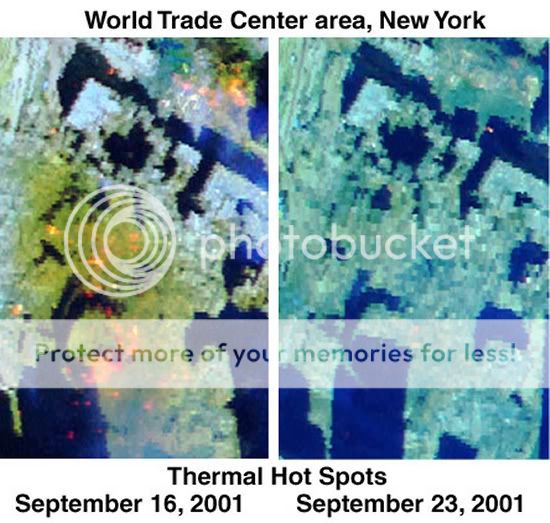
It was not melted plastic which was creating the hot spots under the WTC Towers and WTC 7 imaged by NASA AVIRIS on September 16 and still showing temperatures of 1341 degrees F was it?
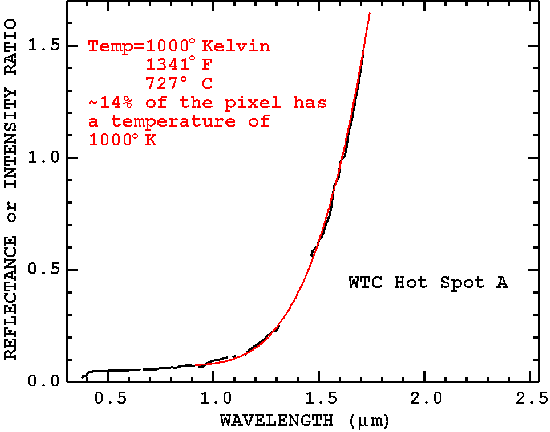
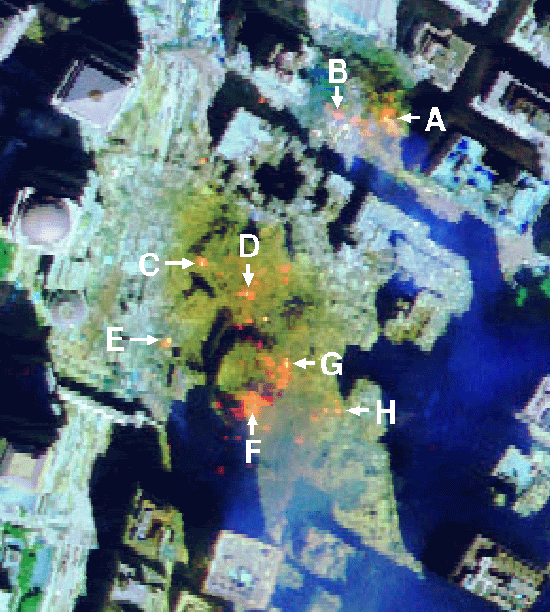
NASA AVIRIS images of WTC
NASA Finds Hot Fires Still Burning Underground at WTC
posted by wmd_2008
Have you seen the pictures of how the floor structure was supported on the outside walls of the build. How this for an explanation you may have seen the pictues of long lines of columns posted by someone earlier WHAT YOU assume is a explosive shock wave could just as easily be internal structures giving way under the massive dynamic load pushing from above.
Nah it is explosive blasts penetrating out through the outer walls from the core structure 7-8 storys ahead. The south Tower has just started 'collapsing' and the top 30 story block is still intact. The same explosive blasts running multiple storys ahead of the floor 'collapses' can be seen on the North Tower.
Rapid ejection of debris on the northwest corner of the tower.
Regular speed & 50% slow motion.
Originally posted by Mintwithahole.
In fact, in the months leading up to the attacks those working in the towers stated that there were allsorts of strangers wandering about the place who are unaccounted for.
Not to mention Sakher "Rocky" Hammad.
A photo ID pass for Sept. 5 found on one of the men charged with fraudulently obtaining a Tennessee driver's license from a Memphis woman gave him access to the six underground levels of the One World Center building.
But which tenant hired Sakher 'Rocky' Hammad, 24, to work on its sprinklers is lost, said Port Authority of New York and New Jersey spokesman Alan Hicks on Friday.
Hammad told federal authorities that he was working on the sprinklers six days before the twin towers were brought down by terrorists, court testimony revealed this week.
But Hicks said the Port Authority, which owned the building, did its own sprinkler work, and that any other work involving sprinklers would have been arranged by an individual tenant.
"We don't know (which one) because all our records were destroyed in the World Trade Center, as were some of the people who know that," Hicks said.
whatreallyhappened.com...
The problem with the whole "it must have been an individual tennant" excuse is that there weren't any individual tennants in the 6 sub-basements where "Rocky's" pass gave him access.
That's just one instance.
reply to post by CameronFox
Interesting point but in looking at the Airlines which are commonly traded as a sector
if investors believe the airline industry is due to drop, they will short all three major carriers. This was not the case here because Delta did not see spikes similar to UAL and AMR.
The high number of put options didn't necessarily ONLY apply to the two airlines involved but traversed several business sectors that might have been effected such as:
Insurance:
Munich RE - The largest reinsurer in Germany
Swiss RE - The largest reinsurer in Switzerland
AXA Group of France -
Trading in shares of Munich Re was almost double its normal level on September 6, and 7, and trading in shares of Swiss Re was more than double its normal level on September 7.
Financial Services Companies:
Merrill Lynch and Morgan Stanley Morgan Stanley Dean Witter & Co. and Merrill Lynch & Co. were both headquartered in lower Manhattan at the time of the attack.
Morgan Stanley occupied 22 floors of the North Tower and Merrill Lynch had headquarters near the Twin Towers. Morgan Stanley, which saw an average of 27 put options on its stock bought per day before September 6, saw 2,157 put options bought in the three trading days before the attack. Merrill Lynch, which saw an average of 252 put options on its stock bought per day before September 5, saw 12,215 put options bought in the four trading days before the attack. Morgan Stanley's stock dropped 13% and Merrill Lynch's stock dropped 11.5% when the market reopened.
Bank of America showed a fivefold increase in put option trading on the Thursday and Friday before the attack.
A Bank of America option that would profit if the No. 3 U.S. bank's stock fell below $60 a share had more than 5,900 contracts traded on the Thursday and Friday before the Sept. 11 assaults, almost five times the previous average trading, according to Bloomberg data. The bank's shares fell 11.5 percent to $51 in the first week after trading resumed on Sept. 17.
Coincidentally though, while most companies would see their stock valuations decline as a result of the attack. Those in the business of supplying the military would see their stocks soar.
Raytheon, maker of Patriot and Tomahawk missiles, saw its stock soar immediately after the attack. Purchases of call options on Raytheon stock increased sixfold on the day before the attack.
US Treasury Notes:
US Treasury Notes are the safe harbor investment especially in the event of a worldwide crisis. Five-year US Treasury notes were purchased in abnormally high volumes before the attack, and their buyers were rewarded with sharp increases in their value following the attack.The SEC began investigating and the Secret Service even began a probe investigating a single $5 Billion trade.
In summary:
Looking at the inordinately high amount of trade volume immediately prior to 9/11, it's beyond coincidence that the PTB knew what was going to transpire and capitalized immensely on this event.
There were also almost $2.5million in unclaimed options left on the table once the news of 9/11 insider trading had reached the MSM which indicates that someone did not want their identity revealed.
Interesting point but in looking at the Airlines which are commonly traded as a sector
if investors believe the airline industry is due to drop, they will short all three major carriers. This was not the case here because Delta did not see spikes similar to UAL and AMR.
The high number of put options didn't necessarily ONLY apply to the two airlines involved but traversed several business sectors that might have been effected such as:
Insurance:
Munich RE - The largest reinsurer in Germany
Swiss RE - The largest reinsurer in Switzerland
AXA Group of France -
Trading in shares of Munich Re was almost double its normal level on September 6, and 7, and trading in shares of Swiss Re was more than double its normal level on September 7.
Financial Services Companies:
Merrill Lynch and Morgan Stanley Morgan Stanley Dean Witter & Co. and Merrill Lynch & Co. were both headquartered in lower Manhattan at the time of the attack.
Morgan Stanley occupied 22 floors of the North Tower and Merrill Lynch had headquarters near the Twin Towers. Morgan Stanley, which saw an average of 27 put options on its stock bought per day before September 6, saw 2,157 put options bought in the three trading days before the attack. Merrill Lynch, which saw an average of 252 put options on its stock bought per day before September 5, saw 12,215 put options bought in the four trading days before the attack. Morgan Stanley's stock dropped 13% and Merrill Lynch's stock dropped 11.5% when the market reopened.
Bank of America showed a fivefold increase in put option trading on the Thursday and Friday before the attack.
A Bank of America option that would profit if the No. 3 U.S. bank's stock fell below $60 a share had more than 5,900 contracts traded on the Thursday and Friday before the Sept. 11 assaults, almost five times the previous average trading, according to Bloomberg data. The bank's shares fell 11.5 percent to $51 in the first week after trading resumed on Sept. 17.
Coincidentally though, while most companies would see their stock valuations decline as a result of the attack. Those in the business of supplying the military would see their stocks soar.
Raytheon, maker of Patriot and Tomahawk missiles, saw its stock soar immediately after the attack. Purchases of call options on Raytheon stock increased sixfold on the day before the attack.
US Treasury Notes:
US Treasury Notes are the safe harbor investment especially in the event of a worldwide crisis. Five-year US Treasury notes were purchased in abnormally high volumes before the attack, and their buyers were rewarded with sharp increases in their value following the attack.The SEC began investigating and the Secret Service even began a probe investigating a single $5 Billion trade.
In summary:
Looking at the inordinately high amount of trade volume immediately prior to 9/11, it's beyond coincidence that the PTB knew what was going to transpire and capitalized immensely on this event.
There were also almost $2.5million in unclaimed options left on the table once the news of 9/11 insider trading had reached the MSM which indicates that someone did not want their identity revealed.
You guys really show how you jump to conclusions
1) Never at any point have I said I am AMERICAN or a Scientist!
2) What TITANIUM COLUMNS provide a link to that PLEEEEASE!
3) To the security expert you calcluate how much explosive would
have been required to cause the destruction seen then post back
how that much could have been planted.
Look at any demolition video will say again building stripped
supporting internal walls removed explosive directly on main structural members miles of cable months of planning and guess what
they start at the bottom you see the explosive blast then the dust
not the collapse then the dust you see in south tower collapse.
4) Was it before plane impact or are the making it up because they think like you?! (basement explosions)
5) Bldg 7 was damaged by the collapes of the towers although never shown by you guys! Large gash in building and a fire !
Here is an actual fact for you re fire so amke sure your smoke alarm works!!!
The power and fury of a typical house fire is immensely underestimated by the average person. The National Fire Protection Association has conducted accurate tests involving the growth and temperatures of fires. Did you know that just 3 minutes and 3 seconds after the start of an average living room fire involving a couch, that the temperature 3 feet above the floor within the room is over 500 F? Just 38 seconds later, the temperature in the room is 1,400 F. If you want to protect your possessions from an inferno like this, you will need more than a simple metal box.
THINK ABOUT IT!
Oh and another thing if you have a connecting wall to another property if they had a fire and a hole about the dia of a pencil was in the wall, a room about 5mtr x 5mtr x 4mtr would be full of smoke that you would not be able to see in about 20 seconds.
ps no charge for the safety info
[edit on 3-12-2008 by wmd_2008]
[edit on 3-12-2008 by wmd_2008]
[edit on 3-12-2008 by wmd_2008]
[edit on 3-12-2008 by wmd_2008]
1) Never at any point have I said I am AMERICAN or a Scientist!
2) What TITANIUM COLUMNS provide a link to that PLEEEEASE!
3) To the security expert you calcluate how much explosive would
have been required to cause the destruction seen then post back
how that much could have been planted.
Look at any demolition video will say again building stripped
supporting internal walls removed explosive directly on main structural members miles of cable months of planning and guess what
they start at the bottom you see the explosive blast then the dust
not the collapse then the dust you see in south tower collapse.
4) Was it before plane impact or are the making it up because they think like you?! (basement explosions)
5) Bldg 7 was damaged by the collapes of the towers although never shown by you guys! Large gash in building and a fire !
Here is an actual fact for you re fire so amke sure your smoke alarm works!!!
The power and fury of a typical house fire is immensely underestimated by the average person. The National Fire Protection Association has conducted accurate tests involving the growth and temperatures of fires. Did you know that just 3 minutes and 3 seconds after the start of an average living room fire involving a couch, that the temperature 3 feet above the floor within the room is over 500 F? Just 38 seconds later, the temperature in the room is 1,400 F. If you want to protect your possessions from an inferno like this, you will need more than a simple metal box.
THINK ABOUT IT!
Oh and another thing if you have a connecting wall to another property if they had a fire and a hole about the dia of a pencil was in the wall, a room about 5mtr x 5mtr x 4mtr would be full of smoke that you would not be able to see in about 20 seconds.
ps no charge for the safety info
[edit on 3-12-2008 by wmd_2008]
[edit on 3-12-2008 by wmd_2008]
[edit on 3-12-2008 by wmd_2008]
[edit on 3-12-2008 by wmd_2008]
posted by nh_ee
But to add to the list,
The unusually high number of PUT Options
posted by CameronFox
Clearly explained here:
Put Options
You were clearly disproven in the previous post by nh_ee. Put-options were a major piece of evidence pointing to an INSIDE JOB and foreknowledge of 9-11 by the already filthy rich billionaire elitists of the New World Order. 9-11 Myths is a disinformation source, highly paid to spread propaganda and lies.
The story...
There was very high trading in "put options" on American Airline and United Airlines, immediately before 9/11. These were effectively gambles that their share prices would fall, which of course is what happened once the attacks took place. This shows the traders must have had advance knowledge of 9/11.
Our take...
This is a complex story, but the claims don’t always match the reality.
Although there were high volumes traded on these days, for instance, they weren’t as exceptionally high as some sites like to claim. Here’s one analysis.
There were very good reasons to sell American Airlines shares, too, as they’d just announced a string of bad news. Read more here.
United Airlines stocks were falling in price, too. If investors anticipated they were about to release bad results then their put options would also be worth buying (although keep in mind that the UAL put volumes weren’t the highest in the year anyway). Here’s our thoughts.
Some point to stories like the “unclaimed millions” from UAL puts as having a sinister explanation, but we disagree. Here’s why.
There was plenty of talk about potential insider dealings in other stocks, too. We haven’t researched these in any depth, but it’s worth pointing out that some people believe the claims were overblown.
What about most of the options being put through a CIA-linked bank? We weren’t convinced.
[edit on 12/3/08 by SPreston]
posted by wmd_2008
3) To the security expert you calcluate how much explosive would
have been required to cause the destruction seen then post back
how that much could have been planted.
THINK ABOUT IT!
So how many more guys like Sakher 'Rocky' Hammad do we not know about, with security passes to the 6 underground level basement? Hundreds? How many do we not know about who had security passes to other areas of the towers? Hundreds? Hammad was found out completely by accident and it sure was not the FBI trying to find him was it?
Tennessee driver's license examiner Katherine Smith who caught Hammad, died in a fiery car crash, a day before she was to appear in court. I wonder if the FBI got rid of her for exposing their 9-11 Explosive Planting INSIDE JOB?
posted by Griff
The problem with the whole "it must have been an individual tennant" excuse is that there weren't any individual tennants in the 6 sub-basements where "Rocky's" pass gave him access.
A photo ID pass for Sept. 5 found on one of the men charged with fraudulently obtaining a Tennessee driver's license from a Memphis woman gave him access to the six underground levels of the One World Center building.
But which tenant hired Sakher 'Rocky' Hammad, 24, to work on its sprinklers is lost, said Port Authority of New York and New Jersey spokesman Alan Hicks on Friday.
Hammad told federal authorities that he was working on the sprinklers six days before the twin towers were brought down by terrorists, court testimony revealed this week.
But Hicks said the Port Authority, which owned the building, did its own sprinkler work, and that any other work involving sprinklers would have been arranged by an individual tenant.
"We don't know (which one) because all our records were destroyed in the World Trade Center, as were some of the people who know that," Hicks said.
whatreallyhappened.com...
new topics
-
Bobiverse
Fantasy & Science Fiction: 1 hours ago -
Florida man's trip overseas ends in shock over $143,000 T-Mobile phone bill
Social Issues and Civil Unrest: 1 hours ago -
Former Labour minister Frank Field dies aged 81
People: 3 hours ago -
SETI chief says US has no evidence for alien technology. 'And we never have'
Aliens and UFOs: 5 hours ago -
This is our Story
General Entertainment: 8 hours ago -
President BIDEN Vows to Make Americans Pay More Federal Taxes in 2025 - Political Suicide.
2024 Elections: 10 hours ago -
Ode to Artemis
General Chit Chat: 11 hours ago
top topics
-
President BIDEN Vows to Make Americans Pay More Federal Taxes in 2025 - Political Suicide.
2024 Elections: 10 hours ago, 14 flags -
Should Biden Replace Harris With AOC On the 2024 Democrat Ticket?
2024 Elections: 16 hours ago, 6 flags -
One Flame Throwing Robot Dog for Christmas Please!
Weaponry: 15 hours ago, 6 flags -
Don't take advantage of people just because it seems easy it will backfire
Rant: 15 hours ago, 4 flags -
Ditching physical money
History: 14 hours ago, 4 flags -
SETI chief says US has no evidence for alien technology. 'And we never have'
Aliens and UFOs: 5 hours ago, 4 flags -
Ode to Artemis
General Chit Chat: 11 hours ago, 3 flags -
Former Labour minister Frank Field dies aged 81
People: 3 hours ago, 3 flags -
VirginOfGrand says hello
Introductions: 16 hours ago, 2 flags -
This is our Story
General Entertainment: 8 hours ago, 2 flags
active topics
-
Marjorie Taylor Greene Files Motion to Vacate Speaker Mike Johnson
US Political Madness • 65 • : WeMustCare -
Election Year 2024 - Interesting Election-Related Tidbits as They Happen.
2024 Elections • 71 • : WeMustCare -
President BIDEN Vows to Make Americans Pay More Federal Taxes in 2025 - Political Suicide.
2024 Elections • 46 • : 5thHead -
The Reality of the Laser
Military Projects • 36 • : Zaphod58 -
So this is what Hamas considers 'freedom fighting' ...
War On Terrorism • 256 • : DBCowboy -
Breaking Baltimore, ship brings down bridge, mass casualties
Other Current Events • 475 • : ArMaP -
Bobiverse
Fantasy & Science Fiction • 1 • : TzarChasm -
SETI chief says US has no evidence for alien technology. 'And we never have'
Aliens and UFOs • 22 • : Ophiuchus1 -
Police clash with St George’s Day protesters at central London rally
Social Issues and Civil Unrest • 43 • : SprocketUK -
Mood Music Part VI
Music • 3097 • : TheWoker