It looks like you're using an Ad Blocker.
Please white-list or disable AboveTopSecret.com in your ad-blocking tool.
Thank you.
Some features of ATS will be disabled while you continue to use an ad-blocker.

An Experiment in Alternative Methods of Earthquake Prediction
page: 148share:
Good friend of mine just posted on his Facebook a few hours ago that he has this overwhelming feeling that something bad is about to happen. I find
it very odd and out of character for him since he's a pretty happy go lucky guy and nothing really gets to him. Two other people commented on it
saying that they were also having "episodes" yesterday and today. Just wanted to make a note here since he lives right up the road from me and I
find it kind of strange.
reply to post by wasobservingquietly
Hello WOQ,
yes, it has been a bit quiet on here lately I suppose. I need to mention that I was still lurking and taking note of all the posts made here even while I wasn't actively contributing; I expect that many of us do the same from time to time.
As for “boring” – it would be great if it would stay that way in respect of major quakes, but the world being as it is now I doubt it will be too boring for too long. What I mean is that because there are now more people living on this planet than ever before, the odds are that even in places where larger quakes did relatively little harm in the past – such as the New Madrid region or the PNW, to name a couple within the US alone – we're not going to get off so lightly next time.
And then, when we consider the several hundred currently-running nuclear reactors around the world, and various others that have been shut down but which still have spent fuel pools that need to be cooled and maintained, they are another factor in making things potentially far worse.
The New Madrid Seismic Zone: it's a quandary, because scientists still can't be sure how things might pan out next time or even when the next big event might be. I think there's pretty fair agreement in the scientific community that there will be a next time, but anything beyond that is hard to determine as they are still conducting paleoseismological research on past events.
From the point of view of quake insurance, I did a bit of research online and found that in California, only about 12% of homeowners have it as an optional extra on their home policies. (This article from Insure [dot] com confirms the 12% figure.) So, if that's the case in the state where most expect the “big one” to come along eventually, it seems unlikely that a greater percentage of residents in other states would have quake insurance.
Regarding potential losses, another of the references states the following:
The above can be found in this article from USA Today, Oct 18, 2011.
Just as an addendum here, that region is where some researchers now believe a mag 8.2 quake is possible. That's twice the size of a 7.9 (in shaking) and nearly three times stronger in terms of energy release.
Now, a mag 8.0 or bigger quake in the NMSZ – or a series of them as occurred in 1811/12 – would likely also result in damage well up in the many tens of billions of dollars. (I recall the FEMA/DHS documents give such figures but I don't recall the precise number.) And only a small percentage of home owners would be insured.
On the question of whether the insurance companies could cover the claims, the answer is “probably yes” – as things stand, they should be able to. As insuring risk is their business, they would have a fair idea of what amounts they will likely have to pay out, and a decent chunk of their risk is reinsured through companies like Swiss Re anyway.
The trouble is, it's not just the damage to private homes and businesses. There would be massive damage to govt buildings, infrastructure and the like, and all of that will eventually have to be funded by the taxpayer in one way or another.
The human cost is a chilling factor. It would be very high and the FEMA estimates I recall give casualty estimates in the tens of thousands: it would exceed the toll of any major event in US domestic history.
Considering the PNW, I need to do more looking and try to find some well-researched estimates of the potential cost of a PNW mega-quake/tsunami event. The last time I checked, Japan's March 2011 event cost more than $120 billion in property damage alone, but that figure doesn't include the ongoing and massive cleanup costs for the Fukushima nuclear catastrophe, which could eventually work out more expensive than all the rest of the disaster's losses combined. Just the added costs to Japan of having to import more fossil fuels (after shutting down all their reactors for “inspections”) will eventually run into billions as well.
(Continued in next post)
Hello WOQ,
yes, it has been a bit quiet on here lately I suppose. I need to mention that I was still lurking and taking note of all the posts made here even while I wasn't actively contributing; I expect that many of us do the same from time to time.
As for “boring” – it would be great if it would stay that way in respect of major quakes, but the world being as it is now I doubt it will be too boring for too long. What I mean is that because there are now more people living on this planet than ever before, the odds are that even in places where larger quakes did relatively little harm in the past – such as the New Madrid region or the PNW, to name a couple within the US alone – we're not going to get off so lightly next time.
And then, when we consider the several hundred currently-running nuclear reactors around the world, and various others that have been shut down but which still have spent fuel pools that need to be cooled and maintained, they are another factor in making things potentially far worse.
The New Madrid Seismic Zone: it's a quandary, because scientists still can't be sure how things might pan out next time or even when the next big event might be. I think there's pretty fair agreement in the scientific community that there will be a next time, but anything beyond that is hard to determine as they are still conducting paleoseismological research on past events.
From the point of view of quake insurance, I did a bit of research online and found that in California, only about 12% of homeowners have it as an optional extra on their home policies. (This article from Insure [dot] com confirms the 12% figure.) So, if that's the case in the state where most expect the “big one” to come along eventually, it seems unlikely that a greater percentage of residents in other states would have quake insurance.
Regarding potential losses, another of the references states the following:
A 2007 study by Risk Management Solutions looked at the potential costs of a replay of the last major quake in Southern California — the 7.9-magnitude Fort Tejon quake, which hit near Bakersfield in 1857. It found a repeat of that quake would cause $150 billion in damage to homes, businesses and industries — more than the damage cost from Hurricane Katrina— with only about $15 billion to $25 billion covered by insurance.
The above can be found in this article from USA Today, Oct 18, 2011.
Just as an addendum here, that region is where some researchers now believe a mag 8.2 quake is possible. That's twice the size of a 7.9 (in shaking) and nearly three times stronger in terms of energy release.
Now, a mag 8.0 or bigger quake in the NMSZ – or a series of them as occurred in 1811/12 – would likely also result in damage well up in the many tens of billions of dollars. (I recall the FEMA/DHS documents give such figures but I don't recall the precise number.) And only a small percentage of home owners would be insured.
On the question of whether the insurance companies could cover the claims, the answer is “probably yes” – as things stand, they should be able to. As insuring risk is their business, they would have a fair idea of what amounts they will likely have to pay out, and a decent chunk of their risk is reinsured through companies like Swiss Re anyway.
The trouble is, it's not just the damage to private homes and businesses. There would be massive damage to govt buildings, infrastructure and the like, and all of that will eventually have to be funded by the taxpayer in one way or another.
The human cost is a chilling factor. It would be very high and the FEMA estimates I recall give casualty estimates in the tens of thousands: it would exceed the toll of any major event in US domestic history.
Considering the PNW, I need to do more looking and try to find some well-researched estimates of the potential cost of a PNW mega-quake/tsunami event. The last time I checked, Japan's March 2011 event cost more than $120 billion in property damage alone, but that figure doesn't include the ongoing and massive cleanup costs for the Fukushima nuclear catastrophe, which could eventually work out more expensive than all the rest of the disaster's losses combined. Just the added costs to Japan of having to import more fossil fuels (after shutting down all their reactors for “inspections”) will eventually run into billions as well.
(Continued in next post)
(Continued from previous post)
About your final comment, WOQ:
I agree with you. I'm sure we'd like to think so but human nature being what it is, even if a medium-large quake hits the region (eg a low mag 6), the outcome will likely be different. I'd say that in the first few days, the news and TV will be full of the story and most people will worry like anything, some folks will suddenly try to get quake insurance (if the insurance cos. will now sell them any!!), a few will protest to authorities and ask why they're not doing more to make things safer by retrofitting etc etc, and a few might even move to other areas. Then after a couple of weeks at most – if nothing bigger arrives in short order – things will settle down and most people will just carry on as before and forget about it, continuing to believe that disasters and sudden, horrible death only happen to other people.
Sadly, that's just the way most people are. And to be honest, I can't exclude myself. It's a survival mechanism. Otherwise, we'd never drive our cars on the highways where disaster can await us at any moment, we'd never go on airplanes or whatever. It's not about the actual risk, but how we perceive that risk.
I'll put it this way: while there is still a fair degree of scientific uncertainty about the what, when (and even exactly where) of the New Madrid, the Cascadia Subduction zone in the PNW is much better understood and it's a given that one day it will let go again in a big way, with the potential for a mag 9.0 quake and a tsunami just as bad as the one that hit Japan little more than one year ago. Based on the fact that some of the past events there came along at less 300-year intervals and the last one was 312 years ago, the PNW is already “in the zone”.
But as I said in my last post, very little of great value is being done to try and reduce the loss of life and property damage.
Why? Because very few are willing to believe that it could happen to them. Okay, so while I accept that attitude at the human, individual level, governments and authorities should be assessing risk to their people based on the reality of the risk, not any personal perception of that risk. The reality is simply what the experts have made clear: it's going to happen.
I feel that nothing substantial will be done. Sea walls will not be built in very low-lying seaside residential areas, sufficient escape towers in the same areas will remain plans on bureaucrats' desks, permits will be granted for new housing developments, resorts and hotels in areas vulnerable to landslides, soil liquefaction and tsunami inundation, older bricks-and-mortar school buildings, fire stations and hospitals won't be retrofitted and hence will collapse like card houses... the list of what won't be done is long and painful.
I guess we all remember Galveston after Hurricane Ike roared through on Sept 13, 2008. One of the main factors in the huge amount of property damage was that many homes were built beyond the part of the island that was protected by a sea wall. In fact, homes (including holiday homes) were built in places where realistically, they should never have been built at all. The result? Many of those homes were utterly destroyed. They were washed away; even the ground upon which they'd stood was gone – washed away by the storm. People built homes in unsafe areas and nothing was done about it, because extra residents meant more taxes for the local authorities. They were given permission to build in unsafe locations!
What makes this all the more appalling is that Galveston was the location of the deadliest natural disaster in US history, when it was hit by a hurricane in 1900 and somewhere between 6,000 and 12,000 people died. The exact figure will never be known but most references I've read cite around 8,000 dead as a likely estimate.
Whatever the number, it's awful. Even one life lost in such a way is one too many.
But even with that tragedy in the island's past, and even knowing that the sea wall built after that event did not protect the entire length of the island's inhabited regions as they steadily expanded beyond its reach, modern-day authorities there made no serious efforts to extend the defences and try to save lives and property from a future event. They let people build in the most exposed areas – and they paid a heavy price.
This is just one example, but it helps to explain why I expect that whatever is done in the PNW in the future – before the next big CSZ quake and tsunami arrives – it will be nowhere near enough, nowhere near what could be done if those in power would assess risk on the basis of what it really is, rather than what they wish it to be.
I'll be very glad to eventually be proven wrong.
Best regards,
Mike
About your final comment, WOQ:
Maybe, if everyone is lucky, there will be some good sized moderate ones before the big one.
Just enough to shake people out of their complacency & normalcy bias!!!
I agree with you. I'm sure we'd like to think so but human nature being what it is, even if a medium-large quake hits the region (eg a low mag 6), the outcome will likely be different. I'd say that in the first few days, the news and TV will be full of the story and most people will worry like anything, some folks will suddenly try to get quake insurance (if the insurance cos. will now sell them any!!), a few will protest to authorities and ask why they're not doing more to make things safer by retrofitting etc etc, and a few might even move to other areas. Then after a couple of weeks at most – if nothing bigger arrives in short order – things will settle down and most people will just carry on as before and forget about it, continuing to believe that disasters and sudden, horrible death only happen to other people.
Sadly, that's just the way most people are. And to be honest, I can't exclude myself. It's a survival mechanism. Otherwise, we'd never drive our cars on the highways where disaster can await us at any moment, we'd never go on airplanes or whatever. It's not about the actual risk, but how we perceive that risk.
I'll put it this way: while there is still a fair degree of scientific uncertainty about the what, when (and even exactly where) of the New Madrid, the Cascadia Subduction zone in the PNW is much better understood and it's a given that one day it will let go again in a big way, with the potential for a mag 9.0 quake and a tsunami just as bad as the one that hit Japan little more than one year ago. Based on the fact that some of the past events there came along at less 300-year intervals and the last one was 312 years ago, the PNW is already “in the zone”.
But as I said in my last post, very little of great value is being done to try and reduce the loss of life and property damage.
Why? Because very few are willing to believe that it could happen to them. Okay, so while I accept that attitude at the human, individual level, governments and authorities should be assessing risk to their people based on the reality of the risk, not any personal perception of that risk. The reality is simply what the experts have made clear: it's going to happen.
I feel that nothing substantial will be done. Sea walls will not be built in very low-lying seaside residential areas, sufficient escape towers in the same areas will remain plans on bureaucrats' desks, permits will be granted for new housing developments, resorts and hotels in areas vulnerable to landslides, soil liquefaction and tsunami inundation, older bricks-and-mortar school buildings, fire stations and hospitals won't be retrofitted and hence will collapse like card houses... the list of what won't be done is long and painful.
I guess we all remember Galveston after Hurricane Ike roared through on Sept 13, 2008. One of the main factors in the huge amount of property damage was that many homes were built beyond the part of the island that was protected by a sea wall. In fact, homes (including holiday homes) were built in places where realistically, they should never have been built at all. The result? Many of those homes were utterly destroyed. They were washed away; even the ground upon which they'd stood was gone – washed away by the storm. People built homes in unsafe areas and nothing was done about it, because extra residents meant more taxes for the local authorities. They were given permission to build in unsafe locations!
What makes this all the more appalling is that Galveston was the location of the deadliest natural disaster in US history, when it was hit by a hurricane in 1900 and somewhere between 6,000 and 12,000 people died. The exact figure will never be known but most references I've read cite around 8,000 dead as a likely estimate.
Whatever the number, it's awful. Even one life lost in such a way is one too many.
But even with that tragedy in the island's past, and even knowing that the sea wall built after that event did not protect the entire length of the island's inhabited regions as they steadily expanded beyond its reach, modern-day authorities there made no serious efforts to extend the defences and try to save lives and property from a future event. They let people build in the most exposed areas – and they paid a heavy price.
This is just one example, but it helps to explain why I expect that whatever is done in the PNW in the future – before the next big CSZ quake and tsunami arrives – it will be nowhere near enough, nowhere near what could be done if those in power would assess risk on the basis of what it really is, rather than what they wish it to be.
I'll be very glad to eventually be proven wrong.
Best regards,
Mike
reply to post by Cauliflower
Thanks very much for your post. You raise some good points.
I'd have to agree that it's a natural tendency for us to retrospectively look for indicators and speaking personally, that's one reason I have endeavoured to refer back to my predictions here, to identify them either as "hits" or "no hits" and also (where possible) give some details about what methodology I employed. So, the thread has value in that respect as the posts are logged and untouchable by us after a fairly short time.
Another value of a thread like this is that besides specific predictions, we can also log general "feelings" and later, check back to see if there appears to be any correlation between the number of posts (and posters) and any significant quake events. There is an apparent correlation between such posts in the days prior to Japan's quake of March 11 last year, and I believe that the recent pair of mag 8 quakes (on the same day in Indonesia) might correlate as well but I haven't done any detailed analysis yet.
Simply put, some people seem able to sense quakes ahead of time. What mechanism/s may be involved are still unclear and we have various ideas about it and some are detailed within the thread, but even the specific predictions posted here at least lend support to the idea.
I'd agree that magnetic and gravitic data are useful to some for possible quake prediction. In addition -- and I expect you know all this but I'm mentioning it just for completeness -- some researchers are considering a link between anomalies in ionospheric heating (eg pre the Japan quake of last March), along with very detailed studies of highly accurate gps measurements. Some also look for links between volcanic activity and seismic activity, others consider remote triggering effects. I feel that all of these areas of study could be part of the bigger picture and for sure -- as you've suggested -- it could well be that there are researchers who have other or at least more advanced methods and technology that are not generally known or available.
In such a case, it would depend on who has it and what their motivation is. But yes, I can see that some might use such fore-knowledge of a major event to gain a finanacial advantage. In fact, if a wealthy individual or a consortium had enough funds to put into the research they could probably achieve far more in terms of predicting major quake events in a few years, than most grant-driven, paper-publishing and peer-reviewed researchers could manage in decades. In that case, they could likely make their investment pay. I can barely imagine how much money some astute investors could make if they'd gone short on Tepco and other Japanese power co. stocks, for example. I expect that billions (of $$) would not be out out the question.
Your perspective is very interesting. I think we'd be glad if you could share more of your insights.
With best regards,
Mike
Thanks very much for your post. You raise some good points.
I'd have to agree that it's a natural tendency for us to retrospectively look for indicators and speaking personally, that's one reason I have endeavoured to refer back to my predictions here, to identify them either as "hits" or "no hits" and also (where possible) give some details about what methodology I employed. So, the thread has value in that respect as the posts are logged and untouchable by us after a fairly short time.
Another value of a thread like this is that besides specific predictions, we can also log general "feelings" and later, check back to see if there appears to be any correlation between the number of posts (and posters) and any significant quake events. There is an apparent correlation between such posts in the days prior to Japan's quake of March 11 last year, and I believe that the recent pair of mag 8 quakes (on the same day in Indonesia) might correlate as well but I haven't done any detailed analysis yet.
Simply put, some people seem able to sense quakes ahead of time. What mechanism/s may be involved are still unclear and we have various ideas about it and some are detailed within the thread, but even the specific predictions posted here at least lend support to the idea.
I'd agree that magnetic and gravitic data are useful to some for possible quake prediction. In addition -- and I expect you know all this but I'm mentioning it just for completeness -- some researchers are considering a link between anomalies in ionospheric heating (eg pre the Japan quake of last March), along with very detailed studies of highly accurate gps measurements. Some also look for links between volcanic activity and seismic activity, others consider remote triggering effects. I feel that all of these areas of study could be part of the bigger picture and for sure -- as you've suggested -- it could well be that there are researchers who have other or at least more advanced methods and technology that are not generally known or available.
In such a case, it would depend on who has it and what their motivation is. But yes, I can see that some might use such fore-knowledge of a major event to gain a finanacial advantage. In fact, if a wealthy individual or a consortium had enough funds to put into the research they could probably achieve far more in terms of predicting major quake events in a few years, than most grant-driven, paper-publishing and peer-reviewed researchers could manage in decades. In that case, they could likely make their investment pay. I can barely imagine how much money some astute investors could make if they'd gone short on Tepco and other Japanese power co. stocks, for example. I expect that billions (of $$) would not be out out the question.
Your perspective is very interesting. I think we'd be glad if you could share more of your insights.
With best regards,
Mike
edit on 12/5/12 by JustMike because: typos
reply to post by TMG333
Hi TMG,
thanks for posting that. Good to have it logged. I have nothing specific to report myself. Some unease, but without any specific indicators I can't define any region, so in my case at least I can't offer any kind of prediction right now.
I have seen a lot of chatter on various threads about May 20 as a significant date for a major quake event. That's still a little bit far off for me to offer much of an opinion, though. (As regulars here know I rarely go more than a week out and usually limit my time window to only three to five days.) If I can narrow down a region and date (and magnitude) then I'll post.
EDIT to add: and my apologies for everyone for hogging the thread! Seems I'm the only one around right now. It's the time difference, you know, what with the world being kind of round and all...
Mike
Hi TMG,
thanks for posting that. Good to have it logged. I have nothing specific to report myself. Some unease, but without any specific indicators I can't define any region, so in my case at least I can't offer any kind of prediction right now.
I have seen a lot of chatter on various threads about May 20 as a significant date for a major quake event. That's still a little bit far off for me to offer much of an opinion, though. (As regulars here know I rarely go more than a week out and usually limit my time window to only three to five days.) If I can narrow down a region and date (and magnitude) then I'll post.
EDIT to add: and my apologies for everyone for hogging the thread! Seems I'm the only one around right now. It's the time difference, you know, what with the world being kind of round and all...
Mike
edit on 12/5/12 by JustMike because: I added an edit. That's the reason for the edit.
reply to post by JustMike
Just wanted to say thank you Mike for your guidance and your contributions to this thread. When you do have the time to post, the information you provide is full of balanced information that I find puts everything into perspective. That is much appreciated and even though I don't post much (due to work and school and not much free time), I follow this thread and have learned a lot from your posts. Just wanted to say thanks!!!
Just wanted to say thank you Mike for your guidance and your contributions to this thread. When you do have the time to post, the information you provide is full of balanced information that I find puts everything into perspective. That is much appreciated and even though I don't post much (due to work and school and not much free time), I follow this thread and have learned a lot from your posts. Just wanted to say thanks!!!
I don't have anything specific to post either. My balance is now off and my ears ring all the time. I have a general feeling of unease, but nothing
specific. My husband doesn't want anything to happen on the 20th, because it's just a few days after his birthday.
reply to post by winotka
Hope you'll feel better soon. My ears have also been ringing like crazy the past day or so. No physical reason for it, either.
reply to post by justsaying
Thank you. I also learn a lot here -- especially from lurking on Quakewatch and other good threads. So much great info available on this site!
Okay I need to get some sleep. Early start in the morning and it's almost 10.40 pm here already.
Best regards,
Mike
Hope you'll feel better soon. My ears have also been ringing like crazy the past day or so. No physical reason for it, either.
reply to post by justsaying
Thank you. I also learn a lot here -- especially from lurking on Quakewatch and other good threads. So much great info available on this site!
Okay I need to get some sleep. Early start in the morning and it's almost 10.40 pm here already.
Best regards,
Mike
reply to post by JustMike
I don't have anything to report re: alternative methods of earthquake predictions, but I do also want to echo other's gratitude to you for your posts, here and elsewhere on the site. I find that I learn quite a bit from your contributions no matter the subject as you generally cover many things within a single post.
That being said, I do want to respond a bit to your post re: Galveston and Hurricane Ike. I live near the island (and have lived in the area my entire 43 years, so I've seen every major hurricane to come through the Gulf Coast including Alicia and Ike) and work on the east end, so I got to see first hand what you are referring to. My avatar is the memorial statue placed on Seawall blvd. that is dedicated to the 1900 hurricane and is a photo I took myself.
I will tell you also that the seawall (which was build as a result of the Great Hurricane of 1900) did very little to stop the storm surge that came around the island and flooded most of the houses that were not build up on stilts. The difference between earthquakes and hurricanes is that with a hurricane, you are generally given many days notice and our ability to track they progress and future path has become quite accurate within a few days time frame.
Local officials were urging residents to evacuate as strongly as possible (we do not have mandatory evacuations here in Texas, so people cannot be made to leave) and issuing statements along the lines of "if you choose to stay, please write your name and social security number on your arm so that your body can be easily identified."
Even with warnings of that nature, people stayed. Some even stayed on the fishing piers they resided in built out above the water and when they called 911 to come and rescue them, they were told that they were on their own as emergency responders were not going to risk their lives in the situation (this was during the height of the storm) and that the people would just have to ride out the storm and hope for the best.
The point I am making here is that no matter the seriousness of the situation, there are some who will heed no warning. Even when the danger is visible, imminent, and certainly directed at them.
Even if reliable methods for earthquake forecasting are developed, it will take quite come time before those methods are respected and acted upon. Even after such a time as people learn to understand that earthquakes can be forecast reliably, they will not necessarily act upon the information received by those forecasts. Those who choose not to listen to the authorities have no one but themselves to blame should something happen as a result of whatever disaster is being warned about.
For anyone interested in the science of Earthquake Prediction, I can recommend a couple of threads:
A Discussion on the Methodology of Earthquake Prediction: a thread I authored in response to another thread (which I will link after this) that was proven to be a hoax.
And
New ATS Member Claiming To Have Important Warning/Information. You Be The Judge... This thread indeed turned out to be a hoax, but so much interesting and real information was discovered over the course of the thread (and Mike participated in it too with the same depth of knowledge that he has become known for in every thread he involves himself with), that I think many members would be surprise to learn the contents of that thread.
Yes there is some bickering in the thread and some useless posts, but for the great majority of us who participated in a substantial manner in that thread, a tremendous amount was learned about the state of the art in regards to earthquake prediction (forecasting is probably more accurate), so if you have any interest in the topic at all this and the above-linked threads are highly recommended by me.
I don't have anything to report re: alternative methods of earthquake predictions, but I do also want to echo other's gratitude to you for your posts, here and elsewhere on the site. I find that I learn quite a bit from your contributions no matter the subject as you generally cover many things within a single post.
That being said, I do want to respond a bit to your post re: Galveston and Hurricane Ike. I live near the island (and have lived in the area my entire 43 years, so I've seen every major hurricane to come through the Gulf Coast including Alicia and Ike) and work on the east end, so I got to see first hand what you are referring to. My avatar is the memorial statue placed on Seawall blvd. that is dedicated to the 1900 hurricane and is a photo I took myself.
I will tell you also that the seawall (which was build as a result of the Great Hurricane of 1900) did very little to stop the storm surge that came around the island and flooded most of the houses that were not build up on stilts. The difference between earthquakes and hurricanes is that with a hurricane, you are generally given many days notice and our ability to track they progress and future path has become quite accurate within a few days time frame.
Local officials were urging residents to evacuate as strongly as possible (we do not have mandatory evacuations here in Texas, so people cannot be made to leave) and issuing statements along the lines of "if you choose to stay, please write your name and social security number on your arm so that your body can be easily identified."
Even with warnings of that nature, people stayed. Some even stayed on the fishing piers they resided in built out above the water and when they called 911 to come and rescue them, they were told that they were on their own as emergency responders were not going to risk their lives in the situation (this was during the height of the storm) and that the people would just have to ride out the storm and hope for the best.
The point I am making here is that no matter the seriousness of the situation, there are some who will heed no warning. Even when the danger is visible, imminent, and certainly directed at them.
Even if reliable methods for earthquake forecasting are developed, it will take quite come time before those methods are respected and acted upon. Even after such a time as people learn to understand that earthquakes can be forecast reliably, they will not necessarily act upon the information received by those forecasts. Those who choose not to listen to the authorities have no one but themselves to blame should something happen as a result of whatever disaster is being warned about.
For anyone interested in the science of Earthquake Prediction, I can recommend a couple of threads:
A Discussion on the Methodology of Earthquake Prediction: a thread I authored in response to another thread (which I will link after this) that was proven to be a hoax.
And
New ATS Member Claiming To Have Important Warning/Information. You Be The Judge... This thread indeed turned out to be a hoax, but so much interesting and real information was discovered over the course of the thread (and Mike participated in it too with the same depth of knowledge that he has become known for in every thread he involves himself with), that I think many members would be surprise to learn the contents of that thread.
Yes there is some bickering in the thread and some useless posts, but for the great majority of us who participated in a substantial manner in that thread, a tremendous amount was learned about the state of the art in regards to earthquake prediction (forecasting is probably more accurate), so if you have any interest in the topic at all this and the above-linked threads are highly recommended by me.
reply to post by jadedANDcynical
Hello J&C,
thank you for the links to those other threads. I need to re-read a lot of the posts as there is such a volume of information there. I truly feel that some researchers are far further along in forecasting quakes than is commonly believed. There is certainly good evidence that momentum is moving in that direction, at least.
I appreciate the points you have made about the situation in Galveston. As you're there on the ground and have seen it all close up I'll accept your take on it, and I apologise for being so harsh on the authorities in respect of improving the sea wall.
From the human perspective I cannot even imagine how it must have been for the people who chose to stay put and ride the storm out, then when it was too late and they called for rescue and were told that no-one could get to them... Lord... It sends shudders through me. I feel terrible for them and what they suffered, and also for the fact that it's such a common human condition to sometimes deny real risk to our lives -- often because we fear the loss of possessions if we leave them behind, or simply because we don't perceive the reality of the risk.
Back in my younger days when I lived in Australia I spent some time as a volunteer with our Country Fire Service. From those experiences I can only back up what you said: even when people have been warned that their lives are in peril if they stay where they are, some simply refuse to leave and try to "ride it out". Or else, they wait too long and get caught on a roadway with flames all around them and nowhere to hide. Or they call the emergency number and literally scream for help as their home starts to go up in flames around them.
I have seen the results and it's the stuff of nightmares. Like burnt-out cars that have actually melted down into the tarmac of the roadway, their occupants still inside them. And other things I won't even write about. Because just writing this much brings me to tears and I can't say any more.
Sadly, this will always be the way it is. Some people will not accept their own mortality and how fragile and tenuous their hold on life really is. There is little we can do about it but try to educate them. But even so, there are thankfully many who will take heed to warnings of impending disaster. In this case, I'm talking of the approaching storm or firestorm, the onrushing flood of a swollen river, the erupting volcano that's soon to explode. Events that are close and manifestly real are the ones most likely to move people to action, and that's why -- paradoxically -- less people might react to an earthquake warning, even if the science progresses to the point where reliable forecasts can be made.
I fully agree with you that at least in the beginning, many will simply not believe what they are being told if they are warned of an impending destructive quake. They won't perceive the true import of the risk until it's too late and the quake hits. It will take some hard lessons before the majority will respond to the warnings, and then (as you say), those who don't will have no-one to blame but themselves.
Getting back to the point I made about actual versus perceived risk, this is another reason why I feel that those in positions of power should do more to improve the defences. Joe and Jane Public have little understanding of the actual risks -- and they don't need to. They have enough on their plates just managing life day to day.
It's the job of those who are charged with "serving" (and protecting) the people in respect of these risks to be aware of what's likely, and also what needs to be done. The (anti-tsunami) sea walls, escape towers, retrofitting buildings, stricter guidelines for building in areas vulnerable to liquefaction, landslides and tsunami inundation, and so on. They need to act in response to the real risk, because the average Joe and Jane won't -- and many don't have the resources even if they wanted to.
As a guesstimate I suppose it would take a decade of diligent effort to get the physical side of the PNW "defences" to the stage where they could save or at least give a fighting chance to as many people as possible.
Meanwhile, the geoseismic clock ticks on. I hope that it's a good long time yet before it sounds its dreadful knell.
Best regards,
Mike
Apologies for such a gloomy post. I feel strangely affected today. Odd way to feel on the 4th anniversary of when Kattrax OP'd this thread on May 14, 2008, but there it is.
thank you for the links to those other threads. I need to re-read a lot of the posts as there is such a volume of information there. I truly feel that some researchers are far further along in forecasting quakes than is commonly believed. There is certainly good evidence that momentum is moving in that direction, at least.
I appreciate the points you have made about the situation in Galveston. As you're there on the ground and have seen it all close up I'll accept your take on it, and I apologise for being so harsh on the authorities in respect of improving the sea wall.
From the human perspective I cannot even imagine how it must have been for the people who chose to stay put and ride the storm out, then when it was too late and they called for rescue and were told that no-one could get to them... Lord... It sends shudders through me. I feel terrible for them and what they suffered, and also for the fact that it's such a common human condition to sometimes deny real risk to our lives -- often because we fear the loss of possessions if we leave them behind, or simply because we don't perceive the reality of the risk.
Back in my younger days when I lived in Australia I spent some time as a volunteer with our Country Fire Service. From those experiences I can only back up what you said: even when people have been warned that their lives are in peril if they stay where they are, some simply refuse to leave and try to "ride it out". Or else, they wait too long and get caught on a roadway with flames all around them and nowhere to hide. Or they call the emergency number and literally scream for help as their home starts to go up in flames around them.
I have seen the results and it's the stuff of nightmares. Like burnt-out cars that have actually melted down into the tarmac of the roadway, their occupants still inside them. And other things I won't even write about. Because just writing this much brings me to tears and I can't say any more.
Sadly, this will always be the way it is. Some people will not accept their own mortality and how fragile and tenuous their hold on life really is. There is little we can do about it but try to educate them. But even so, there are thankfully many who will take heed to warnings of impending disaster. In this case, I'm talking of the approaching storm or firestorm, the onrushing flood of a swollen river, the erupting volcano that's soon to explode. Events that are close and manifestly real are the ones most likely to move people to action, and that's why -- paradoxically -- less people might react to an earthquake warning, even if the science progresses to the point where reliable forecasts can be made.
I fully agree with you that at least in the beginning, many will simply not believe what they are being told if they are warned of an impending destructive quake. They won't perceive the true import of the risk until it's too late and the quake hits. It will take some hard lessons before the majority will respond to the warnings, and then (as you say), those who don't will have no-one to blame but themselves.
Getting back to the point I made about actual versus perceived risk, this is another reason why I feel that those in positions of power should do more to improve the defences. Joe and Jane Public have little understanding of the actual risks -- and they don't need to. They have enough on their plates just managing life day to day.
It's the job of those who are charged with "serving" (and protecting) the people in respect of these risks to be aware of what's likely, and also what needs to be done. The (anti-tsunami) sea walls, escape towers, retrofitting buildings, stricter guidelines for building in areas vulnerable to liquefaction, landslides and tsunami inundation, and so on. They need to act in response to the real risk, because the average Joe and Jane won't -- and many don't have the resources even if they wanted to.
As a guesstimate I suppose it would take a decade of diligent effort to get the physical side of the PNW "defences" to the stage where they could save or at least give a fighting chance to as many people as possible.
Meanwhile, the geoseismic clock ticks on. I hope that it's a good long time yet before it sounds its dreadful knell.
Best regards,
Mike
Apologies for such a gloomy post. I feel strangely affected today. Odd way to feel on the 4th anniversary of when Kattrax OP'd this thread on May 14, 2008, but there it is.
edit on 14/5/12 by JustMike because: (no reason given)
I just have to say, I enjoy this thread immensely. Particularly because of the extremely thoughtful, kind and well written posts. JustMike,
JadedandCynical, and many others; thank you.
I'm not one that experiences physical symptoms before large earthquakes or storms. But I certainly don't doubt the human capacity to pick up on some sort of pre-event vibration/feeling/what-have-you, and I really respect the courage the participants in this thread show by posting their experiences.
The only physical 'links' I experience are headaches when the solar IMF is pointing in a strong southerly direction, and vertigo after really deep earthquakes, such as in the Fiji region every few days, but never anything prior to the event.
Anyway, I just wanted to let you all know that I find your posts valuable. Please, continue on.
I'm not one that experiences physical symptoms before large earthquakes or storms. But I certainly don't doubt the human capacity to pick up on some sort of pre-event vibration/feeling/what-have-you, and I really respect the courage the participants in this thread show by posting their experiences.
The only physical 'links' I experience are headaches when the solar IMF is pointing in a strong southerly direction, and vertigo after really deep earthquakes, such as in the Fiji region every few days, but never anything prior to the event.
Anyway, I just wanted to let you all know that I find your posts valuable. Please, continue on.
I just woke up with a very very bad headache behind my right eye. It started last night and was pretty dull, slept about 4 or 5 hours, woke up a
couple times through the night.
reply to post by Olivine
Thanks for your comments, Olivine.
Things have been a bit quiet lately. I must admit that I haven't been posting much or even studying the daily quake info as intently as I normally would. It's a busy time of year in my work at present, but even allowing for that I have found it hard to focus on the subject and dig deep for data.
All the same I've been keeping an eye on things and I'd like to make a few comments about the current situation and what could be coming up soon.
One thing that's bothering me right now is that it's been quite a while since the last mag 7 or bigger quake. In fact the last mag 7 was a 7.0 in the Gulf of California on April 12, just one day after the April 11 mag 8.4 and 8.0 events off Sumatra.
Weird, that. Two very powerful events off Sumatra (a pair of mag 8s in the same region on the same day is very, very rare indeed), then one day later a pretty solid bump down in the Gulf of Cali and then -- not a heck of a lot. Okay, there have been some mag 6-range quakes but no 7s. For about six weeks. Seeing as we average about 18 of them a year that's a fair break.
This has been discussed a bit over on the quakewatch thread (where I still lurk almost daily even if I don't post often). I think the consensus is that there is no particular "reason" why it's been so quiet lately; it's just the way our planet is sometimes.
All the same, I don't like it being so quiet. Unless something very odd has happened without our noticing, energy is still building up on fault lines all over the place at the same sort of rate it normally does, but not a whole lot is happening to release energy buildups quake-wise. Plenty of little quakes, sure. But one mag 7.0 is 100 times bigger than a mag 5.0 and it releases 1,000 times more energy. And that's what I'm talking about, because we haven't had a massive uptick in smallish quakes to "balance out" the energy of a couple of big ones.
Yes, where they had the two mag 8s, a lot of energy got released. Like, the equivalent of many tens of thousands of mag 5 quakes. (And no, I'm not exaggerating.) But that's a highly active area, with pretty fast-moving plates (up to 20 cm/year versus 5 cm/year for lots of other places), so they get more of the big events.
Leaving aside Sumatra and that region in general, it's been a little below average elsewhere. True, short-term statistics are problematic. I'm just making a slightly less than scientific observation. In other words, I'm going with my gut.
Now, while my gut says this current quiet certainly doesn't have to imply some kind of "calm before the storm" situation -- meaning it's not like everything has to suddenly all let go at once with mag 8 quakes hither and yon -- it's not unreasonable to expect there will be some activity a bit above the average before too long. A pretty big mag 7 would not surprise me in the least.
But the problem is: where?
Based on historical data alone, the possible locations would make a very long list! So instead, I'm just going to list a few that I feel are likely, and some don't even follow that data so closely anyway.
First: Peru. This has bothered me for a while. They had a decent-sized mag 6 there a couple weeks back but I'm still leery of it. I just feel it's been rather long since a bigger shaker there by the coastal regions. (Southern Peru more likely than the north.)
Second: I see the eastern border of the Tibetan Autonomous Region as a likely candidate for a destructive event. A mag 7 there is historically very unlikely but even a mid-range 6 could be quite serious.
Third: southern Italy, down near Messina. It's been over 100 years since the Messina Quake and tsunami of 1908 -- and that was a mag 7.2 event. I feel that the region could be building up to another. I know there was a tragic quake in the north of Italy but that's a different fault region entirely.
Fourth: Turkey, especially close to Istanbul. Again, it's been a long time.
Fifth and probably least likely: off Portugal. There's a subsea fault capable of very powerful jolts and it's been pretty quiet for a couple of centuries now.
None of the above are what I'd define as predictions. When I make predictions I give locations, time frames (within a matter of days), and likely magnitude. I cannot define the time frames here well enough but I want you all to know that these are the regions I am most concerned about right now. Yes, I'm concerned about the CSZ in the US Pacific Northwest, but I'm always concerned about that one as its destructive potential is horrendous.
So, what I've stated above is just to let you know where I'm watching most closely. Some other regions might be statistically more likely (eg Chile and of course Taiwan, Indonesia and the surrounding regions), but this is about what I feel, not what the stats say.
Best regards to everyone,
Mike
Thanks for your comments, Olivine.
Things have been a bit quiet lately. I must admit that I haven't been posting much or even studying the daily quake info as intently as I normally would. It's a busy time of year in my work at present, but even allowing for that I have found it hard to focus on the subject and dig deep for data.
All the same I've been keeping an eye on things and I'd like to make a few comments about the current situation and what could be coming up soon.
One thing that's bothering me right now is that it's been quite a while since the last mag 7 or bigger quake. In fact the last mag 7 was a 7.0 in the Gulf of California on April 12, just one day after the April 11 mag 8.4 and 8.0 events off Sumatra.
Weird, that. Two very powerful events off Sumatra (a pair of mag 8s in the same region on the same day is very, very rare indeed), then one day later a pretty solid bump down in the Gulf of Cali and then -- not a heck of a lot. Okay, there have been some mag 6-range quakes but no 7s. For about six weeks. Seeing as we average about 18 of them a year that's a fair break.
This has been discussed a bit over on the quakewatch thread (where I still lurk almost daily even if I don't post often). I think the consensus is that there is no particular "reason" why it's been so quiet lately; it's just the way our planet is sometimes.
All the same, I don't like it being so quiet. Unless something very odd has happened without our noticing, energy is still building up on fault lines all over the place at the same sort of rate it normally does, but not a whole lot is happening to release energy buildups quake-wise. Plenty of little quakes, sure. But one mag 7.0 is 100 times bigger than a mag 5.0 and it releases 1,000 times more energy. And that's what I'm talking about, because we haven't had a massive uptick in smallish quakes to "balance out" the energy of a couple of big ones.
Yes, where they had the two mag 8s, a lot of energy got released. Like, the equivalent of many tens of thousands of mag 5 quakes. (And no, I'm not exaggerating.) But that's a highly active area, with pretty fast-moving plates (up to 20 cm/year versus 5 cm/year for lots of other places), so they get more of the big events.
Leaving aside Sumatra and that region in general, it's been a little below average elsewhere. True, short-term statistics are problematic. I'm just making a slightly less than scientific observation. In other words, I'm going with my gut.
Now, while my gut says this current quiet certainly doesn't have to imply some kind of "calm before the storm" situation -- meaning it's not like everything has to suddenly all let go at once with mag 8 quakes hither and yon -- it's not unreasonable to expect there will be some activity a bit above the average before too long. A pretty big mag 7 would not surprise me in the least.
But the problem is: where?
Based on historical data alone, the possible locations would make a very long list! So instead, I'm just going to list a few that I feel are likely, and some don't even follow that data so closely anyway.
First: Peru. This has bothered me for a while. They had a decent-sized mag 6 there a couple weeks back but I'm still leery of it. I just feel it's been rather long since a bigger shaker there by the coastal regions. (Southern Peru more likely than the north.)
Second: I see the eastern border of the Tibetan Autonomous Region as a likely candidate for a destructive event. A mag 7 there is historically very unlikely but even a mid-range 6 could be quite serious.
Third: southern Italy, down near Messina. It's been over 100 years since the Messina Quake and tsunami of 1908 -- and that was a mag 7.2 event. I feel that the region could be building up to another. I know there was a tragic quake in the north of Italy but that's a different fault region entirely.
Fourth: Turkey, especially close to Istanbul. Again, it's been a long time.
Fifth and probably least likely: off Portugal. There's a subsea fault capable of very powerful jolts and it's been pretty quiet for a couple of centuries now.
None of the above are what I'd define as predictions. When I make predictions I give locations, time frames (within a matter of days), and likely magnitude. I cannot define the time frames here well enough but I want you all to know that these are the regions I am most concerned about right now. Yes, I'm concerned about the CSZ in the US Pacific Northwest, but I'm always concerned about that one as its destructive potential is horrendous.
So, what I've stated above is just to let you know where I'm watching most closely. Some other regions might be statistically more likely (eg Chile and of course Taiwan, Indonesia and the surrounding regions), but this is about what I feel, not what the stats say.
Best regards to everyone,
Mike
edit on 25/5/12 by JustMike because: added linky
Very nice post Mike.
Came to check in b/c I just literally got knocked over with some symptoms just a few minutes ago and I have been having very minimal symptoms over the last few months. Literally a strong wave of anxiety, nausea, blackness, ear ringing hit me suddenly (yuck!!) and I can tell my pulse picked up, and I am not sure what I can attribute it too. I have been having a really great morning too, so this is just plain weird what just happened. I hope it's a great big nothing but of course I think of what it could mean and so I thought I would check in here and see what's up over at quake watch. Hope all is well everywhere and this wave just means I am working too hard. Take care everyone.
Came to check in b/c I just literally got knocked over with some symptoms just a few minutes ago and I have been having very minimal symptoms over the last few months. Literally a strong wave of anxiety, nausea, blackness, ear ringing hit me suddenly (yuck!!) and I can tell my pulse picked up, and I am not sure what I can attribute it too. I have been having a really great morning too, so this is just plain weird what just happened. I hope it's a great big nothing but of course I think of what it could mean and so I thought I would check in here and see what's up over at quake watch. Hope all is well everywhere and this wave just means I am working too hard. Take care everyone.
reply to post by justsaying
Hope you're feeling better, justsaying. Or at least, no worse!
People, back in my last post I discussed the current, relative world-wide quiet in terms of larger quakes, namely that there had been none of mag 7.0 or greater since April 11. Based purely on my recalled averages for such events I thought this was rather a long time to go between mag 7-plus events.
However, I thought it better to do some more digging so I searched the NEIC database for details of mag 7 (or bigger) quakes in the date range: 1992/06/02 to 2012/06/01 -- that is, 20 years of data.
The search returned 309 quakes, which averages out at just a tad over 15 per year.
On that basis, there has been a mag 7 or bigger quake once every 23 days or so in that period. So, roughly every three weeks or so. If we simply go by statistics, then as it's already been over 7 weeks since the mag 7.0 in the Gulf of California on April 12, we are way "overdue" for one now.
But as I've pointed out a few times, quakes aren't buses or babies and they don't arrive according to any discernible timetable. In fact, as the data in the above search indicate, there are several examples where the intervals between mag 7 (or bigger) quakes was well over two months. And back in 2004, for example, we had this:
Cat......YEAR..MO...DAY.......TIME..........LAT.......LONG.....DEPTH........MAGNITUDE
PDE....2004....02....07....024235.21....-4.00.....135.02........10............7.3 MwGS
PDE....2004....07....15....042714.73... -17.66.. -178.76.....565...........7.1 MwHRV
More than five months between two quakes of magnitude 7 or bigger! And that five-month gap did not result in all h*ll immediately breaking loose. But I need to mention that things picked up, with 5 mag 7-range quakes in November, then a mag 8.1 on Dec 23, and then (in an entirely different region), the horrendous mag 9.1 Great Asia Quake and Tsunami on Dec 26.
But even that series of events doesn't give us much guidance. In 2010, for example -- the year before the huge Japan 9.0 of March 11, 2011 -- there were 24 quakes of mag 7.0 or bigger (including the 8.8 in Chile). That's way above the 15-per-year "average".
The point is that a relatively "busy" year in terms of larger quakes doesn't have to mean that a quieter one will follow. Nor, conversely, does a quiet year have to mean that a huge quake is shortly to arrive. Yes, it might, but it's not something that I think can be statistically supported with any degree of confidence.
So okay, just for now I simply wish to state that while statistically we are "overdue" for a bigger quake, it means very little in reality. We could get three in the next couple of days (as we did on April 11-12), but it's also possible that we could go another month or even much longer without one.
And considering what we've seen in Italy, we always have to bear in mind that even quakes way below a mag 7 can be destructive and deadly.
Every life matters.
Mike
Hope you're feeling better, justsaying. Or at least, no worse!
People, back in my last post I discussed the current, relative world-wide quiet in terms of larger quakes, namely that there had been none of mag 7.0 or greater since April 11. Based purely on my recalled averages for such events I thought this was rather a long time to go between mag 7-plus events.
However, I thought it better to do some more digging so I searched the NEIC database for details of mag 7 (or bigger) quakes in the date range: 1992/06/02 to 2012/06/01 -- that is, 20 years of data.
The search returned 309 quakes, which averages out at just a tad over 15 per year.
On that basis, there has been a mag 7 or bigger quake once every 23 days or so in that period. So, roughly every three weeks or so. If we simply go by statistics, then as it's already been over 7 weeks since the mag 7.0 in the Gulf of California on April 12, we are way "overdue" for one now.
But as I've pointed out a few times, quakes aren't buses or babies and they don't arrive according to any discernible timetable. In fact, as the data in the above search indicate, there are several examples where the intervals between mag 7 (or bigger) quakes was well over two months. And back in 2004, for example, we had this:
Cat......YEAR..MO...DAY.......TIME..........LAT.......LONG.....DEPTH........MAGNITUDE
PDE....2004....02....07....024235.21....-4.00.....135.02........10............7.3 MwGS
PDE....2004....07....15....042714.73... -17.66.. -178.76.....565...........7.1 MwHRV
More than five months between two quakes of magnitude 7 or bigger! And that five-month gap did not result in all h*ll immediately breaking loose. But I need to mention that things picked up, with 5 mag 7-range quakes in November, then a mag 8.1 on Dec 23, and then (in an entirely different region), the horrendous mag 9.1 Great Asia Quake and Tsunami on Dec 26.
But even that series of events doesn't give us much guidance. In 2010, for example -- the year before the huge Japan 9.0 of March 11, 2011 -- there were 24 quakes of mag 7.0 or bigger (including the 8.8 in Chile). That's way above the 15-per-year "average".
The point is that a relatively "busy" year in terms of larger quakes doesn't have to mean that a quieter one will follow. Nor, conversely, does a quiet year have to mean that a huge quake is shortly to arrive. Yes, it might, but it's not something that I think can be statistically supported with any degree of confidence.
So okay, just for now I simply wish to state that while statistically we are "overdue" for a bigger quake, it means very little in reality. We could get three in the next couple of days (as we did on April 11-12), but it's also possible that we could go another month or even much longer without one.
And considering what we've seen in Italy, we always have to bear in mind that even quakes way below a mag 7 can be destructive and deadly.
Every life matters.
Mike
edit on 3/6/12 by JustMike because: (no reason given)
Prediction
Back in this post on May 25 (a bit further up this page), I discussed the current relative lack of strong quake activity and went on to mention some regions I was keeping an eye on. Listing them in order of likelihood, the first I mentioned was:
Today, June 7, there was a magnitude 6.0 quake in Southern Peru, about 80 km inland from the coast. Here's a screenshot of the data page:
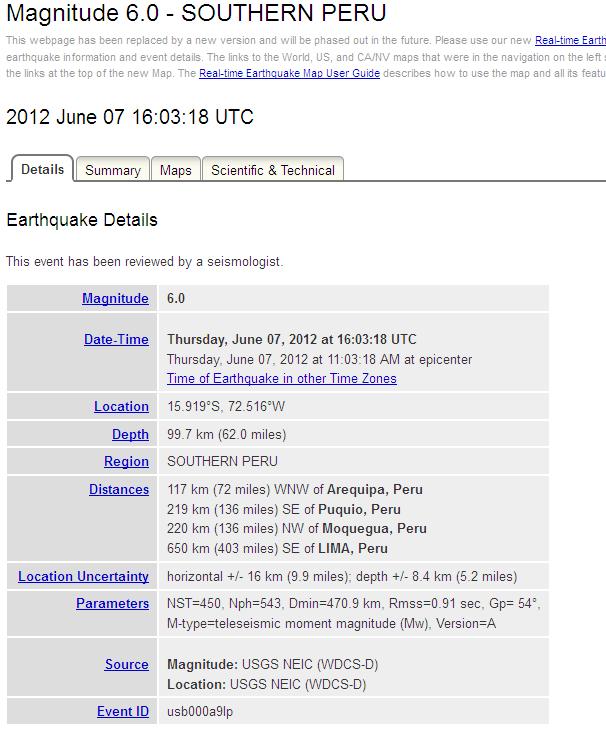
The original can be found here on USGS, but because that link will likely "404" after a week, I provided the screenshot above.
The above activity in southern Peru serves to strengthen my belief that the statements I made a couple of weeks ago were on the right track. However, the statements in my earlier post were not predictions as I could not give a precise time window. They were observations based on indications I had personally noted. (I have discussed the significance of "indications" earlier in this thread in the way that I apply them to predictions and observations.)
As I consider the indications are now stronger, I'll now be more specific and make an actual prediction, with magnitude, region and time window.
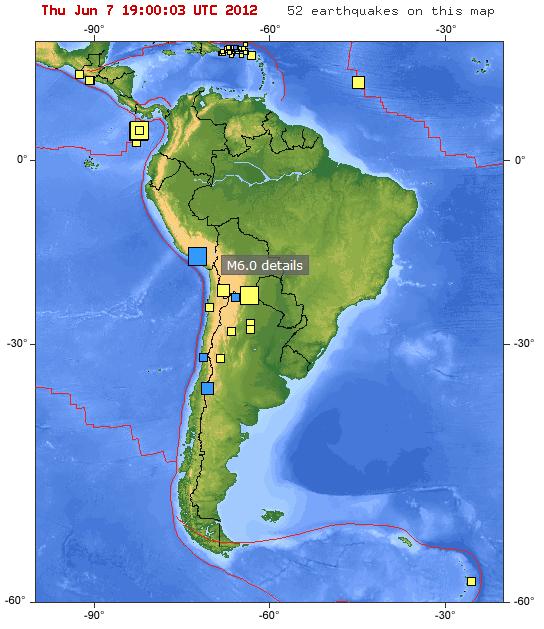
Let's take a look at the South America map, which also shows the above quake (it's the big blue square):
My feeling is that if there is to be a major quake -- that is, one of magnitude 7.0 or greater -- it could occur north-west of the current quake's location, namely closer to Lima. This would place the epicentre at about 14 S latitude and between about 76 and 77 W longitude, making it west of the town of Ica. I have provided the marked map below to indicate the region:
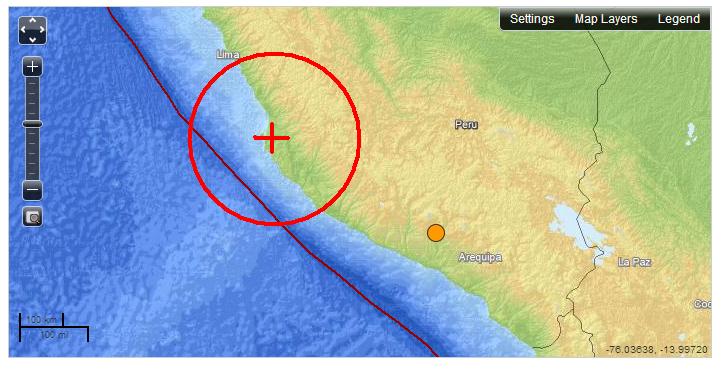
You'll see that the circle also covers part of the red line off the coast that indicates the subduction zone. This is because if there is a larger event it could also occur off the coast there, rather than on land in a near-coastal region.
So, while I am posting this as a prediction, as usual I do with with some trepidation as this is by no means a game for me. Bigger quakes are serious matters. The reasons I'm posting here rather than creating a special thread are that I'm not seeking to alarm people or fear-monger and also I'm not seeking a bunch of stars or flags. (I don't get flags here as I'm not the OP of the thread.) I just want this logged and on record in a form that I cannot touch in the future.
SUMMARY:
This prediction is for an earthquake of magnitude 7.0 (Mw) or greater, within or at least close to the coordinates of 14 S and 76 to 77 W, within a time window of seven days from the time of this post, which is just after 20:15 UTC on June 7, 2012.
A quake in or very close the stated zone will only be counted as a "hit" if it is at least a magnitude 6.5 Mw and is within the specified time window. Anything less than that just is too small in terms of energy release.
End of post.
Mike
Back in this post on May 25 (a bit further up this page), I discussed the current relative lack of strong quake activity and went on to mention some regions I was keeping an eye on. Listing them in order of likelihood, the first I mentioned was:
First: Peru. This has bothered me for a while. They had a decent-sized mag 6 there a couple weeks back but I'm still leery of it. I just feel it's been rather long since a bigger shaker there by the coastal regions. (Southern Peru more likely than the north.)
Today, June 7, there was a magnitude 6.0 quake in Southern Peru, about 80 km inland from the coast. Here's a screenshot of the data page:
The original can be found here on USGS, but because that link will likely "404" after a week, I provided the screenshot above.
The above activity in southern Peru serves to strengthen my belief that the statements I made a couple of weeks ago were on the right track. However, the statements in my earlier post were not predictions as I could not give a precise time window. They were observations based on indications I had personally noted. (I have discussed the significance of "indications" earlier in this thread in the way that I apply them to predictions and observations.)
As I consider the indications are now stronger, I'll now be more specific and make an actual prediction, with magnitude, region and time window.
Let's take a look at the South America map, which also shows the above quake (it's the big blue square):
My feeling is that if there is to be a major quake -- that is, one of magnitude 7.0 or greater -- it could occur north-west of the current quake's location, namely closer to Lima. This would place the epicentre at about 14 S latitude and between about 76 and 77 W longitude, making it west of the town of Ica. I have provided the marked map below to indicate the region:
You'll see that the circle also covers part of the red line off the coast that indicates the subduction zone. This is because if there is a larger event it could also occur off the coast there, rather than on land in a near-coastal region.
So, while I am posting this as a prediction, as usual I do with with some trepidation as this is by no means a game for me. Bigger quakes are serious matters. The reasons I'm posting here rather than creating a special thread are that I'm not seeking to alarm people or fear-monger and also I'm not seeking a bunch of stars or flags. (I don't get flags here as I'm not the OP of the thread.) I just want this logged and on record in a form that I cannot touch in the future.
SUMMARY:
This prediction is for an earthquake of magnitude 7.0 (Mw) or greater, within or at least close to the coordinates of 14 S and 76 to 77 W, within a time window of seven days from the time of this post, which is just after 20:15 UTC on June 7, 2012.
A quake in or very close the stated zone will only be counted as a "hit" if it is at least a magnitude 6.5 Mw and is within the specified time window. Anything less than that just is too small in terms of energy release.
End of post.
Mike
reply to post by JustMike
Hi, Mike!
I haven't been able to post much lately. The old computersaurus keeps shutting off!
Our youngest son said the parts for a different one should be here within a week. I can't wait. If had known
how many times a day I would have to sign in, I would have picked a much shorter username!!! Plus, a lot of links
won't work for me either. Hopefully I'll be observing a lot less quietly soon!
Anyway, the reason for my post...I was wondering if your prediction is based solely on observation, or if you are feeling it too?
Hubby has been feeling a good sized one coming for a few weeks now. But he hasn't figured out how to 'fine tune' them yet.
He started going into a seizure three times in the last two days. It has always happened when he's asleep, but yesterday, one time he was awake.
That has never happened before. We haven't been able to definitively tie them to earthquakes, but they found no medical reason for them.
It usually only happens once every few months, so this is really out of the norm! He said he feels a definite build up of pressure that's increasing.
Last night before the 5.8 in Chile we both were dizzy, uncoordinated & exhausted. Too much so for a 5.8! But then with the 5.6 & 6.0; three good sized ones in 12 hours, could explain it I guess. That's why I was wondering if you were feeling anything also?
Take care,
WOQ
Hi, Mike!
I haven't been able to post much lately. The old computersaurus keeps shutting off!
Our youngest son said the parts for a different one should be here within a week. I can't wait. If had known
how many times a day I would have to sign in, I would have picked a much shorter username!!! Plus, a lot of links
won't work for me either. Hopefully I'll be observing a lot less quietly soon!
Anyway, the reason for my post...I was wondering if your prediction is based solely on observation, or if you are feeling it too?
Hubby has been feeling a good sized one coming for a few weeks now. But he hasn't figured out how to 'fine tune' them yet.
He started going into a seizure three times in the last two days. It has always happened when he's asleep, but yesterday, one time he was awake.
That has never happened before. We haven't been able to definitively tie them to earthquakes, but they found no medical reason for them.
It usually only happens once every few months, so this is really out of the norm! He said he feels a definite build up of pressure that's increasing.
Last night before the 5.8 in Chile we both were dizzy, uncoordinated & exhausted. Too much so for a 5.8! But then with the 5.6 & 6.0; three good sized ones in 12 hours, could explain it I guess. That's why I was wondering if you were feeling anything also?
Take care,
WOQ
Hello, WOQ,
about your question:
...my answer is that it's a combination of both, but not quite in the way you've described with being uncoordinated and so forth. I do get such episodes but usually only just a few days before a major quake event, and not very often even in those cases.
But those sorts of feelings rarely give me insight into the precise "where" of an event, so I can't do much with them by way of actual predictions.
The prediction I posted yesterday was derived in a different way and is based on the same sort of criteria I've followed with several others in this thread, especially those cases where I've been very specific with time window, magnitude and lat/long position.
Basically, it works like this: I routinely observe what's going on around the world with quakes. It's just a daily thing for me. Also, the question of "where will the next major one be?" tends to go round in my mind on a daily basis as well. Not as an obsessive thing, but as a natural response to what I see going on.
And sometimes, I get a location. I get a name of a country or region. (How? It's like they almost jump out at me off the map!) Then I keep watch. This was the case with Peru. I've been keeping an eye on that country since the middle of March (I first referenced my specific interest in Peru in a post here on March 20) but it's only been in the past week or so that I've seen a possible pattern developing in that greater region that suggests the location I stated and the possible time frame.
The complete explanation would take a lot longer and I'd have to add lots of linkies to various posts I have on this thread and elsewhere on ATS to back up what I'm saying, but fundamentally I use a combination of rather boring and practical observation combined with taking note of what I “see” (inadequate term, really). Most of my more successful prediction attempts here have worked this way.
Einstein said: "There is no logical way to the discovery of these elemental laws. There is only the way of intuition, which is helped by a feeling for the order lying behind the appearance."
In other words, if we go only on logic and the "A+B leads to C" kind of thinking, and ignore the fact that our planet doesn't always follow that same line of thinking, we'll get nowhere. We need to use a bit of intuition and that's what I try to do.
So, we will see. The odds of my being right in this case are pretty small but sometimes we just have to press on regardless.
Mike
about your question:
[...] Anyway, the reason for my post...I was wondering if your prediction is based solely on observation, or if you are feeling it too?
[...]
Last night before the 5.8 in Chile we both were dizzy, uncoordinated & exhausted. Too much so for a 5.8! But then with the 5.6 & 6.0; three good sized ones in 12 hours, could explain it I guess. That's why I was wondering if you were feeling anything also?
...my answer is that it's a combination of both, but not quite in the way you've described with being uncoordinated and so forth. I do get such episodes but usually only just a few days before a major quake event, and not very often even in those cases.
But those sorts of feelings rarely give me insight into the precise "where" of an event, so I can't do much with them by way of actual predictions.
The prediction I posted yesterday was derived in a different way and is based on the same sort of criteria I've followed with several others in this thread, especially those cases where I've been very specific with time window, magnitude and lat/long position.
Basically, it works like this: I routinely observe what's going on around the world with quakes. It's just a daily thing for me. Also, the question of "where will the next major one be?" tends to go round in my mind on a daily basis as well. Not as an obsessive thing, but as a natural response to what I see going on.
And sometimes, I get a location. I get a name of a country or region. (How? It's like they almost jump out at me off the map!) Then I keep watch. This was the case with Peru. I've been keeping an eye on that country since the middle of March (I first referenced my specific interest in Peru in a post here on March 20) but it's only been in the past week or so that I've seen a possible pattern developing in that greater region that suggests the location I stated and the possible time frame.
The complete explanation would take a lot longer and I'd have to add lots of linkies to various posts I have on this thread and elsewhere on ATS to back up what I'm saying, but fundamentally I use a combination of rather boring and practical observation combined with taking note of what I “see” (inadequate term, really). Most of my more successful prediction attempts here have worked this way.
Einstein said: "There is no logical way to the discovery of these elemental laws. There is only the way of intuition, which is helped by a feeling for the order lying behind the appearance."
In other words, if we go only on logic and the "A+B leads to C" kind of thinking, and ignore the fact that our planet doesn't always follow that same line of thinking, we'll get nowhere. We need to use a bit of intuition and that's what I try to do.
So, we will see. The odds of my being right in this case are pretty small but sometimes we just have to press on regardless.
Mike
edit on 8/6/12 by JustMike because: I edited it for clarity.
A quick heads up....just in case.
Hubby's feeling something!
He felt pretty good today....until he came home from work & got into the shower! (Water conducting/intensifying effect?)
He said a feeling of overwhelming sadness hit him. Then he started crying, shaking, was dizzy & it was hard to breathe.
Symptom -wise 5-6.
When he got out, it went down to a 5.
So altogether since.....
Overwhelming sadness, shaking, dizzy, hard to breathe, like he's being squeezed.
Piercing pain through the left pec, front to back, like he was shot with an arrow!
Pressure in the eyes. Ears ringing.
Stomach in knots, feels like he could upchuck.
Started about 3:30 PM EDT.
It didn't let up. He had to go lie down & fell asleep.
Hope it's a coincidence....but so many symptoms!
WOQ
Hubby's feeling something!
He felt pretty good today....until he came home from work & got into the shower! (Water conducting/intensifying effect?)
He said a feeling of overwhelming sadness hit him. Then he started crying, shaking, was dizzy & it was hard to breathe.
Symptom -wise 5-6.
When he got out, it went down to a 5.
So altogether since.....
Overwhelming sadness, shaking, dizzy, hard to breathe, like he's being squeezed.
Piercing pain through the left pec, front to back, like he was shot with an arrow!
Pressure in the eyes. Ears ringing.
Stomach in knots, feels like he could upchuck.
Started about 3:30 PM EDT.
It didn't let up. He had to go lie down & fell asleep.
Hope it's a coincidence....but so many symptoms!
WOQ
Hello gang, I've just come back home to sunny So Cal after a month back east in Virginia. Today started with a lot of nausea and bad feelings before
I got to the airport. I took some Dramamine to help get me through my 9 hour journey, and I'm still feeling pretty loopy 12 hours later. As soon as
I stepped outside of LAX I started having sharp piercing pains in my upper back kind of under my shoulder blade. Once I got myself out of Los Angeles
it got much better. Probably just all the stress from traveling but I thought I'd mention since WOQ's hubby was having the piercing pain and nausea
earlier today too.
I had several dreams of quakes while I was back east, way more than I ever have at home. It had me obsessively checking my phone for alerts. I kept dreaming of 6-7's in California and a large 8+ in the south pacific somewhere. I had a lot of headaches over the last week too, much more persistent than I'd been having the first 3 weeks I was out there. That's about all I have to report for now.
I had several dreams of quakes while I was back east, way more than I ever have at home. It had me obsessively checking my phone for alerts. I kept dreaming of 6-7's in California and a large 8+ in the south pacific somewhere. I had a lot of headaches over the last week too, much more persistent than I'd been having the first 3 weeks I was out there. That's about all I have to report for now.
new topics
-
WF Killer Patents & Secret Science Vol. 1 | Free Energy & Anti-Gravity Cover-Ups
General Conspiracies: 21 minutes ago -
Hurt my hip; should I go see a Doctor
General Chit Chat: 1 hours ago -
Israel attacking Iran again.
Middle East Issues: 2 hours ago -
Michigan school district cancels lesson on gender identity and pronouns after backlash
Education and Media: 2 hours ago -
When an Angel gets his or her wings
Religion, Faith, And Theology: 3 hours ago -
Comparing the theology of Paul and Hebrews
Religion, Faith, And Theology: 4 hours ago -
Pentagon acknowledges secret UFO project, the Kona Blue program | Vargas Reports
Aliens and UFOs: 5 hours ago -
Boston Dynamics say Farewell to Atlas
Science & Technology: 5 hours ago -
I hate dreaming
Rant: 5 hours ago -
Man sets himself on fire outside Donald Trump trial
Mainstream News: 7 hours ago
top topics
-
The Democrats Take Control the House - Look what happened while you were sleeping
US Political Madness: 8 hours ago, 18 flags -
In an Historic First, In N Out Burger Permanently Closes a Location
Mainstream News: 10 hours ago, 16 flags -
A man of the people
Medical Issues & Conspiracies: 15 hours ago, 11 flags -
Biden says little kids flip him the bird all the time.
Politicians & People: 7 hours ago, 8 flags -
Man sets himself on fire outside Donald Trump trial
Mainstream News: 7 hours ago, 7 flags -
Pentagon acknowledges secret UFO project, the Kona Blue program | Vargas Reports
Aliens and UFOs: 5 hours ago, 6 flags -
Israel attacking Iran again.
Middle East Issues: 2 hours ago, 5 flags -
Michigan school district cancels lesson on gender identity and pronouns after backlash
Education and Media: 2 hours ago, 4 flags -
4 plans of US elites to defeat Russia
New World Order: 17 hours ago, 4 flags -
Boston Dynamics say Farewell to Atlas
Science & Technology: 5 hours ago, 4 flags
active topics
-
Sheetz facing racial discrimination lawsuit for considering criminal history in hiring
Social Issues and Civil Unrest • 7 • : Caver78 -
Hurt my hip; should I go see a Doctor
General Chit Chat • 9 • : rickymouse -
Silent Moments --In Memory of Beloved Member TDDA
Short Stories • 48 • : Encia22 -
MULTIPLE SKYMASTER MESSAGES GOING OUT
World War Three • 52 • : cherokeetroy -
Israel attacking Iran again.
Middle East Issues • 22 • : Boomer1947 -
WF Killer Patents & Secret Science Vol. 1 | Free Energy & Anti-Gravity Cover-Ups
General Conspiracies • 1 • : WakeofPoseidon -
The Democrats Take Control the House - Look what happened while you were sleeping
US Political Madness • 67 • : WeMustCare -
Thousands Of Young Ukrainian Men Trying To Flee The Country To Avoid Conscription And The War
Other Current Events • 53 • : ghandalf -
Boston Dynamics say Farewell to Atlas
Science & Technology • 5 • : Caver78 -
Biden says little kids flip him the bird all the time.
Politicians & People • 16 • : stelth2