It looks like you're using an Ad Blocker.
Please white-list or disable AboveTopSecret.com in your ad-blocking tool.
Thank you.
Some features of ATS will be disabled while you continue to use an ad-blocker.

What transitional form will we have this week?
page: 1share:
If you guessed "legged lizards to snakes" you'd be right!
see? there are transitional forms
now for some commentary: i think this find is really cool. they can even identify the bones within the legs.
What was lost tens of millions of years ago is now found.
A fossil animal locked in Lebanese limestone has been shown to be an extremely precious discovery - a snake with two legs.
Scientists have only a handful of specimens that illustrate the evolutionary narrative that goes from ancient lizard to limbless modern serpent.
Researchers at the European Light Source (ESRF) in Grenoble, France, used intense X-rays to confirm that a creature imprinted on a rock, and with one visible leg, had another appendage buried just under the surface of the slab.
"We were sure he had two legs but it was great to see it, and we hope to find other characteristics that we couldn't see on the other limb," said Alexandra Houssaye from the National Museum of Natural History, Paris.
see? there are transitional forms
now for some commentary: i think this find is really cool. they can even identify the bones within the legs.
wow, i provide evidence of a transitional form (something that creationists and IDists keep asking for) and i don't even get a reply.
how odd
how odd
reply to post by madnessinmysoul
Dude, you mean this with an infinite time and genetic mutations....
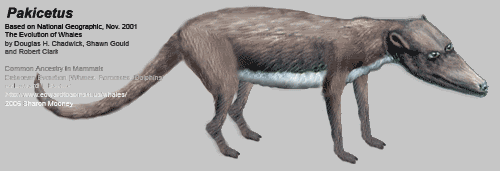
made this....

Okay???
Dude, you mean this with an infinite time and genetic mutations....
made this....
Okay???
reply to post by Heronumber0
no
you also need the proper conditions and the proper chain of events. this stuff isn't just about mutation, it's about pressure.
with infinite time and genetic mutations you'd only get genetic drift.
no
you also need the proper conditions and the proper chain of events. this stuff isn't just about mutation, it's about pressure.
with infinite time and genetic mutations you'd only get genetic drift.
Cool, more evidence of evolution.
I find it interesting that snakes lost their legs over time. Does that mean it's more efficient to slither? Or maybe just more efficient for snakes in particular due to their behavioral patterns (ie. if they stayed close to the ground much of the time).
I find it interesting that snakes lost their legs over time. Does that mean it's more efficient to slither? Or maybe just more efficient for snakes in particular due to their behavioral patterns (ie. if they stayed close to the ground much of the time).
reply to post by madnessinmysoul
In fairness, MIMS, I read up on the 'evidence' and it talked about inner ear structure unique to cetaceans and also something about tooth cusps. However, these are two lines of evidence and when matched against the caveats proposed by phylogeneticists do not convince me as being strong points of evidence - sorry mate but I am not convinced of the link especially with cetaceans. Equine lineage has had similar problems as you would also admit.
For example:
Phylogenetics
In fairness, MIMS, I read up on the 'evidence' and it talked about inner ear structure unique to cetaceans and also something about tooth cusps. However, these are two lines of evidence and when matched against the caveats proposed by phylogeneticists do not convince me as being strong points of evidence - sorry mate but I am not convinced of the link especially with cetaceans. Equine lineage has had similar problems as you would also admit.
For example:
(I have highlighted salient points)
True structural convergence: structures that have undergone convergent evolution can artificially result in incorrect tree topologies. Including more characters in the analysis also aids in overcoming convergent effects.
Character reversals: characters that revert to an ancestral state pose a challenge similar to convergence. Because DNA and RNA only have four different character states, they are especially prone to reversals during evolution.
Lost characters: lineages that have lost characters (such as whales and their hindlimbs) can also pose cladistic problems. Often, if a cladistic analysis indicates strongly that a certain character has been lost during evolution, it is best to omit this character in higher resolution analyses of that lineage.
Phylogenetics
reply to post by Heronumber0
...not in this thread. this thread is my retreat from oversciencing things. it's where i can just lay back, relax, and talk about a really cool fossil.
if you want me to lay down some heavy science, go to a different thread.
...not in this thread. this thread is my retreat from oversciencing things. it's where i can just lay back, relax, and talk about a really cool fossil.
if you want me to lay down some heavy science, go to a different thread.
Originally posted by madnessinmysoul
reply to post by Heronumber0
...not in this thread. this thread is my retreat from oversciencing things. it's where i can just lay back, relax, and talk about a really cool fossil.
if you want me to lay down some heavy science, go to a different thread.
No problem MIMS. You can come to one of my threads to discuss the Science if you want to. However, let's kick off our shoes and chat. MIMS, there is a problem in whale evolution and also horse evolution if you want to discuss a line of intermediate forms. Firstly the links between a land-based mammal which looks like a wolf and the modern whale seems to depend on two features - one is the structure of the inner ear which is a series of bone structures found in whales only but was found in a wolf-like fossil. It was then decided that one was an ancestor of the other.
But...deciding which creature goes where in a line from ancient fossils to modern fossils is an inexact art - even the guys who do it are unsure and admit it. So, I say that intermediate forms have a problem - there should be millions, but only hundreds have been found.
reply to post by Heronumber0
It's not an inexact art - it's a science Fossils are not made from every creature, so expecting to find one for each intermediate species is never going to happen. And that is not a problem.
There are no problems with whale or horse evolution - I don't know where you get this stuff from. If you'd care to share, we can discuss it.
It's not an inexact art - it's a science Fossils are not made from every creature, so expecting to find one for each intermediate species is never going to happen. And that is not a problem.
There are no problems with whale or horse evolution - I don't know where you get this stuff from. If you'd care to share, we can discuss it.
reply to post by dave420
OK dave. In my answer I have to separate fact from my personal opinions.
Firstly, just to summarise it the lineage of the horse was thought to follow a certain plan from the examination of fossls and an initial lineage was suggested on the basis of the features.
talkorigins
Suffice to say this lineage is still taught in British Biology textbooks.
However, in conclusion there is no direct line of descent with well-defined intermediates. I am including extended quotes so that I do not misrepresent or quotemine this information:
Conclusions
In other words, what was thought of as a well established lineage was later shown to be false. The lesson to be learned IMHO is that one should not asume a phylogenetic relationship on the basis of scanty facts or a small number of what seem to be intermediate forms. We have to be extremely careful about inferences made from intermediate forms.
You will point out that this is the scientific method but I would argue that what is speculation should be clearly stated as speculation and not touted as incontrovertible fact, which is too often the case. I will refer to whales later if you wish but will also add on Kettlewell's initial fixing of the results on the peppered moth (Biston betularia) which exists in different melanic forms and was thought to be selected on the basis of predation by birds.
OK dave. In my answer I have to separate fact from my personal opinions.
Firstly, just to summarise it the lineage of the horse was thought to follow a certain plan from the examination of fossls and an initial lineage was suggested on the basis of the features.
Here, one could see the fossil species "Eohippus" transformed into an almost totally different-looking (and very familiar) descendent, Equus, through a series of clear intermediates. Biologists and interested laypeople were justifiably excited. Some years later, the American Museum of Natural History assembled a famous exhibit of these fossil horses, designed to show gradual evolution from "Eohippus" (now called Hyracotherium) to modern Equus. Such exhibits focussed attention on the horse family not only as evidence for evolution per se, but also specifically as a model of gradual, straight-line evolution, with Equus being the "goal" of equine evolution. This story of the horse family was soon included in all biology textbooks.
talkorigins
Suffice to say this lineage is still taught in British Biology textbooks.
However, in conclusion there is no direct line of descent with well-defined intermediates. I am including extended quotes so that I do not misrepresent or quotemine this information:
There are no truly consistent "trends".
Tracing a line of descent from Hyracotherium to Equus reveals several apparant trends: reduction of toe number, increase in size of cheek teeth, lengthening of the face, increase in body size. But these trends are not seen in all of the horse lines. On the whole, horses got larger, but some horses (Archeohippus, Calippus) then got smaller again. Many recent horses evolved complex facial pits, and then some of their descendants lost them again. Most of the recent (5-10 My) horses were three-toed, not one-toed, and we see a "trend" to one toe only because all the three-toed lines have recently become extinct.
Additionally, these traits do not necessarily evolve together, or at a steady rate. The various morphological characters each evolved in fits and starts, and did not evolve as a suite of characters. For example, throughout the Eocene, the feet changed little, and only the teeth evolved. Throughout the Miocene, both feet and teeth evolved rapidly. Rates of evolution depend on the ecological pressures facing the species.
The "direction" of evolution depends on the ecological challenges facing the individuals of a species and on the variation in that species, not on an inherent "evolutionary trend
Conclusions
In other words, what was thought of as a well established lineage was later shown to be false. The lesson to be learned IMHO is that one should not asume a phylogenetic relationship on the basis of scanty facts or a small number of what seem to be intermediate forms. We have to be extremely careful about inferences made from intermediate forms.
You will point out that this is the scientific method but I would argue that what is speculation should be clearly stated as speculation and not touted as incontrovertible fact, which is too often the case. I will refer to whales later if you wish but will also add on Kettlewell's initial fixing of the results on the peppered moth (Biston betularia) which exists in different melanic forms and was thought to be selected on the basis of predation by birds.
reply to post by Heronumber0
Hey there, Hero.
Your objections have to do with taxonomy and cladistics rather than evolution itself. What it amounts to is a statement -- accepted by all respectable biologists -- that evolution is not teleological; forms are not evolving towards some ideal of perfection.
Anyway, the taxonomic evidence linking Pakicetus with modern whales merely confirms what we already know from molecular evidence: that whales and modern hippopotami had a common ancestor antecedent to both forms. See (for instance) Dawkins, The Ancestor's Tale, 'Laurasiatheres' for more information.
It has been established for at least half a century that whales are the descendants of land-dwelling animals that returned to the sea. This is old, well-established knowledge you're attempting to contest here.
Your objections have to do with taxonomy and cladistics rather than evolution itself. What it amounts to is a statement -- accepted by all respectable biologists -- that evolution is not teleological; forms are not evolving towards some ideal of perfection.
Anyway, the taxonomic evidence linking Pakicetus with modern whales merely confirms what we already know from molecular evidence: that whales and modern hippopotami had a common ancestor antecedent to both forms. See (for instance) Dawkins, The Ancestor's Tale, 'Laurasiatheres' for more information.
It has been established for at least half a century that whales are the descendants of land-dwelling animals that returned to the sea. This is old, well-established knowledge you're attempting to contest here.
Originally posted by Astyanax
accepted by all respectable biologists
Ad-Populum and I would expect the "respectable" ones are those that agree with the lot of Darwinian Dolts
forms are not evolving towards some ideal of perfection.
No he wasn't saying they were just asking to prove they are evolving into new species but even the word "speciation" is getting to be so deliberatly obfuscated by these dimwits just so they can come up with more new excuses to get everyone so confused when they switch back to using micro evolution to substantiate macro evolution.
It has been established for at least half a century that whales are the descendants of land-dwelling animals that returned to the sea. This is old, well-established knowledge you're attempting to contest here.
Lots of the bunk we see as proof touted by evolutionist was well established that long and proven bunk later. The strange thing is,, it is still being taught to our kids as evolution fact when in fact it is BUNK
Bunk (like religion) has no business in science and evolution is bunk
Mims keeps suggesting I come to visit OC so I have and I am glad he suggested it. I am sure I can learn a lot just reading hero's posts.
He seems to be the only one of you guys that knows what time it is.
- Con
[edit on 18-4-2008 by Conspiriology]
Originally posted by dave420
Fossils are not made from every creature, so expecting to find one for each intermediate species is never going to happen
Oh you got that right but not for the reason you say. Its never going to happen because macroevolution is never going to happen.
clever way to word that but let me correct you on just a couple of little word tricks I see so often done by you Athevolutionist's
so expecting to find one for "ANY" intermediate species is never going to happen
And that is not a problem.
Oh Yes it is.
For the same reason Darwin writes in his book of origins. If Darwin could have used the tools we have today just to see how complex a single cell is and that it makes our nano technology seem like childs play, he would have never come up with that silly idea in the first place.
There are no problems with whale or horse evolution - I don't know where you get this stuff from. If you'd care to share, we can discuss it.
LOL you don't get out much do you ha ha the horse has been totally debunked. As for the whale,, same thing, it is up to interpretation and the evolutionist uses so much word games to explain it almost all of it is garbage. Dawkins average paragrapghs grade level 21 readability big fat zero. Ill never forget that and you might want to get yourself a Science writer software program so you can see what I am talking about.
- Con
[edit on 18-4-2008 by Conspiriology]
Originally posted by madnessinmysoul
reply to post by Heronumber0
...not in this thread. this thread is my retreat from oversciencing things. it's where i can just lay back, relax, and talk about a really cool fossil.
You're the one calling it a "transitional" form mims
if you want me to lay down some heavy science, go to a different thread.
Another words if anyone disagree's or blinds him with science that proves him wrong then just go away.
Damn I sure would have enjoyed it too but you are right,, you never really were much of a challenge in that regard.
Good luck
- Con
[edit on 18-4-2008 by Conspiriology]
Young Earth creationism... is not science in the least. Rather, it is an infantile view of the universe grasping at straws as it loses it's
underpinnings that were sparse in the first place and only became established for lack of a better alternative. Darwinism, on the other hand, makes an
(excellent and brilliant) attempt to explain these things instead of just "God did it". I cannot fathom (and indeed fear even to do so) how much
duller my life would be if I wasn't for Darwin.
You expect correctly. Evolutionary theory is central to a branch of modern biology, phylogeny. Apparently vestigial structures, fossils, embryological evidence, etcetera is all bunk as well? Let me guess... Satan put it there to tempt us to sin?
That's how real science works, my friend. Old theories and hypothesis are not clung to when they are found to be wrong; they are rewritten. That's more than Creationists' rediculous fundamentals have ever done.
Except that the current vast consensus and volume of evidence suggest otherwise. I know that if my children were mindlessly indoctrined with infantile and scientifically worthless creationist views, I would take issue.
Maybe it won't. No problem for evolutionary theory because we never claimed that it would. Punctuated equilibrium - the idea that species stay relatively similar until a new pressure is put upon them - on the other hand, most likely did happen, and probably will again, due to new selective pressures.
Complexity of an organism has nothing to do with evolutionary theory's correctness or falseness, so that argument is meaningless.
Let me get this straight... because you can't read it or understand it, it must be false? An argument of ignorance? Sounds awfully familiar... indeed, it's what creationists have been using for hundreds of years to try to gain a hold over their audience. Well guess what? Science can explain plenty of it now. Not all of it, not yet or perhaps ever. Science doesn't claim to be able to. Either way, dark age views do not have a place in the information age, and it's beginning to become blatant.
There is no science in creationism. The OP did not want to get into another argument because creationists' are painfully circular. Luckily, since this is my first post in this forum, I still have plenty of room for frustration.
Let's see how this spins out.
I would expect the "respectable" ones are those that agree with the lot of Darwinian Dolts
You expect correctly. Evolutionary theory is central to a branch of modern biology, phylogeny. Apparently vestigial structures, fossils, embryological evidence, etcetera is all bunk as well? Let me guess... Satan put it there to tempt us to sin?
so they can come up with more new excuses to get everyone so confused when they switch back to using micro evolution to substantiate macro evolution.
That's how real science works, my friend. Old theories and hypothesis are not clung to when they are found to be wrong; they are rewritten. That's more than Creationists' rediculous fundamentals have ever done.
Lots of the bunk we see as proof touted by evolutionist was well established that long and proven bunk later. The strange thing is,, it is still being taught to our kids as evolution fact when in fact it is BUNK
Except that the current vast consensus and volume of evidence suggest otherwise. I know that if my children were mindlessly indoctrined with infantile and scientifically worthless creationist views, I would take issue.
Oh you got that right but not for the reason you say. Its never going to happen because macroevolution is never going to happen.
Maybe it won't. No problem for evolutionary theory because we never claimed that it would. Punctuated equilibrium - the idea that species stay relatively similar until a new pressure is put upon them - on the other hand, most likely did happen, and probably will again, due to new selective pressures.
If Darwin could have used the tools we have today just to see how complex a single cell is and that it makes our nano technology seem like childs play, he would have never come up with that silly idea in the first place.
Complexity of an organism has nothing to do with evolutionary theory's correctness or falseness, so that argument is meaningless.
LOL you don't get out much do you ha ha the horse has been totally debunked. As for the whale,, same thing, it is up to interpretation and the evolutionist uses so much word games to explain it almost all of it is garbage. Dawkins average paragrapghs grade level 21 readability big fat zero. Ill never forget that and you might want to get yourself a Science writer software program so you can see what I am talking about.
Let me get this straight... because you can't read it or understand it, it must be false? An argument of ignorance? Sounds awfully familiar... indeed, it's what creationists have been using for hundreds of years to try to gain a hold over their audience. Well guess what? Science can explain plenty of it now. Not all of it, not yet or perhaps ever. Science doesn't claim to be able to. Either way, dark age views do not have a place in the information age, and it's beginning to become blatant.
Another words if anyone disagree's or blinds him with science that proves him wrong then just go away.
There is no science in creationism. The OP did not want to get into another argument because creationists' are painfully circular. Luckily, since this is my first post in this forum, I still have plenty of room for frustration.
Let's see how this spins out.
And ever at thy season be thou free
Did you read the OP? What is a snake with legs?
You know, I could have sworn I saw one in the park yesterday morning.
Your literary judgements are derived from a piece of computer software? How droll and original.
so expecting to find one for "ANY" intermediate species is never going to happen
Did you read the OP? What is a snake with legs?
ha ha the horse has been totally debunked.
You know, I could have sworn I saw one in the park yesterday morning.
Dawkins average paragrapghs grade level 21 readability big fat zero.
Your literary judgements are derived from a piece of computer software? How droll and original.
What is a snake with legs?
We usually call that a lizard. Mystery solved.
reply to post by Bigwhammy
Yes, and when it's got a shell on its back it's a turtle. These sauropsids, eh, can't tell 'em apart.
And what do we usually call these?
We usually call that a lizard. Mystery solved.
Yes, and when it's got a shell on its back it's a turtle. These sauropsids, eh, can't tell 'em apart.
And what do we usually call these?
Originally posted by Astyanax
reply to post by Heronumber0
Hey there, Hero.
Your objections have to do with taxonomy and cladistics rather than evolution itself. What it amounts to is a statement -- accepted by all respectable biologists -- that evolution is not teleological; forms are not evolving towards some ideal of perfection.
Hey Astyanax,
I am looking up some of the so-called evidence and I think what will happen once again which happened in the equine lineage is that the story may have to be modified. However, this is the story of Science all over surely where there is no complete certainty but always room for modification of a previous theory. Do I have a problem with cladistics? No not really, it is interesting to place species conveniently into clades and talk about taxonomic units etc... However, you should read the caveats and you will find that you cannot claim a paradigmatic lineage for the whale. Yes there are inferences made on the basis of the Darwinian gradualism but how much hard and fast information is there? For example, how many Pakicetus fossils are there and how many other wolf-like 'intermediates?'
Anyway, the taxonomic evidence linking Pakicetus with modern whales merely confirms what we already know from molecular evidence: that whales and modern hippopotami had a common ancestor antecedent to both forms. See (for instance) Dawkins, The Ancestor's Tale, 'Laurasiatheres' for more information.
It has been established for at least half a century that whales are the descendants of land-dwelling animals that returned to the sea. This is old, well-established knowledge you're attempting to contest here.
I am not contesting incontrovertible truth Astyanax, I am contesting inferences made on the whim of one or two prominent scientists and the influence of prominent scientists in the field of cetacean evolution. I am currently reading the papers on molecular homology and cannot comment further until I read them correctly. I think you know the scientific world well enough to understand how the views of famous 'expert' scientists in a field can disproportionally influence scientific opinion and orthodoxy.
We usually call that a lizard. Mystery solved.
While I'm sure you realize this already with your infinite creationist wisdom, there are differences between snakes and lizards that go beyond the amount of limbs they possess.
Similar reasons account for why we can tell that a wolf-like creature such as Ambulocetus probably evolved into whales.
P.S.
Heronumber0, allow me to ask exactly why you doubt that whales had land-living ancestors? For instance, otters are living examples of creatures that can live on land and in water, but they bear a huge amount of similarity to land living mustelids.
[edit on 19-4-2008 by SlyCM (work)]
new topics
-
Supreme Court Oral Arguments 4.25.2024 - Are PRESIDENTS IMMUNE From Later Being Prosecuted.
Above Politics: 36 minutes ago -
Krystalnacht on today's most elite Universities?
Social Issues and Civil Unrest: 45 minutes ago -
Chris Christie Wishes Death Upon Trump and Ramaswamy
Politicians & People: 1 hours ago -
University of Texas Instantly Shuts Down Anti Israel Protests
Education and Media: 3 hours ago -
Any one suspicious of fever promotions events, major investor Goldman Sachs card only.
The Gray Area: 5 hours ago -
God's Righteousness is Greater than Our Wrath
Religion, Faith, And Theology: 9 hours ago
top topics
-
VP's Secret Service agent brawls with other agents at Andrews
Mainstream News: 14 hours ago, 11 flags -
Nearly 70% Of Americans Want Talks To End War In Ukraine
Political Issues: 15 hours ago, 5 flags -
Sunak spinning the sickness figures
Other Current Events: 15 hours ago, 5 flags -
Electrical tricks for saving money
Education and Media: 13 hours ago, 4 flags -
Late Night with the Devil - a really good unusual modern horror film.
Movies: 17 hours ago, 3 flags -
Krystalnacht on today's most elite Universities?
Social Issues and Civil Unrest: 45 minutes ago, 3 flags -
University of Texas Instantly Shuts Down Anti Israel Protests
Education and Media: 3 hours ago, 2 flags -
Any one suspicious of fever promotions events, major investor Goldman Sachs card only.
The Gray Area: 5 hours ago, 2 flags -
Supreme Court Oral Arguments 4.25.2024 - Are PRESIDENTS IMMUNE From Later Being Prosecuted.
Above Politics: 36 minutes ago, 2 flags -
Chris Christie Wishes Death Upon Trump and Ramaswamy
Politicians & People: 1 hours ago, 0 flags
active topics
-
University of Texas Instantly Shuts Down Anti Israel Protests
Education and Media • 59 • : theatreboy -
The Reality of the Laser
Military Projects • 48 • : 5thHead -
Nearly 70% Of Americans Want Talks To End War In Ukraine
Political Issues • 69 • : SchrodingersRat -
Supreme Court Oral Arguments 4.25.2024 - Are PRESIDENTS IMMUNE From Later Being Prosecuted.
Above Politics • 1 • : network dude -
Candidate TRUMP Now Has Crazy Judge JUAN MERCHAN After Him - The Stormy Daniels Hush-Money Case.
Political Conspiracies • 744 • : Threadbarer -
Truth Social goes public, be careful not to lose your money
Mainstream News • 129 • : matafuchs -
Krystalnacht on today's most elite Universities?
Social Issues and Civil Unrest • 2 • : marg6043 -
Remember These Attacks When President Trump 2.0 Retribution-Justice Commences.
2024 Elections • 56 • : WeMustCare -
British TV Presenter Refuses To Use Guest's Preferred Pronouns
Education and Media • 148 • : Consvoli -
VP's Secret Service agent brawls with other agents at Andrews
Mainstream News • 44 • : ByeByeAmericanPie