It looks like you're using an Ad Blocker.
Please white-list or disable AboveTopSecret.com in your ad-blocking tool.
Thank you.
Some features of ATS will be disabled while you continue to use an ad-blocker.

The Sloppy Science of Global Warming
page: 10
share:
I was going to put this in BAN, but thought it didn't really belong there.
The following is an excert from an article by Roy W. Spencer (anyone know him?)
Full Article
It seems that one of the things he is saying is something I've believed for a long time - there is not enough data.
I realise that some will try and discredit the source or the material, but I think the time for hatchet jobs has passed and that real discussion is the order of the day.
Alleged GW or climate change (call it what you will) debate shouldn't be about belief it should be about facts.
Not opinion, not the IPCC, not the merits of one persons favourite against another, but FACTS.
Here's my position - I don't believe much of what the doom mongers say, but I am open minded enough to accept that they might be right.
Any thoughts?
The following is an excert from an article by Roy W. Spencer (anyone know him?)
While a politician might be faulted for pushing a particular agenda that serves his own purposes, who can fault the impartial scientist who warns us of an imminent global-warming Armageddon? After all, the practice of science is an unbiased search for the truth, right? The scientists have spoken on global warming. There is no more debate. But let me play devil’s advocate. Just how good is the science underpinning the theory of manmade global warming? My answer might surprise you: it is 10 miles wide, but only 2 inches deep.
Contrary to what you have been led to believe, there is no solid published evidence that has ruled out a natural cause for most of our recent warmth – not one peer-reviewed paper. The reason: our measurements of global weather on decadal time scales are insufficient to reject such a possibility. For instance, the last 30 years of the strongest warming could have been caused by a very slight change in cloudiness. What might have caused such a change? Well, one possibility is the sudden shift to more frequent El Niño events (and fewer La Niña events) since the 1970s. That shift also coincided with a change in another climate index, the Pacific Decadal Oscillation.
Full Article
It seems that one of the things he is saying is something I've believed for a long time - there is not enough data.
I realise that some will try and discredit the source or the material, but I think the time for hatchet jobs has passed and that real discussion is the order of the day.
Alleged GW or climate change (call it what you will) debate shouldn't be about belief it should be about facts.
Not opinion, not the IPCC, not the merits of one persons favourite against another, but FACTS.
Here's my position - I don't believe much of what the doom mongers say, but I am open minded enough to accept that they might be right.
Any thoughts?
I have been, for longer than anyone, unconvinced of global warming. So it's quite fun to read diatribe like this trying to spin blatantly
contradictory evidence:
www.npr.org...
What is the excuse when evidence doesn't support Global Warming?
"YOU'RE DOING IT WRONG"
Of course 'Dubya is going to bring belief into it..... you're talking about a guy who takes his orders from a giant invisible deity.
[edit on 3/20/2008 by Yarcofin]
www.npr.org...
Some 3,000 scientific robots that are plying the ocean have sent home a puzzling message. These diving instruments suggest that the oceans have not warmed up at all over the past four or five years. That could mean global warming has taken a breather. Or it could mean scientists aren't quite understanding what their robots are telling them.
What is the excuse when evidence doesn't support Global Warming?
"YOU'RE DOING IT WRONG"
Of course 'Dubya is going to bring belief into it..... you're talking about a guy who takes his orders from a giant invisible deity.
[edit on 3/20/2008 by Yarcofin]
Originally posted by budski
The following is an excert from an article by Roy W. Spencer (anyone know him?)
yeah, he's a fundiegelical creationist climatologist. One of the few actual working climatologists who are part of the denial industry. Also part of the group whose 'sloppy' science led to errors in the UAH satellite data set which suggested no trend in tropospheric temps.
The non-sloppy data does.
[edit on 20-3-2008 by melatonin]
But doesn't he mention more than that?
And who says he's wrong?
I'd be interested to see a list of "pro" and "con" scientists.
My guess is that "sloppy" is hatchet work, as is "one of the few deniers"
Since when does a majority confer omnipotence?
Since when does a minority equate to incompetence or just plain being wrong?
This is what I'm talking about with the different factions - they all seem to think that the one who shouts loudest is right, and the reason why is simple.
It's because none of them really know, they just believe they do.
And who says he's wrong?
I'd be interested to see a list of "pro" and "con" scientists.
My guess is that "sloppy" is hatchet work, as is "one of the few deniers"
Since when does a majority confer omnipotence?
Since when does a minority equate to incompetence or just plain being wrong?
This is what I'm talking about with the different factions - they all seem to think that the one who shouts loudest is right, and the reason why is simple.
It's because none of them really know, they just believe they do.
Originally posted by budski
But doesn't he mention more than that?
You asked who he was. I answered.
And who says he's wrong?
Spencer & Clarke accepted their UAH data was full of errors. It was sloppy science. So if it applies to other climatologists who are sloppy because he just says so, or you do, then it certainly applies to Spencer.
What he says is pretty stupid anyway. There will never be enough data for the likes of Spencer, or yourself. When a scientist claims that ID is as scientific as evolutionary theory, we know he's sort of out there --------------->
If he can let his religion pervade his scientific thinking so easily, well you know...even Roger Pielke jr has picked up on his wacky ways (and Pielke's a bit of 'skeptic').
He also recently claimed that the rises in CO2 are probably due to ocean processes. He's lost it by the looks of it, going 'emeritus' as we say.
Who was talking about omnipotence? I just showed that the claim of sloppy science can readily apply to Spencer. You can't have it both ways. They had to correct their data multiple times for simple errors in calculation. These errors fed 'skeptics' for ages before they were uncovered.
the thing about global warming is this, an this is fact an has alot to do with explaining the current situation of life at this time.
Oil is made from Carbon, which along time ago was in the air, an the tiny lil sea creatures like Planton an such ate that carbon, an then they were eaten by biger fish who then died an settled into the ground an started decomposing, well that matter decomposed an the carbon that the planton ate turnt into Oil thru lifes neat process of recycling. then Chevron an BP came along an drilled for it an turnt it into Gasoline. Yay we lose.
But once you consume that Oil you release its carbon back into the world from its sleeping dwelling, So this would kinda be like a cycle. an all that carbon is affecting the global structure an throwing us back into a cycle that im sure is recorded already, Hows that so hard to understand?
Oil is made from Fossilized Organic carbon based Lifeforms, an when we consume that oil an use it, it releases that carbon right back into the atmosphere. Causing Change.
Whether its Warming Or Cooling Or Sidewayzing its doing something.....
Oil is made from Carbon, which along time ago was in the air, an the tiny lil sea creatures like Planton an such ate that carbon, an then they were eaten by biger fish who then died an settled into the ground an started decomposing, well that matter decomposed an the carbon that the planton ate turnt into Oil thru lifes neat process of recycling. then Chevron an BP came along an drilled for it an turnt it into Gasoline. Yay we lose.
But once you consume that Oil you release its carbon back into the world from its sleeping dwelling, So this would kinda be like a cycle. an all that carbon is affecting the global structure an throwing us back into a cycle that im sure is recorded already, Hows that so hard to understand?
Oil is made from Fossilized Organic carbon based Lifeforms, an when we consume that oil an use it, it releases that carbon right back into the atmosphere. Causing Change.
Whether its Warming Or Cooling Or Sidewayzing its doing something.....
What if? the Global Warming increase is being obscured by global dimming caused by an increase in airborne particulate matter caused by humans?
Global Dimming: Wiki
Global dimming also creates a cooling effect that may have partially masked the effect of greenhouse gases on global warming.
According to Beate Liepert, "We lived in a global warming plus a global dimming world and now we are taking out global dimming. So we end up with the global warming world, which will be much worse than we thought it will be, much hotter."[
Global Dimming: Wiki
I'm pretty sure that "global dimming gone will make our planet much hotter" can be dismissed. As I've mentioned so many times, our planet is not
experiencing record high levels of CO2, even if they are very high for the last 650,000 years. I watched the "global dimming" video, and it suggests
that our teeny contribution will make the planet uninhabitable, indeed, raising the global temp up an additional 50 degrees Kelvin if memory serves.
Yet, they failed to explain why non-avian dinos weren't roasted and failed to explain how we in fact evolved if CO2 can kill off the biosphere.
Whether the elevated CO2 was natural is irrelevant; it was there, in the atmosphere. Furthermore, regardless of CO2 level, the Holocene Maximum had a
high temperature, and according to the global dimming video it should have released CH4 and similarly roasted the biosphere. And yet, in another point
against catastrophism, it didn't; furthermore, all the species that are "going to go extinct" survived and thrived throughout the Holocene Maximum.
The distinction most often made here is AGW vs. natural GW vs. no GW at all, however I make another: catastrophist AGW and "passive" AGW. It is the catastrophist point of view I take most issue against, mostly because I view the evidence to be, as the thread title puts it, sloppy at best (and that addresses only a scientific regard). Remember, people; the task of proof rides with the proponents, not the skeptics.
So basically, I my humble view, the the plausibility of AGW is inversely related to how catastrophic the speaker believes it will be. Consequently, the global dimming video's claims are frankly ludicrous; on the other hand, a prediction of a small rise of perhaps a few tenths of a degree Kelvin is plausible.
That reminds me, The Great Global Warming Swindle is widely regarded as blasphemy because of it's few and minor errors; yet An Inconvenient Truth is regarded as gospel with it's numerous and so-large-as-to-be-seemingly-deliberate errors.
The distinction most often made here is AGW vs. natural GW vs. no GW at all, however I make another: catastrophist AGW and "passive" AGW. It is the catastrophist point of view I take most issue against, mostly because I view the evidence to be, as the thread title puts it, sloppy at best (and that addresses only a scientific regard). Remember, people; the task of proof rides with the proponents, not the skeptics.
So basically, I my humble view, the the plausibility of AGW is inversely related to how catastrophic the speaker believes it will be. Consequently, the global dimming video's claims are frankly ludicrous; on the other hand, a prediction of a small rise of perhaps a few tenths of a degree Kelvin is plausible.
That reminds me, The Great Global Warming Swindle is widely regarded as blasphemy because of it's few and minor errors; yet An Inconvenient Truth is regarded as gospel with it's numerous and so-large-as-to-be-seemingly-deliberate errors.
Originally posted by melatonin
What he says is pretty stupid anyway. There will never be enough data for the likes of Spencer, or yourself. When a scientist claims that ID is as scientific as evolutionary theory, we know he's sort of out there --------------->
Amd yet you happily accept data you know to be flawed when it supports your view - like the NASA data, and like data flawed by the urban heat island effect.
I'd happily accept reasonable data instead of all the doom stuff we have constantly rammed down our throats by gore and his ilk - most of which is wrong anyway, but that's not going to happen, because the idea of blaming man for anything and everything is currently very fashionable.
I predict a few very red faces in the years to come, when whatever the latest fad is supercedes unproven scare stories.
Originally posted by budski
Amd yet you happily accept data you know to be flawed when it supports your view - like the NASA data, and like data flawed by the urban heat island effect.
But all data is flawed to a degree. That's just the way it is. Rarely it's simple schoolboy errors (e.g., Spencer & UAH; NASA & Y2K), more often just a characteristic of the data/methodology (e.g., statistical uncertainty; less than ideal method).
And for the UHI, attempts are made to control for it.
I'd happily accept reasonable data instead of all the doom stuff we have constantly rammed down our throats by gore and his ilk - most of which is wrong anyway, but that's not going to happen, because the idea of blaming man for anything and everything is currently very fashionable.
But what is 'reasonable' data? Data that conforms to your own preconceptions? If a series of doctors tell you you have terminal cancer, do you keep seeing more docs finding the one which will allow you to happily accept more 'reasonable' data?
We can easily blame man for what we are doing in this regard, we are releasing billions of tonnes of CO2 every year. It is a GHG. Basic physics does show they alter radiative balance. It will lead to positive forcing.
Whether that will be 'catastrophic' is a fairly subjective question. Depends what you think catastrophic is. Probably will be for people like the Bangladeshis, maybe not so much for others.
I predict a few very red faces in the years to come, when whatever the latest fad is supercedes unproven scare stories.
Of course, in your heart you know you're right. Pity the evidence we have suggests otherwise. The best any scientist can do is follow the evidence. Much better than the dishonesty and misrepresentation of those obscuring the evidence.
[edit on 21-3-2008 by melatonin]
melatonin: When a scientist claims that ID is as scientific as evolutionary theory, we know he's sort of out there
That's one heck of a sciency litmus test you got yourself there, Mel. I believe the psych guys call that confirmation bias. Reduce the urge to project that back, Mel. The psych guys got a name for that one too.
Melatonin, going through that article, and skipping the sensationalism and/or political crap, do you take any issues with what was presented as science? Seriously mel, I know you know this stuff*, and I could care less who this guy is known to associate with or what his opinion is on some other completely irrelevant topic. But, it seems he's made some distinct and testable/verifiable claims, what did you think of them?
[from the article]
- there is no solid published evidence that has ruled out a natural cause for most of our recent warmth – not one peer-reviewed paper.
- the last 30 years of the strongest warming could have been caused by a very slight change in cloudiness/'el nino-la nina/Pacific Decadal Oscillation
- the warming of Alaska coincides with when we starting measuring it with satellites
- "2007 opening of the Northwest Passage as summertime sea ice in the Arctic Ocean gradually receded, yet the very warm 1930s in the Arctic also led to the Passage opening in the 1940s. Of course, we had no satellites to measure the sea ice back then."
- It was just as warm during the Medieval Period as it is now
- The "Infrared Iris” effect is a natural cooling mechanism and "it will reduce man-made global warming by the end of this century to a small fraction of a degree"
- The actual observed current climate data is "exactly opposite to how computerized climate models that predict substantial global warming have been programmed to behave"
- Low clouds could be a cause rather than an effect (negative feedback instead of the hypothesized positive feedback)
- We've had six consecutive years with no warming
How much of that list is BS, and how much is reasonable, Mel? Honestly, I have no idea who to believe. Also, what do you think it means that the oceans are cooling(colder) rather than what was expected or predicted based on the theory of AGW. Further, in your opinion, what would a reasonable falsification of AGW look like?
*Note: I like Melatonin. Melatonin is much smarter and more educated than I am (and most people for that matter.) On top of that, he's a scientist. Studied it. Does it and teaches it for a living. So I ask him, not to bait, not to be facetious but, because he most likely knows the answer and could more-than-likely provide a reasonable answer based on the current data, evidence and hypotheses. Something to sink my teeth in to.
Just sayin'
TransOptic:
Whether its Warming Or Cooling Or Sidewayzing its doing something.....
I'd agree with that. The idea that all that CO2 we're pumping into the atmosphere is having no effect seems very counter-intuitive. What happens when the sinks (oceans/biosphere) have reached their tipping point and can no longer hold all that excess CO2? I worry about an abrupt and intense feedback-loop or correction. Warmer, Hotter, sidewayzyer... whatever.
We can't and we won't stop pumping CO2 or even substantially limit the amount CO2 anytime in the near future. Just. Will. Not. Happen. It's unreasonable to think otherwise. It's not feasible for a hundred and one different reasons. There's even an argument that the damage may already be done, therefore, even if we could, it would be too late to mitigate the damages.
So, now what? Where's the research and funding to figure that out? Honest question: does anybody know if anybody is working on that end of things? If the consensus has already decided. If the science is so strong. What are they planning on doing now?
Regards.
Originally posted by Rren
That's one heck of a sciency litmus test you got yourself there, Mel. I believe the psych guys call that confirmation bias. Reduce the urge to project that back, Mel. The psych guys got a name for that one too.
Well, not really. ID isn't science. And any scientist who claims it is, is wacky. That's not even contemplating the other wacky stuff he has said.
Anyway, seeing it's you R., I'll make the effort...
- there is no solid published evidence that has ruled out a natural cause for most of our recent warmth – not one peer-reviewed paper.
Heh, so we would expect to find a single article that rules out every single natural variable we could think of? Bit much too expect I feel. What we do is assess the contribution of the natural variables, and see where we stand. If you're interested, the recent IPCC contains the current estimates of forcings.
And we see that human impacts are playing a significant role.
- the last 30 years of the strongest warming could have been caused by a very slight change in cloudiness/'el nino-la nina/Pacific Decadal Oscillation
Could have been caused by fairies as well (sorry, can't help myself sometimes). Until they bring evidence to support such claims as direct causes of long-term trends, they mean little.
The problem with such natural effects (ENSO/PDO) is that they just shift energy around the planet. Energy comes in from the sun, it escapes from the earth - so we just ignore the elephant in the room? We can already observe the impacts of our emissions on the radiative balance of the atmosphere.
GEOPHYSICAL RESEARCH LETTERS, VOL. 31, L03202, doi:10.1029/2003GL018765, 2004
Radiative forcing - measured at Earth's surface - corroborate the increasing greenhouse effect
Abstract
The Intergovernmental Panel of Climate Change (IPCC) confirmed concentrations of atmospheric greenhouse gases and radiative forcing to increase as a result of human activities. Nevertheless, changes in radiative forcing related to increasing greenhouse gas concentrations could not be experimentally detected at Earth's surface so far. Here we show that atmospheric longwave downward radiation significantly increased (+5.2(2.2) Wm−2) partly due to increased cloud amount (+1.0(2.8) Wm−2) over eight years of measurements at eight radiation stations distributed over the central Alps. Model calculations show the cloud-free longwave flux increase (+4.2(1.9) Wm−2) to be in due proportion with temperature (+0.82(0.41) °C) and absolute humidity (+0.21(0.10) g m−3) increases, but three times larger than expected from anthropogenic greenhouse gases. However, after subtracting for two thirds of temperature and humidity rises, the increase of cloud-free longwave downward radiation (+1.8(0.8) Wm−2) remains statistically significant and demonstrates radiative forcing due to an enhanced greenhouse effect.
www.agu.org...
Letters to Nature
Nature 410, 355-357 (15 March 2001) | doi:10.1038/35066553; Received 17 May 2000; Accepted 15 January 2001
Increases in greenhouse forcing inferred from the outgoing longwave radiation spectra of the Earth in 1970 and 1997
John E. Harries, Helen E. Brindley, Pretty J. Sagoo and Richard J. Bantges
The evolution of the Earth's climate has been extensively studied1, 2, and a strong link between increases in surface temperatures and greenhouse gases has been established3, 4. But this relationship is complicated by several feedback processes—most importantly the hydrological cycle—that are not well understood5, 6, 7. Changes in the Earth's greenhouse effect can be detected from variations in the spectrum of outgoing longwave radiation8, 9, 10, which is a measure of how the Earth cools to space and carries the imprint of the gases that are responsible for the greenhouse effect11, 12, 13. Here we analyse the difference between the spectra of the outgoing longwave radiation of the Earth as measured by orbiting spacecraft in 1970 and 1997. We find differences in the spectra that point to long-term changes in atmospheric CH4, CO2 and O3 as well as CFC-11 and CFC-12. Our results provide direct experimental evidence for a significant increase in the Earth's greenhouse effect that is consistent with concerns over radiative forcing of climate.
www.nature.com...
- the warming of Alaska coincides with when we starting measuring it with satellites
Could be caused by satellites as well then?
- "2007 opening of the Northwest Passage as summertime sea ice in the Arctic Ocean gradually receded, yet the very warm 1930s in the Arctic also led to the Passage opening in the 1940s. Of course, we had no satellites to measure the sea ice back then."
And?
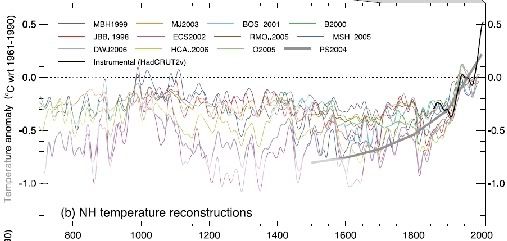
- It was just as warm during the Medieval Period as it is now
The evidence suggests this is unlikely to be the case.
- The "Infrared Iris” effect is a natural cooling mechanism and "it will reduce man-made global warming by the end of this century to a small fraction of a degree"
Except that Lindzen's Iris effect is questionable theoretically, and also observationally.
earthobservatory.nasa.gov...
Guess we have another coulda woulda shoulda. There are a number of studies showing why it is probably not so relevant, and a single recent paper by the Spencer crew which might provide 'nominal' support by assessing short-term seasonal effects. Guess it's Spencer's version of the resurrection.
- The actual observed current climate data is "exactly opposite to how computerized climate models that predict substantial global warming have been programmed to behave"
?
What does he mean 'programmed to behave'? Does he mean that models and observations are wildly different? Predominately not. But not all observations and models coincide, sometimes this is due to 'sloppy' science, like when the UAH data was used in this same way - then t'was discovered Spencer & Christy were algebraicly challenged.
But they have produced many verified predictions, from stratospheric cooling to greater warming nights than days. And they have their uses.
I think Thorpe gives a very fair assessment of climate modelling. But remember, it's not just about modelling.
- Low clouds could be a cause rather than an effect (negative feedback instead of the hypothesized positive feedback)
Could also be made of belly-button fluff (sorry again). Coulda woulda shoulda.
Might also be postive, might be neutral. The uncertainties in cloud/aerosol forcings are allowed for. That's why the forcing estimates have a big range.
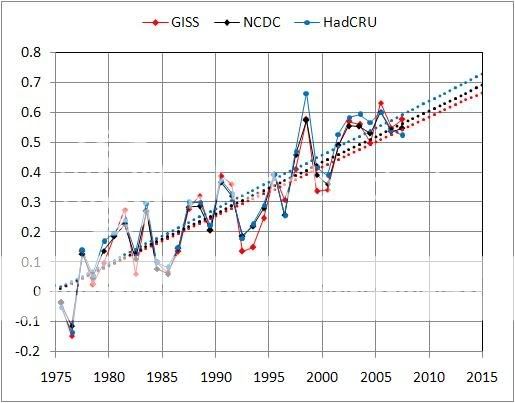
- We've had six consecutive years with no warming
And?
Only if you think the climate involves one variable is this an issue. Many periods in the past 30 years show a similar natural noise.
How much of that list is BS, and how much is reasonable, Mel?
Most is obscurantism, some is BS.
Also, what do you think it means that the oceans are cooling(colder) rather than what was expected or predicted based on the theory of AGW. Further, in your opinion, what would a reasonable falsification of AGW look like?
Not too sure it is.
Hansen, J., L. Nazarenko, R. Ruedy, Mki. Sato, J. Willis, A. Del Genio, D. Koch, A. Lacis, K. Lo, S. Menon, T. Novakov, Ju. Perlwitz, G. Russell, G.A. Schmidt, and N. Tausnev, 2005: Earth's energy imbalance: Confirmation and implications. Science, 308, 1431-1435, doi:10.1126/science.1110252.
Our climate model, driven mainly by increasing human-made greenhouse gases and aerosols among other forcings, calculates that Earth is now absorbing 0.85±0.15 W/m2 more energy from the Sun than it is emitting to space. This imbalance is confirmed by precise measurements of increasing ocean heat content over the past 10 years. Implications include: (i) expectation of additional global warming of about 0.6°C without further change of atmospheric composition; (ii) confirmation of the climate system's lag in responding to forcings, implying the need for anticipatory actions to avoid any specified level of climate change; and (iii) likelihood of acceleration of ice sheet disintegration and sea level rise.
So, model is confirmed by observations of increasing ocean heat content. More SST data here.
Reasonable falsification would to show that CO2 isn't a GHG, that this massive emission of GHGs aren't altering the radiative balance of the atmosphere (which they are). Indeed, even most of the 'skeptics' accept that it is. They just obscure about uncertainties and feedbacks. Generally playing FUD, a well known method since they tobacco 'wars'.
Where's the research and funding to figure that out? Honest question: does anybody know if anybody is working on that end of things?
I think you already know some of the answers. We have no ideal method of mitigation apart from we reduce our spewing of emissions. Thus, we solve it by reducing our direct impact. This can be achieved by more intelligent use of energy and more sustainable production of energy.
As you said, it's not an easy option. Other methods are being studied, from removing CO2 emissons at site of production, to mirrors in space.
Or we can just depend on the wishful-thinking of coulda shoulda woulda.
[edit on 21-3-2008 by melatonin]
Originally posted by melatonin
Well, not really. ID isn't science. And any scientist who claims it is, is wacky. That's not even contemplating the other wacky stuff he has said.
Anyway, seeing it's you R., I'll make the effort...
Appreciate that, short bus. I know it ain't easy for ya.
- there is no solid published evidence that has ruled out a natural cause for most of our recent warmth – not one peer-reviewed paper.
Heh, so we would expect to find a single article that rules out every single natural variable we could think of? Bit much too expect I feel. What we do is assess the contribution of the natural variables, and see where we stand. If you're interested, the recent IPCC contains the current estimates of forcings.
I believe the way he worded that he meant to say, 'even now with all of the data we have, we can't, via peer-reviewed science, rule out a natural cause for most of our recent warmth. Not every possible variable but, the most significant cause. Does that change your answer at all?
And we see that human impacts are playing a significant role.
That report is a bit much for me, but I guess I asked for it, so I'm giving it a go. Slowly.
But this is what you're talking about here, right:
Changes in radiative forcings between 1750 and 2005 as estimated by the IPCC.
- Total radiative forcing from the sum of all human activities is a warming force of about +1.6 watts/m²
- Radiative forcing from an increase of solar intensity since 1750 is about +0.12 watts/m²
- Radiative forcing from carbon dioxide, methane, and nitrous oxide combined is very likely (>90%) increasing more quickly during the current era (1750-present) than at any other time in the last 10,000 years.
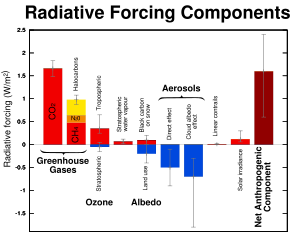
So wouldn't that qualify as a peer-reviewed study showing man/GHB's as the main cause for most of our current warming? No? I was surprised by his statement because I assumed that there were numerous papers out there pointing towards man as the major cause/force. I thought that was the whole point. What am I missing?
- the last 30 years of the strongest warming could have been caused by a very slight change in cloudiness/'el nino-la nina/Pacific Decadal Oscillation
Could have been caused by fairies as well (sorry, can't help myself sometimes). Until they bring evidence to support such claims as direct causes of long-term trends, they mean little.
[I know I know, short bus. It's okay. Take a deep breath, it will pass. Much as I love the fairies under the garden intellectual cow patty... staying on topic:]
Isn't the PDO already in evidence? What do you mean by "long-term" trend and why wouldn't the PDO be considered evidence wrt climate forcing (would that be the proper term here?) Seems to be but, I may be missing some finer point here. Also, the PDO and El Nino are interconnected, doesn't that complicate matters so far as modeling goes? Are you saying that it's insignificant, or most likely is, or we just don't understand it well enough, or we understand it fine and it's already factored in,... none of the above. Sorry for all the questions, mel. I'm tryin'.
The problem with such natural effects (ENSO/PDO) is that they just shift energy around the planet. Energy comes in from the sun, it escapes from the earth - so we just ignore the elephant in the room? We can already observe the impacts of our emissions on the radiative balance of the atmosphere.
However, after subtracting for two thirds of temperature and humidity rises, the increase of cloud-free longwave downward radiation (+1.8(0.8) Wm−2) remains statistically significant and demonstrates radiative forcing due to an enhanced greenhouse effect.
www.agu.org...
I'll have to take your/their word on "statistically significant" and how they got there. Could you maybe break that down into layman's terms? Especially the last part I quoted and the "three times larger than expected from anthropogenic... " part. That may be unreasonable to do on a discussion board, mel. That's cool. I'll keep chugging in my free time but, it's hard to know where to start and what to focus on.
Letters to Nature
Nature 410, 355-357 (15 March 2001) | doi:10.1038/35066553; Received 17 May 2000; Accepted 15 January 2001
[...snip*]
Our results provide direct experimental evidence for a significant increase in the Earth's greenhouse effect that is consistent with concerns over radiative forcing of climate.
Only based on the part you provided, wouldn't this also be, "solid published evidence" of an unnatural cause for climate change? The language in these papers is hard for someone like me to parse. Seems solid but, then "consistent with concerns" seems odd language.
- the warming of Alaska coincides with when we starting measuring it with satellites
Could be caused by satellites as well then?
I understood him to be saying that it's just a coincidence and we have no reliable way of knowing if the warming is anything out of the ordinary. No? Is there an issue here that you're aware of wrt Alaskan measurements or do you not have any clue what he was talking about in the article?
- "2007 opening of the Northwest Passage as summertime sea ice in the Arctic Ocean gradually receded, yet the very warm 1930s in the Arctic also led to the Passage opening in the 1940s. Of course, we had no satellites to measure the sea ice back then."
And?
No idea, mel. I'm asking you... but, I figure he's going for a 'it's just a normal cyclic thing.' Again, is there nothing interesting or of note wrt the Northwest Passage? You already know the article and information contained there-in is garbage... I'm still trying to figure out what's what. (Still stuck on your first cite [IPCC])
- It was just as warm during the Medieval Period as it is now
The evidence suggests this is unlikely to be the case.
How much of a difference are we talking? Doesn't seem all that much, or did I read that graph wrong?
- The "Infrared Iris” effect is a natural cooling mechanism and "it will reduce man-made global warming by the end of this century to a small fraction of a degree"
Except that Lindzen's Iris effect is questionable theoretically, and also observationally.
earthobservatory.nasa.gov...
Thanks for the link. Much more my speed.
Guess we have another coulda woulda shoulda. There are a number of studies showing why it is probably not so relevant, and a single recent paper by the Spencer crew which might provide 'nominal' support by assessing short-term seasonal effects. Guess it's Spencer's version of the resurrection.
Man it's like tourettes syndrome or something with you. Anyway, from your link:
In short, if water vapor is the 800-pound gorilla of the Earth’s greenhouse effect, then carbon dioxide is the steroid pill that helps water vapor lift temperatures even higher.
[...snip*]
the Earth has an adaptive infrared iris—a built in “check-and-balance” mechanism that effectively counters global warming (Lindzen et al. 2001). Much like the iris in a human eye contracts to allow less light to pass through the pupil in a brightly lit environment, Lindzen suggests that the area covered by high cirrus clouds contracts to allow more heat to escape into outer space from a very warm environment.
Now to the 'evidence against' link at the bottom of the page:
whereas Lindzen’s experiment predicts that cirrus clouds change in extent to reduce warming at the surface by anywhere from 0.45 to 1.1 degrees, Lin’s experiment predicts that changes in the tropical clouds will help warm the surface by anywhere from 0.05 to 0.1 degree (Lin et al. 2001).
Now from the 'resolving differences' link at the bottom of that page:
Currently, both Lindzen and Lin stand by their findings and there is ongoing debate between the two teams. At present, the Iris Hypothesis remains an intriguing hypothesis—neither proven nor disproven.
Reading that page - from 2002 - it seems that the tests to resolve the contradictions by better modeling cloud cover were to be in the works. Do you know if that's still the case, or have the findings been released already? If so, whom did they support?
Okay mel, I have to stop here and read the rest of your links, and some of my own... and still keep on chugging on that IPCC report. Just wanted to give this thread a bump and see if I'm gaining any headway yet. With any luck you'll get some more informed discussion. If not, feel free to do some AGW For Dummies in the meantime. I'm all ears.
Regards.
PS,
"Short bus" is American for special. You're special, mel.... real special.
reply to post by Rren
Compartmentalizing global warming, and singling out carbon dioxide as the single contributory factor oversimplifies the root of the problem, no matter how many graphs and statements you try to back your arguments with.
Compartmentalizing global warming, and singling out carbon dioxide as the single contributory factor oversimplifies the root of the problem, no matter how many graphs and statements you try to back your arguments with.
Originally posted by Kinesis
reply to post by Rren
Compartmentalizing global warming, and singling out carbon dioxide as the single contributory factor oversimplifies the root of the problem,
I haven't noticed, in my limited reading, that CO2 is singled out as the only contributory factor (try reading some of the technical stuff, they include many, many factors and try to determine their relevance wrt climate change... that's the whole point as I see it.) As I quoted from the link melatonin posted, " In short, if water vapor is the 800-pound gorilla of the Earth’s greenhouse effect, then carbon dioxide is the steroid pill that helps water vapor lift temperatures even higher."
In, um... shorter: CO2 exasperates the problem.
Do you disagree with that... or are you saying the effect is negligible... or neither?
no matter how many graphs and statements you try to back your arguments with.
I assume you are speaking in general rather than at me; as I've shown already in my reply to mel, I'm not even sure how to properly read them much less put them in context wrt relevance. I'm just asking questions; tryin' to deny some [of my own] ignorance. If you feel like you've got a decent handle on things, by all means pitch in. I can't be the only confused fence-sitter in the house.
Proxies, statistics, meta-analysis, climate science in general, etc...; how do you discuss this - in any meaningful sense - without the graphs, statements and arguments? I'm in no position to evaluate such things, but my ignorance of the how-to's, or your desire to not have them included in the discussion, doesn't change how such things are done.
Or did I miss your point?
Regards and Happy Easter all! Especially the heathen melatonin.... Have a Peeps on me.

You can have two, mel ('cause God and Rren love you so).. they're good for the soul.
Originally posted by Rren
Originally posted by Kinesis
reply to post by Rren
In, um... shorter: CO2 exasperates the problem.
Do you disagree with that... or are you saying the effect is negligible... or neither?
Proxies, statistics, meta-analysis, climate science in general, etc...; how do you discuss this - in any meaningful sense - without the graphs, statements and arguments? I'm in no position to evaluate such things, but my ignorance of the how-to's, or your desire to not have them included in the discussion, doesn't change how such things are done.
Or did I miss your point?
Visual aids and independant reports don't evaluate the whole extent of the damage that's being done. Figuratively speaking, you need to take the hot iron out of the coals and brand the delinquent corporations responsible for this mess. Significant cutbacks in production, and shortages of supply will be inevitable when companies such and DOW, ESSO, Exxon and subsidiary companies are held to the fire. Environmental assessments of their carbon footprint over the decades should all be analyzed collectively. Whether it been soil and water contamination, or air pollution, the reality is most of the truth never sees the light of day.
Smaller governments should resist large cash payoffs, and seek collaboration with other larger governments to hold these companies responsible. By forcing them to release information that would be self-condemning, at least the public would have a better idea of the scope of the problem, and how and where to begin to deal with it.
You simply don't get it Budski. Your right there is no solid evidence that Humans are the sole cause of global warming. But in a sane world who
cares?
We have studied the impacts OUR actions could potentially have on the planet, and the science is in. Carbon, changing the face of the planet and thus its libido, filling the sky's with contrails, methane, on and on we KNOW that we are IMPACTING our planet.
While you and your ilk are so busy "defending" your own ideology and god knows what else from god knows what (really man what is it you are fighting so hard against) the rest of the planet is waking up to the fact that we need to stop #ting where we eat.
I say this because I am sick to death of the pathetic back and forth over how legit AGW is. Want to know something that is a fact, your not going to get very far with that debate here, the topic is dead, the horse throughly beaten. Feel free to continue, it is your wasted energy. My advice to you is WAKE UP.
Rarly have i seen someone on this board claim that GW is 100% human, almost never (not that I can think of any way) has anyone denied that the planet could very well be doing al lot of this on its own.
What is important is that we wake up to the fact that we live in a CLOSED FINITE SYSTEM. It can only produce X amounts of goods and absorb X amounts of waste. What you seem to be missing int he GW topic is how it is reshaping how HUMANS see the EARTH. It is the begining of a new, more balanced relationship.
It would be great if ATS could move on from these pointless debates on how legitimate the science for AGW or its counterparts as they are a serious waste of time.
We KNOW this, humans are having widespread negative impacts on this planet. We MUST learn how to live in a more balanced was with the earth. Global warming is the tip of the iceberg (pun intended) even if it does turn out to be the planet that is causing warming, finding ways to avoid polluting this planet would be a great idea.
We have studied the impacts OUR actions could potentially have on the planet, and the science is in. Carbon, changing the face of the planet and thus its libido, filling the sky's with contrails, methane, on and on we KNOW that we are IMPACTING our planet.
While you and your ilk are so busy "defending" your own ideology and god knows what else from god knows what (really man what is it you are fighting so hard against) the rest of the planet is waking up to the fact that we need to stop #ting where we eat.
I say this because I am sick to death of the pathetic back and forth over how legit AGW is. Want to know something that is a fact, your not going to get very far with that debate here, the topic is dead, the horse throughly beaten. Feel free to continue, it is your wasted energy. My advice to you is WAKE UP.
Rarly have i seen someone on this board claim that GW is 100% human, almost never (not that I can think of any way) has anyone denied that the planet could very well be doing al lot of this on its own.
What is important is that we wake up to the fact that we live in a CLOSED FINITE SYSTEM. It can only produce X amounts of goods and absorb X amounts of waste. What you seem to be missing int he GW topic is how it is reshaping how HUMANS see the EARTH. It is the begining of a new, more balanced relationship.
It would be great if ATS could move on from these pointless debates on how legitimate the science for AGW or its counterparts as they are a serious waste of time.
We KNOW this, humans are having widespread negative impacts on this planet. We MUST learn how to live in a more balanced was with the earth. Global warming is the tip of the iceberg (pun intended) even if it does turn out to be the planet that is causing warming, finding ways to avoid polluting this planet would be a great idea.
Originally posted by Rren
Appreciate that, short bus. I know it ain't easy for ya.
yes, short-bus. People generally say window-licker over here. So, yeah, cheers.
i'm sorta temporally-challenged (i.e. lots of stuff to do), but I'm also a big fan of procrastination.
I believe the way he worded that he meant to say, 'even now with all of the data we have, we can't, via peer-reviewed science, rule out a natural cause for most of our recent warmth. Not every possible variable but, the most significant cause. Does that change your answer at all?
But when he says 'rule out', what is he really trying to say? 100% certainity? Of course, we can't provide that. What we can do is make assessments of various factors. And when we do, the evidence suggests that human factors are very important.
Whether human factors can account for 49%, or 51% post-industrial isn't really that important. Even at 30% it's enough to worry about. We started at 280ppm, now at 380ish, at doubling we estimate 2-4.5'C for CO2 induced effects (ghg + feedbacks) alone - this comes from models and observations. And that's without accounting for other factors (i.e. natural variability, cooling aerosols, etc).
So, we take each influence as we find them. Solar- not likely major influence for at least the last 30 years. Cosmic rays - not likely a major influence. ENSO/PDO - no real evidence for long-term influences. So is that all natural effects? Probably not. But do we wait in hope to find other influences? Or act on the information we have?
Information based on very basic physics, which has been producing verified predictions.
That report is a bit much for me, but I guess I asked for it, so I'm giving it a go. Slowly.
But this is what you're talking about here, right:
Changes in radiative forcings between 1750 and 2005 as estimated by the IPCC.
They are the estimated forcings at the current time. And we are seeing the fingerprints of human impacts. As you can see, clouds have a big range of uncertainity. We can base our decisions on that I suppose, and ignore what we are more certain of.
So wouldn't that qualify as a peer-reviewed study showing man/GHB's as the main cause for most of our current warming? No? I was surprised by his statement because I assumed that there were numerous papers out there pointing towards man as the major cause/force. I thought that was the whole point. What am I missing?
I think it goes down to the 'rule out' thing, and also the notion we should have a single paper to rule out natural effects, all of them in one go. Research is disparate, but the IPCC attempts to bring the stuff together.
Anyway, for example, Pielke Sr. thinks that solar effects and human land-use effects are under-estimated. He believes that CO2 effects might only be around 30% of current forcings. if correct, is that enough to ignore?
Others, like Hansen and many others, think we underestimating. The IPCC is pretty conservative actually, heh.
Isn't the PDO already in evidence? What do you mean by "long-term" trend and why wouldn't the PDO be considered evidence wrt climate forcing (would that be the proper term here?)...Are you saying that it's insignificant, or most likely is, or we just don't understand it well enough, or we understand it fine and it's already factored in,... none of the above. Sorry for all the questions, mel. I'm tryin'.
It exists, if that's what you mean.
But, as i said, it just moves energy around. It's not a forcing.
Amazing the recent change from 'it's solar!', 'it's cozmik rays!', to 'it's PDO!'.
I'll have to take your/their word on "statistically significant" and how they got there. Could you maybe break that down into layman's terms? Especially the last part I quoted and the "three times larger than expected from anthropogenic... " part. That may be unreasonable to do on a discussion board, mel. That's cool. I'll keep chugging in my free time but, it's hard to know where to start and what to focus on.
OK, they assessed the changes observed from radiative effects in a single area. wm-2 is a measure of energy. They found a total of 5.2wm-2 increase in forcing, of which 1wm-2 was directly attributable to clouds.
Of the 4.2wm-2 remaining. They could show that 1.8wm-2 was readily attributed to human-sourced GHGs. The remainder was due to water vapour effects, which are a feedback from temperature increases, and can be affected by regional influences. Thus, the 1.8wm-2 is for human GHG effects, the rest regional and feedback.
Similarly, the estimated predictions contain these sort of feedbacks. Thus, about 1'C of the 3'C best estimate (2-4.5) is due to CO2, the remainder is from feedbacks like water vapour and albedo changes (less ice to reflect)etc.
Only based on the part you provided, wouldn't this also be, "solid published evidence" of an unnatural cause for climate change? The language in these papers is hard for someone like me to parse. Seems solid but, then "consistent with concerns" seems odd language.
Because science doesn't deal in absolutes. The evidence is consistent with current theory, rather than proven. It's what I spend some of my time pointing out to undergrads - data supports/confirms/consistent with rather than proves hypotheses/theories.
Tentative rather than absolute. On this, the ideologues play their games - you know, you can't explain x to my satisfaction, so the whole theory is wrong.
I understood him to be saying that it's just a coincidence and we have no reliable way of knowing if the warming is anything out of the ordinary. No? Is there an issue here that you're aware of wrt Alaskan measurements or do you not have any clue what he was talking about in the article?
to me, he's essentially saying that we didn't have good data from alaska until the satellite age, therefore we probably can't depend on anything at all, and must obviously forget all the other evidence, and I guess we can keep emitting. Cool.
You must see why this is just obscuration? We also don't have good data from my house ever, therefore I guess we must question the validity of the science.
quote]No idea, mel. I'm asking you... but, I figure he's going for a 'it's just a normal cyclic thing.' Again, is there nothing interesting or of note wrt the Northwest Passage? You already know the article and information contained there-in is garbage... I'm still trying to figure out what's what. (Still stuck on your first cite [IPCC])
It's just obscuration. It doesn't matter that the NW passage was open in the past. Not a jot. it's a regional issue. Makes a change from 'they grew grapes in england during the middle-ages' lark they normally play.
How much of a difference are we talking? Doesn't seem all that much, or did I read that graph wrong?
Looks to be a few tenths of a degree (maybe .4ish) for short periods in the highest proxy study. Average all proxies, maybe 0.8ish. But, R., we are only 100ppm into where we could be heading. we could easily hit levels of 1000ppm before we've used up all fossil fuels. Then we might be talking a potential 6'C above pre-industrial.
Reading that page - from 2002 - it seems that the tests to resolve the contradictions by better modeling cloud cover were to be in the works. Do you know if that's still the case, or have the findings been released already? If so, whom did they support?
You mean for the Iris effect? There's minimal evidence for it, and more against.
The recent IPCC report contains more information for where we are for clouds, and it does point out we have a bit more knowledge than the last report. Clouds are an issue. They can both reflect and absorb. So, they might have a net positive effect, or a net negative effect. As I said, the uncertainties are somewhat accounted for.
There's a good video of a presentation by a cloud researcher I watched a few weeks back, I'll see if I can hunt it down.
But clouds are unlikely to save the day. They'd have to have a massive negative forcing, and they don't appear to have helped during the PETM. Suppose we can live in hope.
Enjoy your easter sunday, R.
[edit on 23-3-2008 by melatonin]
reply to post by Animal
I'm glad somebody out there can think straight.
Global warming is a symptom of the greater threat that the industry is burdening us and future generations with. Those who aren't part of the solution, are definitely part of the problem.
I'm glad somebody out there can think straight.
Global warming is a symptom of the greater threat that the industry is burdening us and future generations with. Those who aren't part of the solution, are definitely part of the problem.
new topics
-
The Baloney aka BS Detection Kit
Social Issues and Civil Unrest: 3 hours ago -
Suspected Iranian agent working for Pentagon while U.S. coordinated defense of Israel
US Political Madness: 3 hours ago -
How does my computer know
Education and Media: 6 hours ago -
USO 10 miles west of caladesi island, Clearwater beach Florida
Aliens and UFOs: 10 hours ago
top topics
-
USO 10 miles west of caladesi island, Clearwater beach Florida
Aliens and UFOs: 10 hours ago, 8 flags -
Suspected Iranian agent working for Pentagon while U.S. coordinated defense of Israel
US Political Madness: 3 hours ago, 5 flags -
How does my computer know
Education and Media: 6 hours ago, 2 flags -
The Baloney aka BS Detection Kit
Social Issues and Civil Unrest: 3 hours ago, 1 flags
active topics
-
The Baloney aka BS Detection Kit
Social Issues and Civil Unrest • 2 • : budzprime69 -
US and Israel Reportedly Conclude Most Hostages Still Held in Gaza Are Dead
War On Terrorism • 146 • : Ohanka -
How does my computer know
Education and Media • 10 • : Scratchpost -
Negotiations and Diplomacy.
History • 13 • : Kurokage -
Brave Russians say NO to 'vote Vlad'
Breaking Alternative News • 121 • : Kurokage -
It has begun... Iran begins attack on Israel, launches tons of drones towards the country
World War Three • 629 • : SchrodingersRat -
Suspected Iranian agent working for Pentagon while U.S. coordinated defense of Israel
US Political Madness • 6 • : CarlLaFong -
Candidate TRUMP Now Has Crazy Judge JUAN MERCHAN After Him - The Stormy Daniels Hush-Money Case.
Political Conspiracies • 191 • : SchrodingersRat -
Running Through Idiot Protestors Who Block The Road
Rant • 47 • : stu119 -
Afterlife, unknown, so prepare, or just go into the unknown (bad)!!
ATS Skunk Works • 51 • : Kennyb75
0