It looks like you're using an Ad Blocker.
Please white-list or disable AboveTopSecret.com in your ad-blocking tool.
Thank you.
Some features of ATS will be disabled while you continue to use an ad-blocker.

Could It Be That Sound Frequency Has the Power To Heal Our DNA?
page: 6share:
Originally posted by cruzion
The plants probably grew better within the enclosed space of the greenhouse because the 'death metal' music was the most sonically active; The speakers were pushing the most air. As the speaker vibrates, it's pushing air back and forth. More than likely it was tiny, constant air movement was stimulating the plants. Like trees and plants in harsher environs tend to be more sturdier naturally. It's just the plants reaction to it's environment. Plants don't have ears. Also, vibration can be carried through other mediums besides air. Perhaps there was bass vibration being carried through the table to the pots? They should have done more tests with amplitude, and perhaps switched the music half through the test to see if the change would relate within the fauna growth. Mythbusters is entertaining, but it's hardly real science.
The Rife stuff is a myth perpetuated by people selling useless equipment to the gullible and desperate. I could have a program that flashed pics of Mickey Mouse at you, and if I told you it cured flu or cancer, I'm sure, just by placebo, it would cure someone eventually. The Rife stuff may work as a tool for creating belief, but I highly doubt the claims made by most sellers. You will also find most positive info about the Rife stuff is expounded on websites that also sell the (usually exspensive) equipment.
Besides that, how compotent are your computer or home stereo speakers at transmitting precise frequencies? Also, how well does muscle, skin, veins etc. transfer vibration? I would have thought they would have a huge dampening effect. Do they do anything other than dampen, like drop the hertz interval? You would think that people studying the effects of vibration on the body would have data on all this stuff. The body is composed of different materials with different masses and different water, mineral and metal content. The vibration is just not going to pass through without being hindered in some way.
The same goes for flashing lights at frequency. How is that affecting a bacterium that lives deep inside a body? Magic?
errr more sturdier. But I get basically what you are saying.
I just thought of something today..Due to the nature of how the ground is saturated, wouldn't sound pass more easily through wet saturated ground than the air itself? At least into the deeper areas where a plant or tree might reach (above the more solid strata beneath it).
The reason there is no solid data on sound effects on the human body is because there really hasn't been any clinical tests to prove that it is anything other than pseudoscience. It doesn't mean that it isn't real, it just means that mainstream science is in denial until they are proven wrong (which then means people have to conduct their own studies and research, which then gets discredited because they aren't "scientists"). It's a lovely world we live in. The same pretty much goes for ghosts and the paranormal. It's real, but mainstream science is too ignorant to look at the evidence objectively and not be biased about it as being pseudoscience. Then, the researchers who actually do the work and lay down the blood, sweat, and tears to do the real research get scoffed and criticized by the same scientific community that doesn't really care whether or not something is relevant, but really just cares about who at what university is going to get the next lump of money for the next big research project.
Science is a small word to describe "what scientists think they know" about the natural world. It is, in some cases, nothing more than an educated guess based on what we know currently. Our understanding about the natural world is constantly changing and we are always learning new astonishing things. The problem is that scientists get one thing into their head and their bias takes over. They then focus on what they can feasibly get research grants and money for (anything other than pseudoscientific endeavours). It's a loop of ignorance that has gone on for decades/centuries and will continue until people decide to challenge the status quo. It almost seems as if science is no longer a search for truth at all, but rather a bunch of people fighting over money who are only worried about peer recognition and self-advancement. It's a money pit for people wanting a more distinguished resume. I'm sure lots of scientists would be interested in researching the paranormal if the pay was right. But then the bias nature of science comes into play, where scientists scoff and criticise their peers for even being interested in such silly topics (because they are, indeed, challenging the status quo in mainstream science). Isn't that where the big discoveries are made?
The only reason you see people on TV looking for "ghosts" is not only for the entertainment value for the network airing the show, but also because these are driven, focused people who are good at what they do. It is also because there is a need for that kind of research and noone else is doing it. The problem is then that these people are not actually scientists even though some of these groups that investigate the paranormal do apply a scientific approach. But what exactly is science? Who exactly is a scientist? Does the title only apply to those getting grants to conduct formal studies? Or does it also apply to those conducting unformal studies? I think it depends on the individuals conducting the research. But that doesn't mean that the mainstream scientific community will not distance themselves as much as possible from the research, it's validity, it's evidence, and it's implications. That is really what is going on right now and it is because of simple human ignorance at the most fundamental level.
The same goes for this topic. Sorry for the long winded response..
-ChriS
[edit on 15-3-2008 by BlasteR]
[edit on 15-3-2008 by BlasteR]
Here is a story about 'gong healing':
www.holistic-resonance.com...
"When played properly, the gong produces a whole spectrum of harmonics that are based on pressure waves. The gong sound vibrates the energy meridians in the body and brings them into balance."
More:
www.holistic-resonance.com...
"When played properly, the gong produces a whole spectrum of harmonics that are based on pressure waves. The gong sound vibrates the energy meridians in the body and brings them into balance."
More:
I'll first admit that I have not read the entire thread, so this may have mentioned already.
There is a method for growing plants that uses sound called "Sonic Boom".
From:
www.advancedtechnologyclub.com...
It may be that rock or death metal happen to hit these notes that mimic birdsong more than other types of music? It could have an impact on the plants is they are sound sensitive like this. This is also a good reason not to use plants when doing this type of experiment.
P.S. Another interesting thing for the gardeners out there is to spread rock dust into the soil of your garden to revitalize the depleted soil. There is a group doing this somewhere or other (Google...) that have been getting plants to grow where they normally do not do well.
There is a method for growing plants that uses sound called "Sonic Boom".
From:
www.advancedtechnologyclub.com...
Sonic Bloom is a unique combination sound and a specially formulated foliary spray. The special sound is made up of a harmonic frequencies that parallel bird song. These sounds stimulate the tiny pores on the plant leaves to open. When these pores, called stomata, are open, the plat is able to absorb up to 700% more nutrients.
Once the pores are opened, special nutrients are sprayed onto the plants. These nutrients are really the critical activating factor of Sonic Bloom. The nutrient was derived from seaweed and it contains over 100 trace minerals, amino acids, and naturally occurring growth hormones. The sound is a tool to increase the receptivity of this organic foliar spray.
It may be that rock or death metal happen to hit these notes that mimic birdsong more than other types of music? It could have an impact on the plants is they are sound sensitive like this. This is also a good reason not to use plants when doing this type of experiment.
P.S. Another interesting thing for the gardeners out there is to spread rock dust into the soil of your garden to revitalize the depleted soil. There is a group doing this somewhere or other (Google...) that have been getting plants to grow where they normally do not do well.
i did a youtube search and found www.youtube.com...
and tried to dl them and found
www.savetube.com...
then needed a player and found
www.download.com...
thanks. like a few years ago on another pc i tried brainwave generators but not on this new laptop have i reacqainted myself with this "info".
and tried to dl them and found
www.savetube.com...
then needed a player and found
www.download.com...
thanks. like a few years ago on another pc i tried brainwave generators but not on this new laptop have i reacqainted myself with this "info".
Hello to all. i am joining this thread kind of late, and after reading it I did some research and was amazed at the amount of websites that had
information on the healing power of vibrational frequencies. It would appear that you guys have much more depth of knowledge than I can hope for so
maybe someone can jump start me al little bit because this stuff is very interesting to me. Many of the sites i hit talked about The Sacred
Solfeggio™ CD that apparently is on sale. does anybody have any experience with it or similar audio CD's that they can recommend to be used to
assist physical healing? Also any commercial artists that use healing frequencies in their music? I'm not trying to be lazy here, just thinking maybe
there are some experts here that can help me. Thanks in advance and a flag for the OP.
reply to post by sizzle
Thanks Sizzle, I really appreciated your post... I have been consciously aware of how certain kinds of tones and music affect me for sometime. I am looking for any CD's of these frequencies. I immerse myself in Tibetan and Gregorian chants and swear that they have assisted me greatly in dealing with my serious health issues.
Side note: How is the first frequency "UT" pronounced? Like it's written? It seems so hard compared to the flowing pronunciation of the other frequencies.
Again, thank you for your post...
Thanks Sizzle, I really appreciated your post... I have been consciously aware of how certain kinds of tones and music affect me for sometime. I am looking for any CD's of these frequencies. I immerse myself in Tibetan and Gregorian chants and swear that they have assisted me greatly in dealing with my serious health issues.
Side note: How is the first frequency "UT" pronounced? Like it's written? It seems so hard compared to the flowing pronunciation of the other frequencies.
Again, thank you for your post...
Here's one that sells wooden beds to use with sound therapy.
WOODEN BEDS
DNA rewind= healing.
How about DNA rewind = rejuvination.
I always hear a lot about various methods of causing healing effects.
Others folks seem to be happy just to get relaxed and to sleep.
It would seem that if the body rewinds to a healthful state that it could keep on rewinding to a yourfull state.
Are we so obsessed with sickness that we ask no more than to be healed?
WOODEN BEDS
DNA rewind= healing.
How about DNA rewind = rejuvination.
I always hear a lot about various methods of causing healing effects.
Others folks seem to be happy just to get relaxed and to sleep.
It would seem that if the body rewinds to a healthful state that it could keep on rewinding to a yourfull state.
Are we so obsessed with sickness that we ask no more than to be healed?
This is always interesting -- here is a page where a person can download some computer based rife/frequence generators to test.
www.esseraudiosolutions.com...
www.esseraudiosolutions.com...
Originally posted by lw2525
Here is a story about 'gong healing':
www.holistic-resonance.com...
"When played properly, the gong produces a whole spectrum of harmonics that are based on pressure waves. The gong sound vibrates the energy meridians in the body and brings them into balance."
More:
I hope it is okay to just simply thank you for that addition. I have done extensive searches on sound frequencies to offer the readers here as much as I possibly could. But I saw nothing like this. Again, Thank you so much.
Originally posted by OhZone
Here's one that sells wooden beds to use with sound therapy.
WOODEN BEDS
DNA rewind= healing.
How about DNA rewind = rejuvination.
Are we so obsessed with sickness that we ask no more than to be healed?
I, personally don't know that I would call it an obsession with healing. I am more prone to call it a necessity.
If some of the info being spread about chemtrails, vaccines and fluoridated water; then I think it is becoming more and more obsessingly mandatory to find ways to heal ourselves.
Anymore. it seems that some of medical science can't even be trusted.
I would never discount all of medical science, because, countless lives have been saved.
But thank you for causing us to ponder the situation.
Originally posted by ReelView
This is always interesting -- here is a page where a person can download some computer based rife/frequence generators to test.
www.esseraudiosolutions.com...
I very much appreciate this link. I was looking for it.
I had ran across it early on, but forgot where it was.
Another member asked about it, and I wasn't able to find it.
So, kudos for you.
For those of you who may be more geometrically or mathematically inclined;
What do you think that Nicola Tesla meant by his statement in my signature?
About the magnificence of the numbers 3, 6, and 9 being the keys to the universe?
Could some attempt to explain this or give a theory?
What do you think that Nicola Tesla meant by his statement in my signature?
About the magnificence of the numbers 3, 6, and 9 being the keys to the universe?
Could some attempt to explain this or give a theory?
Originally posted by sizzle
For those of you who may be more geometrically or mathematically inclined;
What do you think that Nicola Tesla meant by his statement in my signature?
About the magnificence of the numbers 3, 6, and 9 being the keys to the universe?
Could some attempt to explain this or give a theory?
I'm not really sure about the importance of the numbers 3, 6, and 9 other than the numbers themselves being factors of 3, but his quote is interesting in a few ways that come to mind. Nature has a specific type physical parameters that make certain geometric shapes and numbers "perfect". What I mean by that is specific number and geometric combinations like the "golden rectangle", "golden triangle", "golden ratio", etc.. All pop up in nature in unexpected places.
The signifigance of the golden rectangle is the fact that it is, in and of itself, a geometric form consisting of an infinite number of perfect squares. This image below from jimloy.com illustrates this..
There are other more interesting aspects of these shapes and numbers, but the intriguing thing is that they are all similar in that they are infinite in some geometrical way. The mathematical term Pi for example. It is a mathematically perfect number for figuring out various geometric dimensions and lengths. Just as the golden triangle is infinite in it's design (in a way), Pi is an infinite number as far as we can tell. But it is a number. Doesn't that mean it has to end somewhere? It leaves you scratching your head.
My best guess is that somehow he was implying that 3, 6, and 9 are interrelated in a similar fashion not only mathematically but within nature itself. The fact that they are all factors of the same number could imply that he was talking about something similar to the golden rectangle image in this post, in which the numbers propogate to infinity in some way mathematically (though he isn't specifying in your quote how).
I did a search and found this on merlib.org...
I'm not sure if it is the direct quote or not because the poster doesn't say. But if it is, it is a more complete version of that same quote..
if you only knew the meaning of the numbers 3, 6 and 9, you would have _a key_ (one key) to the universal laws keeping the universe in a tension-based harmony, with every single frequency affecting every single other frequency, and planets having their own base frequencies (7.83hz for planet earth), with every single biomagnetic living entity, all energy being put into fulfillment with the inward and the outward spiraling implosive concentration and diffusion, nature's heart-beat.
-ChriS
I've heard that your body goes through various vibration-frequencies when you are asleep, and I'm inferring that this is what "re-energizes" you
for another day and kills a lot of bad bacteria in and on your body...also I have actually stayed awake while my body goes through this process to a
degree and there was one point where it felt like my body was vibrating so intense that I could feel and hear the reverberations of multiple
frequencies. (Kind of like in the gong video where, two equal frequencies bounce off one another)
I accidentally hit "new thread" and then when I tried to post, I lost everything I had typed. (Basically post is much more brief)
I accidentally hit "new thread" and then when I tried to post, I lost everything I had typed. (Basically post is much more brief)
reply to post by BlasteR
Thank you, that will take some studying for me, as math was not my strongest point. But I am interested enough to try to understand. Thank you.
Thank you, that will take some studying for me, as math was not my strongest point. But I am interested enough to try to understand. Thank you.
Originally posted by S.O.U.P.
I've heard that your body goes through various vibration-frequencies when you are asleep, and I'm inferring that this is what "re-energizes" you for another day and kills a lot of bad bacteria in and on your body...also I have actually stayed awake while my body goes through this process to a degree and there was one point where it felt like my body was vibrating so intense that I could feel and hear the reverberations of multiple frequencies. (Kind of like in the gong video where, two equal frequencies bounce off one another)
I accidentally hit "new thread" and then when I tried to post, I lost everything I had typed. (Basically post is much more brief)
It's interesting that you should say that. I have noticed that when I stay up all night studying for extended periods of time, that my body begins to vibrate.
I wish I had seen your original post before you lost it and reposted. But thanx.
There is actually an episode of "60 Minutes" on CBS right now (7-8 Eastern time) about sleep. They are going to talk about how without sleep
you are more prone to getting sick, or even fat etc.
[edit on 16-3-2008 by S.O.U.P.]
[edit on 16-3-2008 by S.O.U.P.]
(sorry for doublepost) I don't know if anybody watched it, but they didn't really go into the reason behind why sleeping is so important, but w/e it
was interesting.
reply to post by sizzle
Yeah, usually the vibrations begin after 45+ minutes meditation (which when I began I just focused on relaxing parts of my body, which in turn resulted in vibrating). I've been figure out if it is possible to get the "rest" you get with good sleep, but without actually falling asleep. Not to thread hijack or anything but it seems like my thoughts are much more focused and concise rather than when awake. I can easily picture individual objects or detailed scenes in my mind, I think this also leads to how we are able to dream.
So if these frequencies do work to kill harmful bacteria and "rejuvenate" us every night, I then wonder if it is possible to measure these frequencies then try and replicate their use(s).
[edit on 16-3-2008 by S.O.U.P.]
reply to post by sizzle
Yeah, usually the vibrations begin after 45+ minutes meditation (which when I began I just focused on relaxing parts of my body, which in turn resulted in vibrating). I've been figure out if it is possible to get the "rest" you get with good sleep, but without actually falling asleep. Not to thread hijack or anything but it seems like my thoughts are much more focused and concise rather than when awake. I can easily picture individual objects or detailed scenes in my mind, I think this also leads to how we are able to dream.
So if these frequencies do work to kill harmful bacteria and "rejuvenate" us every night, I then wonder if it is possible to measure these frequencies then try and replicate their use(s).
[edit on 16-3-2008 by S.O.U.P.]
reply to post by BlasteR
Does the swirl motion drawn into that picture of the golden rectangle remind you in the least of the milky way, or am I just too tired to see things correctly? Now I"m not even sure the milky way is a spiral! Oh well, at any rate, it's a spiral in the picture. That seems to indicate something doesn't it? I'm not mathematically inclined either, so I'm just being speculative. Did I just make sense? I've been working A LOT...lol.
Does the swirl motion drawn into that picture of the golden rectangle remind you in the least of the milky way, or am I just too tired to see things correctly? Now I"m not even sure the milky way is a spiral! Oh well, at any rate, it's a spiral in the picture. That seems to indicate something doesn't it? I'm not mathematically inclined either, so I'm just being speculative. Did I just make sense? I've been working A LOT...lol.
Reply to Sizzle.
I think Tesla must be referring to the Enneagram.
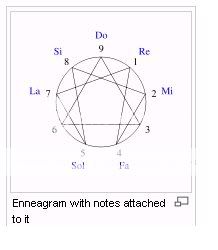
This diagram is said by some to contain all the knowledge in the universe.
It originates in Vedic Mathematics. In modern times it has been associated with the teachings of the Russian mystic G.I. Gurdjieff and his follower the philosopher P.D. Ouspensky.
All processes in the Universe according to their teaching can be represented as following the progression of a musical octave.
Note in the above diagram the important positions of 3 , 6, and 9 on the triangle. These represent the start and end of the octave and the two intervals. At the two intervals an external force needs to be applied or the process may not be completed and the desired end is not reached.
According to this teaching this applies to all processes from the formation of galaxies to a human life, to the striking of a match.
(Note to musicians: the two intervals occur in the diagram at different places than in the musical octave-the above diagram represents the cosmic octave.)
This is a vast teaching and I cannot hope to even scratch the surface in a post like this.
See en.wikipedia.org...
for more info.
Or else see the works of P.D.Ouspensky.
A good introduction is "A Study of Gurdjieff's Teaching" by Kenneth Walker.
Type G.I Gurdjieff into YouTube to see examples of the music and sacred dances taught by Gurdjieff,including some dances based on the Enneagram.
Type it into Amazon.com for CDs of Gurdjieff's music. My favourite is "Sacred Hymns" by the Jazz pianist Keith Jarrett.
Sizzle -I hope this may go some way to answering your question. If not it may help point the direction in which to find it.
I am not at present aware of any direct connection between Tesla and Gurdjieff- I shall go and type them both into Google!
Great Thread by the way-Already Starred and Flagged a few posts back!
[edit on 16-3-2008 by Bashibozkedi]
For those of you who may be more geometrically or mathematically inclined;
What do you think that Nicola Tesla meant by his statement in my signature?
About the magnificence of the numbers 3, 6, and 9 being the keys to the universe?
Could some attempt to explain this or give a theory?
I think Tesla must be referring to the Enneagram.
This diagram is said by some to contain all the knowledge in the universe.
It originates in Vedic Mathematics. In modern times it has been associated with the teachings of the Russian mystic G.I. Gurdjieff and his follower the philosopher P.D. Ouspensky.
All processes in the Universe according to their teaching can be represented as following the progression of a musical octave.
Note in the above diagram the important positions of 3 , 6, and 9 on the triangle. These represent the start and end of the octave and the two intervals. At the two intervals an external force needs to be applied or the process may not be completed and the desired end is not reached.
According to this teaching this applies to all processes from the formation of galaxies to a human life, to the striking of a match.
(Note to musicians: the two intervals occur in the diagram at different places than in the musical octave-the above diagram represents the cosmic octave.)
This is a vast teaching and I cannot hope to even scratch the surface in a post like this.
See en.wikipedia.org...
for more info.
Or else see the works of P.D.Ouspensky.
A good introduction is "A Study of Gurdjieff's Teaching" by Kenneth Walker.
Type G.I Gurdjieff into YouTube to see examples of the music and sacred dances taught by Gurdjieff,including some dances based on the Enneagram.
Type it into Amazon.com for CDs of Gurdjieff's music. My favourite is "Sacred Hymns" by the Jazz pianist Keith Jarrett.
Sizzle -I hope this may go some way to answering your question. If not it may help point the direction in which to find it.
I am not at present aware of any direct connection between Tesla and Gurdjieff- I shall go and type them both into Google!
Great Thread by the way-Already Starred and Flagged a few posts back!
[edit on 16-3-2008 by Bashibozkedi]
new topics
-
) A very interesting and exciting breaking news story..
Political Conspiracies: 26 minutes ago -
Go Woke, Go Broke--Forbes Confirms Disney Has Lost Money On Star Wars
Movies: 1 hours ago -
Freddie Mercury
Paranormal Studies: 1 hours ago -
Nirvana - Immigrant Song
Music: 5 hours ago -
British TV Presenter Refuses To Use Guest's Preferred Pronouns
Education and Media: 6 hours ago -
Tucker Carlson interviews Christian pastor from Bethlehem.
Middle East Issues: 8 hours ago -
Trump To Hold Dinner with President of Poland At Trump Tower Tonight
2024 Elections: 9 hours ago
top topics
-
British TV Presenter Refuses To Use Guest's Preferred Pronouns
Education and Media: 6 hours ago, 15 flags -
Trump To Hold Dinner with President of Poland At Trump Tower Tonight
2024 Elections: 9 hours ago, 8 flags -
Tucker Carlson interviews Christian pastor from Bethlehem.
Middle East Issues: 8 hours ago, 6 flags -
Revolution in advertising: the Russians launched a unique satellite
Science & Technology: 14 hours ago, 5 flags -
A family from Kansas with six children moved to the Moscow region
Other Current Events: 12 hours ago, 5 flags -
Go Woke, Go Broke--Forbes Confirms Disney Has Lost Money On Star Wars
Movies: 1 hours ago, 4 flags -
Nirvana - Immigrant Song
Music: 5 hours ago, 4 flags -
Freddie Mercury
Paranormal Studies: 1 hours ago, 3 flags -
Echo & The Bunnymen - The Killing Moon!
Music: 17 hours ago, 3 flags -
) A very interesting and exciting breaking news story..
Political Conspiracies: 26 minutes ago, 0 flags
active topics
-
Gold and silver prices....woo hoo
History • 74 • : annonentity -
Running Through Idiot Protestors Who Block The Road
Rant • 99 • : Terpene -
House has voted to impeach Mayorkas
US Political Madness • 165 • : Vermilion -
Candidate TRUMP Now Has Crazy Judge JUAN MERCHAN After Him - The Stormy Daniels Hush-Money Case.
Political Conspiracies • 298 • : xuenchen -
Trump To Hold Dinner with President of Poland At Trump Tower Tonight
2024 Elections • 13 • : opethPA -
British TV Presenter Refuses To Use Guest's Preferred Pronouns
Education and Media • 31 • : Consvoli -
Go Woke, Go Broke--Forbes Confirms Disney Has Lost Money On Star Wars
Movies • 5 • : onestonemonkey -
) A very interesting and exciting breaking news story..
Political Conspiracies • 1 • : Dalamax -
Biden doesnt want the votes of "Death to America" chanters
US Political Madness • 18 • : marg6043 -
Fossils in Greece Suggest Human Ancestors Evolved in Europe, Not Africa
Origins and Creationism • 55 • : strongfp