It looks like you're using an Ad Blocker.
Please white-list or disable AboveTopSecret.com in your ad-blocking tool.
Thank you.
Some features of ATS will be disabled while you continue to use an ad-blocker.

Paradise Lost and Found?
page: 110
share:
Have archaeologists found The Garden of Eden at Göbekli Tepe in southern Turkey?
www.archaeologynews.org
Göbekli Tepe
Why did they go to the trouble of covering it up?
More on the dig
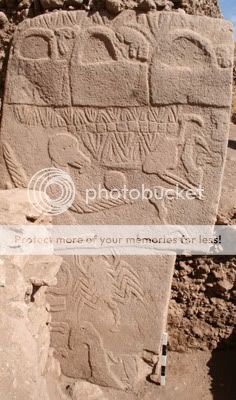
Picture of one of the sculpted pillars.
Some of the other claims as to the location of the Garden of Eden include, other parts of Mesopotamia, Africa and the Persian gulf.
Garden of Eden
Dilmun, also has been linked to the Garden of Eden story.
Whether it is Eden or not its a fascinating link between the move from a hunter gatherer lifestyle to agriculture.
mojo
www.archaeologynews.org
From where he stands, he can see four circles of large, T-shaped stone pillars arranged around two even larger monoliths — some five metres tall — that tower over the circles. Many of the forty-odd pillars are decorated with exquisite relief carvings depicting a lush landscape populated by wild boars, birds, reptiles, and lions. The level of representation becomes even more breathtaking in the context of the site’s age; the various layers were created somewhere between 7500 and 10,000 BC, according to carbon dating done by Schmidt. That’s before the invention of the wheel.
Göbekli Tepe
It is currently considered the oldest known shrine or temple complex in the world, and the planet's oldest known example of mounumental architecture.
After 8000 BC, the site was abandoned and purposefully covered up with soil.
Why did they go to the trouble of covering it up?
More on the dig
The thesis is this. Historians have long wondered if the Eden story is a folk memory, an allegory of the move from hunter-gathering to farming. Seen in this way, the Eden story describes how we moved from a life of relative leisure - literally picking fruit from the trees - to a harsher existence of ploughing and reaping.
Picture of one of the sculpted pillars.
Some of the other claims as to the location of the Garden of Eden include, other parts of Mesopotamia, Africa and the Persian gulf.
Garden of Eden
Dilmun, also has been linked to the Garden of Eden story.
Dilmun is also described in the epic story of Enki and Ninhursag as the site at which the Creation occurred. Ninlil, the Sumerian goddess of air and south wind had her home in Dilmun. It is also featured in the Epic of Gilgamesh, and is one of the sites that some theorists have proposed as the true location of the Garden of Eden.
Whether it is Eden or not its a fascinating link between the move from a hunter gatherer lifestyle to agriculture.
mojo
just a thought...even if that place was what the bible calls the garden of eden, would it really offer up much validity to the claims of said book?
most fictional stories are based off of actual events or locations, so unless they find an angel with a fire-sword guarding a tree with fruit that is proven in a lab to alter one's DNA to perceive the "all" of the universe, i do not think it would knock any skeptics on their religious buttocks.
most fictional stories are based off of actual events or locations, so unless they find an angel with a fire-sword guarding a tree with fruit that is proven in a lab to alter one's DNA to perceive the "all" of the universe, i do not think it would knock any skeptics on their religious buttocks.
looking at that sculpture I can certainly see that figure holding a round object in it's appendage representing the serpent tempting adam and eve
with the forbidden fruit.
originally posted by banyan even if that place was what the bible calls the garden of eden, would it really offer up much validity to the claims of said book?
No, it offers no validity to the bible.
I agree with what one of the archaeologists said, if anything it is proof of a racial
memory passed on to future generations of a time when our ancestors were in the
process of moving from a hunter gatherer society to an urban agricultural one. It is
accepted by most unbiased scholars that sumerian myth is the basis for much of what
ended up being recorded in biblical scripture.
My belief is that the cultures from turkey (Catalhoyuk and Göbekli Tepe and a few others) were the pre-cursor cultures to the Ubaidian and Sumerian cultures.
originally posted by ThePiemaker looking at that sculpture I can certainly see that figure holding a round object in it's appendage representing the serpent tempting adam and eve with the forbidden fruit.
Hmmm, i went back and looked closely at the picture after reading your comment and yes i think it could be interpreted that way. I'm no expert but from a laymans pov i agree.
mojo
[edit on 9/2/08 by mojo4sale]
Originally posted by ThePiemaker
looking at that sculpture I can certainly see that figure holding a round object in it's appendage representing the serpent tempting adam and eve with the forbidden fruit.
Also notice the Tempter is not a limbless snake. The creature with the fruit is a bird. Birds can mimick speech but snakes cannot.
Some verses in Genesis:
"And the serpent said to the woman..."
"On your belly you will go."
I would say birds are more cautious than snakes.
reply to post by mojo4sale
Awesome find mojo!
I'm under the impression that multiple civilizations all started at once and this could possibly be one of those epicenters.
I don't think this is proof of the "Garden of Eden" from the bible. One Irish scholar/priest figured out the year of creation to be 4004 bc. Well, that theory kinda goes out the window regardless of how old the universe is...
Awesome find mojo!
I'm under the impression that multiple civilizations all started at once and this could possibly be one of those epicenters.
I don't think this is proof of the "Garden of Eden" from the bible. One Irish scholar/priest figured out the year of creation to be 4004 bc. Well, that theory kinda goes out the window regardless of how old the universe is...
reply to post by biggie smalls
Likewise, i dont necessarily believe this is the garden of eden. What i found fascinating though was why they would bury the whole thing under tons of soil after they decide not to use the site again.
Does it seem strange to anyone else that they would do this?
It seems a lot of trouble to go to to cover up something that you have decided means nothing to you anymore.
Or is it just me.
Likewise, i dont necessarily believe this is the garden of eden. What i found fascinating though was why they would bury the whole thing under tons of soil after they decide not to use the site again.
Does it seem strange to anyone else that they would do this?
It seems a lot of trouble to go to to cover up something that you have decided means nothing to you anymore.
Or is it just me.
I consider the Garden of Eden story to be no more than a "things were so much better in the good ol' days" myth - perhaps inspired by folk memories
of hunter gather times before we started toiling for food.
Nonetheless Göbekli Tepe is a fascinating site
Well, we bury dead people. Why not dead religious centers?
[edit on 14-2-2008 by Essan]
Nonetheless Göbekli Tepe is a fascinating site
Originally posted by mojo4sale
What i found fascinating though was why they would bury the whole thing under tons of soil after they decide not to use the site again.
Well, we bury dead people. Why not dead religious centers?
[edit on 14-2-2008 by Essan]
Originally posted by Essan
Originally posted by mojo4sale
What i found fascinating though was why they would bury the whole thing under tons of soil after they decide not to use the site again.
Well, we bury dead people. Why not dead religious centers?
[edit on 14-2-2008 by Essan]
Sure we bury dead people, in fact there are zillions of them.
How many religious centers can you think of that have been deliberately buried?
It might just me but i dont think the answer is that simple.
I'm more inclined to believe that perhaps they were hiding it for some reason?
mojo
Or they were made to cover it up.
I have only ever seen the date of creation in the bible calculated by counting the generations back to the date of the creation of Adam. Not the Earth.
If the whole Sumerian-myth-fueled ancient astronaut theory is actually correct, this would coincide with the Veda's 3300 BC (ish) proposed date. In fact, it seems a lot of stuff really kicked off from around 3000BC onwards.
It could be that the new "gods" look at the previous fertility religion and think "kill that as soon as possible". Religious sites are normally abandoned and left well alone, hence the abundance of them still standing.
I have only ever seen the date of creation in the bible calculated by counting the generations back to the date of the creation of Adam. Not the Earth.
If the whole Sumerian-myth-fueled ancient astronaut theory is actually correct, this would coincide with the Veda's 3300 BC (ish) proposed date. In fact, it seems a lot of stuff really kicked off from around 3000BC onwards.
It could be that the new "gods" look at the previous fertility religion and think "kill that as soon as possible". Religious sites are normally abandoned and left well alone, hence the abundance of them still standing.
Burying it does sound odd, but as mentioned above.. they may have been made to bury it.
To dismantle or destroy such an area would be a painstakingly event and would take considerable time.
If the theory was they had to 'get rid of it' in a hurry, then burying it may be the way to go.
Incidentally, how did they come to the conclusion that it was purposely buried. Or was this speculation?
(I haven't had time to read the article yet )
To dismantle or destroy such an area would be a painstakingly event and would take considerable time.
If the theory was they had to 'get rid of it' in a hurry, then burying it may be the way to go.
Incidentally, how did they come to the conclusion that it was purposely buried. Or was this speculation?
(I haven't had time to read the article yet )
Great post. This is the type of post that keeps me looking at this site.
I'd love it if someone has the time to find some links to sites that have pictures of this site.
I've found a few but the pictures were very limited.
Keep up the good work.
I'd love it if someone has the time to find some links to sites that have pictures of this site.
I've found a few but the pictures were very limited.
Keep up the good work.
Originally posted by Wildbob77
I'd love it if someone has the time to find some links to sites that have pictures of this site.
I've found a few but the pictures were very limited.
I'll see if i can dig up ( no pun intended ) some more info and pictures when i get home from work.
mojo
new topics
-
The US Supreme Court Appears to Side With the January 6th 2021 Capitol Protestors.
Political Conspiracies: 10 minutes ago -
That which the "news" never talks about; Truth about election fraud
Mainstream News: 1 hours ago -
Biden doesnt want the votes of "Death to America" chanters
US Political Madness: 1 hours ago -
Horizon Post office scandal
Regional Politics: 2 hours ago -
Joe Biden and Donald Trump are both traitors
US Political Madness: 4 hours ago -
I'm new here. Avid conspiracy fan.
Introductions: 4 hours ago -
Denmark's Notre-Dame moment - 17th Century Borsen goes up in Flames
Mainstream News: 5 hours ago
top topics
-
Suspected Iranian agent working for Pentagon while U.S. coordinated defense of Israel
US Political Madness: 13 hours ago, 16 flags -
The Baloney aka BS Detection Kit
Social Issues and Civil Unrest: 13 hours ago, 7 flags -
That which the "news" never talks about; Truth about election fraud
Mainstream News: 1 hours ago, 6 flags -
Denmark's Notre-Dame moment - 17th Century Borsen goes up in Flames
Mainstream News: 5 hours ago, 4 flags -
How does my computer know
Education and Media: 16 hours ago, 3 flags -
Joe Biden and Donald Trump are both traitors
US Political Madness: 4 hours ago, 3 flags -
I'm new here. Avid conspiracy fan.
Introductions: 4 hours ago, 3 flags -
Horizon Post office scandal
Regional Politics: 2 hours ago, 1 flags -
Biden doesnt want the votes of "Death to America" chanters
US Political Madness: 1 hours ago, 1 flags -
The US Supreme Court Appears to Side With the January 6th 2021 Capitol Protestors.
Political Conspiracies: 10 minutes ago, 1 flags
active topics
-
Candidate TRUMP Now Has Crazy Judge JUAN MERCHAN After Him - The Stormy Daniels Hush-Money Case.
Political Conspiracies • 245 • : matafuchs -
The US Supreme Court Appears to Side With the January 6th 2021 Capitol Protestors.
Political Conspiracies • 0 • : WeMustCare -
Afterlife, unknown, so prepare, or just go into the unknown (bad)!!
ATS Skunk Works • 55 • : 0bserver1 -
Biden doesnt want the votes of "Death to America" chanters
US Political Madness • 4 • : Hakaiju -
Are the 'Abrahamic Religions' all Really the Worshipping the Same Abrahamic God?
Conspiracies in Religions • 186 • : Coelacanth55 -
It has begun... Iran begins attack on Israel, launches tons of drones towards the country
World War Three • 754 • : Vermilion -
That which the "news" never talks about; Truth about election fraud
Mainstream News • 4 • : Justoneman -
US and Israel Reportedly Conclude Most Hostages Still Held in Gaza Are Dead
War On Terrorism • 151 • : NorthOS -
SHORT STORY WRITERS CONTEST -- April 2024 -- TIME -- TIME2024
Short Stories • 19 • : JJproductions -
I'm new here. Avid conspiracy fan.
Introductions • 11 • : 19Bones79
10