It looks like you're using an Ad Blocker.
Please white-list or disable AboveTopSecret.com in your ad-blocking tool.
Thank you.
Some features of ATS will be disabled while you continue to use an ad-blocker.

Lack of foundation damage puts an end to 757 impact debate at the Pentagon
page: 17share:
reply to post by seanm
If the wing drug along the ground what happened to the engine under the wing and why was there no damage to the pentagon lawn as a result?
If the guy said he saw something (i.e. wing drug along the ground) that the evidence says did not exist then his whole testimony has to be called into question
[edit on 15-10-2007 by etshrtslr]
emphises added.
I watched in horror as the plane flew at treetop level, banked slightly to the left, drug it's wing along the ground and slammed into the west wall of the Pentagon exploding into a giant orange fireball. Then black smoke. Then white smoke." www.jmu.edu...
If the wing drug along the ground what happened to the engine under the wing and why was there no damage to the pentagon lawn as a result?
If the guy said he saw something (i.e. wing drug along the ground) that the evidence says did not exist then his whole testimony has to be called into question
[edit on 15-10-2007 by etshrtslr]
reply to post by seanm
That's 1, not 103.
However......
The old USA Today building is over 2 miles away.
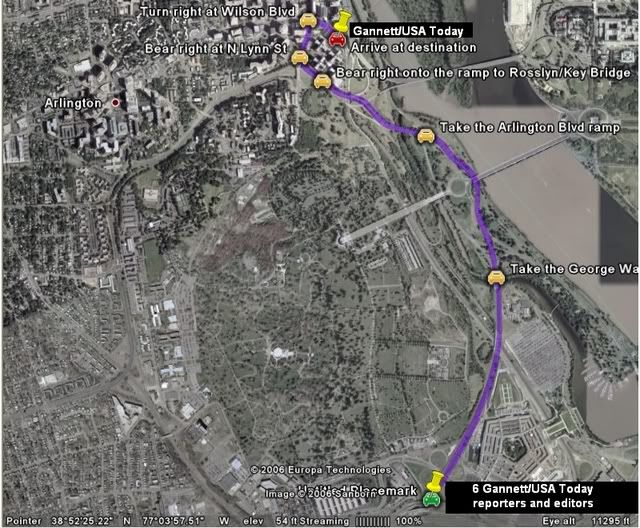
He would not be able to physically see the "impact".
Besides the fact that Steve Andersen is a USA Today employee which instantly raises questions about the legitimacy of his account.......he reports the wing dragging into the ground proving his account a fabrication.
So far you have zero.
But this has nothing to do with the foundation.
I challenge you to list all 103 of your so called "impact witnesses" one by one in this thread so they can be fully addressed in a thread where it is on topic.
[edit on 15-10-2007 by Craig Ranke CIT]
That's 1, not 103.
However......
The old USA Today building is over 2 miles away.
He would not be able to physically see the "impact".
Besides the fact that Steve Andersen is a USA Today employee which instantly raises questions about the legitimacy of his account.......he reports the wing dragging into the ground proving his account a fabrication.
So far you have zero.
But this has nothing to do with the foundation.
I challenge you to list all 103 of your so called "impact witnesses" one by one in this thread so they can be fully addressed in a thread where it is on topic.
[edit on 15-10-2007 by Craig Ranke CIT]
Originally posted by etshrtslr
reply to post by seanm
emphises added.
I watched in horror as the plane flew at treetop level, banked slightly to the left, drug it's wing along the ground and slammed into the west wall of the Pentagon exploding into a giant orange fireball. Then black smoke. Then white smoke." www.jmu.edu...
If the wing drug along the ground what happened to the engine under the wing and why was there no damage to the pentagon lawn as a result?
Do you doubt he saw AA77 hit the Pentagon?
If the guy said he saw something (i.e. wing drug along the ground) that the evidence says did not exist then his whole testimony has to be called into question
Really? Why? Because you didn't see a photo of what you imagine you should see? Please explain.
[edit on 15-10-2007 by seanm]
Originally posted by Craig Ranke CIT
reply to post by seanm
That's 1, not 103.
Are you confused by what I wrote?
But this has nothing to do with the foundation.
Of course eyewitness reports have everything to do with the Pentagon foundation.
I challenge you to list all 103 of your so called "impact witnesses" one by one in this thread so they can be fully addressed in a thread where it is on topic.
Your claim that AA77 did not hit the Pentagon is very much on topic here.
"Frank Probst, an information management specialist for the Pentagon Renovation Program, left his office trailer near the Pentagon's south parking lot at 9:36 a.m. Sept. 11. Walking north beside Route 27, he suddenly saw a commercial airliner crest the hilltop Navy Annex. American Airlines Flight 77 reached him so fast and flew so low that Probst dropped to the ground, fearing he'd lose his head to its right engine."
www.moaa.org...
[edit on 15-10-2007 by Craig Ranke CIT]
reply to post by seanm
Yes I doubt the guys whole testimony.
Where is the evidence that a wing drug along the ground? And if the wing is dragging then the engine would also be dragging into the ground.
There are plenty of pictures that fateful day of the pentagon and the pristine lawn in front of the damaged building.
So if he is wrong about the wing dragging along the ground then as I said before you have to question all of his testimony.
Yes I doubt the guys whole testimony.
Where is the evidence that a wing drug along the ground? And if the wing is dragging then the engine would also be dragging into the ground.
There are plenty of pictures that fateful day of the pentagon and the pristine lawn in front of the damaged building.
So if he is wrong about the wing dragging along the ground then as I said before you have to question all of his testimony.
Mr Seanm.
Just a short question :
Do you believe that Steve Anderson from USA Today is telling the truth?
Just answer yes, or no.
After that I have a surprise for you.
Just a short question :
Do you believe that Steve Anderson from USA Today is telling the truth?
Just answer yes, or no.
After that I have a surprise for you.
Can anyone pick out some things of interest in this persons witness report ?
Subject: Hispanic Hero Recalls Experiences
Date: Tue, 30 Sep 2003 12:18:03 -0400
From: Press Service [email protected]
Reply-To: [email protected]
To: [email protected]
By Rudi Williams
American Forces Press Service
[edit on 15-10-2007 by ULTIMA1]
Subject: Hispanic Hero Recalls Experiences
Date: Tue, 30 Sep 2003 12:18:03 -0400
From: Press Service [email protected]
Reply-To: [email protected]
To: [email protected]
By Rudi Williams
American Forces Press Service
WASHINGTON, Sept. 30, 2003 - Many courageous military and
civilian men and women have been honored for their
actions after the Sept. 11, 2001, terrorist attacks on
New York's World Trade Center and the Pentagon.
But only one member of the Air Force received the
Airman's Medal, the nation's highest award for heroism
not involving combat with an enemy. He also received the
Purple Heart for his injuries.
Senior Master Sgt. Noel Sepulveda, 53, a Hispanic-
American member of the Air Force Reserve, was a medical
inspector at the Air Force Inspection Agency, Kirtland
Air Force Base, N.M. But on Sept. 11, 2001, he was
working at the Pentagon as a reserve program manager in
the Air Force Strategies and Policies Office.
As he reached his motorcycle, Sepulveda noticed the
aircraft wasn't following the normal flight path down the
Potomac River for Ronald Reagan Washington National
Airport. Instead, it was coming over a distant hotel,
headed in the direction of the Pentagon.
"It seemed like the pilot was scrambling to keep control,
and I watched as he dropped lower and lower," Sepulveda
said. "Then he dropped his landing gear and started
coming down even faster and lower.
As it came down, the plane was hitting light poles, the
sergeant said. "Then the right wheel hit a light pole and
the plane popped into a 45-degree angle. The pilot tried
to recover -- go back vertical – but he hit some more
light poles.
"He dipped the plane's nose slightly, and then smashed
into the building," said Sepulveda, who was presented the
Airman's Medal and Purple Heart by Air Force Chief of
Staff Gen. John P. Jumper at the Pentagon April 15, 2002.
Sepulveda said the wings disintegrated, and then
disappeared. "For a brief second, you could see the
fuselage sticking out of the side of the Pentagon,"
Sepulveda recalls. "Then, all of a sudden, this ball of
fire comes out from inside. It looked like it was just
coming from inside the building, engulfing the fuselage.
And then the fuselage was all gone."
Sepulveda said the sweltering heat felt like it was
engulfing his body. "Then, suddenly, it felt like
somebody grabbed me, put their hands on his chest, picked
me up and threw me back against the light pole I was
standing by," he said.
"The back of my head, my back, and all that hit the
pole," he said. "Small pieces of shrapnel from the
airplane hit my motorcycle."
[edit on 15-10-2007 by ULTIMA1]
Hello....what about that perfectly circular whole the impact made on the other end of the buidling like an exit wound?? I was watching future weapons
once and thats exactly what happens when a missle with a shape charge hits something....especially if its uraniam tipped.
Originally posted by GUICE
Hello....what about that perfectly circular whole the impact made on the other end of the buidling like an exit wound?? I was watching future weapons once and thats exactly what happens when a missle with a shape charge hits something....especially if its uraniam tipped.
It was probably created with something like this:
www.pentagonresearch.com...
Originally posted by etshrtslr
reply to post by seanm
Yes I doubt the guys whole testimony.
Do you believe AA77 hit the Pentagon?
Originally posted by LaBTop
Mr Seanm.
Just a short question :
Do you believe that Steve Anderson from USA Today is telling the truth?
I am 100% confident that AA77 hit the Pentagon. Do you have doubts that it did?
Originally posted by Craig Ranke CIT
It was probably created with something like this:
www.pentagonresearch.com...
I have seen that before.
Also wasn't there reports of maybe rescuers may have cut it bigger to get in.
But that still does not account for why we still have no reports for the parts matching the plane or photos and videos not released.
Originally posted by GUICE
Hello....what about that perfectly circular whole the impact made on the other end of the buidling like an exit wound??
What about it?
I was watching future weapons once and thats exactly what happens when a missle with a shape charge hits something....especially if its uraniam tipped.
That's sounds like "WTC 7 fell just like a controlled demolition."
So, do you have a point?
If i was going to try to take down a builidng that had a reinforced concrete wall, collums and interior walls, i would either just use a missile or
use a missile to take out the wall and then send in the plane to cause as most damage as possible.
Seanm, I had a look at the second link of your own link list, "Help for Ultima1" on page 15 of this thread.
You probably didn't realize that there is a detailed map of the last part of the flight path of flight 77 provided by a government paid source, the NTSB board's own publicized FDR data, and their conclusions, such as that map :
www.gwu.edu...
Figure 3. - DC Area Flight Path.
Could you guess at how many miles that plane MISSED the Gannet/USA Today headquarter buildings, which you find near that first Potomac bridge, very near to the left upper border of that map.
Here you can find a photograph of these 2 buildings, off the Gannet website. Just click the 1980s icon, and that photo will appear :
www.gannett.com...
You have already the info from Craig, that these buildings are about 2 miles from the Pentagon, so just compare that stretch to the nearest part of 77th flightpath on that map, you so helpful provided.
I'll assist you a tad bit : that was about 2 miles, since the impact point at the Pentagon's west wall was the nearest point that plane ever flew "close" to the Gannet/USA Today headquarters.
All the earlier parts of that flightpath are moving still further away from that building.
Now observe mr Anderson's remarks again, with an investigative mind.
He's not telling the truth.
Or has been persuaded to lie "for a good cause".
I'll try.
He said "Shortly after watching the second tragedy".
That 2nd tragedy he meant, was the second plane hitting WTC 2 South Tower, at 09:02:54 am. That's clear when you read the whole emailed piece from him to his former university, see the link above from jmu.edu.
The first time frame we can fit to the Pentagon explosions was Barbara Honneger's fallen clock in the Helipad tower, at 09:38, and the seismic evidence puts it somewhere around 09:40 to 09:44 am.
That's not exactly "Shortly" after 09:03, ain't it?
That's 36 to 41 minutes LATER.
Then he said :
""banked slightly to the left, drug it's wing along the ground"".
If you look at the final flightpath from Craig :
the plane banked slightly to the RIGHT instead of to the left, as its last move.
And him observing that left wing from that distance hitting the ground is a masterpiece of extreme sharp eyesight.
He also said :
""Shortly after watching the second tragedy, I heard jet engines pass our building, which, being so close to the airport is very common. But I thought the airport was closed. I figured it was a plane coming in for landing. A few moments later, as I was looking down at my desk, the plane caught my eye.""
So he first heard the engines, then a few moments (seconds we presume) later, he saw the plane when looking down.
Now look again at the final flightpath map.
Is that observation of a far away plane fitting his remark ""heard jet engines pass our building"" ?
He also ""thought the airport was closed"".
That nation wide order by the FAA was given later.
He gave his recollection of the day shortly after 9/11, and we all were fooled for 5 long years by the flightpath put on line by a mr Koepple, which followed the normal flight path down the Potomac River for Ronald Reagan Washington National Airport.
Untill the final flightpath was published by NTSB.
Mr Anderson's memory seemed to be helped by this first flightpath "setup" scenario.
In that case it fitted right into the ""pass our building"" remark.
You probably didn't realize that there is a detailed map of the last part of the flight path of flight 77 provided by a government paid source, the NTSB board's own publicized FDR data, and their conclusions, such as that map :
www.gwu.edu...
Figure 3. - DC Area Flight Path.
Could you guess at how many miles that plane MISSED the Gannet/USA Today headquarter buildings, which you find near that first Potomac bridge, very near to the left upper border of that map.
Here you can find a photograph of these 2 buildings, off the Gannet website. Just click the 1980s icon, and that photo will appear :
www.gannett.com...
You have already the info from Craig, that these buildings are about 2 miles from the Pentagon, so just compare that stretch to the nearest part of 77th flightpath on that map, you so helpful provided.
I'll assist you a tad bit : that was about 2 miles, since the impact point at the Pentagon's west wall was the nearest point that plane ever flew "close" to the Gannet/USA Today headquarters.
All the earlier parts of that flightpath are moving still further away from that building.
Now observe mr Anderson's remarks again, with an investigative mind.
He's not telling the truth.
Or has been persuaded to lie "for a good cause".
Posted by seanm :
Craig, you mean I am right. Shall I start?
"I witnessed the jet hit the Pentagon on September 11. From my office on the 19th floor of the USA TODAY building in Arlington, Va., I have a view of Arlington Cemetery, Crystal City, the Pentagon, National Airport and the Potomac River. ... Shortly after watching the second tragedy, I heard jet engines pass our building, which, being so close to the airport is very common. But I thought the airport was closed. I figured it was a plane coming in for landing. A few moments later, as I was looking down at my desk, the plane caught my eye. It didn't register at first. I thought to myself that I couldn't believe the pilot was flying so low. Then it dawned on me what was about to happen. I watched in horror as the plane flew at treetop level, banked slightly to the left, drug it's wing along the ground and slammed into the west wall of the Pentagon exploding into a giant orange fireball. Then black smoke. Then white smoke."
www.jmu.edu...
Will you dissemble badly, Craig?
I'll try.
He said "Shortly after watching the second tragedy".
That 2nd tragedy he meant, was the second plane hitting WTC 2 South Tower, at 09:02:54 am. That's clear when you read the whole emailed piece from him to his former university, see the link above from jmu.edu.
The first time frame we can fit to the Pentagon explosions was Barbara Honneger's fallen clock in the Helipad tower, at 09:38, and the seismic evidence puts it somewhere around 09:40 to 09:44 am.
That's not exactly "Shortly" after 09:03, ain't it?
That's 36 to 41 minutes LATER.
Then he said :
""banked slightly to the left, drug it's wing along the ground"".
If you look at the final flightpath from Craig :
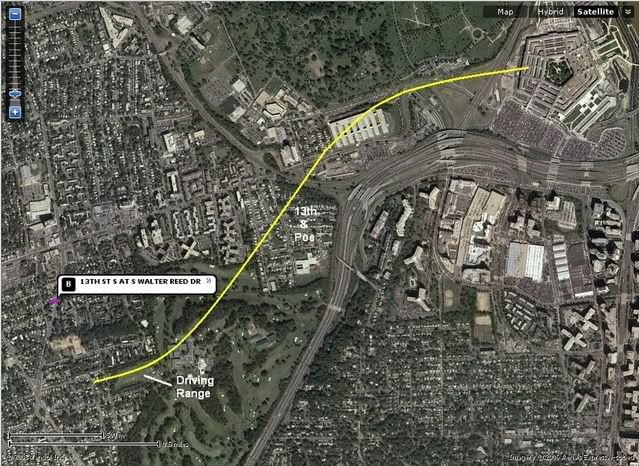
the plane banked slightly to the RIGHT instead of to the left, as its last move.
And him observing that left wing from that distance hitting the ground is a masterpiece of extreme sharp eyesight.
He also said :
""Shortly after watching the second tragedy, I heard jet engines pass our building, which, being so close to the airport is very common. But I thought the airport was closed. I figured it was a plane coming in for landing. A few moments later, as I was looking down at my desk, the plane caught my eye.""
So he first heard the engines, then a few moments (seconds we presume) later, he saw the plane when looking down.
Now look again at the final flightpath map.
Is that observation of a far away plane fitting his remark ""heard jet engines pass our building"" ?
He also ""thought the airport was closed"".
That nation wide order by the FAA was given later.
He gave his recollection of the day shortly after 9/11, and we all were fooled for 5 long years by the flightpath put on line by a mr Koepple, which followed the normal flight path down the Potomac River for Ronald Reagan Washington National Airport.
Untill the final flightpath was published by NTSB.
Mr Anderson's memory seemed to be helped by this first flightpath "setup" scenario.
In that case it fitted right into the ""pass our building"" remark.
Originally posted by seanm
Originally posted by etshrtslr
Yes I doubt the guys whole testimony.
Do you believe AA77 hit the Pentagon?
Its not about what I believe its all about the evidence as you have been so fond of pointing out on this thread.
So please show me the evidence to support your witnesses testimony that the wing drug along the ground as he states in his testimony.
[edit on 15-10-2007 by etshrtslr]
Originally posted by etshrtslr
Originally posted by seanm
Originally posted by etshrtslr
Yes I doubt the guys whole testimony.
Do you believe AA77 hit the Pentagon?
Its not about what I believe its all about evidence. Show me some evidence that the wing drug along the ground as he states in his testimony.
[edit on 15-10-2007 by etshrtslr]
There is no evidence for that.
So what?
How about this:
from the witness' distance and vantage point it appeared to drag along the ground. In reality perhaps it was just low. In fact there's plenty of evidence for this, but that's not what you asked for.
Reason for the discrepancy is likely his view and impressions, not any kind of lie casting any kind of doubt on what actually happened.
This is a strawman argument. Show me something that doesn't exist, you can't, so there's a 'hole' in the story and now it's what, supposed to sink? Please...
Originally posted by LaBTop
You have already the info from Craig, that these buildings are about 2 miles from the Pentagon, so just compare that stretch to the nearest part of 77th flightpath on that map, you so helpful provided.
I'll assist you a tad bit : that was about 2 miles, since the impact point at the Pentagon's west wall was the nearest point that plane ever flew "close" to the Gannet/USA Today headquarters.
All the earlier parts of that flightpath are moving still further away from that building.
Now observe mr Anderson's remarks again, with an investigative mind.
He's not telling the truth.
Or has been persuaded to lie "for a good cause".
I originally doubted anderson's account highly thinking they had been across the River,, but realizing they had then been just north of the Pgon, it seems only somewhat doubtful. It never made me doubt the overall story - maybe he just wanted to say he saw it for whatever reason. Possibly sinister but that's far from proven.
The first time frame we can fit to the Pentagon explosions was Barbara Honneger's fallen clock in the Helipad tower, at 09:38,
9:32 is Honegger time, that's her case mostly, and it's apparently pure strung-together bunk. Officially it's 9:37:45. Early DoD reports said 9:41. Therefore:
seismic evidence puts it somewhere around 09:40 to 09:44 am.
Really? Got a link?
That's not exactly "Shortly" after 09:03, ain't it?
That's 36 to 41 minutes LATER.
'shortly' is such a subjective word. You really trying to prove this guy's a liar based on that?
Then he said :
""banked slightly to the left, drug it's wing along the ground"".
If you look at the final flightpath from Craig :
the plane banked slightly to the RIGHT instead of to the left, as its last move.
And him observing that left wing from that distance hitting the ground is a masterpiece of extreme sharp eyesight.
And if you ignore Craig's impossible flight path (ask Lear) and Anderson's lack of expertise (perhaps he confused a left roll with a left bank) then there's nothing odd about this. In fact I'm starting to think he DID see the whole thing.
He also said :
""Shortly after watching the second tragedy, I heard jet engines pass our building, which, being so close to the airport is very common. But I thought the airport was closed. I figured it was a plane coming in for landing. A few moments later, as I was looking down at my desk, the plane caught my eye.""
So he first heard the engines, then a few moments (seconds we presume) later, he saw the plane when looking down.
Now look again at the final flightpath map.
Is that observation of a far away plane fitting his remark ""heard jet engines pass our building"" ?
Subjective again. Do you have calaculations on sound waves to prove the fficial plane couldn't be heard crossing way in fromt of the bldg west-to-east?
He also ""thought the airport was closed"".
That nation wide order by the FAA was given later.
I think I've heard around Reagan was closed that day in general for some reason, so this point is more interesting if taken as true. Sorry no sources handy...
He gave his recollection of the day shortly after 9/11, and we all were fooled for 5 long years by the flightpath put on line by a mr Koepple, which followed the normal flight path down the Potomac River for Ronald Reagan Washington National Airport.
Untill the final flightpath was published by NTSB.
Mr Anderson's memory seemed to be helped by this first flightpath "setup" scenario.
In that case it fitted right into the ""pass our building"" remark.
That could be something. He may've been embellishing based on this map, or vice-versa depending on which came first. Maybe worth looking into but I got bigger fish to fry.
[edit on 15-10-2007 by Caustic Logic]
Jet engines passing his building means -before- 9/11 just ONE possible option for this guy :
The Potomac approach path, enforced by FAA and their controllers very heavily.
That means in his back, since then his office must have been on the southwest side of the buildings, to be able to see the Pentagon west wall, see that building photo link!
And thus he described obviously a for him normally observed flightpath over the Potomac river in the direction of Ronald Reagan International Airport.
Since he said so clearly.
(Edit : ""I heard jet engines pass our building, which, being so close to the airport is very common."" End Edit)
And if you had read the guy's full email to his former university, he was describing the normal flight pattern of a normal early morning with bright weather, assisting in flights taking off on time.
[edit on 15/10/07 by LaBTop]
The Potomac approach path, enforced by FAA and their controllers very heavily.
That means in his back, since then his office must have been on the southwest side of the buildings, to be able to see the Pentagon west wall, see that building photo link!
And thus he described obviously a for him normally observed flightpath over the Potomac river in the direction of Ronald Reagan International Airport.
Since he said so clearly.
(Edit : ""I heard jet engines pass our building, which, being so close to the airport is very common."" End Edit)
And if you had read the guy's full email to his former university, he was describing the normal flight pattern of a normal early morning with bright weather, assisting in flights taking off on time.
[edit on 15/10/07 by LaBTop]
reply to post by Caustic Logic
Belief without evidence is faith.
When someone touts a witness and there is discrepancy in the witnesses testimony to the observed facts then it should be obvious to all off us to at least reconcile the discrepancies in the testimony and ultimately find the truth as best we can.
And I will ask you to provide some physical proof to the witnesses testimony that was provided. He gave very explicit testimony of a wing drugging into the ground.
With the plethora of video and picture evidence of that day it should be easy to prove or disprove this particular witness testimony as far as a wing drugging into the ground.
I think its obvious by your flippant response to my post that finding out the truth about what happened on 9-11 is not your objective.
Belief without evidence is faith.
When someone touts a witness and there is discrepancy in the witnesses testimony to the observed facts then it should be obvious to all off us to at least reconcile the discrepancies in the testimony and ultimately find the truth as best we can.
And I will ask you to provide some physical proof to the witnesses testimony that was provided. He gave very explicit testimony of a wing drugging into the ground.
With the plethora of video and picture evidence of that day it should be easy to prove or disprove this particular witness testimony as far as a wing drugging into the ground.
I think its obvious by your flippant response to my post that finding out the truth about what happened on 9-11 is not your objective.
new topics
-
Electrical tricks for saving money
Education and Media: 6 minutes ago -
VP's Secret Service agent brawls with other agents at Andrews
Mainstream News: 1 hours ago -
Sunak spinning the sickness figures
Other Current Events: 2 hours ago -
Nearly 70% Of Americans Want Talks To End War In Ukraine
Political Issues: 2 hours ago -
Late Night with the Devil - a really good unusual modern horror film.
Movies: 4 hours ago -
Cats Used as Live Bait to Train Ferocious Pitbulls in Illegal NYC Dogfighting
Social Issues and Civil Unrest: 5 hours ago -
The Good News According to Jesus - Episode 1
Religion, Faith, And Theology: 7 hours ago -
HORRIBLE !! Russian Soldier Drinking Own Urine To Survive In Battle
World War Three: 9 hours ago
top topics
-
SETI chief says US has no evidence for alien technology. 'And we never have'
Aliens and UFOs: 16 hours ago, 8 flags -
Florida man's trip overseas ends in shock over $143,000 T-Mobile phone bill
Social Issues and Civil Unrest: 12 hours ago, 8 flags -
Cats Used as Live Bait to Train Ferocious Pitbulls in Illegal NYC Dogfighting
Social Issues and Civil Unrest: 5 hours ago, 7 flags -
VP's Secret Service agent brawls with other agents at Andrews
Mainstream News: 1 hours ago, 6 flags -
Former Labour minister Frank Field dies aged 81
People: 14 hours ago, 4 flags -
Bobiverse
Fantasy & Science Fiction: 12 hours ago, 3 flags -
HORRIBLE !! Russian Soldier Drinking Own Urine To Survive In Battle
World War Three: 9 hours ago, 3 flags -
Nearly 70% Of Americans Want Talks To End War In Ukraine
Political Issues: 2 hours ago, 3 flags -
Sunak spinning the sickness figures
Other Current Events: 2 hours ago, 3 flags -
Late Night with the Devil - a really good unusual modern horror film.
Movies: 4 hours ago, 2 flags
active topics
-
VP's Secret Service agent brawls with other agents at Andrews
Mainstream News • 14 • : lilzazz -
Electrical tricks for saving money
Education and Media • 0 • : annonentity -
Late Night with the Devil - a really good unusual modern horror film.
Movies • 4 • : DBCowboy -
Hate makes for strange bedfellows
US Political Madness • 41 • : Solvedit -
Nearly 70% Of Americans Want Talks To End War In Ukraine
Political Issues • 11 • : DBCowboy -
SETI chief says US has no evidence for alien technology. 'And we never have'
Aliens and UFOs • 40 • : Irishhaf -
President BIDEN Vows to Make Americans Pay More Federal Taxes in 2025 - Political Suicide.
2024 Elections • 124 • : Justoneman -
Ditching physical money
History • 20 • : GENERAL EYES -
Sunak spinning the sickness figures
Other Current Events • 3 • : NoCorruptionAllowed -
The Reality of the Laser
Military Projects • 42 • : Zaphod58