It looks like you're using an Ad Blocker.
Please white-list or disable AboveTopSecret.com in your ad-blocking tool.
Thank you.
Some features of ATS will be disabled while you continue to use an ad-blocker.

9/11 ABL - Smoking Gun - This Is It
page: 2share:
im pretty sure when the first of the anti gov explanation 9.11 videos where popping up I saw this and it was dismissed as being a lot closer to the
camera as it appears and is merely a bird.
Ive seen the video and it fits the bird explanation.
Ive seen the video and it fits the bird explanation.
Originally posted by FredT
Again, if they used it how come there were no fires. As I pointed out, its one thing to heat up a paper thin missile casing and ignite the fuel, its another to heat up structural steel that thick and NOT cause fires in the internal structure???
You just said size doesn't matter, now you are worried about the size of the metal on the exterior of the WTC. I don't understand your intentions, or your way of thought.
Originally posted by FredT
Total inability to prove not withstanding, lets say they have all three. ill even buy into your agrument that its related to environmental issues and the adaptive mirror is a bust when it comes to quelling atmospheric blooming.: Why be so close in as I stated? Why orbit around the structure. Surely if you say the ABL in flight you would notice right?
GBL = ground based laser = en.wikipedia.org...
SBL = space based laser = www.fas.org...
ABL = airborne laser
These are all real. Actually its was Ronald Regans idea to make a SBL.
en.wikipedia.org...
The problem with lasers, is that the atmosphere (clouds, fog, and other stuff) weakens the laser over a distance.
The reason one would need to get closer, is to make the laser more powerfull!
Such a simple explaination.
Originally posted by FredT
Why would they need to heat the structure at all?
Because the WTC's were designed to withstand the impact of a jet. If they truely wanted the WTC's to fall, they would softwen the exterior so the jet can penetrate the exterior and mess up the interior. I believe the jet used had explosives inside of it.
Not only that, but, if you look closely at the video I have in my original post, you can see the "tracking laser" disappears when the jet hits, then you see the explosion, then the "tracking laser" comes back..
It is my opinion that they fired the full potential of the laser exactly when the "tracking laser" disappeared, when the explosion starts.
reply to post by eagle32
Ive never in my life seen a "bird" of this size, (12 feet?), fly in a perfectly straight downward line, ESPECIALLY after a huge explosion.

You would think the explosion would scare the bird into flying another direction. You would think the bird's flight doesn't look like it is moving to the ribs and gaps of both WTC and the other building. Also, you would think if it was a bird, it wouldnt shape itself to the smoke and fire.
Also, only 1 bird? Such a huge distance and you can only see 1 large bird?
What are the chances that this "bird" happens to disappear right where the tip of the wing of the jet hits the WTC, then magically reappear in the position it was previously traveling?
No, it cant be a bird.
[edit on 21-8-2007 by 11 11]
Ive never in my life seen a "bird" of this size, (12 feet?), fly in a perfectly straight downward line, ESPECIALLY after a huge explosion.
You would think the explosion would scare the bird into flying another direction. You would think the bird's flight doesn't look like it is moving to the ribs and gaps of both WTC and the other building. Also, you would think if it was a bird, it wouldnt shape itself to the smoke and fire.
Also, only 1 bird? Such a huge distance and you can only see 1 large bird?
What are the chances that this "bird" happens to disappear right where the tip of the wing of the jet hits the WTC, then magically reappear in the position it was previously traveling?
No, it cant be a bird.
[edit on 21-8-2007 by 11 11]
Maybe this flash is actually a freak accurance of the "invisible" laser becoming visible heat?
We all know, when you aim a gun's sights, you aim above the target so the barrel of the gun is pointed at the target. Maybe the "tracking laser" was aimed at the wing tip of the jet, so that the actual body of the jet would get hit by the laser?
Maybe there was a smaller version of the laser on the nose of the jet that hit??
[edit on 21-8-2007 by 11 11]
We all know, when you aim a gun's sights, you aim above the target so the barrel of the gun is pointed at the target. Maybe the "tracking laser" was aimed at the wing tip of the jet, so that the actual body of the jet would get hit by the laser?
Maybe there was a smaller version of the laser on the nose of the jet that hit??
[edit on 21-8-2007 by 11 11]
Originally posted by FredT
Total inability to prove not withstanding, lets say they have all three...
From Boeings website...The ABL
www.boeing.com...
www.boeing.com...
Originally posted by 11 11
You just said size doesn't matter, now you are worried about the size of the metal on the exterior of the WTC. I don't understand your intentions, or your way of thought.
No you said:
Besides, I don't think a laser of this size acts in any way close to "basic physics".
Implying that a larger laser can defy physics?
As I was trying to point out and aparently failed in your case is that the structure of a missile casing is realtivly thin. Weight is everything in a missile be it an ICBM or a scud. Logicaly it dictates that its much easier to cause a failure in a thin object than a thick no? Compared to the WTC towers a missile esp a balistic missile which the ABL is designed to go after is pretty small eh? Thus easier for a given output to destroy. the laser in question would have to dwell on the structure for some time (The ABL can shoot 30-40 times eh?) assuming that the steel structure would act as a heat sink. Also, the glass would not be able to withstand that degree of thermal stress and would have shattered (im assuming) prior to the jets impact.
While theater ballistic missiles typically have steel skins of roughly 3-4mm thickness, a liquid fueled ICBM will probably have a skin made of 2mm thick aluminum. (This presumes it used structure similar to that of the Russian SS-18 missile, a very large two-stage liquid fueled ICBM.) Thus, damaging the ICBM skin will require less energy.
www.fas.org...
Are you inplying that the core structure of the WTC is that thin?
These are all real.
Real theories but very little evidence that they progressed beyond the intial research stage. The ABL is by far the furthest along and it has yet to demonstrate anything of real value YET.
The reason one would need to get closer, is to make the laser more powerfull! Such a simple explaination.
Yes but the system was designed with engagments in the 200 km range as noted here:
The ABL will first see the missile plume several hundred kilometers away using its infrared seekers. Its two low power illuminating lasers will then determine the target range and get initial information about the atmosphere between the ABL and the missile. They will then track the missile and provide aiming data to the ABL.
www.fas.org...
Even 40 km away would have put it over the water. Yet you seem to think that this oddly shaped 747 was loitering over downtown Manhattan? Any you just noticed it now?
Because the WTC's were designed to withstand the impact of a jet. If they truely wanted the WTC's to fall, they would softwen the exterior so the jet can penetrate the exterior and mess up the interior.
But the exterior of the WTC was a facade and the core was responsable for the gravity loads
The structural system, deriving from the I.B.M. Building in Seattle, is impressively simple. The 208-foot wide facade is, in effect, a prefabricated steel lattice, with columns on 39-inch centers acting as wind bracing to resist all overturning forces; the central core takes only the gravity loads of the building. www.civil.usyd.edu.au...
So the plane should have and did have no problem getting through the inner perimeter. If the F-4 can power through all that concrete eh? I ask again why would the facade need to be heated up?
and again, why no sign of fire, windows blasting outward ) or inward for that matter secondary to the thermal stress and the actual impact of the laser etc?
Again the tracking laser stays on for the engagement it would not turn off then the blast of the main. If you did that last milisecond correction could not be made and the motion of the A/c would make it impossible to dwell on the target.
Originally posted by FredT
Besides, I don't think a laser of this size acts in any way close to "basic physics".
Implying that a larger laser can defy physics?
YES, "BASIC" physics. Keyword there...
Originally posted by FredT
As I was trying to point out and aparently failed in your case is that the structure of a missile casing is realtivly thin.
What I was trying to point out and apparently failed, is that SIZE DOESN'T MATTER. We do have lasers that can cut through steel. Are you implying we don't??
Originally posted by FredT
Are you inplying that the core structure of the WTC is that thin?
No I am implying that the laser is more powerful than they tell you.
Originally posted by FredT
Real theories but very little evidence that they progressed beyond the intial research stage. The ABL is by far the furthest along and it has yet to demonstrate anything of real value YET.
Thats because you are a civilian and do not have the full information. When you can prove that it has not passed research stage, then maybe your thoughts hold water. At this current day, I have video of working laser weapons. They are real. I actually have video proof of Rumsfeld talking about direct energy weapons, and how "normal" procedure for new weapons is to develop, test, employ. Yet he also says sometimes they use things even if they are only in "test" stage.
If you can find the full video of this:
video.google.com...
You would be supprized by their answer.
Originally posted by FredT
Yet you seem to think that this oddly shaped 747 was loitering over downtown Manhattan? Any you just noticed it now?
I knew this information for ages, I just decided to tell you all NOW. Because it is time.
Originally posted by FredT
But the exterior of the WTC was a facade and the core was responsable for the gravity loads
Hence why they needed a jet to penitrate the exterior so the explosives in the jet can ruin the interior core. Come on man, think harder.
Originally posted by FredT
So the plane should have and did have no problem getting through the inner perimeter. If the F-4 can power through all that concrete eh? I ask again why would the facade need to be heated up?
LOL! The exterior of WTC is made of steel. I have yet seen aluminum pass through steel with pure kinetic energy. B.T.W. The F-4 did NOT power through all the concrete.. it disintegrated on impact, nice try though, I now see your intentions on this subject. Let me tell you that the US Government isn't as "innocent" as you believe.
video.google.com...
Originally posted by FredT
and again, why no sign of fire, windows blasting outward ) or inward for that matter secondary to the thermal stress and the actual impact of the laser etc?
Windows will not "blast outward or inward" in heat, actually it will just melt the glass and drip down since glass is a liquid. Also, when you heat up steel, it doesn't just catch on fire, it warms up and looses its strength. It could loose its strength with no visual signs...
See your imagination is expecting "hollywood" and not "reality".
Originally posted by FredT
Again the tracking laser stays on for the engagement it would not turn off then the blast of the main. If you did that last milisecond correction could not be made and the motion of the A/c would make it impossible to dwell on the target.
Are you an expert on this weapon????
How do you know the "tracking laser" doesn't shut off so all the power could be used on the main laser? If I were to create a tracking laser system, I would only need to use the laser for the first few minutes to get the calculations of the targets future position. Once I calculate the future position of the target, I could shut if off, and fire the main laser at that position.
This is all irrelevant anyway, because now all you are doing (the mod of this forum I might add) is derailing this conversation by asking questions that you nor anybody without a security clearance could possibly know.
You are debating about something (the way the laser works) without first knowing yourself how it works. Its classic straw man if you ask me.
[edit on 21-8-2007 by 11 11]
Hmmm a laser cutting 10mm steel. I don't see this laser "concentrating" on a spot to heat it up. Looks like an instant cut to me...
Here is a laser cutting AK-47 parts.. Go figure..
There is no question about the power of lasers. The question is, what can they use it for?
[edit on 21-8-2007 by 11 11]
Here is a laser cutting AK-47 parts.. Go figure..
There is no question about the power of lasers. The question is, what can they use it for?
[edit on 21-8-2007 by 11 11]
You can have a space based one that shoots down other satellites and really high flying missiles. A ground based one that protects a ground based target from lower flying missles. Or a sky based one on a jet that protects large areas of sky....
What about the Deathstar? That has a laser.
Originally posted by 11 11
Some cameras have a setting that will mix the normal camera mode with infrared mode for better images in dark environments. It is not a "full night vision" it is just an infrared assist.
Yeah, black & white CC cameras.
Sorry, but claiming that a laser beam shot that hole in the kevlar and bricks of the Pentagon is ludacris.
Are you really suggesting that these lasers would have such a powerful beam with 12 foot 'points' thru 'space'?? After traveling however far away, and concentrate enough power to do all of these things? Those beams are for shooting down artillery rounds and missles, not for blowing massives holes thru concrete and melting the entire sides of building etc.
[edit on 21-8-2007 by IgnoranceIsntBlisss]
pinner99, that was really funny!
From airforce-technology.com
It would be hard for the airborne laser to be shooting buildings on 9/11 2001 if it wasn't even flying yet.
Modification of the aircraft, involving installation of the turret in the aircraft's nose and modifications to accept the laser, optics and computer hardware, was completed in May 2002.
In July 2002, the modified aircraft took the first of a series of test flights. After receiving airworthiness certification, the aircraft was flown to Edwards Air Force Base, California, in December 2002, for the installation of systems. The aircraft returned to airworthiness flight testing in December 2004 following installation of the beam control / fire control system.
From airforce-technology.com
It would be hard for the airborne laser to be shooting buildings on 9/11 2001 if it wasn't even flying yet.
Originally posted by IgnoranceIsntBlisss
Sorry, but claiming that a laser beam shot that hole in the kevlar and bricks of the Pentagon is ludacris.
Are you really suggesting that these lasers would have such a powerful beam with 12 foot 'points' thru 'space'?? After traveling however far away, and concentrate enough power to do all of these things? Those beams are for shooting down artillery rounds and missles, not for blowing massives holes thru concrete and melting the entire sides of building etc.
I never said it shot that hole, nor did I claim it melts the entire side of the building. I did however say that it HELPED the creation of it. The beam could have slowly weakened the steel, not melt it. It could also, heat up the bricks and kevlar to a point that makes them extremely fragile.
High strength magnets, I mean light, can heat things up FAST. The ABL is basically a magnifying glass with the power of 10 Suns. When you heat things, they become FRAGILE.
[edit on 21-8-2007 by 11 11]
Originally posted by Boone 870
pinner99, that was really funny!
Boone I am not saying that these things do not exist. I am saying that you need to slow down and think about what YOU are saying. Lasers heating up the structure a split second before the plane hit? Come on now. I do not under stand how people can say that the U.S. did this. The only thing the U.S. did to themselves was allow a group of psycotic muslim fundamentalists board some planes and fly them into major structures through a major flaw in their security.
pinner99, I was being serious, I really did laugh. You may want to read my post again. I don't believe the airborne laser was used.
Originally posted by Boone 870
It would be hard for the airborne laser to be shooting buildings on 9/11 2001 if it wasn't even flying yet.
Can you show me proof that it wasn't flying before 2001? I have proof that they test fitted and fired the laser on a 747-200 in 2001. I also have proof of Rumsfeld saying they are capable of taking weapons in development, and using them in real world situations, before they have complete all the testing.
If you can prove without a doubt that the military did not fly the jet untill 2002, you might have a good reason not to believe. But I know for a fact that the US Military lies to us about their weapons and when they use them...
Heck, it could have been a ground based laser that did this!
Originally posted by pinner99
Come on now. I do not under stand how people can say that the U.S. did this.
Come on, if you really think the US government is an innocent child that never lies, well then you need to wake up. We are lied to by the government on a daily basis. Heck the US government steals from their own citizens on a daily basis. Heck, the US government uses the civilians as SLAVES, so they can play with the big toys. How you can believe that the US did not do this is far beyond my comprehension.
The US governments weapons and capabilities are at LEAST 100 years more advanced then they tell us. You would be supprized how many things the government used to play with before the public even knew they existed.
Whilst you're arguing (in a friendly way) the finer points of the capabilities (or not) of the ABL, did anyone else spot this addition to the tail of
the aircraft in the video, that does not appear on the ABL?
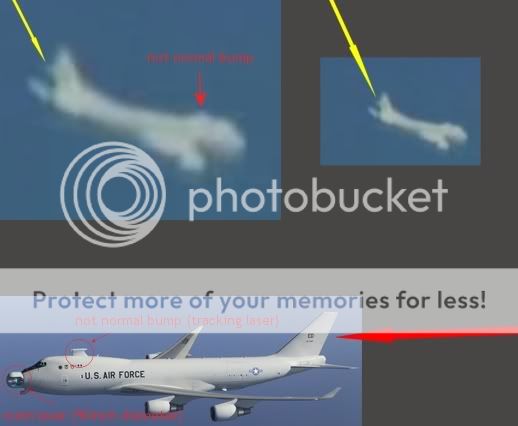
[edit on 22-8-2007 by mirageofdeceit]
[edit on 22-8-2007 by mirageofdeceit]
Originally posted by 11 11
Come on, if you really think the US government is an innocent child that never lies, well then you need to wake up. We are lied to by the government on a daily basis. Heck the US government steals from their own citizens on a daily basis. Heck, the US government uses the civilians as SLAVES, so they can play with the big toys. How you can believe that the US did not do this is far beyond my comprehension.
.
11 11, I never said the government does not lie. I said I do not believe all this crap about the government being a facilitator of 911. At least not on purpose. How you can believe the US DID this is far beyond my comprehension.
Originally posted by Boone 870
pinner99, I was being serious, I really did laugh. You may want to read my post again. I don't believe the airborne laser was used.
Sorry Boone. I'm a spaz.
Alrighty then. I debated if I should even wade into this type of thread, and man was I right.
Last point I will make:
You refer to me a civilian and basicaly imply I am naive as to not knowing the FULL capacity of the "black" lasers the government has in space, on the ground, in the air, behind that bush etc? "You cannot prove it" you claim, Yet you want me to accept these things at face value with ZERO proof on your end that any of these things exist.
Last point I will make:
You refer to me a civilian and basicaly imply I am naive as to not knowing the FULL capacity of the "black" lasers the government has in space, on the ground, in the air, behind that bush etc? "You cannot prove it" you claim, Yet you want me to accept these things at face value with ZERO proof on your end that any of these things exist.
new topics
-
Weinstein's conviction overturned
Mainstream News: 42 minutes ago -
Supreme Court Oral Arguments 4.25.2024 - Are PRESIDENTS IMMUNE From Later Being Prosecuted.
Above Politics: 2 hours ago -
Krystalnacht on today's most elite Universities?
Social Issues and Civil Unrest: 2 hours ago -
Chris Christie Wishes Death Upon Trump and Ramaswamy
Politicians & People: 2 hours ago -
University of Texas Instantly Shuts Down Anti Israel Protests
Education and Media: 4 hours ago -
Any one suspicious of fever promotions events, major investor Goldman Sachs card only.
The Gray Area: 7 hours ago -
God's Righteousness is Greater than Our Wrath
Religion, Faith, And Theology: 11 hours ago
top topics
-
VP's Secret Service agent brawls with other agents at Andrews
Mainstream News: 16 hours ago, 11 flags -
Nearly 70% Of Americans Want Talks To End War In Ukraine
Political Issues: 16 hours ago, 6 flags -
Krystalnacht on today's most elite Universities?
Social Issues and Civil Unrest: 2 hours ago, 6 flags -
Sunak spinning the sickness figures
Other Current Events: 16 hours ago, 5 flags -
Supreme Court Oral Arguments 4.25.2024 - Are PRESIDENTS IMMUNE From Later Being Prosecuted.
Above Politics: 2 hours ago, 5 flags -
Weinstein's conviction overturned
Mainstream News: 42 minutes ago, 4 flags -
Electrical tricks for saving money
Education and Media: 14 hours ago, 4 flags -
University of Texas Instantly Shuts Down Anti Israel Protests
Education and Media: 4 hours ago, 2 flags -
Any one suspicious of fever promotions events, major investor Goldman Sachs card only.
The Gray Area: 7 hours ago, 2 flags -
Chris Christie Wishes Death Upon Trump and Ramaswamy
Politicians & People: 2 hours ago, 1 flags
active topics
-
Supreme Court Oral Arguments 4.25.2024 - Are PRESIDENTS IMMUNE From Later Being Prosecuted.
Above Politics • 21 • : Vermilion -
Remember These Attacks When President Trump 2.0 Retribution-Justice Commences.
2024 Elections • 57 • : TzarChasm -
Weinstein's conviction overturned
Mainstream News • 9 • : chiefsmom -
-@TH3WH17ERABB17- -Q- ---TIME TO SHOW THE WORLD--- -Part- --44--
Dissecting Disinformation • 670 • : cherokeetroy -
Nearly 70% Of Americans Want Talks To End War In Ukraine
Political Issues • 78 • : Consvoli -
University of Texas Instantly Shuts Down Anti Israel Protests
Education and Media • 100 • : CriticalStinker -
British TV Presenter Refuses To Use Guest's Preferred Pronouns
Education and Media • 159 • : 5thHead -
HORRIBLE !! Russian Soldier Drinking Own Urine To Survive In Battle
World War Three • 40 • : Myhandle -
President BIDEN Vows to Make Americans Pay More Federal Taxes in 2025 - Political Suicide.
2024 Elections • 144 • : underpass61 -
Sunak spinning the sickness figures
Other Current Events • 19 • : Freeborn