It looks like you're using an Ad Blocker.
Please white-list or disable AboveTopSecret.com in your ad-blocking tool.
Thank you.
Some features of ATS will be disabled while you continue to use an ad-blocker.

Clean power generator
page: 12
share:
Just a brainstorm I recently had...
I've come up with some pretty hair-brained and impractical or impossible energy concepts in the past. This one is based wholly on existing technology, and only requiring solar energy and water as an input, and the only exhaust is water vapor. This device is infinitely scalable, from a simple camping generator, to a whole-home generator, to a whole-large building generator. All it requires is water.
This is NOT a free energy device (yet, on a cost factor, as cheap as water is, it might as well be). It does not break the law of conservation, and is quite possible with current technology.
The general concept is quite simple - an electrolysis machine (extracting hydrogen from water) combined with a simple turbine generator. The initial power input (not shown in the below diagram) is solar power.
I am providing a diagram of this power source, and hopefully (as it's home drawn in MS Paint) will be clear enough to understand. If anyone has any questions, please feel free to ask me.
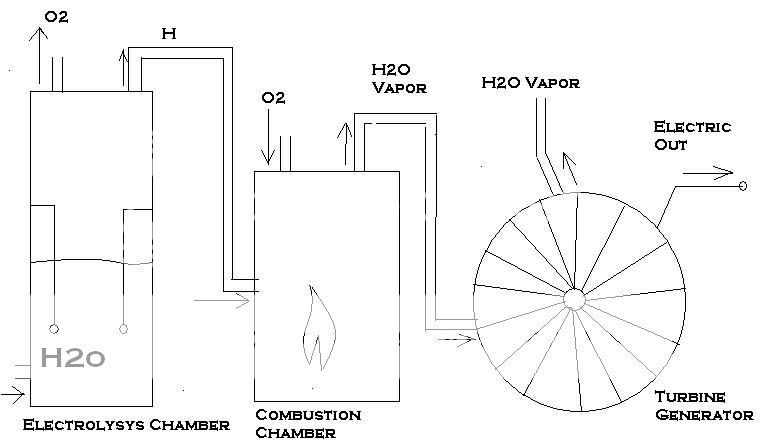
Extremely simple. Highly efficient. Clean burning. What else could we ask for?
I've come up with some pretty hair-brained and impractical or impossible energy concepts in the past. This one is based wholly on existing technology, and only requiring solar energy and water as an input, and the only exhaust is water vapor. This device is infinitely scalable, from a simple camping generator, to a whole-home generator, to a whole-large building generator. All it requires is water.
This is NOT a free energy device (yet, on a cost factor, as cheap as water is, it might as well be). It does not break the law of conservation, and is quite possible with current technology.
The general concept is quite simple - an electrolysis machine (extracting hydrogen from water) combined with a simple turbine generator. The initial power input (not shown in the below diagram) is solar power.
I am providing a diagram of this power source, and hopefully (as it's home drawn in MS Paint) will be clear enough to understand. If anyone has any questions, please feel free to ask me.
Extremely simple. Highly efficient. Clean burning. What else could we ask for?
I see a couple of things that may be problems:
First...why not just have pure solar power? If you have to power something THRU solar power to generate power, there is bound to be energy loss. Second, how is it that the combustion step does not emit carbon dioxide?
BTW, I do not believe that carbon dioxide contributes appreciably to global warming.
First...why not just have pure solar power? If you have to power something THRU solar power to generate power, there is bound to be energy loss. Second, how is it that the combustion step does not emit carbon dioxide?
BTW, I do not believe that carbon dioxide contributes appreciably to global warming.
I am gonna have to disagree on the effecient part.
1) where are you getting the electricity from?
2) how would you keep the H and O separate to allow only the oxygen to leave. And even then this barrier woudl still have to allow watter and electricity to pass though it.
3) while the hydrogen can be used a a fuel, would you be able to separate H fast enough to continue the burn?
4) How will you keep the "water vapor" from going out the O2 intake?
That is just what i see right off the bat. Good thinking though
1) where are you getting the electricity from?
2) how would you keep the H and O separate to allow only the oxygen to leave. And even then this barrier woudl still have to allow watter and electricity to pass though it.
3) while the hydrogen can be used a a fuel, would you be able to separate H fast enough to continue the burn?
4) How will you keep the "water vapor" from going out the O2 intake?
That is just what i see right off the bat. Good thinking though
Solar power is required to extract the hydrogen. Hydrogen is more efficient with current technology than solar (The solar energy that hits the earth
in every square foot is enough to power roughly 30 homes). Our current solar cells are not anywhere near that efficient. With even the top solar
cell technology, we'd only be able to power one average sized (1500 square feet) home with roughly 500 square feet of solar power.
Hydrogen is an energy source that we can harness with much greater efficiency. Between hydrogen burning and the turbine, this device, as laid out, will operate at roughly 60% efficiency between the hydrogen fuel and the electrical output of the turbine.
Finally, how will it not generate CO2 in the exhaust? It's the simple physics of hydrogen combustion. No fossil fuels are used in this device. The spark that facilitates combustion (and with enough provided hydrogen, may only need to be used once, in order to sustain combustion) can also be generated by the solar cells. When hydrogen burns, it combines with oxygen to combust and release its energy. The result is nothing more than water vapor. This is well documented.
To answer your final statement...
CO2 IS a major greenhouse gas. I have been prepping to go back to school for aerospace engineering, and have started some of the basic math and science courses. CO2 is a natural greenhouse gas. It's the reason that the Earth remains warm and comfortable, while our other two neighbors - Mars and Venus (both within the "comfort belt" in the solar system remain either extremely hot or extremely cold). Mars' atmosphere is too thin, and Venus' atmosphere (which can reach temperatures over 800 degrees F.) is thicker, and loaded with CO2. CO2 has also been listed as the most desirable greenhouse gas in the Mars Direct project, in order to warm the Martian atmosphere.
CO2 is certainly an issue in global warming.
Hydrogen is an energy source that we can harness with much greater efficiency. Between hydrogen burning and the turbine, this device, as laid out, will operate at roughly 60% efficiency between the hydrogen fuel and the electrical output of the turbine.
Finally, how will it not generate CO2 in the exhaust? It's the simple physics of hydrogen combustion. No fossil fuels are used in this device. The spark that facilitates combustion (and with enough provided hydrogen, may only need to be used once, in order to sustain combustion) can also be generated by the solar cells. When hydrogen burns, it combines with oxygen to combust and release its energy. The result is nothing more than water vapor. This is well documented.
To answer your final statement...
CO2 IS a major greenhouse gas. I have been prepping to go back to school for aerospace engineering, and have started some of the basic math and science courses. CO2 is a natural greenhouse gas. It's the reason that the Earth remains warm and comfortable, while our other two neighbors - Mars and Venus (both within the "comfort belt" in the solar system remain either extremely hot or extremely cold). Mars' atmosphere is too thin, and Venus' atmosphere (which can reach temperatures over 800 degrees F.) is thicker, and loaded with CO2. CO2 has also been listed as the most desirable greenhouse gas in the Mars Direct project, in order to warm the Martian atmosphere.
CO2 is certainly an issue in global warming.
First, let me state that the diagram I provided is intentionally simplified. I'm hoping to sell this idea. Many of the operational aspects are
intentionally eliminated in that diagram.
To address your questions:
1. As mentioned in the original article, initial power is obtained from solar cells. They are not shown in the diagram.
2-3. www.stardrivedevice.com... and www.patentstorm.us... and www.sbir.nasa.gov... and www.freshpatents.com... and adsabs.harvard.edu...
I hope that's enough sources for you.
It should also be noted that the solar-powered electrolysis generator has already been invented by scientists in Switzerland. www.dangerouslaboratories.org... (Requires Acrobat Reader), www.sciencenews.org...
The search terms (on www.google.com...) that I used for the above references are as follows:
Operation of the electrolysis device:
"electrolysis generator solar" (in quotes)
Existence of the base device:
"electrolysis solar"
Feel free to check them out for yourself.
To address your questions:
1. As mentioned in the original article, initial power is obtained from solar cells. They are not shown in the diagram.
2-3. www.stardrivedevice.com... and www.patentstorm.us... and www.sbir.nasa.gov... and www.freshpatents.com... and adsabs.harvard.edu...
I hope that's enough sources for you.
It should also be noted that the solar-powered electrolysis generator has already been invented by scientists in Switzerland. www.dangerouslaboratories.org... (Requires Acrobat Reader), www.sciencenews.org...
The search terms (on www.google.com...) that I used for the above references are as follows:
Operation of the electrolysis device:
"electrolysis generator solar" (in quotes)
Existence of the base device:
"electrolysis solar"
Feel free to check them out for yourself.
Woh slow down here before you try to sell your idea Im not trying to condemn your brainstorming efforts but there a few problems with your
idea..
The most obvious of which is that the combustion of hydrogen and oxygen does not produce H2O...
Now if you intend to use the combustion process to boil water to power the turbine we run into another problem. Electrolysis as we know it requires more energy to separate hydrogen from oxygen than can be extracted from the heat by burning that hydrogen. This has been proven time and time again yet I am sure others will argue saying that people have used "special frequencies" or "certain electrode design" to induce electrolysis using less electricity such as with Stan Meyer's device or with the " Joe Cell " .. (I believe these are frauds for various reasons.)
Now if you use the solar power or any other electrical source for electrolysis and store the hydrogen and oxygen where they can be used to power hydrogen fuel cells then you have a free energy device (solar power) that stores energy (separated hydrogen and oxygen) for use during a later time (in fuel cells) However this process is far less than 100 percent efficient. Therefore for a non moving power source it would be far more cost effective and efficient to simply use the solar panels to start with. The only advantages of using electrolysis is for energy storage for use where mobile power sources are needed. ( with electric or hybrid cars or other forms of transportation )
This combination of solar power (or other power sources) and fuel cell systems (using the stored energy) is obviously nothing new and has been proposed for years thus one of the reasons for advancements in hydrogen fuel cell technology for use in automobiles.
[edit on 30-6-2007 by Heckman]
The most obvious of which is that the combustion of hydrogen and oxygen does not produce H2O...
Now if you intend to use the combustion process to boil water to power the turbine we run into another problem. Electrolysis as we know it requires more energy to separate hydrogen from oxygen than can be extracted from the heat by burning that hydrogen. This has been proven time and time again yet I am sure others will argue saying that people have used "special frequencies" or "certain electrode design" to induce electrolysis using less electricity such as with Stan Meyer's device or with the " Joe Cell " .. (I believe these are frauds for various reasons.)
Now if you use the solar power or any other electrical source for electrolysis and store the hydrogen and oxygen where they can be used to power hydrogen fuel cells then you have a free energy device (solar power) that stores energy (separated hydrogen and oxygen) for use during a later time (in fuel cells) However this process is far less than 100 percent efficient. Therefore for a non moving power source it would be far more cost effective and efficient to simply use the solar panels to start with. The only advantages of using electrolysis is for energy storage for use where mobile power sources are needed. ( with electric or hybrid cars or other forms of transportation )
This combination of solar power (or other power sources) and fuel cell systems (using the stored energy) is obviously nothing new and has been proposed for years thus one of the reasons for advancements in hydrogen fuel cell technology for use in automobiles.
[edit on 30-6-2007 by Heckman]
I'm not sure what effect if any solar powered units will have in this case. Solar power is not exactly cheap or reliably strong. Solar panels that
cover the surface area of my backyard are just enough to help power the Space Station, let alone the entire state of Texas relying on the same
measurements is not exactly a hair brain scheme to save fuel or make money.
I'm not sure what effect if any solar powered units will have in this case. Solar power is not exactly cheap or reliably strong. Solar panels that
cover the surface area of my backyard are just enough to help power the Space Station, let alone the entire state of Texas relying on the same
measurements is not exactly a hair brain scheme to save fuel or make money.
you should focus your energy on wave or tidal power.. thats where the real potential is at.
the only reason i see doing this is if you need the oxygen or hydrogen as a mobile fuel supply... why would you convert electricity to gas and back o
electricity??? seems you would lose 70 percent from electrolysis to fuel and 50 from fuel to electricity...
would be a very fun project but you would be losing lots of power.... try and make it so you can use the fuel in a way you cannot use electricity and then it gain efficiency and need for the devise.;!! later
would be a very fun project but you would be losing lots of power.... try and make it so you can use the fuel in a way you cannot use electricity and then it gain efficiency and need for the devise.;!! later
If all you wanted was steam or steam to turn a generator, just use a large freznel lens and some black pipes. If you want to store power, use many
batteries connected to the generator.
One square meter (not foot) of sunlight will produce 1000watts of heat power, if solar cells were 100%eff., we would need about 2-5 meter square solar cells for 2-5KW of power. Freznel lenses are just about 100% eff. and are more durable then solar cells.
www.youtube.com...
One square meter (not foot) of sunlight will produce 1000watts of heat power, if solar cells were 100%eff., we would need about 2-5 meter square solar cells for 2-5KW of power. Freznel lenses are just about 100% eff. and are more durable then solar cells.
www.youtube.com...
Originally posted by XL5
If all you wanted was steam or steam to turn a generator, just use a large freznel lens and some black pipes. If you want to store power, use many batteries connected to the generator.
Yea, this idea is entertaining.
Steam is used to generate power just north of me. They burn wood chips from ground trees off of cleared land. What's interesting is they can afford to pay high freight for these chips getting them shipped in from out of state and still make a profit on the power produced from the steam.
Using steam turbines must be cheap or else they wouldn't be in business.
The question would be how one would scale a system down small enough to run a single home.
The idea with the lens is interesting but it would be a pain to keep focused throughout the day.
new topics
-
Nirvana - Immigrant Song
Music: 1 hours ago -
British TV Presenter Refuses To Use Guest's Preferred Pronouns
Education and Media: 2 hours ago -
Tucker Carlson interviews Christian pastor from Bethlehem.
Middle East Issues: 4 hours ago -
Trump To Hold Dinner with President of Poland At Trump Tower Tonight
2024 Elections: 5 hours ago -
A family from Kansas with six children moved to the Moscow region
Other Current Events: 8 hours ago -
Revolution in advertising: the Russians launched a unique satellite
Science & Technology: 10 hours ago
top topics
-
I Guess Cloud Seeding Works
Fragile Earth: 15 hours ago, 15 flags -
Canadian Forces bow out and loose interest in UFO’s
Aliens and UFOs: 16 hours ago, 7 flags -
Trump To Hold Dinner with President of Poland At Trump Tower Tonight
2024 Elections: 5 hours ago, 7 flags -
Revolution in advertising: the Russians launched a unique satellite
Science & Technology: 10 hours ago, 5 flags -
A family from Kansas with six children moved to the Moscow region
Other Current Events: 8 hours ago, 4 flags -
Tucker Carlson interviews Christian pastor from Bethlehem.
Middle East Issues: 4 hours ago, 4 flags -
Echo & The Bunnymen - The Killing Moon!
Music: 13 hours ago, 3 flags -
British TV Presenter Refuses To Use Guest's Preferred Pronouns
Education and Media: 2 hours ago, 2 flags -
Nirvana - Immigrant Song
Music: 1 hours ago, 2 flags
active topics
-
The US Supreme Court Appears to Side With the January 6th 2021 Capitol Protestors.
Political Conspiracies • 38 • : Dalamax -
It has begun... Iran begins attack on Israel, launches tons of drones towards the country
World War Three • 835 • : Oldcarpy2 -
Running Through Idiot Protestors Who Block The Road
Rant • 92 • : FlyersFan -
Canadian Forces bow out and loose interest in UFO’s
Aliens and UFOs • 12 • : pianopraze -
-@TH3WH17ERABB17- -Q- ---TIME TO SHOW THE WORLD--- -Part- --44--
Dissecting Disinformation • 504 • : Thoughtful3 -
Nirvana - Immigrant Song
Music • 1 • : CataclysmicRockets -
A family from Kansas with six children moved to the Moscow region
Other Current Events • 45 • : FlyersFan -
I Guess Cloud Seeding Works
Fragile Earth • 14 • : pianopraze -
Revolution in advertising: the Russians launched a unique satellite
Science & Technology • 60 • : RussianTroll -
Candidate TRUMP Now Has Crazy Judge JUAN MERCHAN After Him - The Stormy Daniels Hush-Money Case.
Political Conspiracies • 271 • : Threadbarer
2