It looks like you're using an Ad Blocker.
Please white-list or disable AboveTopSecret.com in your ad-blocking tool.
Thank you.
Some features of ATS will be disabled while you continue to use an ad-blocker.

On to something huge here! (UFO HOAX)
page: 1share:
OK, Now I am officially freaked out, I was talking with A Local UFO investigator Michael La Riche who told me to check out the following site because
they had some footage & pictures of the same type of Objects that I am filming here over Lake Erie, They are freaken exactly the same as what I am
filming, What is going on?
Check out the video's and photo's www.ORBWATCH.COM
Then compare to my footage, I think we are on to something huge here!
www.youtube.com...
Time for some answers!
[edit on 9-2-2007 by Frozenthought]
[edit on 2-22-2007 by Springer]
Check out the video's and photo's www.ORBWATCH.COM
Then compare to my footage, I think we are on to something huge here!
www.youtube.com...
Time for some answers!
[edit on 9-2-2007 by Frozenthought]
[edit on 2-22-2007 by Springer]
I looked at the orb watch website and all I see are several pictures of MD-80 landing lights. There is even one with the light not fully extended
shining through cloud cover, which is an eerie sight if you don’t know what it is. This picture specifically is the one with the clouds: www.iprimus.ca..." target='_blank' class='tabOff'/> The one behind it has not yet turned on his wing lights but is obviously on the same approach yet
further out/next to land.
Originally posted by defcon5
I looked at the orb watch website and all I see are several pictures of MD-80 landing lights. There is even one with the light not fully extended shining through cloud cover, which is an eerie sight if you don’t know what it is. This picture specifically is the one with the clouds: www.iprimus.ca..." target='_blank' class='tabOff'/> The one behind it has not yet turned on his wing lights but is obviously on the same approach yet further out/next to land.
They are not planes, IMO
Holy crap!! I live in the upper penninsula of michigan and was getting a cab ride home the other night, on the way home me and the cab driver saw the
exact and i mean exact dual light thing over water, he stopped the cab and we watched it for a good 5 minutes(p.s. i live on the great lakes)
[edit on 9-2-2007 by Rowsdower77]
[edit on 9-2-2007 by Rowsdower77]
Originally posted by Frozenthought
They are not planes, IMO
Dude…
Give me a reason why. Is it because you don’t want them to be? I watched your video, and your looking at aircraft on approach over a lake. Over a lake with no obstructions, they can be seen for a very long distance and appear to be hovering like that. The air temperature and pollution will make the lights appear strobbing, just like it does the stars. I see nothing here to tell me its anything more then a pair of DM-80’s/DC-9’s.
Heck you can even see the one bank in behind the other, meaning the
[edit on 2/9/2007 by defcon5]
Originally posted by defcon5
Originally posted by Frozenthought
They are not planes, IMO
Dude…
Give me a reason why. Is it because you don’t want them to be? I watched your video, and your looking at aircraft on approach over a lake. Over a lake with no obstructions, they can be seen for a very long distance and appear to be hovering like that. The air temperature and pollution will make the lights appear strobing, just like it does the stars. I see nothing here to tell me its anything more then a pair of DM-80’s DC-9’s.
"What amazes me about this footage is that there is no noise from jet aircraft, helicopters, etc., and a UFO comes so closely by to hover right on top of the other UFO and then flies back out the way it came in. No airplane could do this. Also, when the video camera switches to night shot mode, we can see the UFOs are not boats on the lake. They are hovering a good 50 - 100 feet above the water." - David Sereda
How about if I just post some expert opinion?
hoax. Those lights almost look like car headlights. Looks like they are in front of a body of water, could be a lake, and cars driving over a bridge or something like that. Just seems to low. There aren’t any points of reference or anything else to get a good idea of size.
UFO NEWS: At exactly 1:04 minutes before the end of the video (some counters may differ) there is an exposure change and zoom back - you will see the point where the cameraman changed the electronic shutter speed on his camera allowing more light exposure. Any illusion created by runnning cars over a bridge is blown at this point…when you see the relationship between the water and the UFOs. As a professional videographer for over 30 years and a 3D visual effects artist I can earnestly say, “If this is fake it’s one of the best”. My hats off to this filmmaker or digital artist no matter how you look at it.Looks like planes’ landing lights to me - one plane flying toward the camera and later on joined by another plane flying behind the first on the same flightpath. Nothing jumps out as being particularly mysterious but maybe I’m just being a bit too rational and applying occam’s razor?
UFO NEWS: Yes. It looks very much like airplanes landing lights. Airplanes that hover in the air for several minutes without moving in relation to the cameraman and make no discernible sound.
UFO NEWS: These craft are clearly hovering. They are not receding in the distance or changing in size at any point in this video (except when the cameraman ’snap-zooms’ back at one point). What these craft do is not natural or typical for known aircraft. Either these are some kind of super-secret silent military helicopters or…
How about if I just post some expert opinion?
Sure, do that. What makes the person your quoting an expert?
I have worked on aircraft for many years and can tell what type they are by their light patterns much of the time. So if it's not an aircraft, then why does the second one bank when it gets behind the first? Because it just came in from another direction and must bank to change direction. The lights bank because they are connected to wings, and aircraft bank to turn because they use ailerons.
As to the lack of sound. Aircraft make very little sound when they are facing directly toward you, they also don’t make any sound at distance. Since your shooting over a lake, the distance is very hard to discern, and what might only seen like it’s a couple miles off, might actually be 10 or 15 miles away.
Even your experts posted this:
Looks like planes’ landing lights to me - one plane flying toward the camera and later on joined by another plane flying behind the first on the same flightpath. Nothing jumps out as being particularly mysterious but maybe I’m just being a bit too rational and applying occam’s razor?
es. It looks very much like airplanes landing lights. Airplanes that hover in the air for several minutes without moving in relation to the cameraman and make no discernible sound.
Oh, the reason they seem low is that the earth is curved, and thus they might be at greater altitude then they appear in the video if the distance is significant.
[edit on 2/9/2007 by defcon5]
I hate to be a wet diaper, but it is beginning to look more and more like staged disclosure.
It reminds me of Ronald Reagan's infamous quote about an extraterrestrial threat being the catalyst to bring mankind together for a common cause.
HaHa, the ultimate terrorist!
It's just that sightings and experiences have been claimed for quite some time, ignored by mainstream America and suddenly it is on news channels and lots of video is there for our consumption.
I don't know, but I don't trust the whole new "expsosure" movement.
Then again, my favorite website is a conspiracy site!
Edit to add: Or something really big is happening................ NOW
[edit on 9-2-2007 by interestedalways]
[edit on 9-2-2007 by interestedalways]
It reminds me of Ronald Reagan's infamous quote about an extraterrestrial threat being the catalyst to bring mankind together for a common cause.
HaHa, the ultimate terrorist!
It's just that sightings and experiences have been claimed for quite some time, ignored by mainstream America and suddenly it is on news channels and lots of video is there for our consumption.
I don't know, but I don't trust the whole new "expsosure" movement.
Then again, my favorite website is a conspiracy site!
Edit to add: Or something really big is happening................ NOW
[edit on 9-2-2007 by interestedalways]
[edit on 9-2-2007 by interestedalways]
I drive truck at night and I pass Boeing Field and Sea-Tac Airport on I-5 almost every night. These look like two planes stacking up for approach on
parallel runways. Could you maybe post a Google map link of your location while taking the video and the nearest commercial airport? I try to keep
an open mind in all things-- Were the lights flashing different colors? Did you see any erratic movement that a plane could not do? Hovering on top
of each other seems easy to explain as one object being far behind the other.
Whether or not these are real, you did a good job of recording and getting it posted. If people see UFOs and don't report them for fear of ridicule then we all might miss out on important discoveries.
Don't stop looking
Whether or not these are real, you did a good job of recording and getting it posted. If people see UFOs and don't report them for fear of ridicule then we all might miss out on important discoveries.
Don't stop looking
Were the lights flashing different colors?
MD-80’s/DC-9’s don’t have any discernable flashing Navigation lights to be seen when looking at them head on. You’ll only see the three bright approach lights (only two if the nose gear is still up); they are so bright they drown out the other navigation lights in comparison. The strobbing that appears in the film could be atmospheric distortion, same as you see with stars. Now add to this factor that he is filming over a huge lake at night, and if its recent, during the winter, and you have to add another factor into the mess. Lakes shed the heat that they absorb during the day, at night. If you have ever looked at a light through heat rising off of something you’ll get that same effect.
[edit on 2/9/2007 by defcon5]
True that!
Do we have access to any footage that is long in duration?
Surely 10-30 mins would allow for planes to be discounted or proven.
Maybe thats why theyre so short.
Do we have access to any footage that is long in duration?
Surely 10-30 mins would allow for planes to be discounted or proven.
Maybe thats why theyre so short.
those donmt look as if they are behaving like planes to me by lookingnat the video, could some kind of expreimental military plane?? i found this
image on google earth though of a lakeside airport on the east basin i dont know alot about the area and wether the airport is still in use or not.
heres thr image
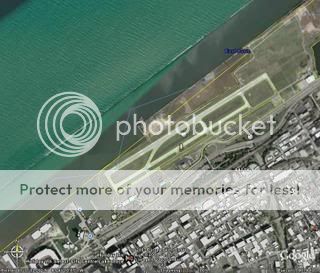
[edit on 9/2/2007 by spookymulder]
heres thr image
[edit on 9/2/2007 by spookymulder]
Did a bit of looking around…
Here is a good example what am MD-80 landing config is and how bright the three lights are:
This is how they look retracted and how close they are to the nav lights causing them to drown them out:
www.scfotografi.dk..." target='_blank' class='tabOff'/>
This is a Glasair, smaller but similar light layout:
Another small aircraft, again note how the Nav lights are drown out:
MD-90, basically same as an DC-9 and MD-80:
B-717:
www2.lnet.ne.jp..." target='_blank' class='tabOff'/>
[edit on 2/9/2007 by defcon5]
Here is a good example what am MD-80 landing config is and how bright the three lights are:
This is how they look retracted and how close they are to the nav lights causing them to drown them out:
www.scfotografi.dk..." target='_blank' class='tabOff'/>
This is a Glasair, smaller but similar light layout:
Another small aircraft, again note how the Nav lights are drown out:
MD-90, basically same as an DC-9 and MD-80:
B-717:
www2.lnet.ne.jp..." target='_blank' class='tabOff'/>
[edit on 2/9/2007 by defcon5]
OK. I fully beleive these videos are real, however just to prove it, can you go on Google Earth or Google maps and tell me EXACTLY where you were
filming.
That way I can see if it is possible for a 717, DC9, MD80 / MD90 to have even flown over that area.
Thank you.
P.S: THANK YOU FOR SHARING!
That way I can see if it is possible for a 717, DC9, MD80 / MD90 to have even flown over that area.
Thank you.
P.S: THANK YOU FOR SHARING!
that first image would def explain the triple that was seen cos if ya think about it the 2 wing lights r on then they switch the landing light on and
u have a triple i still aint so sure about the way they are flyin though dosent seem like normal plane behaviour and the fact they were making no
niose.
Originally posted by defcon5
So if it's not an aircraft, then why does the second one bank when it gets behind the first? Because it just came in from another direction and must bank to change direction. The lights bank because they are connected to wings, and aircraft bank to turn because they use ailerons.
Nice post. I'd like your thoughts on something that from my layman view doesn't fit the banking theory.
After the first 'bank', when it turns back the way it came, the lights level out. Then very quickly the lights get very bright again (2:15). His buddy said it looked like afterburners. This happened very quickly. Wouldn't a plane have to be turning incredibly fast and sharp for the lights to get bright that fast without a noticeable change in angle and distance between the 2 lights?
[edit on 9-2-2007 by Snootch]
[edit on 9-2-2007 by Snootch]
I watched the video closely and here is what I got out of it:
00:40 Second aircraft (AC2) comes into view, it’s already on a left bank of probably 15 degrees, this is apparent as the right wing light is higher then the left one.
00:55 The Second aircraft (AC2) continues its bank until level with aircraft 1 (AC1). At this point it is pointing toward the camera with its landing lights, so they are much brighter. You have to consider that not only distance but also angle to camera is going to effect brightness.
1:15 AC2 still banking slightly to the left heading back to the right edge of the screen. The camera operator moves the camera.
01:28 AC2 lights continue to dim as the turn continues and the lights get further off the direct angle with the camera lens. At this point AC2 appears to be either making an S-turn or is heading to a different runway. S-turns are used to slow up the second aircraft in a stack so the first has time to land and taxi off the runway. They can also be used to lose additional altitude. It is very common to see the second or third aircraft in a landing stack do turns of this fashion.
01:30 Camera moves again.
01:47 As the aircraft are getting closer the angle between them is increasing and it’s showing up on the zoomed in film as what appears to be a fast speed in movement. In reality they are moving at the same speed but on different trajectories thus multiplying their speed the same way two cars going in different directions would.
01:44 The camera operator switches camera modes to low light or night vision. Upon doing this it appears to change the zoom level, thus making the aircraft appear to shoot back together at high speed. There is something VERY interesting to note in the lower left corner of the screen at this point. Right on the coast, is a bright spot, if you watch that bright spot closely you’ll notice what appears to be dim flickering lights, I am going to guess landing lights from the end of a runway. It appears to be pretty far in the distance, but it clearly shows up on the night vision lens.
02:11 Operator realizes that AC1 is getting close to landing at the bright spot in the distance, so he suddenly becomes quite interested in only filming AC2. If AC2 had been moving on afterburners or at UFO warp speed it should be well out of sight by now. We stays on AC2 until the footage ends.
Anyway, that is the way I see it.
You must remember that the lights not only get brighter or dimmer based on distance, but also on how directly they are facing the camera. So in a turn the lights might only face directly at the camera for a few seconds thus your bright flash. So the answer is no, it would not have to be.
If someone would like to analyze something in this video I would like to see an analysis of the bright area ¾ of the way down on the left hand side of the screen when the camera goes to night vision. Looks a bit too much like the end of a runway to me.
[edit on 2/9/2007 by defcon5]
00:40 Second aircraft (AC2) comes into view, it’s already on a left bank of probably 15 degrees, this is apparent as the right wing light is higher then the left one.
00:55 The Second aircraft (AC2) continues its bank until level with aircraft 1 (AC1). At this point it is pointing toward the camera with its landing lights, so they are much brighter. You have to consider that not only distance but also angle to camera is going to effect brightness.
1:15 AC2 still banking slightly to the left heading back to the right edge of the screen. The camera operator moves the camera.
01:28 AC2 lights continue to dim as the turn continues and the lights get further off the direct angle with the camera lens. At this point AC2 appears to be either making an S-turn or is heading to a different runway. S-turns are used to slow up the second aircraft in a stack so the first has time to land and taxi off the runway. They can also be used to lose additional altitude. It is very common to see the second or third aircraft in a landing stack do turns of this fashion.
01:30 Camera moves again.
01:47 As the aircraft are getting closer the angle between them is increasing and it’s showing up on the zoomed in film as what appears to be a fast speed in movement. In reality they are moving at the same speed but on different trajectories thus multiplying their speed the same way two cars going in different directions would.
01:44 The camera operator switches camera modes to low light or night vision. Upon doing this it appears to change the zoom level, thus making the aircraft appear to shoot back together at high speed. There is something VERY interesting to note in the lower left corner of the screen at this point. Right on the coast, is a bright spot, if you watch that bright spot closely you’ll notice what appears to be dim flickering lights, I am going to guess landing lights from the end of a runway. It appears to be pretty far in the distance, but it clearly shows up on the night vision lens.
02:11 Operator realizes that AC1 is getting close to landing at the bright spot in the distance, so he suddenly becomes quite interested in only filming AC2. If AC2 had been moving on afterburners or at UFO warp speed it should be well out of sight by now. We stays on AC2 until the footage ends.
Anyway, that is the way I see it.
After the first 'bank', when it turns back the way it came, the lights level out. Then very quickly the lights get very bright again (2:15). His buddy said it looked like afterburners. Wouldn't a plane have to be turning incredibly fast and sharp for the lights to get bright that fast without a noticeable change in angle and distance between the 2 lights?
You must remember that the lights not only get brighter or dimmer based on distance, but also on how directly they are facing the camera. So in a turn the lights might only face directly at the camera for a few seconds thus your bright flash. So the answer is no, it would not have to be.
If someone would like to analyze something in this video I would like to see an analysis of the bright area ¾ of the way down on the left hand side of the screen when the camera goes to night vision. Looks a bit too much like the end of a runway to me.
[edit on 2/9/2007 by defcon5]
Your video is interesting Frozenthought. From what I see, and I'm no photo/vid analysis expert, they are not aircraft lights. Delattoso or Dr Bruce
McAbee should see your images, I believe Delattoso can be located in Phoenix. There's also a few image analyst members here that may have the time to
take a peek at it?
Dallas
Dallas
There is no way that the lights on the video are caused by any fixed wing aircraft, no way whatsoever. The only possibility is that it may have been a
chopper, but that theory goes out the window because there is no sound being emitted. As you can see a clear gap between the light it means the object
is not all that far away, and definatly in audible range.
Thanks for sharing this video.
Be safe
Thanks for sharing this video.
Be safe
new topics
-
God's Righteousness is Greater than Our Wrath
Religion, Faith, And Theology: 2 hours ago -
Electrical tricks for saving money
Education and Media: 5 hours ago -
VP's Secret Service agent brawls with other agents at Andrews
Mainstream News: 6 hours ago -
Sunak spinning the sickness figures
Other Current Events: 7 hours ago -
Nearly 70% Of Americans Want Talks To End War In Ukraine
Political Issues: 7 hours ago -
Late Night with the Devil - a really good unusual modern horror film.
Movies: 9 hours ago -
Cats Used as Live Bait to Train Ferocious Pitbulls in Illegal NYC Dogfighting
Social Issues and Civil Unrest: 10 hours ago
top topics
-
VP's Secret Service agent brawls with other agents at Andrews
Mainstream News: 6 hours ago, 9 flags -
Florida man's trip overseas ends in shock over $143,000 T-Mobile phone bill
Social Issues and Civil Unrest: 17 hours ago, 8 flags -
Cats Used as Live Bait to Train Ferocious Pitbulls in Illegal NYC Dogfighting
Social Issues and Civil Unrest: 10 hours ago, 8 flags -
Electrical tricks for saving money
Education and Media: 5 hours ago, 4 flags -
Bobiverse
Fantasy & Science Fiction: 17 hours ago, 3 flags -
HORRIBLE !! Russian Soldier Drinking Own Urine To Survive In Battle
World War Three: 14 hours ago, 3 flags -
Nearly 70% Of Americans Want Talks To End War In Ukraine
Political Issues: 7 hours ago, 3 flags -
Sunak spinning the sickness figures
Other Current Events: 7 hours ago, 3 flags -
Late Night with the Devil - a really good unusual modern horror film.
Movies: 9 hours ago, 2 flags -
The Good News According to Jesus - Episode 1
Religion, Faith, And Theology: 12 hours ago, 1 flags
active topics
-
Cats Used as Live Bait to Train Ferocious Pitbulls in Illegal NYC Dogfighting
Social Issues and Civil Unrest • 20 • : Asher47 -
Nearly 70% Of Americans Want Talks To End War In Ukraine
Political Issues • 12 • : Asher47 -
VP's Secret Service agent brawls with other agents at Andrews
Mainstream News • 39 • : Asher47 -
Electrical tricks for saving money
Education and Media • 4 • : Lumenari -
New whistleblower Jason Sands speaks on Twitter Spaces last night.
Aliens and UFOs • 54 • : Ophiuchus1 -
DONALD J. TRUMP - 2024 Candidate for President - His Communications to Americans and the World.
2024 Elections • 514 • : WeMustCare -
The Acronym Game .. Pt.3
General Chit Chat • 7744 • : bally001 -
Truth Social goes public, be careful not to lose your money
Mainstream News • 128 • : Astyanax -
Sunak spinning the sickness figures
Other Current Events • 5 • : glen200376 -
SETI chief says US has no evidence for alien technology. 'And we never have'
Aliens and UFOs • 44 • : MikeDeGrasseTyson