It looks like you're using an Ad Blocker.
Please white-list or disable AboveTopSecret.com in your ad-blocking tool.
Thank you.
Some features of ATS will be disabled while you continue to use an ad-blocker.

F-3 or F-36A
page: 1share:
The F-3 program was initiated in response to Japan's requirement for an interceptor to replace its aging fleet of F-15J. The F-22 was considered too
expensive to allow for a 1 to 1 replacement of the Eagle fleet. In addition, with the rise of communist China air's power, Japan felt that it needs
to increase its number of air frames beyond current levels. Hence the hunt was on for a relatively affordable interceptor that will afford it a clear
and distinct advantage over any Su-27 derivative and/or the next generation of eastern bloc fighter. Since advance 3rd generation types such as the
European Typhoon or Rafael, as well as an evolved version of the Mitsubishi F-2 or US-teens will fall way short of requirement, the decision was made
to pursue a brand new airframe. The crash project was to be a joint venture between the US and Japanese military industrial complex. The initial
budget was roughly 6 billion USD, but this was subsequently double to 12 billion with 6 billion coming from the USA which sees the opportunity to
acquire a naval interceptor to supplement the F-18 E/F. Given the very modest development budget the program attempted to avoid the development of new
systems as much as possible and inherits the majority of internal systems from the F-35. The radar is an updated version of the F-35’s AN/APG-81
AESA unit, designated the AN/APG-81(v)1, with an advanced antenna group utilizing Gallium-Indium-Aluminum MMICs and a 25% increase in the number of
T/R modules. The F135-PW-100 engine, cockpit displays, distributed aperture optical sensors, ESM are all practically carried over from the F-35. In
essence the F-3 program attempts to repackage the F-35 into a new airframe optimized for interception. Greater speed and stealth are emphasized, as is
the reduced supersonic drag. Internal fuel capacity is reduced (5500kg vs 8300kg) and payload capacity is cut (4200kg vs 7700kg). The aircraft bears
some resemblance to the YF-23 and is constructed largely of advanced composites. The F-3 has a combat radius of 450 nm on internal fuel. Thanks to the
low bypass engine, it boasts an operational altitude in excess of 22000 nm. It is also be sustains at Mach1.5 without afterburners and can attain Mach
2.2 on full reheat. The aircraft has two internal weapon bays, each capable of accommodating two AIM-120 C/D missiles or two 250lb small diameter
bombs. There is no internal gun even though provision was made for the F-35B’s centerline gun pod to be carried. There are two wet hard points under
each wing rated for 1500kg. These are capable of handling an external tank, a pair of AIM-120 C/D missiles, a pair of AIM-9X missiles and other
ordnance. The unit cost is expected to be about 60 million USD assuming a production run of 500 units. To facilitate export to a wider range of
clients, the US partners are also preparing a downgraded version power by a General Electric F110-GE-132 engine (32,000 lbs thrust). This version will
be equipped with the F-18E’s AN/APG-79 radar and is dubbed the F-36/110-LC. This attempt appears to be patterned after the abortive efforts in the
late 70s to offer a downgraded F-16 with the single spool J79 turbojet engine (F-16/70).
i74.photobucket.com...
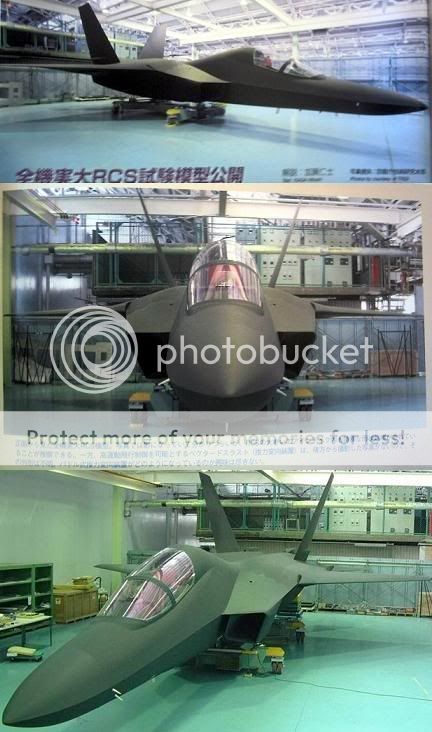
i74.photobucket.com...
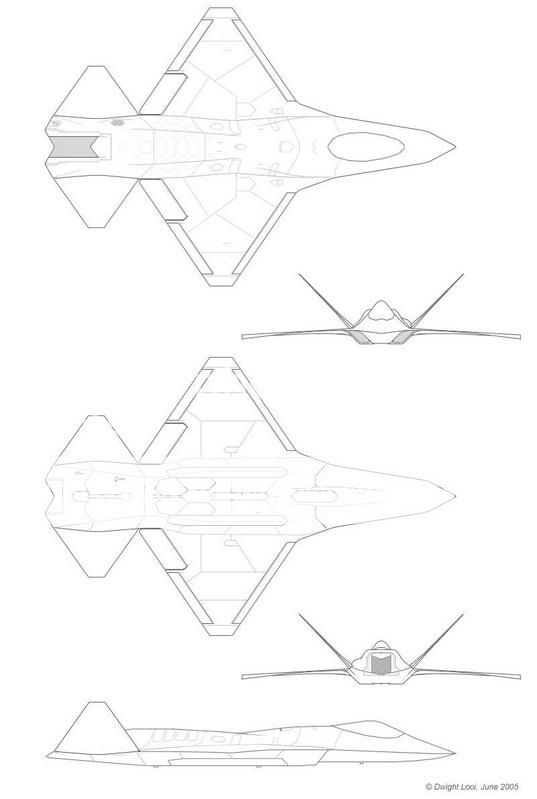
Mod Edit: Image Size – Please Review This Link.
[edit on 15/1/2007 by Mirthful Me]
i74.photobucket.com...
i74.photobucket.com...
Mod Edit: Image Size – Please Review This Link.
[edit on 15/1/2007 by Mirthful Me]
That's a rather interesting design. The cockpit looks like a Sukhoi cockpit, and I've never seen a nose cone that long on a modern fighter
aircraft.
Just initial observations at first glance.
Just initial observations at first glance.
Interesting indeed..
Whats the current state of affairs with this project?
With an IOC of 2010 we should expect to see some prototype fly soon aye?
Assuming that this is infact a full commitment from the Japanese and perhaps the US as well.
Some points:
The First 3-4 pics show an a/c which is NOT the orthographic schematic shown in the end.. for many observable reasons.
So whats the final airframe?
That nose cone makes this design look like a trainer but single seated!
I found some info on a forum about this but that was dated 05..
The same info has been circulating around last year as well with no substantial updates.
So a little skeptical on the project realization here..
There's some chatter about the F-2B/C as well? Twin tail finned F-2 with 2D TVC? Nothing substantial on any new indigenous fighter on the horizon for the JASDF IMO.
Whats the current state of affairs with this project?
With an IOC of 2010 we should expect to see some prototype fly soon aye?
Assuming that this is infact a full commitment from the Japanese and perhaps the US as well.
Some points:
The First 3-4 pics show an a/c which is NOT the orthographic schematic shown in the end.. for many observable reasons.
So whats the final airframe?
That nose cone makes this design look like a trainer but single seated!
I found some info on a forum about this but that was dated 05..
The same info has been circulating around last year as well with no substantial updates.
So a little skeptical on the project realization here..
There's some chatter about the F-2B/C as well? Twin tail finned F-2 with 2D TVC? Nothing substantial on any new indigenous fighter on the horizon for the JASDF IMO.
This is certain new kind of most exciting thing to see. It does surprise me to see that design coming out of Japan in joint venture with US Department
of Defense. And that picture of drawing design of jet is bit cousin to F-23 in first glance. I love that already. Hope US Navy and Air Force would get
their hands on that too. We're going to see paradigam leap of generations of jets coming up. That very long nose is very new to me too. From my
standpoint, it looks like it's interceptor design to fly very fast and its airframe is very sleek and low profile which it shows that it can take the
fight to today's latest and advanced fighters. Very good post.
Really cool aircraft! Although as a previoud poster pointed out, the plane in the pictures is clearly not the same as the plane in the diagrams.
The drawings look much more like the YF-23 than the prototype.
The drawings look much more like the YF-23 than the prototype.
Ooh la la!
Reminds me of an F/A-22 crossed with a Honda CFX!
The last time I said something like that was for the Raptor.
AWESOME aircraft!
Is it just me or is it hot in here?
Reminds me of an F/A-22 crossed with a Honda CFX!
The last time I said something like that was for the Raptor.
AWESOME aircraft!
Is it just me or is it hot in here?
The last two pictures ( the specs and ortho ) are a fictional design done by dwight looi first posted in the
World Armed Forces Forum. It was quite a while ago too.
Ah, so it's a "fantasy" aircraft.
Anyway, I'm kind of puzzled as to why Japan never showed interest in the F-35 program? They will need replacements and a new fighter soon (F-4EJ's), yet no clear indigenous solution seem to be forthcoming. Given the F-22's cost Japan would not be able to procure a large amount of airframes. Not to mention the foreign sales and technology transfer issues (aka an "export" Raptor).
However Japan could afford 100-150 F-35's and still have the most advanced jet in the region. There would be no major technology transfer issues and the F-35 is still likely to offer greater capably than any indigenous design could. Japan would also save time, money and effort by purchasing a proven jet that's already in production instead of starting a new and uncertain fighter program on their own.
So, am I missing something here?
[edit on 15-1-2007 by WestPoint23]
Anyway, I'm kind of puzzled as to why Japan never showed interest in the F-35 program? They will need replacements and a new fighter soon (F-4EJ's), yet no clear indigenous solution seem to be forthcoming. Given the F-22's cost Japan would not be able to procure a large amount of airframes. Not to mention the foreign sales and technology transfer issues (aka an "export" Raptor).
However Japan could afford 100-150 F-35's and still have the most advanced jet in the region. There would be no major technology transfer issues and the F-35 is still likely to offer greater capably than any indigenous design could. Japan would also save time, money and effort by purchasing a proven jet that's already in production instead of starting a new and uncertain fighter program on their own.
So, am I missing something here?
[edit on 15-1-2007 by WestPoint23]
If japan wants to be able to combat the chinese even if only till the americans come help them then they would need something better than this or the
F35. The best plane would be a plane with a reasonably large range while being significantly more powerfull than the chinese planes to combat the
difference in numbers. Atm this would be F22 or the typhoon.
Originally posted by tomcat ha
If japan wants to be able to combat the chinese even if only till the americans come help them then they would need something better than this or the F35.
Not really, the Chinese don't have anything comparable to the F-35, let alone better.
Originally posted by tomcat ha
The best plane would be a plane with a reasonably large range while being significantly more powerfull than the chinese planes to combat the difference in numbers.
The F-35 gives you roughly a 700 mile combat radius, you're telling me that Japan needs more range than that to combat China? Also, 150-200 F-35's combined with Japans F-15's and perhaps a C/D version of the F-2 will more than make up for the number ratio. Even if we do assume some pretty ridicules things.
Originally posted by tomcat ha
Atm this would be F22 or the typhoon.
I don't see what the Typhoon offers over the F-35 in this context and situation?
The F-22 would be ideal but can they buy a large number of them and will they get the "full" package?
[edit on 15-1-2007 by WestPoint23]
that sketch somewhat reminds me of a pic i saw on a thread here on ATS
(i think)
yep, here it is.
SHARC Thread on ATS by gfad
Subsonic High Alpha Research Concept
they got different intakes though
(i think)
yep, here it is.
SHARC Thread on ATS by gfad
Subsonic High Alpha Research Concept
they got different intakes though
The Typhoon is a better Air to air fighter. The F35 is mainly a fighter bomber. Why would the UK otherwise continue to build typhoons because its
slightly more expensive than a F35. The F35 only has its stealth over the Typhoon.
China is advancing rapidly and if they get the Su30mki like planes then the F35's will have a hard time
In case of Japan's large coast the longer ranged the better.
China is advancing rapidly and if they get the Su30mki like planes then the F35's will have a hard time
In case of Japan's large coast the longer ranged the better.
Originally posted by WestPoint23
Not really, the Chinese don't have anything comparable to the F-35, let alone better. 150-200 F-35's combined with Japans F-15's and perhaps a C/D version of the F-2 will more than make up for the number ratio.
Gotta disagree with you there. You can count on thousands of Chinese aircraft, most reasonably recent and comparable (if not better) than the F-15s.
The Japanese F-15s don't have AESA radars do they? [Or PESA for that matter?]
Originally posted by WestPoint23
I don't see what the Typhoon offers over the F-35 in this context and situation?
Well... if you want to take advantage of the JSF's VLO tech, how many missiles can you carry? (is it 4 or 6)
With the EF2000 you can loadout with, what, 12? 14?
I know if I'm in a flight of 4 facing 20 bad guys which loadout I'd like.
Originally posted by tomcat ha
The Typhoon is a better Air to air fighter. The F35 is mainly a fighter bomber.
I disagree, the F-35, especially the A and C variants are not mainly fighter bombers, they are multi role aircraft. Also, IMO the Typhoon is not a better overall A2A fighter, the Lightning has several key advantages.
Originally posted by tomcat ha
Why would the UK otherwise continue to build typhoons because its slightly more expensive than a F35.
This question is so open ended and in some aspects irrelevant it cannot possibly be used as an argument that fighter X is better than Y.
Originally posted by tomcat ha
The F35 only has its stealth over the Typhoon.
We can also argue about it's sensor and avionics suite as well. Anyway, with regards to stealth, that's a pretty big difference when it could be the only thing that determines who lives and who does not.
Originally posted by tomcat ha
China is advancing rapidly and if they get the Su30mki like planes then the F35's will have a hard time.
Why? In this case it is more appropriate to say that the Flanker's will have an extremely difficult time.
Originally posted by tomcat ha
In case of Japan's large coast the longer ranged the better.
The F-35 has more internal fuel and a higher bypass engine which translates into more endurance and range than the Tiffy.
Originally posted by kilcoo316
Originally posted by WestPoint23
Not really, the Chinese don't have anything comparable to the F-35, let alone better. 150-200 F-35's combined with Japans F-15's and perhaps a C/D version of the F-2 will more than make up for the number ratio.
Gotta disagree with you there. You can count on thousands of Chinese aircraft, most reasonably recent and comparable (if not better) than the F-15s.
The Japanese F-15s don't have AESA radars do they? [Or PESA for that matter?]
Originally posted by WestPoint23
I don't see what the Typhoon offers over the F-35 in this context and situation?
Well... if you want to take advantage of the JSF's VLO tech, how many missiles can you carry? (is it 4 or 6)
With the EF2000 you can loadout with, what, 12? 14?
I know if I'm in a flight of 4 facing 20 bad guys which loadout I'd like.
Would you rather kill 4-6 bogies that never knew you were there, or try to kill 12-14 that do? The JSF can carry additional A2A weapons if it uses external carriage, though that would negate its stealth advantage.
Can you honestly see this happening? I mean look at the last 3 latest airframe costs: F22, EF2000, JSF - There all massively over budget, we're
talking HUGE amounts of money here.
Im not saying japan can't afford it - Its richer than any single europian nation but there defence budget is lower than the UK's, France's and russia's. Basically if this thing were to be built it would have to be at least a 50:50 split between the US and japan... I really cant see the US going for that. Its got the 22 and the 35 and all subsequent gens will be UAVs.
If this thing were built it would mean a massive japanese investment and they just dont have the air defence infrastucture to manufacture this without US facilities.
Shame though - Take the largest engine you can find and put it into a stripped out, dart like, missile laidend rocket and point it at the worlds next super power. That takes some serious balls.
Im not saying japan can't afford it - Its richer than any single europian nation but there defence budget is lower than the UK's, France's and russia's. Basically if this thing were to be built it would have to be at least a 50:50 split between the US and japan... I really cant see the US going for that. Its got the 22 and the 35 and all subsequent gens will be UAVs.
If this thing were built it would mean a massive japanese investment and they just dont have the air defence infrastucture to manufacture this without US facilities.
Shame though - Take the largest engine you can find and put it into a stripped out, dart like, missile laidend rocket and point it at the worlds next super power. That takes some serious balls.
Originally posted by kilcoo316
Gotta disagree with you there. You can count on thousands of Chinese aircraft, most reasonably recent and comparable (if not better) than the F-15s.
China does not have thousands of aircraft comparable to the F-15, at best only a few hundred that I would consider equal (just the airframe) to the F-15C/D (non AESA).
Originally posted by kilcoo316
The Japanese F-15s don't have AESA radars do they? [Or PESA for that matter?
No they (F-15CJ/DJ) do not have AESA or PESA, however the F-2 carries an AESA radar.
Originally posted by kilcoo316
Well... if you want to take advantage of the JSF's VLO tech, how many missiles can you carry? (is it 4 or 6)
Currently it is only configured to carry four internal AAM's, however there is room for six, should that option be necessary.
Originally posted by kilcoo316
With the EF2000 you can loadout with, what, 12? 14?
Twelve, if you want to fly straight and level at 500 kt for half you usual combat radius that is, but anyway that's besides the point. The F-35 can also be loaded into double digits, but what would be the point? To carry as many missiles as possible or ensure that you will not be shot down. What good will having twelve missiles do me if I'm only at parity with my opponent. the F-35 ensures survival, you can launch your six, return and repeat, running multiple sorties if needed. That's effective in the sustained long term, losing half your force every mission, is not.
Originally posted by BlueRaja
Would you rather kill 4-6 bogies that never knew you were there, or try to kill 12-14 that do?
So after firing off missiles, you'd rather run back to base - just in time to be clobbered by the follow up A2G raid... each to their own I suppose.
Originally posted by BlueRaja
The JSF can carry additional A2A weapons if it uses external carriage, though that would negate its stealth advantage.
I said that already - which is better for Japan, a stealthy JSF that almost certainly doesn't have enough AAMs, or a non-stealthy JSF or EF that does.
There is also the fact Japan is an island nation, and its more than likely any intercepts would take place over the sea. Would you rather be over the sea with two engines or one?
I guess that would depend on how many F-35s vs. aggressor aircraft you're talking about. They still have the F-15s and F-2s, and SAMs. Like WP
said, I'd rather not take high casualities whenever possible. You're assuming there are enough aggressor aircraft to completely overwhelm the
Japanese AF. There'd also most likely be some USAF or USN aircraft involved if there were inbound bogies.
Originally posted by WestPoint23
China does not have thousands of aircraft comparable to the F-15, at best only a few hundred that I would consider equal (just the airframe) to the F-15C/D (non AESA).
What you and I consider equal may not be the same. Any Flanker variant is a serious threat to an F-15 IMO. I gather they'll be around 400 Flankers in Chinese service shortly [that we know of]. So my thousands is overestimating (assuming we know the numbers!).
Originally posted by WestPoint23
Currently it is only configured to carry four internal AAM's, however there is room for six, should that option be necessary.
Twelve, if you want to fly straight and level at 500 kt for half you usual combat radius that is, but anyway that's besides the point. The F-35 can also be loaded into double digits, but what would be the point? To carry as many missiles as possible or ensure that you will not be shot down. What good will having twelve missiles do me if I'm only at parity with my opponent. the F-35 ensures survival, you can launch your six, return and repeat, running multiple sorties if needed. That's effective in the sustained long term, losing half your force every mission, is not.
See my response above.
You turn back to base - their follow up A2G raids get you on the ground.
An EF with 12 AAMs probably stands a better chance of returning from an oversea intercept than a 12 AAM loaded JSF.
If the JSF ain't loaded with alot of missiles, it simply may not be able to kill all the bandits (unless you go toe to toe in WVR).
new topics
-
Electrical tricks for saving money
Education and Media: 2 hours ago -
VP's Secret Service agent brawls with other agents at Andrews
Mainstream News: 3 hours ago -
Sunak spinning the sickness figures
Other Current Events: 4 hours ago -
Nearly 70% Of Americans Want Talks To End War In Ukraine
Political Issues: 4 hours ago -
Late Night with the Devil - a really good unusual modern horror film.
Movies: 6 hours ago -
Cats Used as Live Bait to Train Ferocious Pitbulls in Illegal NYC Dogfighting
Social Issues and Civil Unrest: 7 hours ago -
The Good News According to Jesus - Episode 1
Religion, Faith, And Theology: 9 hours ago -
HORRIBLE !! Russian Soldier Drinking Own Urine To Survive In Battle
World War Three: 11 hours ago
top topics
-
Cats Used as Live Bait to Train Ferocious Pitbulls in Illegal NYC Dogfighting
Social Issues and Civil Unrest: 7 hours ago, 8 flags -
Florida man's trip overseas ends in shock over $143,000 T-Mobile phone bill
Social Issues and Civil Unrest: 14 hours ago, 8 flags -
VP's Secret Service agent brawls with other agents at Andrews
Mainstream News: 3 hours ago, 8 flags -
Former Labour minister Frank Field dies aged 81
People: 16 hours ago, 4 flags -
HORRIBLE !! Russian Soldier Drinking Own Urine To Survive In Battle
World War Three: 11 hours ago, 3 flags -
Nearly 70% Of Americans Want Talks To End War In Ukraine
Political Issues: 4 hours ago, 3 flags -
Sunak spinning the sickness figures
Other Current Events: 4 hours ago, 3 flags -
Bobiverse
Fantasy & Science Fiction: 14 hours ago, 3 flags -
Electrical tricks for saving money
Education and Media: 2 hours ago, 3 flags -
Late Night with the Devil - a really good unusual modern horror film.
Movies: 6 hours ago, 2 flags
active topics
-
President BIDEN Vows to Make Americans Pay More Federal Taxes in 2025 - Political Suicide.
2024 Elections • 127 • : RazorV66 -
Cats Used as Live Bait to Train Ferocious Pitbulls in Illegal NYC Dogfighting
Social Issues and Civil Unrest • 17 • : Xtrozero -
VP's Secret Service agent brawls with other agents at Andrews
Mainstream News • 29 • : WeMustCare -
VirginOfGrand says hello
Introductions • 6 • : TheMichiganSwampBuck -
How ageing is" immune deficiency"
Medical Issues & Conspiracies • 31 • : rickymouse -
Electrical tricks for saving money
Education and Media • 1 • : BeyondKnowledge3 -
Why to avoid TikTok
Education and Media • 18 • : burritocat -
-@TH3WH17ERABB17- -Q- ---TIME TO SHOW THE WORLD--- -Part- --44--
Dissecting Disinformation • 654 • : 777Vader -
Thousands Of Young Ukrainian Men Trying To Flee The Country To Avoid Conscription And The War
Other Current Events • 138 • : Xtrozero -
IDF Intel Chief Resigns Over Hamas attack
Middle East Issues • 44 • : BrotherKinsMan