It looks like you're using an Ad Blocker.
Please white-list or disable AboveTopSecret.com in your ad-blocking tool.
Thank you.
Some features of ATS will be disabled while you continue to use an ad-blocker.

Cigar Shaped UFO-The Smoking Gun???
page: 10
share:
I always wondered about the moons of Mars. Seems pretty strange that they've 'disappeared'!! Anyway, you can read more about this in the link
provided.
But what really shook me up was what I read and saw about Phobos 2, the space probe that mysteriously disappeared, lost in the most intriguing circumstances, but not before it had beamed back certain images and information from the planet Mars itself.
Phobos 2 arrived safely at Mars in Jan '89 and entered into an orbit around Mars as the first step for transfer to an orbit that would make it fly almost in tandem with the Martian moon, Phobos (by the same name).
Tass, the official Soviet news agency, reported that "Phobos 2 had failed to communicate with Earth as scheduled after completing an operation yesterday around the Martian moon Phobos. Scientists at mission control have been unable to establish stable radio contact."
And now the smoking gun...
The very last picture taken by Phobos 2
The last transmission from Phobos 2 was a photograph of a gigantic cylindrical 'spaceship', approx, 20km long, 1.5km that was photographed on 25 March 1989 next to the Martian moon Phobos by the Soviet unmanned probe Phobos 2. After the last frame was radio-transmitted back to Earth, the Russian probe mysteriously disappeared.
Now what do you think of this? As for me, I've an open mind!
www.ufos-aliens.co.uk...
But what really shook me up was what I read and saw about Phobos 2, the space probe that mysteriously disappeared, lost in the most intriguing circumstances, but not before it had beamed back certain images and information from the planet Mars itself.
Phobos 2 arrived safely at Mars in Jan '89 and entered into an orbit around Mars as the first step for transfer to an orbit that would make it fly almost in tandem with the Martian moon, Phobos (by the same name).
Tass, the official Soviet news agency, reported that "Phobos 2 had failed to communicate with Earth as scheduled after completing an operation yesterday around the Martian moon Phobos. Scientists at mission control have been unable to establish stable radio contact."
And now the smoking gun...
According to Boris Bolitsky, science correspondent for Radio Moscow, just before radio contact was lost with Phobos 2, several unusual images were radioed back to Earth, described by the Russian as "Quite remarkable features". A report taken from New Scientist of 8 April 1989, described the following: "The features are either on the Martian surface or in the lower atmosphere. The features are between 20 and 25 kilometers wide and do not resemble any known geological formation. They are spindle - shaped and proving to be intriguing and puzzling."
An unusual photo of a thin
shadow across mars
Dr. Becklake described it as "something that is between the spacecraft and Mars, because we can see the Martian surface below it," and stressed that the object was seen by both the optical and the infrared (heat seeking) camera.
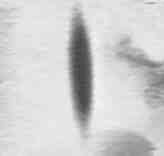

The very last picture taken by Phobos 2
The last transmission from Phobos 2 was a photograph of a gigantic cylindrical 'spaceship', approx, 20km long, 1.5km that was photographed on 25 March 1989 next to the Martian moon Phobos by the Soviet unmanned probe Phobos 2. After the last frame was radio-transmitted back to Earth, the Russian probe mysteriously disappeared.
Now what do you think of this? As for me, I've an open mind!
www.ufos-aliens.co.uk...
Very interesting, I have a question....is there any way of finding out the shutter speed of the camera...as it could be a small object that appears
larger because the shutter is open longer....does that make sense?!
Good find, I have never heard of this before, I have a pretty open mind about it myself but as always I just wish things were a bit clearer in the
images.
Originally posted by ParaNana
Very interesting, I have a question....is there any way of finding out the shutter speed of the camera...as it could be a small object that appears larger because the shutter is open longer....does that make sense?!
Anything that moves while the shutter is open will record as a blur on the film; therefore the shutter controls movement. A fast shutter speed will freeze movement, while a slow shutter speed will not.
If the shutter is open for a longer time (slow shutter speed), the object will look brighter. It has no affect on the size of the object.
In a nutshell, shutter speed only controls movement and the brightness. not the size of the object.
The story you linked to suggests that the shadow on the surface comes from the cigar shaped object
yet the shape is very different..
[edit on 6-9-2006 by errorist]
The cigar shaped craft in the penultimate frame taken by Phobos 2 is apparently the object casting the oblong shadow on the surface of Mars in the earlier photo.
yet the shape is very different..
[edit on 6-9-2006 by errorist]
I dimly remember reading about some images which got got shots of both Martian moons, but one was badly distorted; this might be one of those. There
was also something about getting a picture of one of the moons with Mars in the background.
This page has photos of Martian eclipse shadows:
www.msss.com...
and mentions Phobos 2 specifically.
A full set of processed images is here
astrosurf.com...
but if anyone wants to analyze the images themselves, the raw data from the Phobos 2 mission is actually publically available -- I'd take a look, but it's Granny's 90th birthday and we gotta leave for dinner.
nssdcftp.gsfc.nasa.gov...
www.ias.u-psud.fr...
The effective shutter speed data should be in there, too.
This page has photos of Martian eclipse shadows:
www.msss.com...
and mentions Phobos 2 specifically.
Originally posted by ParaNana
is there any way of finding out the shutter speed of the camera...
A full set of processed images is here
astrosurf.com...
but if anyone wants to analyze the images themselves, the raw data from the Phobos 2 mission is actually publically available -- I'd take a look, but it's Granny's 90th birthday and we gotta leave for dinner.
nssdcftp.gsfc.nasa.gov...
www.ias.u-psud.fr...
The effective shutter speed data should be in there, too.
new topics
-
Man sets himself on fire outside Donald Trump trial
Mainstream News: 6 minutes ago -
Biden says little kids flip him the bird all the time.
2024 Elections: 12 minutes ago -
The Democrats Take Control the House - Look what happened while you were sleeping
US Political Madness: 48 minutes ago -
Sheetz facing racial discrimination lawsuit for considering criminal history in hiring
Social Issues and Civil Unrest: 53 minutes ago -
In an Historic First, In N Out Burger Permanently Closes a Location
Mainstream News: 2 hours ago -
MH370 Again....
Disaster Conspiracies: 3 hours ago -
Are you ready for the return of Jesus Christ? Have you been cleansed by His blood?
Religion, Faith, And Theology: 5 hours ago -
Chronological time line of open source information
History: 6 hours ago -
A man of the people
Diseases and Pandemics: 8 hours ago -
Ramblings on DNA, blood, and Spirit.
Philosophy and Metaphysics: 8 hours ago
top topics
-
Israeli Missile Strikes in Iran, Explosions in Syria + Iraq
World War Three: 16 hours ago, 18 flags -
In an Historic First, In N Out Burger Permanently Closes a Location
Mainstream News: 2 hours ago, 14 flags -
Thousands Of Young Ukrainian Men Trying To Flee The Country To Avoid Conscription And The War
Other Current Events: 13 hours ago, 7 flags -
Iran launches Retalliation Strike 4.18.24
World War Three: 16 hours ago, 6 flags -
The Democrats Take Control the House - Look what happened while you were sleeping
US Political Madness: 48 minutes ago, 6 flags -
12 jurors selected in Trump criminal trial
US Political Madness: 16 hours ago, 4 flags -
4 plans of US elites to defeat Russia
New World Order: 9 hours ago, 4 flags -
A man of the people
Diseases and Pandemics: 8 hours ago, 4 flags -
Sheetz facing racial discrimination lawsuit for considering criminal history in hiring
Social Issues and Civil Unrest: 53 minutes ago, 2 flags -
Are you ready for the return of Jesus Christ? Have you been cleansed by His blood?
Religion, Faith, And Theology: 5 hours ago, 2 flags
active topics
-
Israeli Missile Strikes in Iran, Explosions in Syria + Iraq
World War Three • 91 • : CarlLaFong -
12 jurors selected in Trump criminal trial
US Political Madness • 60 • : ImagoDei -
The Democrats Take Control the House - Look what happened while you were sleeping
US Political Madness • 12 • : ImagoDei -
Man sets himself on fire outside Donald Trump trial
Mainstream News • 0 • : Mantiss2021 -
Are you ready for the return of Jesus Christ? Have you been cleansed by His blood?
Religion, Faith, And Theology • 16 • : FlyersFan -
MH370 Again....
Disaster Conspiracies • 6 • : KnowItAllKnowNothin -
Biden says little kids flip him the bird all the time.
2024 Elections • 0 • : 5thHead -
4 plans of US elites to defeat Russia
New World Order • 34 • : Oldcarpy2 -
Sheetz facing racial discrimination lawsuit for considering criminal history in hiring
Social Issues and Civil Unrest • 2 • : Hecate666 -
Fossils in Greece Suggest Human Ancestors Evolved in Europe, Not Africa
Origins and Creationism • 71 • : Consvoli
0