It looks like you're using an Ad Blocker.
Please white-list or disable AboveTopSecret.com in your ad-blocking tool.
Thank you.
Some features of ATS will be disabled while you continue to use an ad-blocker.

Boeing v Airbus; latest scores
page: 1share:
Welcome to the 'Global Airliner Market' stadium for the latest International match against these two giant clubs in their quest for the big prize;
*cough* Sorry about that, the Millers won on Monday and I still can't believe it, lol.
In all seriousness the first quarter results for 2006 have been revealed and its a bit of a mixed bag generally, though overall its better news for Boeing.
Here's a breakdown;
Total sales = 246 (rise of 50% on 1st quarter of 2005
Airbus sales = 70 Boeing sales =176
Best selling models, Airbus = A320 family (52), Boeing = 737 family (113)
Models with no new orders this quarter;
Airbus A300/310, A380. Boeing 717, 747-8, 777.
Order backlog market share = Airbus 53%, Boeing 47% (5% swing in Boeings favour since last year). Total backlog up 50% on last year.
delivery backlog; Airbus = 2,146. Boeing 1,887.
Individual types with biggest order backlog for each company are; A320 (1,626) and 737 (1,177)
Production output
Airbus = up 18%, Boeing = up 40%
deliveries = Airbus 101, Boeing = 99
In summary, Airbus just about remains in the driving seat but Boeing has made huge strides in the last 12 months and will be confident of retaking pole position within the next 12 months, however rumours of Airbus' impending demise are severely exaggerrated
[edit on 19-4-2006 by waynos]
*cough* Sorry about that, the Millers won on Monday and I still can't believe it, lol.
In all seriousness the first quarter results for 2006 have been revealed and its a bit of a mixed bag generally, though overall its better news for Boeing.
Here's a breakdown;
Total sales = 246 (rise of 50% on 1st quarter of 2005
Airbus sales = 70 Boeing sales =176
Best selling models, Airbus = A320 family (52), Boeing = 737 family (113)
Models with no new orders this quarter;
Airbus A300/310, A380. Boeing 717, 747-8, 777.
Order backlog market share = Airbus 53%, Boeing 47% (5% swing in Boeings favour since last year). Total backlog up 50% on last year.
delivery backlog; Airbus = 2,146. Boeing 1,887.
Individual types with biggest order backlog for each company are; A320 (1,626) and 737 (1,177)
Production output
Airbus = up 18%, Boeing = up 40%
deliveries = Airbus 101, Boeing = 99
In summary, Airbus just about remains in the driving seat but Boeing has made huge strides in the last 12 months and will be confident of retaking pole position within the next 12 months, however rumours of Airbus' impending demise are severely exaggerrated
[edit on 19-4-2006 by waynos]
Notice how Airbus depends on the small plane market the A320, while Boeing has wiping the medium-large market segment. This is important because it is
the most profitable for both.
Airbus is having problems with the A330 that is getting old. Its replacement the A350 is being bombarded by criticism of being an old plane with new engines. Some are suggesting to drop the design completely and start from zero, meaning that for a while that segment will be left exclusively to Boeing. The New 787 Dreamliner the replacement for the 767 is winning contracts all over the world. The A340 never lived to its promises and with a big fuel consumption is getting trashed by the 777.
So things at Airbus are getting even more complicated
Airbus is having problems with the A330 that is getting old. Its replacement the A350 is being bombarded by criticism of being an old plane with new engines. Some are suggesting to drop the design completely and start from zero, meaning that for a while that segment will be left exclusively to Boeing. The New 787 Dreamliner the replacement for the 767 is winning contracts all over the world. The A340 never lived to its promises and with a big fuel consumption is getting trashed by the 777.
So things at Airbus are getting even more complicated
Notice how Airbus depends on the small plane market the A320, while Boeing has wiping the medium-large market segment.
How do you get that? The biggest sellers for both companies, the A320 and 737, are directly comparable with each other.
The A340 never lived to its promises and with a big fuel consumption is getting trashed by the 777.
Although you are right in that the A340 should have done much better in the market than it did, how do you get that it has 'big fuel consumption'? It was the most fuel efficient airliner in the world until Boeing tweaked the 777.
One other factor The A320 and 737 are heading intot hier twighlight years as it were and replacements may soon loom on the horizon. Both depend on the
narrow body sales as much as thier big ones.
I agree that the A340 (I actually like this one as im a sucker for winglets and anything that kind of looks like a 707) as well as the first gen 777 variants -200, -200ER, and perhaps even the 300 are dead they just have not claimed the body.
Edit: Waynos, is AB's backlog all confirmed orders or are they factoring in commitments as well?
[edit on 4/19/06 by FredT]
I agree that the A340 (I actually like this one as im a sucker for winglets and anything that kind of looks like a 707) as well as the first gen 777 variants -200, -200ER, and perhaps even the 300 are dead they just have not claimed the body.
Edit: Waynos, is AB's backlog all confirmed orders or are they factoring in commitments as well?
[edit on 4/19/06 by FredT]
The backlogs are for confirmed secure orders only for both companies. I also omitted to include that Boeing has suffered no cancellations this quarter
while Airbus has had 18 A320's and 2 A330's cancelled, the actual number of orders taken was 90 but ithe figure of 70 I gave was the net total after
these cancellations. Sorry for that oversight.
I will give the actual order break down by type as I have it here;
Airbus = delivered / new orders / TOTAL backlog at end Q1 [/I]
A300/310 = 3 / 0 / 17
A320 family = 78 / 52(net) / 1,626
A330 = 16 / 2(net) / 172
A340 = 4 / 3 / 72
A350 = 0 / 13 / 100
A380 = 0 / 0 / 159
Boeing
717 = 2 / 0 / 3
737 = 72 / 116 / 1,177
747-400 = 4 / 2 / 42
747-8 =0 / 0 / 18
767 = 3 / 4 / 31
777 = 17 / 0 / 271
787 = 0 / 54 / 345
[edit on 20-4-2006 by waynos]
[edit on 20-4-2006 by waynos]
I will give the actual order break down by type as I have it here;
Airbus = delivered / new orders / TOTAL backlog at end Q1 [/I]
A300/310 = 3 / 0 / 17
A320 family = 78 / 52(net) / 1,626
A330 = 16 / 2(net) / 172
A340 = 4 / 3 / 72
A350 = 0 / 13 / 100
A380 = 0 / 0 / 159
Boeing
717 = 2 / 0 / 3
737 = 72 / 116 / 1,177
747-400 = 4 / 2 / 42
747-8 =0 / 0 / 18
767 = 3 / 4 / 31
777 = 17 / 0 / 271
787 = 0 / 54 / 345
[edit on 20-4-2006 by waynos]
[edit on 20-4-2006 by waynos]
Great information as usual Waynos.
Sad to see the 717 dying. I wish it had caught on. Hawaiian has them and they're a nice plane to fly on. One of the quietest planes I've ever flown on.
Here is some interesting info on the 737 family, and the future.
www.b737.org.uk...
Sad to see the 717 dying. I wish it had caught on. Hawaiian has them and they're a nice plane to fly on. One of the quietest planes I've ever flown on.
Here is some interesting info on the 737 family, and the future.
The -900ER (formerly known as the -900X) will have the same length fuselage as the -900 but will have seating for up to 215 passengers. The increase in pax capacity has been achieved by adding a pair of Type II doors aft of the wing for passenger evacuation regulations and installing a new flattened aft pressure bulkhead which would add an extra fuselage frame (approx 1 row of seats) of cabin space. The flat bulkhead will become standard on all 737's from 2006 and the Type II door will be standard on all series 900's although operators may choose to have it deactivated.
Range is increased to 3,200nm with the addition of two 1,970ltr aux fuel tanks (or 2,800nm without aux tanks) and optional winglets. The 900ER will have reinforced landing gear legs, wing-box and keel beam structure to handle the increased MTOW of 85,200kg. Take-off and landing speeds (and hence field length) are reduced by the short field performance improvement package originally developed for the 737-800, this is standard on all 737-900ER's. MZFW will be 67,800kg & MLW 71,400kg, making it similar in weight to the 727 and the brakes will be upgraded as a consequence.
Announced on 26 Jan 2006, the Signals Intelligence (SIGINT) will be based on the MMA airframe. It will be used for airborne intelligence, surveillance and reconnaissance, and also advanced network centric communications.
The Boeing 737 SIGINT variant will have increased mission capability, operational readiness and combat radius relative to legacy aircraft. The design also has built-in growth capacity so payload capacity can easily be increased or upgraded to accommodate future customer requirements.
"A key advantage of this new program is that the 737 SIGINT aircraft will leverage the P-8A's advanced mission system architecture, mature design, and contractor logistics support and training systems approach. For customers that means reduced operating and maintenance costs over the entire life cycle of the system."
The Yellowstone 1 (Y-1) is the project name for the 737 replacement. The family is believed to be comprised of three models which will seat 120, 150 and 190. It will be a whole new aircraft rather than a further 737 derivative and will use much of the systems, structural & design technology of the 787.
Boeing Commercial Airplanes Chief Executive, Alan Mulally, said the new jet program must provide technological advances that will make the 737 obsolete. They will come from a new engine and from the next generation of Boeing composites technology, incorporating the lessons learned from initial 787 manufacture, he said.
Mulally said Boeing may have a 737 replacement in service as early as 2012, which would imply a development-program launch in 2008 or 2009.
www.b737.org.uk...
One thing that struck me as odd, regarding Boeing, was how the 727 was replaced by the 757, which was then itself replaced by the 737! Why was a
stretched 737 not produced in the first place?
Also, the 757 originally had the same nose as the 727/737 (which they both inherited unchanged externally from the 707) but Boeing felt the need to replace it with a new, more spacious nose design with a larger windscreen (see diagram below), therefore why doesn't the new generation 737 use the supposedly superior nose of the 757?
I hope the boeing mafia don't take this as criticism, I just find it puzzling
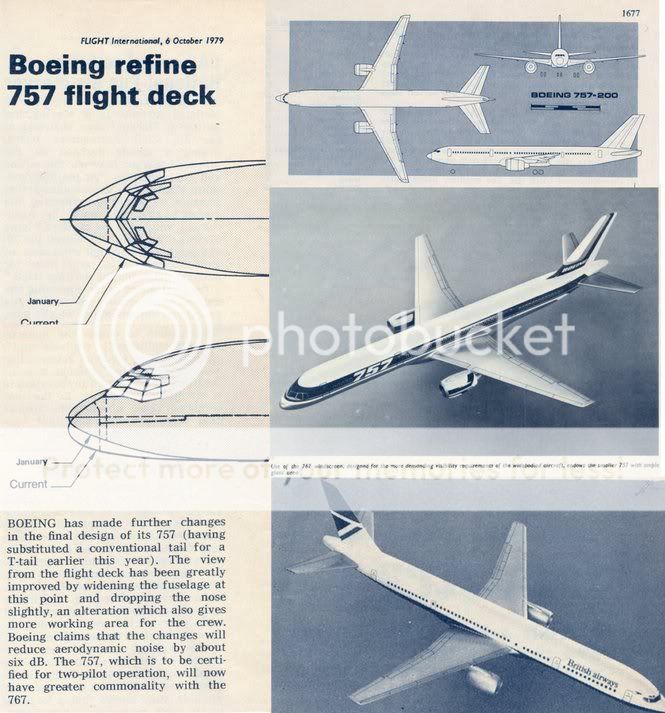
[edit on 20-4-2006 by waynos]
Also, the 757 originally had the same nose as the 727/737 (which they both inherited unchanged externally from the 707) but Boeing felt the need to replace it with a new, more spacious nose design with a larger windscreen (see diagram below), therefore why doesn't the new generation 737 use the supposedly superior nose of the 757?
I hope the boeing mafia don't take this as criticism, I just find it puzzling
[edit on 20-4-2006 by waynos]
As I said elsewhere, its all immaterial as in 5 years time, both companies will be neck deep in the brown stuff.
Neither Boeing or Airbus has anything on the drawing board for alternative energy supply.
Neither Boeing or Airbus has anything on the drawing board for alternative energy supply.
Like what, solar? And neither boeing or airbus makes engines, wouldn't that be up to the engine suppliers to do? There really isn't an alternative
energy source when it comes to aircraft NOTHING can make the power for the weight as oil.
Well the engine manufacturers are only "subcontractors". Since many possible alternative propulsion aircraft would also call for significant design
changes, the incentive should come from the aircraft business.
In the case of a rapid downfall of the aircraft industry a real advantage for Airbus is that Germany and France (along Japan) are the definitive leaders in train and maglev technology. I´d say that Airbus could convert part of its assets into a supporting industry for that market.
[edit on 20/4/2006 by Lonestar24]
In the case of a rapid downfall of the aircraft industry a real advantage for Airbus is that Germany and France (along Japan) are the definitive leaders in train and maglev technology. I´d say that Airbus could convert part of its assets into a supporting industry for that market.
[edit on 20/4/2006 by Lonestar24]
Well Waynos here are some articles about the 777 vs. A340 aka 'the gas guzzler'
Boeing Roars Ahead - Business Week
More
news.monstersandcritics.com...
Now look at the official stats for Airbus and Boeing regarding 2005. Focus on the wide-body segment.
Boeing.
717 737 747 767 777 787 Total
Gross Orders (does not include cancellations or conversions)
- 574 48 19 153 235 1029
AIRBUS 2005 RESULTS
Aircraft orders in 2005 (gross)
A318/A319/A320/A321 918
A300/A310 7
A330/A340/350 166
A380 20
Total 1,111
Now, of that only 15 orders were for the A340. 87 were for the A350. The rest were for the A330.
So if we add up the 767+777+787 orders it totals 407 against Airbus 166.
And if we only compare the A340 against the T7 its 15 vs. 153.
[edit on 20-4-2006 by carcharodon]
Boeing Roars Ahead - Business Week
Boeing's resurgence comes at a time when Airbus is stalling badly. Delivery delays of its 555-seat A380 super-jumbo jet have angered key customers. And an inability to settle on the final design of its new A350 has given the 787 and 777 an even bigger head start. More troubling yet for Airbus: Its four-engine A340 is deemed a gas guzzler. "Boeing sees Airbus as weak, and they're right," says Doug McVitie, an aerospace consultant who used to work for the European jetmaker. "Airbus has had a terrible year."
More
news.monstersandcritics.com...
Boeing is counting on continuing strong sales of its 787 Dreamliner, 747 Advance and long-range 777s. Last year Boeing received orders for 154 of the 777s, 43 of the 747s and 235 Dreamliners.
Now look at the official stats for Airbus and Boeing regarding 2005. Focus on the wide-body segment.
Boeing.
717 737 747 767 777 787 Total
Gross Orders (does not include cancellations or conversions)
- 574 48 19 153 235 1029
AIRBUS 2005 RESULTS
Aircraft orders in 2005 (gross)
A318/A319/A320/A321 918
A300/A310 7
A330/A340/350 166
A380 20
Total 1,111
Now, of that only 15 orders were for the A340. 87 were for the A350. The rest were for the A330.
So if we add up the 767+777+787 orders it totals 407 against Airbus 166.
And if we only compare the A340 against the T7 its 15 vs. 153.
[edit on 20-4-2006 by carcharodon]
But there's no logic in the statement. The simple phrase 'is deemed a gas guzzler' cannot be counted as indelible proof. Look, I agree that the
A340's time is past, brought about by the new generation of powerful but frugal big fans. Apart from the 787, that is also why there is no four
engine variant of the A350 on offer specifically to replace the 340, it is unnecessary.
My point is simply that just because the plane that was the most fuel efficient in the world a few years ago has now been surpassed doesn't justify the use of the term 'gas guzzler'. The A340 didn't suddenly get worse, the competition got better. If the A340 is a gas guzzler, for instance, then so is every single other airliner model currently in production in the world except for the one model of 777 that betters it, you see?
It reminds me of the road test articles you get in car mags, a car that has been praised as the 'very best' all year gets surpassed by a new model and all of a sudden all references to it in the mag say it is 'ageing' and/or 'creaky'. I think 'hang on, it was brilliant in last weeks edition, how did it get 'creaky' all of a sudden in the last 7 days?' Thats all I was referring to in that instance. The terminology used is greatly exaggerated to make an otherwise valid point, namely that efficient twins like the forthcoming 787 and A350 make the A340 superfluous for tomorrows market.
Also, in your own figures, the 737 accounts for more than half of Boeings total sales for 2005. Thats what I was saying, the 737 and A320 are the best selling models. Your figures don't contradict that.
They show that Boeings latest 777 and 787 are outselling their Airbus equivalents but we already knew that.
Doesn't anyone have an answer to my 757 question above? (someone more intelligent than the moron who added the 'Airbus sucks' tag please)
[edit on 20-4-2006 by waynos]
My point is simply that just because the plane that was the most fuel efficient in the world a few years ago has now been surpassed doesn't justify the use of the term 'gas guzzler'. The A340 didn't suddenly get worse, the competition got better. If the A340 is a gas guzzler, for instance, then so is every single other airliner model currently in production in the world except for the one model of 777 that betters it, you see?
It reminds me of the road test articles you get in car mags, a car that has been praised as the 'very best' all year gets surpassed by a new model and all of a sudden all references to it in the mag say it is 'ageing' and/or 'creaky'. I think 'hang on, it was brilliant in last weeks edition, how did it get 'creaky' all of a sudden in the last 7 days?' Thats all I was referring to in that instance. The terminology used is greatly exaggerated to make an otherwise valid point, namely that efficient twins like the forthcoming 787 and A350 make the A340 superfluous for tomorrows market.
Also, in your own figures, the 737 accounts for more than half of Boeings total sales for 2005. Thats what I was saying, the 737 and A320 are the best selling models. Your figures don't contradict that.
They show that Boeings latest 777 and 787 are outselling their Airbus equivalents but we already knew that.
Doesn't anyone have an answer to my 757 question above? (someone more intelligent than the moron who added the 'Airbus sucks' tag please)
[edit on 20-4-2006 by waynos]
The offending tag has been removed.
Back on topic: The 757 nose? Perhaps the cost of refitting the line would have cut into the profit margins?
Back on topic: The 757 nose? Perhaps the cost of refitting the line would have cut into the profit margins?
I'll post something on it later Waynos. I'm only here to catch up, then I gotta get back to packing and getting ready to move. When I have time
later I'll post some of the stuff I've heard.
What you've presented, Waynos, is a snapshot of the present situation between Boeing and Airbust and as such is not particularly informative.
You've failed to mention (conveniently?) is the *trend*. That trend does not favor Airbust. The 380 is overweight, a LONG way from break even
(even using Airbust's accounting) and an answer to a question no one is asking. Additonally, from most reports the 320 will need an extensive
redesign. That's the sort to thing that is not likely to stimulate additional sales.
What you also ignore is the larger economic context in which this competition plays out. Boeing is based in a country with the most productive work force, robust growth, the largest GDP and per capita GDP. America is not a country hostile to private enterprise or hard work.
Europe, on the other hand, is a faced with stagnant growth, a work force that would rather riot than work and is saddled with confiscatory taxation and hidebound regulation.
That difference represents a sustainable competitive advantage for Boeing and that is the primary reason that Boeing will be the dominant player going froward. But Europe's increasing inability to compete in the global market will claim victims well beyond Airbust.
[edit on 20-4-2006 by El Tiante]
[edit on 20-4-2006 by El Tiante]
What you also ignore is the larger economic context in which this competition plays out. Boeing is based in a country with the most productive work force, robust growth, the largest GDP and per capita GDP. America is not a country hostile to private enterprise or hard work.
Europe, on the other hand, is a faced with stagnant growth, a work force that would rather riot than work and is saddled with confiscatory taxation and hidebound regulation.
That difference represents a sustainable competitive advantage for Boeing and that is the primary reason that Boeing will be the dominant player going froward. But Europe's increasing inability to compete in the global market will claim victims well beyond Airbust.
[edit on 20-4-2006 by El Tiante]
[edit on 20-4-2006 by El Tiante]
Originally posted by waynos
Doesn't anyone have an answer to my 757 question above?
757/767 twins. as they are some times called, were a knee jerk reaction to the oil shocks of the 70's. (they were both born at virtually the same time)
airlines wanted fuel efficient planes both narrow body (all narrow bodied planes are made in renton ) and wide body ( all wide bodied planes are made in everett )
the airlines also wanted commonality between cockpits so training would be quick and simple. it was decided to build two new planes instead of the one new and one updated.
also the 737 was only around 10 years old and selling well when the ideas about new fuel efficient planes were being kicked around so why mess with a good thing
[edit on 21-4-2006 by bigx01]
According to what I've heard, the 757 was built as a "hub and spoke" complement to the 767. It was built to similar standards as the 737-200
(short field ops, etc). At the time, they didn't have the engines capable of being mounted on a 737 that would make it comparable to the 757, so
they had to come up with a new design, instead of stretching the 737. It was meant to be used on routes where they had more capacity than a 737 could
carry at the time, but less than a 767 would carry economically. In later years, the orders were falling off so far, and they had upgraded the
engines and other features of the 737, that they decided to end the 757 line, and stretch the 737-900 to a similar capacity as the 757.
That's just what I've heard though. I wouldn't quote me as being 100% right, and if someone else knows different then I'd like to hear it.
That's just what I've heard though. I wouldn't quote me as being 100% right, and if someone else knows different then I'd like to hear it.
Some interesting points raised and statements made there, deserving of some sort of response so here goes, in order of posting;
I never pretended it was anything else, it is quite clearly labelled as the first quarter results and its relevance is that they are the most up to date figures available. I will also add that putting a 't' on the end of Airbus does not make you Oscar Wilde.
Did you actually read the thing? I'm sure I mentioned a 5% gain overall by Boeing over the last 12 months and that they had made huge strides and also that they could be confident of overtaking Airbus in the near future. If that isn't noting the trend then what is it?
159 aircraft sold with only prototypes in the air, "no-one?" I get from all your previous posts that you hate Airbus with a passion, that is your problem not mine and whatever you say wont make them go away, however much you want them to so save your silly stereotypical pronouncements for somebody else OK? There is a saying round these parts, it goes "If you can't say owt intelligent, say nowt". Ever heard it? (btw 'owt' = anything, nowt = nothing in local speak).
Moving along to the 757 question, thanks guys. My enquiry wasn't so much about why Boeing felt the need to build a 757 (and 767). As you will gather from the picture I posted, I have (or had) all the 'Flight' s of the period and followed the story on a weekly basis, as you do.
No, I am wondering, in retrospect, why an all new 757 was produced to replace the 727 in the 1980's when a stretched 737 does the job now?
This is my point, that it was already established in production and a top seller, also the 737-200 was radically redesigned into the CFM-56 powered 737-300 at this very time so surely a stretched 737-300 (which is the direct equivalent of what the 737-900 is today) would surely have been quicker cheaper and easier than developing the 757? This question never occurred to me at the time, I just figured the 737-300 and 757 made perfect sense. It was only when a stretched 737 replaced the 757 that I thought "hold on a minute?"
Now that may make perfect sense and my bafflement may be a result of my own ignorance but how so?
The CFM-56 was made to fit the 737-300 when it could never have been mounted on the 737-200 so why couldn't the PW2037 or RB211-500 be accomodated by redesign?
*thinks as an afterthought* Could it be because the thrust of the CFM-56 has now reached the same level as those bigger engines but is physically smaller, as it always was?.
My curiosity about the cockpit is a separate question and is based upon the reasons contained in the image as to why it was superior to the 'standard Boeing' nose that was being deleted from the 757 at the design stage.
The thing about it offering cockpit commonality with the 767 is surely as good a reason to use it on the 737 today as it was to use it on the 757 25 years ago?
I thought about the point of the expense of retooling the line too (Fred) but on refelction the tooling for the nose already exits but is now redundant with the closure of the 757 line and the line was retooled for an all new wing anyway. So I'm still wondering about that.
Its not as if I 'passionately' believe that the 757 nose should be used, I am just curious about the decision.
Another afterthought; is there any possibility that it is the 'brand recognition' factor of the 737 that keeps the same nose design and 737 designation in use rather than any engineering reason? After all, apart from the nose the current 737 is virtually new by comparison with older models and the use of the 757 nose would have made it the '787' perhaps (with the 7E7 then becoming the 797 of course)?
What you've presented, Waynos, is a snapshot of the present situation between Boeing and Airbust and as such is not particularly informative.
I never pretended it was anything else, it is quite clearly labelled as the first quarter results and its relevance is that they are the most up to date figures available. I will also add that putting a 't' on the end of Airbus does not make you Oscar Wilde.
You've failed to mention (conveniently?) is the *trend*. That trend does not favor Airbus
Did you actually read the thing? I'm sure I mentioned a 5% gain overall by Boeing over the last 12 months and that they had made huge strides and also that they could be confident of overtaking Airbus in the near future. If that isn't noting the trend then what is it?
The 380 is ......................an answer to a question no one is asking....America is not a country hostile to private enterprise or hard work........Europe, on the other hand, is a faced with stagnant growth, a work force that would rather riot than work.........
159 aircraft sold with only prototypes in the air, "no-one?" I get from all your previous posts that you hate Airbus with a passion, that is your problem not mine and whatever you say wont make them go away, however much you want them to so save your silly stereotypical pronouncements for somebody else OK? There is a saying round these parts, it goes "If you can't say owt intelligent, say nowt". Ever heard it? (btw 'owt' = anything, nowt = nothing in local speak).
Moving along to the 757 question, thanks guys. My enquiry wasn't so much about why Boeing felt the need to build a 757 (and 767). As you will gather from the picture I posted, I have (or had) all the 'Flight' s of the period and followed the story on a weekly basis, as you do.
No, I am wondering, in retrospect, why an all new 757 was produced to replace the 727 in the 1980's when a stretched 737 does the job now?
lso the 737 was only around 10 years old and selling well when the ideas about new fuel efficient planes were being kicked around so why mess with a good thing
This is my point, that it was already established in production and a top seller, also the 737-200 was radically redesigned into the CFM-56 powered 737-300 at this very time so surely a stretched 737-300 (which is the direct equivalent of what the 737-900 is today) would surely have been quicker cheaper and easier than developing the 757? This question never occurred to me at the time, I just figured the 737-300 and 757 made perfect sense. It was only when a stretched 737 replaced the 757 that I thought "hold on a minute?"
t the time, they didn't have the engines capable of being mounted on a 737 that would make it comparable to the 757
Now that may make perfect sense and my bafflement may be a result of my own ignorance but how so?
The CFM-56 was made to fit the 737-300 when it could never have been mounted on the 737-200 so why couldn't the PW2037 or RB211-500 be accomodated by redesign?
*thinks as an afterthought* Could it be because the thrust of the CFM-56 has now reached the same level as those bigger engines but is physically smaller, as it always was?.
My curiosity about the cockpit is a separate question and is based upon the reasons contained in the image as to why it was superior to the 'standard Boeing' nose that was being deleted from the 757 at the design stage.
The thing about it offering cockpit commonality with the 767 is surely as good a reason to use it on the 737 today as it was to use it on the 757 25 years ago?
I thought about the point of the expense of retooling the line too (Fred) but on refelction the tooling for the nose already exits but is now redundant with the closure of the 757 line and the line was retooled for an all new wing anyway. So I'm still wondering about that.
Its not as if I 'passionately' believe that the 757 nose should be used, I am just curious about the decision.
Another afterthought; is there any possibility that it is the 'brand recognition' factor of the 737 that keeps the same nose design and 737 designation in use rather than any engineering reason? After all, apart from the nose the current 737 is virtually new by comparison with older models and the use of the 757 nose would have made it the '787' perhaps (with the 7E7 then becoming the 797 of course)?
They had to make several major changes to the engines before they would fit on the 737-300. The gearbox, and several other pieces of engine that are
normally located on the bottom of the engine were moved to the side. That's why the engine has that flattened look to the bottom of it. IIRC that
is the only engine ever built that made those changes, because the plane sits too low for the engines to fit if they didn't.
Sure zaphod, I rememeber that, thanks But couldn't it have been done with the others too? Or maybe the 737 could have been jacked up a bit? I'm
not arguing with you btw, I greatly respect what you say, I just can't really see this as being a reason to design an all new aeroplane.
I was wondering if off the street might know, but if I remember correctly he was working for McDonnell Douglas previously and Boeing inherited him in the takeover?
[edit on 21-4-2006 by waynos]
I was wondering if off the street might know, but if I remember correctly he was working for McDonnell Douglas previously and Boeing inherited him in the takeover?
[edit on 21-4-2006 by waynos]
new topics
-
Las Vegas UFO Spotting Teen Traumatized by Demon Creature in Backyard
Aliens and UFOs: 26 minutes ago -
2024 Pigeon Forge Rod Run - On the Strip (Video made for you)
Automotive Discussion: 1 hours ago -
Gaza Terrorists Attack US Humanitarian Pier During Construction
Middle East Issues: 1 hours ago -
The functionality of boldening and italics is clunky and no post char limit warning?
ATS Freshman's Forum: 2 hours ago -
Meadows, Giuliani Among 11 Indicted in Arizona in Latest 2020 Election Subversion Case
Mainstream News: 3 hours ago -
Massachusetts Drag Queen Leads Young Kids in Free Palestine Chant
Social Issues and Civil Unrest: 3 hours ago -
Weinstein's conviction overturned
Mainstream News: 4 hours ago -
Supreme Court Oral Arguments 4.25.2024 - Are PRESIDENTS IMMUNE From Later Being Prosecuted.
Above Politics: 6 hours ago -
Krystalnacht on today's most elite Universities?
Social Issues and Civil Unrest: 6 hours ago -
Chris Christie Wishes Death Upon Trump and Ramaswamy
Politicians & People: 7 hours ago
top topics
-
Krystalnacht on today's most elite Universities?
Social Issues and Civil Unrest: 6 hours ago, 8 flags -
Weinstein's conviction overturned
Mainstream News: 4 hours ago, 6 flags -
University of Texas Instantly Shuts Down Anti Israel Protests
Education and Media: 9 hours ago, 6 flags -
Supreme Court Oral Arguments 4.25.2024 - Are PRESIDENTS IMMUNE From Later Being Prosecuted.
Above Politics: 6 hours ago, 5 flags -
Massachusetts Drag Queen Leads Young Kids in Free Palestine Chant
Social Issues and Civil Unrest: 3 hours ago, 4 flags -
Meadows, Giuliani Among 11 Indicted in Arizona in Latest 2020 Election Subversion Case
Mainstream News: 3 hours ago, 4 flags -
Chris Christie Wishes Death Upon Trump and Ramaswamy
Politicians & People: 7 hours ago, 2 flags -
Any one suspicious of fever promotions events, major investor Goldman Sachs card only.
The Gray Area: 11 hours ago, 2 flags -
Gaza Terrorists Attack US Humanitarian Pier During Construction
Middle East Issues: 1 hours ago, 2 flags -
2024 Pigeon Forge Rod Run - On the Strip (Video made for you)
Automotive Discussion: 1 hours ago, 1 flags
active topics
-
The functionality of boldening and italics is clunky and no post char limit warning?
ATS Freshman's Forum • 9 • : JonnyC555 -
Las Vegas UFO Spotting Teen Traumatized by Demon Creature in Backyard
Aliens and UFOs • 2 • : Ophiuchus1 -
Candidate TRUMP Now Has Crazy Judge JUAN MERCHAN After Him - The Stormy Daniels Hush-Money Case.
Political Conspiracies • 783 • : Threadbarer -
Gaza Terrorists Attack US Humanitarian Pier During Construction
Middle East Issues • 19 • : Consvoli -
Sunak spinning the sickness figures
Other Current Events • 21 • : Xtrozero -
Nearly 70% Of Americans Want Talks To End War In Ukraine
Political Issues • 87 • : Xtrozero -
University of Texas Instantly Shuts Down Anti Israel Protests
Education and Media • 187 • : Irishhaf -
God's Righteousness is Greater than Our Wrath
Religion, Faith, And Theology • 30 • : confuzedcitizen -
Chris Christie Wishes Death Upon Trump and Ramaswamy
Politicians & People • 19 • : DontTreadOnMe -
Supreme Court Oral Arguments 4.25.2024 - Are PRESIDENTS IMMUNE From Later Being Prosecuted.
Above Politics • 60 • : Annee