It looks like you're using an Ad Blocker.
Please white-list or disable AboveTopSecret.com in your ad-blocking tool.
Thank you.
Some features of ATS will be disabled while you continue to use an ad-blocker.

Pyramids at Giza were there BEFORE the Egyptians got there.
page: 7share:
Chris:
I understand what you're saying, which is exactly my point in all of this. Something, rather a LOT of things do not make any sense. The current possessors of the TRUE history are keeping it hidden from the general public for some reason, and I can't possibly understand what that might be, aside from keeping us subserviant.
It stands to reason, to me anyway, that if they wanted to keep the people listening to them, that they would do everything they could to keep the history that could free the people from the bonds that bind them from reaching their hands.
In other words, they would prevent that information from getting out because they know that if it ever did, that the people would no longer have any reason to listen to them. I think the information being held, if there is indeed any, is such that it could do those things, and even greater things which we cannot yet imagine. Hence the need for utmost secrecy.
TheBorg
I understand what you're saying, which is exactly my point in all of this. Something, rather a LOT of things do not make any sense. The current possessors of the TRUE history are keeping it hidden from the general public for some reason, and I can't possibly understand what that might be, aside from keeping us subserviant.
It stands to reason, to me anyway, that if they wanted to keep the people listening to them, that they would do everything they could to keep the history that could free the people from the bonds that bind them from reaching their hands.
In other words, they would prevent that information from getting out because they know that if it ever did, that the people would no longer have any reason to listen to them. I think the information being held, if there is indeed any, is such that it could do those things, and even greater things which we cannot yet imagine. Hence the need for utmost secrecy.
TheBorg
Silly Lemmings...
The Great pyramid was not built as a tomb, but as an initiation chamber. You entered "as a man" and left "as a God" The sarcophagus was a place where the initiate laid inside for a spiritual "rebirth"
Moses raised as son of Pharoah went through this rite..
Jesus spent most of his early years "studying" in Egypt..
The pyramids were built by levitation.. pure and simple.. its stated in many egyptian legends, but archeologists and scholars write that off as "old wive's tales"
Note this applies to the big set the rest around Egypt were built much later and were copies. These WERE built by man the old fashioned way of hard labour and sweat.
There now you have the answers... so you can stop all the squabbling
Very Silly Lemmings
The Great pyramid was not built as a tomb, but as an initiation chamber. You entered "as a man" and left "as a God" The sarcophagus was a place where the initiate laid inside for a spiritual "rebirth"
Moses raised as son of Pharoah went through this rite..
Jesus spent most of his early years "studying" in Egypt..
The pyramids were built by levitation.. pure and simple.. its stated in many egyptian legends, but archeologists and scholars write that off as "old wive's tales"
Note this applies to the big set the rest around Egypt were built much later and were copies. These WERE built by man the old fashioned way of hard labour and sweat.
There now you have the answers... so you can stop all the squabbling
Very Silly Lemmings
Originally posted by Shane
Originally posted by Allred5923
home.c2i.net...
WoW. That is an interesting Link, to say the least.
Quite a tale.
I have difficulties believing this represents a Truth, but it does explain why we have these similiar structures all over the world.
It also gives the ability for Atlantis to have "influenced" all parts of this planet.
And I thought I HAD STRANGE NOTIONS!
Anyways, thanks for offering it for review.
Ciao
Shane
That's a seriously wild story there. Has anybody else read this? Is it fiction? I'm guessing it has to be, right?
Originally posted by lostinspace
Here's a theory to sink your teeth into:
The father of the ancient Egyptians and the African race was known as Ham from the Hebrew legends. Ham could have been known as Chamu Chufu to the Egyptians. Ham was possibly an expert in the field of astronomy until the day of his death. I have reason to believe that the three pyramids of Egypt were built to his wishes, aligned with Orion's Belt, but not according to the "Belt" we see today. The three pyramids are markers aligned with Orion's Belt as they were positioned before the Great Deluge. The planet changed its axis while the world was over flowing with rain. The reason why the axis had to change was because the solar system lost one primary planet next door to Earth.
The morning of the day of the Great Deluge, which happened at midnight that evening, one of the inhabitants of the Ark proclaimed, "All night we watched the heavens and in the morning saw the sun rise, red and blazing, above the parched valley. Four drops from the clepsydra marked his increasing tardiness."
The night before, the moon was late in rising. One of the Arks inhabitants said the moon should have arived within forty drops of the clepsydra, but it took at least forty plus three more. If a city in the northern hemisphere was too be tilted away from the sun, it would appear that the sun was later in rising and earlier in setting from the previous position as is described.
However, weeks earlier this individual noticed a missing star, most notably one of the roving stars.
en.wikipedia.org...
On a fun note: What movie am I?
A thousand years ago the crystal cracked, a piece of the crystal was lost.
Two new races appeared, the cruel Skeksis and the gentle urRu. The land was ravaged all this time and there was only disparity. However, the Great Conjunction of the three suns was nearing at the end of the thousand years. Jen, the chosen one of the Gelflings was prophesied to return the crystal shard back to the whole crystal, restoring order while bringing back the pure land. A great sacrifice was demanded because the cruel Skeksis sought out to destroy all of his kind to cancel out the prophesy. He was the only one left of his race in the end. Or was he?
Yes blacks were the first version of humans, adam ( meaning he who can blush red ) was about the white man being created, version 2.0. Egyptians did
not build the pyramids. Evidence points to shaman, the magi (like peoples) & fallen devs (angels). Like it or not....
Originally posted by zorgon
Silly Lemmings...
The Great pyramid was not built as a tomb, but as an initiation chamber. You entered "as a man" and left "as a God" The sarcophagus was a place where the initiate laid inside for a spiritual "rebirth"
Don't think so. Have you ever been inside that place? 12 men with torches for lights would have snuffed out the oxygen in that chamber within 30 minutes. It's small, it's stuffy, and there was no ventilation until recently. Hauling a team of people down there for an initation only to drop unconscious by the second invocation makes for a really bad initiation.
Moses raised as son of Pharoah went through this rite..
Jesus spent most of his early years "studying" in Egypt..
No proof of either, actually. There's no recorded son named Moses and I think Christians will argue fiercely with you that Jesus spent his youth in the area of Bethlehem. In fact, a number of the ancient gnostic gospels (from about 100 AD) have tales of Jesus' childhood... in Bethlehem.
The pyramids were built by levitation.. pure and simple.. its stated in many egyptian legends, but archeologists and scholars write that off as "old wive's tales"
I'm familiar with old Egyptian legends. So... tell me which ones, please, mention that the pyramids were built by levitation. We'll look them up and see if they're genuine old legends or if they're something someone "channeled" in 1900 or so.
Darn!
I was hoping for reams of papers proving me wrong
Not just counter hearsay
Now I have to go do my own homework again [walks off kicking a can...]
I was hoping for reams of papers proving me wrong
Not just counter hearsay
Now I have to go do my own homework again [walks off kicking a can...]
www.theforbiddenknowledge.com...
Very interesting read this. Not saying it is true or false info, just interesting
Very interesting read this. Not saying it is true or false info, just interesting
Canadian and Swansea (Wales UK) researchers affiliated to the Ambilac Corporation (To Search for the truth) have combined resources to analyze and interpret the ultimate meaning of the Giza Plateau Pyramid complex Near Cairo Egypt.
Genesis is the most complex, interwoven coded piece of literature ever written, in which we concluded there were three levels of work, the third level of which is the revealing of man's genetic code. In addition, it was concluded that whoever wrote the book of Genesis had; a) constructed the pyramid complex at Giza, and/or b) possessed intimate knowledge of the blueprint from which the complex was constructed. The research group also presented the thesis that the earth was conceived by two sets of lineage, the first was our solar sun, while the second is the mathematical set of the six identified in the Bible as ADAM, SETH, ENOSH, CAINAN, MAHALALEL, and JARED. ADAM being our point of origin in our 'star map' - zero degrees. E.g. ADAM (Terah) from Alcyone in the Pleiades, Abram our sun and Abraham planet earth. It is from this point that an explanation is offered towards an understanding of our very origins and what is about to occur with the precursory event on May 5th 2000.
BlackGuardXIII the reason I bother, is because I hope one day people will pay attention.
This thread is filled with website and blog after each other. However, none of them have conducted any research into the pyramids. It is odd that a site aiming to be credit for being filled with intelligent people would survive just on opinion. This is not the way it should be conducted but nobody can ever post a credible theory against what I or Byrd and many others reference. It's not a case of if we agree with them or not. However, opinion should never be on a topic like this.
The title clearly says: Pyramids at Giza were there BEFORE the Egyptians got there. so some EVIDENCE needs to be displayed. The burden of proof is on those who make such claims, not on those who don't believe. However, is there any given? As per-normal no and worse yet, for those who do believe such things every thread like this sets out to damage what they are intending to proove.
This thread is filled with website and blog after each other. However, none of them have conducted any research into the pyramids. It is odd that a site aiming to be credit for being filled with intelligent people would survive just on opinion. This is not the way it should be conducted but nobody can ever post a credible theory against what I or Byrd and many others reference. It's not a case of if we agree with them or not. However, opinion should never be on a topic like this.
The title clearly says: Pyramids at Giza were there BEFORE the Egyptians got there. so some EVIDENCE needs to be displayed. The burden of proof is on those who make such claims, not on those who don't believe. However, is there any given? As per-normal no and worse yet, for those who do believe such things every thread like this sets out to damage what they are intending to proove.
some good oldfashioned scientific and logical thinking.
Instead of faith, hope or beliefs.
Using as many facts as can be collected, and a few pretty good deductions.
First we have a look at dr Hawass's website, where he announces the latests discoveries on the Giza Plateau. They found indications of a ramp, a quarry, and a harbor and canals.
www.guardians.net...
Please read on what dr Hawass discovered more, to get a good impression about their latests finds.
I'm interested to what purpose the 40 cm round holes were cut in the bedrock around the base of the temples. They lay about 9.50 meters from its base, and were spaced about 5 meters apart.
Nowadays bricklayers still use level-lines to keep their rows of bricks at a horizontal level. They also use plumbs to find the perfect vertical level. The egyptians could have used those 40 cm diameter holes to plant stakes in, to hang lines over the pyramid base, and use their triangle+indicator-plumbs to level the lines to the horizontal level and the height of the first rows of core blocks.
Then lifted the lines up to the second level of blocks. And so on.
This last remark indicates another problem during construction, how to overcome the steeper growing depth of the quarry and the labour involved to get the blocks out of the quarry.
Probably the architects extended the ramp which delivered the blocks to the pyramid construction site, into one side of the quarry. They probably first started to dig that ramp deep into the quarry site, and produced in that process the first rows of 2.5 ton limestone core-blocks. We can still see how we do it now in our own open mining.
I'm still contemplating the eventual use of 2 canals (one with a long row of small wooden barges each holding a 2.5 ton limestone core block, the second returning canal for the empty barges) with parts of the canals on various levels, to overcome the differences in height between the quarry and the pyramid. Instead of water locks (sluices), which the egyptians perhaps did not used or knew of, they could have done this also by means of levers. With these levers all blocks can be jacked up to the level of the next, higher situated canal. The same method which was used at the Cheops pyramid above the thirteenth block level, to jack up blocks alongside the last row, to rise one block-level higher, and push them onto the lower row, in place.
All transportation below the thirteenth (entrance) pyramid level was probably done by sliding wooden sledges pulled by oxen or a gang of men, over 2 ramps coming from the quarry and ending at the left and right side of the south pyramid wall, which upper layer was covered with 2 "rails" of wet clay, oiled mica or oiled slate plates in the middle, and a chalk path on both sides and in the middle was left for the oxen or men to support their pulling strength. They would otherwise slide away on the oiled or wetted surfaces.
Note that the limestone blocks of 2.5 ton were not so exeptional big, their "floorplan" was about the same as a modern transport pallet.
The empty sledges were then slid down on 2 short ramps down to the soil level, where they returned to the quarry on a horizontal level road.
The architects did not choose to go higher with the ramps than the 13th level, since the angle of the ramps was becoming too steep to overcome by oxen and men.
Every one level of blocks higher, the ramps were heightened up a bit, to reach that level again.
After the 13th level, all blocks kept coming from these 2 ramps, but were then all jacked up every higher level with wooden ledgers inserted after about 8 separate jack-ups to reach the next level.
The rest is explained in this link www.prevos.net...
Instead of faith, hope or beliefs.
Using as many facts as can be collected, and a few pretty good deductions.
First we have a look at dr Hawass's website, where he announces the latests discoveries on the Giza Plateau. They found indications of a ramp, a quarry, and a harbor and canals.
www.guardians.net...
II. Evidence found at Giza regarding pyramid construction.
After the overseer of all the Kings work chose the site for building the pyramid he must establish the quarry, supply ramp, harbor, and workmen's camp. The tradition required that the site be on the West side of the Nile. More practical considerations required an ample supply of limestone for the pyramid's core. A quarry supplied the stone for most of the pyramid's bulk. A supply ramp allowed the transport of stone onto the pyramid as it was built.
A harbor and/or canals provided transport of non-local materials.
Fine white limestone for the outer casing, basalt for the temples, alabaster for statues, granite for the burial chambers and temples, and the materials necessary to construct a workmen's village were also brought by this route. Each of the above elements had to be placed in the natural terrain in such a way as to insure efficient flow of men and materials.
During the excavation and the site management project at the Giza Plateau, we found important discoveries connected with the building of the pyramids in general, and with the building of Khufu's pyramid in particular.
Giza will be discussed as follows:
The archaeological evidence found at:
I. Evidence of pyramid base construction found to the East of Khufu's pyramid.
II. A quarry location.
III. The discovery of the ramp of Khufu's pyramid.
IV. The discovery of the harbors of Khufu and Khafre.
V. The discovery of the workmen's community at Giza.
L. Evidence found around the base of the subsidiary pyramids regarding the pyramid base construction.
Please read on what dr Hawass discovered more, to get a good impression about their latests finds.
I'm interested to what purpose the 40 cm round holes were cut in the bedrock around the base of the temples. They lay about 9.50 meters from its base, and were spaced about 5 meters apart.
These holes are set at regular intervals and form lines which run parallel to the sides of the pyramid. The best indication for the reason behind these holes is for stakes that carried a line used as a reference, by the builders, as they formed the base of Khufu's pyramid from blocks of limestone, or in the case of Khafre's pyramid, from granite. These fifteen-ton blocks are marked so as to define the center axis of the pyramid's faces and diagonals. There are also trenches that infer the infusion and drainage of water during and after the leveling operations.
Nowadays bricklayers still use level-lines to keep their rows of bricks at a horizontal level. They also use plumbs to find the perfect vertical level. The egyptians could have used those 40 cm diameter holes to plant stakes in, to hang lines over the pyramid base, and use their triangle+indicator-plumbs to level the lines to the horizontal level and the height of the first rows of core blocks.
Then lifted the lines up to the second level of blocks. And so on.
The quarry must therefore be located low on the plateau, and on the South side of the Great Pyramid, and this is where it is found. The quarry bears testimony to it's ability to supply nicely layered stones which were suitable for the pyramid's large building blocks.
As the pyramid was built, the quarry basin grew deeper and its sides aligned with those of the pyramid.
This last remark indicates another problem during construction, how to overcome the steeper growing depth of the quarry and the labour involved to get the blocks out of the quarry.
Probably the architects extended the ramp which delivered the blocks to the pyramid construction site, into one side of the quarry. They probably first started to dig that ramp deep into the quarry site, and produced in that process the first rows of 2.5 ton limestone core-blocks. We can still see how we do it now in our own open mining.
I'm still contemplating the eventual use of 2 canals (one with a long row of small wooden barges each holding a 2.5 ton limestone core block, the second returning canal for the empty barges) with parts of the canals on various levels, to overcome the differences in height between the quarry and the pyramid. Instead of water locks (sluices), which the egyptians perhaps did not used or knew of, they could have done this also by means of levers. With these levers all blocks can be jacked up to the level of the next, higher situated canal. The same method which was used at the Cheops pyramid above the thirteenth block level, to jack up blocks alongside the last row, to rise one block-level higher, and push them onto the lower row, in place.
All transportation below the thirteenth (entrance) pyramid level was probably done by sliding wooden sledges pulled by oxen or a gang of men, over 2 ramps coming from the quarry and ending at the left and right side of the south pyramid wall, which upper layer was covered with 2 "rails" of wet clay, oiled mica or oiled slate plates in the middle, and a chalk path on both sides and in the middle was left for the oxen or men to support their pulling strength. They would otherwise slide away on the oiled or wetted surfaces.
Note that the limestone blocks of 2.5 ton were not so exeptional big, their "floorplan" was about the same as a modern transport pallet.
The empty sledges were then slid down on 2 short ramps down to the soil level, where they returned to the quarry on a horizontal level road.
The architects did not choose to go higher with the ramps than the 13th level, since the angle of the ramps was becoming too steep to overcome by oxen and men.
Every one level of blocks higher, the ramps were heightened up a bit, to reach that level again.
After the 13th level, all blocks kept coming from these 2 ramps, but were then all jacked up every higher level with wooden ledgers inserted after about 8 separate jack-ups to reach the next level.

The rest is explained in this link www.prevos.net...
www.prevos.net...
Mr Prevos has thoroughly explained nearly all what mr Marchimedes served us as his original, first ever published thoughts about the use of levers.
As you can see, mr Prevos was his precursor by a decennium.
And was able to post some very explicit pictures which clearly depict the way the great egyptian architects planned and constructed their greatests testimonies, the pyramids.
And since he was working in Bangladesh at that time, and got a good insight of the potential of cheap labour there, he offered us a very well-based mathematical model of the planning and execution of the immense task of building a pyramid as big as the Cheops (old-greek)/ Khufu(old-egyptian) pyramid.
The Great pyramid.
I especially like the logical way he adresses a few often neglected parts of the problems these ancient architects had to overcome. They however had a thousand years of experimenting behind them, let's not forget that. They improved with every newer and bigger pyramid.
He also addressed the time consuming aspects of working in 2 directions by 2 groups of builders, towards eachother on every new (increasingly becoming smaller) level of limestone blocks.
Figure 4, Distribution of work teams on the pyramid
And the distances each gang of jack-uppers had to keep to eachother to maintain the most economical workspace. Seven meters apart.
Figure 5, Spacing between jack-up teams.
And he comes up with a reasonable amount of workers on site :
Figure 2, Transportation of stone blocks in a quarry at Tura.
Regarding mr Marchimedes idea of using the first few thousand limestone blocks as the transportation road from the quarry to the pyramid :
There is a strange carbon dating anomaly registered by the scientist who checked the probable age of the top stones and the base stones.
He found that there was a discrepency of about 1700 years between them.
This could be due to repairs with different aged stones by some later pharaoh ofcourse. Which I find a bit farfetched btw.
If his carbon dating findings are 'rock'solid, that would mean that the idea of the first few thousand stones in mr Marchimedes road ending up as the last ones laid on top of the pyramid is not such a deluded one.
It also means that the construction of the Great pyramid took not 20 years, but 1700.
And that about 85 generations(20 yrs/gen.) of egyptians worked in a very slow pace on this phenomenon.
A VERY dedicated journey through time.
What for, by all means?
Even 20 years is already quite an impressive undertaking, but 1700 ???
Mr Prevos has thoroughly explained nearly all what mr Marchimedes served us as his original, first ever published thoughts about the use of levers.
As you can see, mr Prevos was his precursor by a decennium.
And was able to post some very explicit pictures which clearly depict the way the great egyptian architects planned and constructed their greatests testimonies, the pyramids.
And since he was working in Bangladesh at that time, and got a good insight of the potential of cheap labour there, he offered us a very well-based mathematical model of the planning and execution of the immense task of building a pyramid as big as the Cheops (old-greek)/ Khufu(old-egyptian) pyramid.
The Great pyramid.
I especially like the logical way he adresses a few often neglected parts of the problems these ancient architects had to overcome. They however had a thousand years of experimenting behind them, let's not forget that. They improved with every newer and bigger pyramid.
He also addressed the time consuming aspects of working in 2 directions by 2 groups of builders, towards eachother on every new (increasingly becoming smaller) level of limestone blocks.

Figure 4, Distribution of work teams on the pyramid
And the distances each gang of jack-uppers had to keep to eachother to maintain the most economical workspace. Seven meters apart.

Figure 5, Spacing between jack-up teams.
And he comes up with a reasonable amount of workers on site :
According to the calculations done in this report an average work force of about 5,500 men would be present at any time, excluding the labour needed to produce and transport the element to the quarry site. Assuming that it takes one whole day with two people to cut one element out of the quarry face and that 30 elements are produced per hour, 360 elements have to be in production and in transportation at the same time. Transportation from the quarries to the pyramid face is done by oxen sledges as shown in figure 2. To produce and transport 360 elements simultaneously not more then 3,600 men would be needed. The maximum number of workers employed at any time during the project, including staff, cooks etc. Would probably not be more then 10,000 at any time.

Figure 2, Transportation of stone blocks in a quarry at Tura.
Regarding mr Marchimedes idea of using the first few thousand limestone blocks as the transportation road from the quarry to the pyramid :
There is a strange carbon dating anomaly registered by the scientist who checked the probable age of the top stones and the base stones.
He found that there was a discrepency of about 1700 years between them.
This could be due to repairs with different aged stones by some later pharaoh ofcourse. Which I find a bit farfetched btw.
If his carbon dating findings are 'rock'solid, that would mean that the idea of the first few thousand stones in mr Marchimedes road ending up as the last ones laid on top of the pyramid is not such a deluded one.
It also means that the construction of the Great pyramid took not 20 years, but 1700.
And that about 85 generations(20 yrs/gen.) of egyptians worked in a very slow pace on this phenomenon.
A VERY dedicated journey through time.
What for, by all means?
Even 20 years is already quite an impressive undertaking, but 1700 ???
the levers ideas, into a less laborous, more industrious idea :
Pay attention to the beam with the ropes attached, to the left and right of the lifting chamber. They roll up the ropes attached to the 5 levers simultaniously, thus 1 man can do the work of 5.
This is how it works :
The 2 axels on both sides where the 'levers' turn around could be made from mahogoney or the likes, waxed inbetween liftings.
These things can presumably lift 5 metric tons.
Source
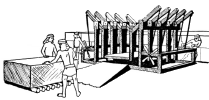
Pay attention to the beam with the ropes attached, to the left and right of the lifting chamber. They roll up the ropes attached to the 5 levers simultaniously, thus 1 man can do the work of 5.
This is how it works :
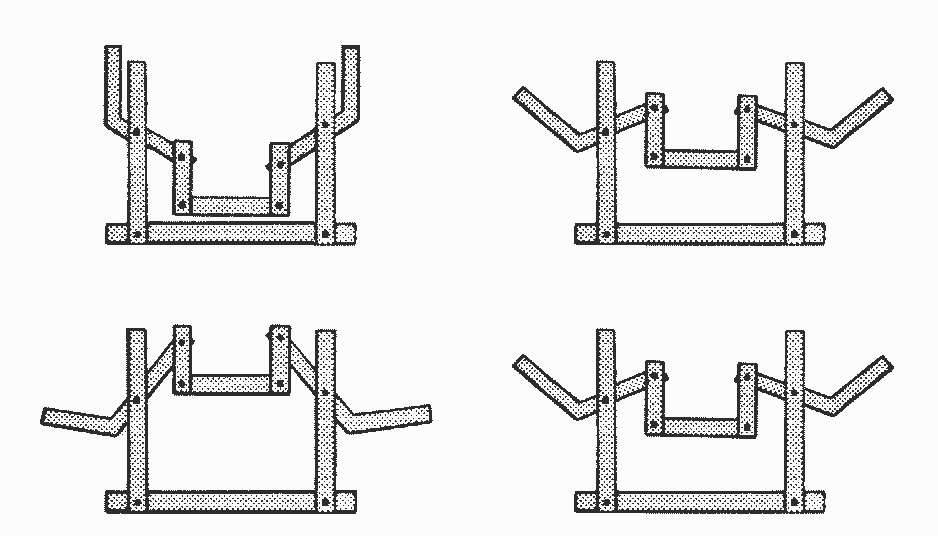
The 2 axels on both sides where the 'levers' turn around could be made from mahogoney or the likes, waxed inbetween liftings.
These things can presumably lift 5 metric tons.
Source
Originally posted by LaBTop
some good oldfashioned scientific and logical thinking.
Instead of faith, hope or beliefs.
Using as many facts as can be collected, and a few pretty good deductions.
Very good offerings have been noted here.
Now, This "anomoly" in dating, and some suggestion about the use of Blocks in the Upper levels being utilized previously as a path laidout from the Quarry to the Pyramid, has me curious.
If his carbon dating findings are 'rock'solid, that would mean that the idea of the first few thousand stones in mr Marchimedes road ending up as the last ones laid on top of the pyramid is not such a deluded one.
It also means that the construction of the Great pyramid took not 20 years, but 1700.
Marc made some good comments under all the Crap, and these additional notes have caused me to wonder.
What if, during construction, the "Quarry Order's" for dimensionally cut blocks also included upper "Expected" Cuts, and these became part of the construction for the building of the Pyramid much earlier than truly required?
I have a personal dislike to do things two times, and I have no intent on ever having to do anything twice. (In an attempt to be more productive at work, rather than having "Down Time").
So, they knew blocks of this or that size would be eventually required. If Quarried and staged at the Site, why could they not have also being part of that Ramp, Hawass has suggested.
Not only could they, (The Builders) have had a hard surface to the Pyramid, the arriving orders from the quarry for later use, were staged and used upon arrival as part of the ramping. Cleanup of the ramp and path would be the completion of the Pyramid????????
I have always had this difficulty with these presumed ramps, and the aspect of believing this was something disposed of afterwards. Rubble and loose rocks piled inorder to reach the apex. And when your done, you have to move it away. Why?
If there is evidence that supports an idea that the upper stones are considerably older than the lower stones, "The Staging" at the site could actually have started at the base with a ramp built out of stones at the same time as they went on building the various levels to 203.
When they reached a certain level (Maybe level 166), the balance of the job was placing the final stones alone, which is disposing of the evidence of the ramp.
And due to the Structure Hawass has found, (a 1/2 " by 19 " Curb on the east and west edges facing the sourthern side of the Great Pyramid, with a HARDENED BASE), the temporary Staging of the Pieces and their collective weight, were addressed in a sort of foundation. Much better than sitting in the sands of time.
It makes this premise of a Ramp, a much more viable option. Certainly the Leverage aspects would still be evident in many cases, such as the completion of the Upper Layers of the Great Pyramid and at certain times one each level, but they could have "rolled or skidded" to the spot in most cases without any lifting.
Also, the stones in the upper portion maybe, (I DO NOT KNOW), been smaller in sizes and therefore less weight to handle.
(Maybe Byrd can offer her insight in respects to this.)
Anyways, just a thought.
Ciao
Shane
Instead of ""The 2 axels on both sides where the 'levers' turn around "" it should read :
""The 4 axels on both sides where the 'levers' turn around "".
All 8 axels will need freedom of movement, to let the construction work properly.
Also, the way this is depicted in the small picture doesn't work as advertised.
To lift the inserted blocks about 1 meter (3 feet) higher, one needs a multiple pulley system.
It is in fact a simple one-pulley system, and should be a multiple pulley system to be able to work as advertised. There should be multiple round beams with different diameters in the 2 operator boxes aside the lifting platform (which should be at least 1.5 x wider as a limestone block to compensate for the inward movement of the lifting platform vertical beams), where the now much longer ropes are wrapped around those round beams multiple times, to form a multiple pulley system, which needs a much longer path for the ropes to take, but gives a far bigger transmission of hand power from the operator of the spoked wheel, to the lifting platform.
I doubt if this construction would work, since it depends on an evenly transmission of power by ALL the ropes to ALL 10 levers depicted.
When one or more lever-ropes would expand, all power would convert to just a few levers, and these could then easily break, or the ropes break.
[edit on 15/8/06 by LaBTop]
""The 4 axels on both sides where the 'levers' turn around "".
All 8 axels will need freedom of movement, to let the construction work properly.
Also, the way this is depicted in the small picture doesn't work as advertised.
To lift the inserted blocks about 1 meter (3 feet) higher, one needs a multiple pulley system.
It is in fact a simple one-pulley system, and should be a multiple pulley system to be able to work as advertised. There should be multiple round beams with different diameters in the 2 operator boxes aside the lifting platform (which should be at least 1.5 x wider as a limestone block to compensate for the inward movement of the lifting platform vertical beams), where the now much longer ropes are wrapped around those round beams multiple times, to form a multiple pulley system, which needs a much longer path for the ropes to take, but gives a far bigger transmission of hand power from the operator of the spoked wheel, to the lifting platform.
I doubt if this construction would work, since it depends on an evenly transmission of power by ALL the ropes to ALL 10 levers depicted.
When one or more lever-ropes would expand, all power would convert to just a few levers, and these could then easily break, or the ropes break.
[edit on 15/8/06 by LaBTop]
Good day.
You also seem to be utterly intrigued by these eventual solutions for hundreds of very interesting possible main construction problems.
I asked myself, if called out to construct something so massive as the Great pyramid, why not start with a limestone "knoll" with the right dimensions?
Just find a limestone knolly hill, which top reaches a height of let's say about 36 meters, f.ex. at the level of the (later) Great Chamber. (1/3 high, or even higher, 2/3 high)
Then start cutting away blocks from the sides of the knoll, untill the 4 sides have the perfect pyramid shape.
These cut away core blocks can be used later to build up those sides again.
Another additional idea could have been to implement the 2 ramps in the original shape of the -to be first found- candidate for a core limestone "knoll". Limestone and not harder rock, since it had to be cut and grinded the simplest way to the desired shape.
These 2 ramps could be cut into blocks at the end of their usefullness, to be used as the last building blocks at the top.
And I say it again, the ramps would never go higher than the level of the Great Chamber. Because otherwise the angle of ascend would be too steep for men and animals who pushed, pulled or slid their loads up that ramp. And the amount of material needed to build a ramp going at last, all the way to the apex, with still a climable angle, would be so immense, that it would cost too much time and especially labour, compared to jacking up of all blocks needed to construct the leftover 2/3 or 1/3 of the top of the pyramid, above the Great Chamber level.
This would also explain those 1700 years difference in carbon dating of blocks and mortar at the top or the bottom of the Great pyramid. The limestone from the quarry and the knoll could be precipitated in slightly different era (on a relatively very short geological scale).
I hereby assume that the carbon dating researcher mentioned by me, used the organisms embedded in the limestone blocks to determine the blocks origins in time.
(I deleted the opened tab to that scientist yesterday, but I will find it back shortly in my History files, and post it. It hinted to solid research anyway. I hope to find his online reference to a wellknown scientific publisher also ofcourse. Never rely on hearsay alone.)
The quarry for core limestone blocks was situated about 500 yards away from the south side of the Great pyramid, so let's assume that the base rock material under the pyramid was also limestone. That would be one of the more important wishes for an egyptian architect who just got the greatest contract of his life.
It would cut his construction time enormously.
Why do I still have that nagging feeling, that in fact the -whole- pyramid was made of blocks, started from a flattened base plate?
The flattening of that base plate was surely aided by swallow trenches cut in the rough limestone base plate, which were filled with water and formed a raster of a perfectly level surface, to which the limestone was grinded down, while the water in it was refreshed to compensate for evaporation in the hot sun, to the level of 2 exactly leveled measurement points near the water inlet, which were no more than about 5 meter apart, and thus kept the whole maze of trenches exactly horizontally level.
The same water out of those trenches (or secondary ones) was probably also used to aid the grinding process. And to wash away most of the finer dust and grinded material.
Perhaps this pharao Khufu had quite a clear idea of possible humane resurrection techniques in the far future, and he perhaps also had found some indications in his vast kingdom that this technique had existed before on earth, much earlier.
Which really convinced him to be sure to build such a FORTRESS for his mummified body, that even 10.000 years passing would not interfere with his inevitable resurrection.
And that ultimately, the mummified body of one, but probably MANY pharaos and dignitaries will be found deep under the Great pyramid.
Because I assume there must be a few very important reasons for the one(s) who were ordering this pyramid erection, and who were the real ones behind this specific pyramids construction plan.
However, if resurrection was the sole reason for this pharao, why didn't he cut a km's long tunnel in a limestone mountain and filled the first 100 meter up with debris?
And thus created a very safe tomb.
But that was not his intent, he wanted to be found at the right time. He didn't believe in the mumbo-jumbo from his priests about direct resurrection, or at least had a healthy mistrust in priests, and opted for the more sophisticated gamble.
So that's why he needed such an immense artefact on top of his grave, that it would survive the eons and would attract the attention of endless amounts of researchers, untill a place in time that DNA techniques were so sophisticated, that any minuscule amount of human tissue could be used to resurrect him.
He gambled that when humanity was able to dig him up, they would also be able to reconstruct his body.
He probably did not take in account, that his (then present) ego would not be duplicated in that eventual process, and it would not be HIM, in effect.
PS : Well, mr Prevos also had the same "knoll" idea, I just see :
edit to add link
[edit on 15-8-2006 by masqua]
Editted in for later reference to the names of internal rooms and shafts, this is a drawing from dr. Hawass, a plan of the Great Pyramid :
Source: Secret doors inside the Great Pyramid by dr Awass.
Take note of the craftmansship of those who chisselled these small shafts.
Intreagueing question what they were meant for.
[edit on 15/8/06 by LaBTop]
You also seem to be utterly intrigued by these eventual solutions for hundreds of very interesting possible main construction problems.
I asked myself, if called out to construct something so massive as the Great pyramid, why not start with a limestone "knoll" with the right dimensions?
Just find a limestone knolly hill, which top reaches a height of let's say about 36 meters, f.ex. at the level of the (later) Great Chamber. (1/3 high, or even higher, 2/3 high)

Then start cutting away blocks from the sides of the knoll, untill the 4 sides have the perfect pyramid shape.
These cut away core blocks can be used later to build up those sides again.
Another additional idea could have been to implement the 2 ramps in the original shape of the -to be first found- candidate for a core limestone "knoll". Limestone and not harder rock, since it had to be cut and grinded the simplest way to the desired shape.
These 2 ramps could be cut into blocks at the end of their usefullness, to be used as the last building blocks at the top.
And I say it again, the ramps would never go higher than the level of the Great Chamber. Because otherwise the angle of ascend would be too steep for men and animals who pushed, pulled or slid their loads up that ramp. And the amount of material needed to build a ramp going at last, all the way to the apex, with still a climable angle, would be so immense, that it would cost too much time and especially labour, compared to jacking up of all blocks needed to construct the leftover 2/3 or 1/3 of the top of the pyramid, above the Great Chamber level.
This would also explain those 1700 years difference in carbon dating of blocks and mortar at the top or the bottom of the Great pyramid. The limestone from the quarry and the knoll could be precipitated in slightly different era (on a relatively very short geological scale).
I hereby assume that the carbon dating researcher mentioned by me, used the organisms embedded in the limestone blocks to determine the blocks origins in time.
(I deleted the opened tab to that scientist yesterday, but I will find it back shortly in my History files, and post it. It hinted to solid research anyway. I hope to find his online reference to a wellknown scientific publisher also ofcourse. Never rely on hearsay alone.)
The quarry for core limestone blocks was situated about 500 yards away from the south side of the Great pyramid, so let's assume that the base rock material under the pyramid was also limestone. That would be one of the more important wishes for an egyptian architect who just got the greatest contract of his life.
It would cut his construction time enormously.
Why do I still have that nagging feeling, that in fact the -whole- pyramid was made of blocks, started from a flattened base plate?
The flattening of that base plate was surely aided by swallow trenches cut in the rough limestone base plate, which were filled with water and formed a raster of a perfectly level surface, to which the limestone was grinded down, while the water in it was refreshed to compensate for evaporation in the hot sun, to the level of 2 exactly leveled measurement points near the water inlet, which were no more than about 5 meter apart, and thus kept the whole maze of trenches exactly horizontally level.
The same water out of those trenches (or secondary ones) was probably also used to aid the grinding process. And to wash away most of the finer dust and grinded material.
Perhaps this pharao Khufu had quite a clear idea of possible humane resurrection techniques in the far future, and he perhaps also had found some indications in his vast kingdom that this technique had existed before on earth, much earlier.
Which really convinced him to be sure to build such a FORTRESS for his mummified body, that even 10.000 years passing would not interfere with his inevitable resurrection.
And that ultimately, the mummified body of one, but probably MANY pharaos and dignitaries will be found deep under the Great pyramid.
Because I assume there must be a few very important reasons for the one(s) who were ordering this pyramid erection, and who were the real ones behind this specific pyramids construction plan.
However, if resurrection was the sole reason for this pharao, why didn't he cut a km's long tunnel in a limestone mountain and filled the first 100 meter up with debris?
And thus created a very safe tomb.
But that was not his intent, he wanted to be found at the right time. He didn't believe in the mumbo-jumbo from his priests about direct resurrection, or at least had a healthy mistrust in priests, and opted for the more sophisticated gamble.
So that's why he needed such an immense artefact on top of his grave, that it would survive the eons and would attract the attention of endless amounts of researchers, untill a place in time that DNA techniques were so sophisticated, that any minuscule amount of human tissue could be used to resurrect him.
He gambled that when humanity was able to dig him up, they would also be able to reconstruct his body.
He probably did not take in account, that his (then present) ego would not be duplicated in that eventual process, and it would not be HIM, in effect.
PS : Well, mr Prevos also had the same "knoll" idea, I just see :
The core masonry consists of large blocks of local limestone taken from the nearby quarries and built around and over a rocky knoll. The size of the knoll cannot be determined, since it is completely covered by the pyramid.
edit to add link
[edit on 15-8-2006 by masqua]
Editted in for later reference to the names of internal rooms and shafts, this is a drawing from dr. Hawass, a plan of the Great Pyramid :
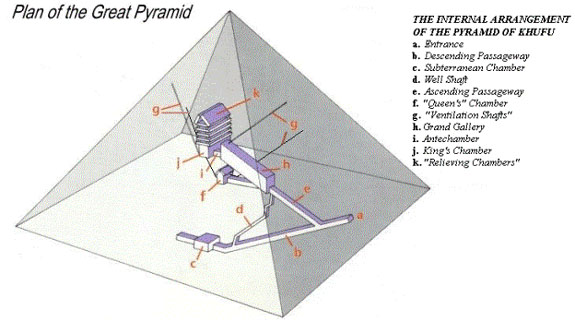
Source: Secret doors inside the Great Pyramid by dr Awass.
Take note of the craftmansship of those who chisselled these small shafts.
Intreagueing question what they were meant for.
[edit on 15/8/06 by LaBTop]
Originally posted by princeea
Yes blacks were the first version of humans, adam ( meaning he who can blush red ) was about the white man being created, version 2.0. Egyptians did not build the pyramids. Evidence points to shaman, the magi (like peoples) & fallen devs (angels). Like it or not....
um...
adam is a play on the word "adama" which in hebrew means dirt, due to the fact that adam was supposedly molded from dirt he was named after it.
also, white people aren't version 2.0 of humanity in any way other than global control and exploitation of other races.
where did you ge the version 2.0 bull from?
where is that evidence that points towards shaman, magi and fallen angels?
i'd be interested in seeing it if it actually existed
Originally posted by madnessinmysoul
um...
adam is a play on the word "adama" which in hebrew means dirt, due to the fact that adam was supposedly molded from dirt he was named after it.
Duh...., I am glad your not the Source of all Information my friend.
119 'adam aw-dam' to show blood (in the face), i.e. flush or turn rosy:--be (dyed, made) red (ruddy).
120 'adam aw-dawm' from 119; ruddy i.e. a human being (an individual or the species, mankind, etc.):--X another, + hypocrite, + common sort, X low, man (mean, of low degree), person.
So much for the dirt, eh?
Seems to me, it means "Able to Blush" as in a Spieces of Mankind.
Sort of makes the balance of your question MUTE, since your premise was based on MISTAKEN VIEWS. This would imply the balance of your presumption is also flawed.
But read Genesis Chapter 1 and Chapter 2. This should clear this up for you.
Ciao
Shane
2000 years and were still tossing that Genesis argument around...
Adam was a front, a smoke screen thats all... keep us busy thinking and guessing about it so we don't see whats really going on..
Everyone knows it was the Anunnaki who created us as an experiment... they are coming back soon to check on the experiment... see how it turned out after 2 millenium.
Well from looking around the world today...tell ya what...if humanity was my experiment... I would wipe it out... get rid of the evidence and hope none of my peers notice how badly messed up the experiment was....
Now wouldn't that be a joke on humanity? Both Religion AND Evolution are wrong... were just some science project gone wrong...
Adam was a front, a smoke screen thats all... keep us busy thinking and guessing about it so we don't see whats really going on..
Everyone knows it was the Anunnaki who created us as an experiment... they are coming back soon to check on the experiment... see how it turned out after 2 millenium.
Well from looking around the world today...tell ya what...if humanity was my experiment... I would wipe it out... get rid of the evidence and hope none of my peers notice how badly messed up the experiment was....
Now wouldn't that be a joke on humanity? Both Religion AND Evolution are wrong... were just some science project gone wrong...
new topics
-
This is our Story
General Entertainment: 37 minutes ago -
President BIDEN Vows to Make Americans Pay More Federal Taxes in 2025 - Political Suicide.
2024 Elections: 2 hours ago -
Ode to Artemis
General Chit Chat: 3 hours ago -
Ditching physical money
History: 7 hours ago -
One Flame Throwing Robot Dog for Christmas Please!
Weaponry: 7 hours ago -
Don't take advantage of people just because it seems easy it will backfire
Rant: 7 hours ago -
VirginOfGrand says hello
Introductions: 8 hours ago -
Should Biden Replace Harris With AOC On the 2024 Democrat Ticket?
2024 Elections: 9 hours ago -
University student disciplined after saying veganism is wrong and gender fluidity is stupid
Education and Media: 11 hours ago
top topics
-
Hate makes for strange bedfellows
US Political Madness: 17 hours ago, 20 flags -
University student disciplined after saying veganism is wrong and gender fluidity is stupid
Education and Media: 11 hours ago, 12 flags -
Police clash with St George’s Day protesters at central London rally
Social Issues and Civil Unrest: 14 hours ago, 9 flags -
President BIDEN Vows to Make Americans Pay More Federal Taxes in 2025 - Political Suicide.
2024 Elections: 2 hours ago, 8 flags -
TLDR post about ATS and why I love it and hope we all stay together somewhere
General Chit Chat: 15 hours ago, 7 flags -
Should Biden Replace Harris With AOC On the 2024 Democrat Ticket?
2024 Elections: 9 hours ago, 6 flags -
Don't take advantage of people just because it seems easy it will backfire
Rant: 7 hours ago, 4 flags -
One Flame Throwing Robot Dog for Christmas Please!
Weaponry: 7 hours ago, 4 flags -
God lived as a Devil Dog.
Short Stories: 12 hours ago, 3 flags -
Ditching physical money
History: 7 hours ago, 3 flags
active topics
-
Russia Ukraine Update Thread - part 3
World War Three • 5718 • : Freeborn -
Hate makes for strange bedfellows
US Political Madness • 40 • : 19Bones79 -
New whistleblower Jason Sands speaks on Twitter Spaces last night.
Aliens and UFOs • 47 • : Ophiuchus1 -
Lawsuit Seeks to ‘Ban the Jab’ in Florida
Diseases and Pandemics • 29 • : Cre8chaos79 -
TLDR post about ATS and why I love it and hope we all stay together somewhere
General Chit Chat • 8 • : Cre8chaos79 -
This is our Story
General Entertainment • 0 • : BrotherKinsMan -
British TV Presenter Refuses To Use Guest's Preferred Pronouns
Education and Media • 126 • : Asher47 -
Why to avoid TikTok
Education and Media • 17 • : mooncake -
The Superstition of Full Moons Filling Hospitals Turns Out To Be True!
Medical Issues & Conspiracies • 22 • : mooncake -
University student disciplined after saying veganism is wrong and gender fluidity is stupid
Education and Media • 23 • : BigDuckEnergy