It looks like you're using an Ad Blocker.
Please white-list or disable AboveTopSecret.com in your ad-blocking tool.
Thank you.
Some features of ATS will be disabled while you continue to use an ad-blocker.

Senior Research Scientist Proves that Planes and Fires Caused Collapse
page: 2share:
Excuse me, bsbray, are you talking to me? or are you talking to Lyte Trizzle?
Because your question applies to both of us, right? But with that aside, I still want my numbers verified. Because if I remember right, for the longest time we had to argue that the towers fell too fast. Faster than gravity even.
Okay, then we got through that and then we went to they fell too straight. Too damned straight I tell you. And apparently we've gotten through that until now Lyte Trizzle has completely went the opposite way to..
they didn't fall straight enough - they spewed too big or something to that effect - never mind the fact you can only pile loose debris so high before it falls over itself - that's okay, we don't have to bring common sense into this.
But THIS...this error that Trizzle's expert found, well, now THAT that's important. So, I think the TRUTH MOVEMENT should publish the new resultant numbers of the equations used in Dr. Greening's paper, with the appropriate mass.
And I'll also get verification (or invalidation, so be it) of my work.
[edit on 1-29-2006 by Valhall]
Because your question applies to both of us, right? But with that aside, I still want my numbers verified. Because if I remember right, for the longest time we had to argue that the towers fell too fast. Faster than gravity even.
Okay, then we got through that and then we went to they fell too straight. Too damned straight I tell you. And apparently we've gotten through that until now Lyte Trizzle has completely went the opposite way to..
they didn't fall straight enough - they spewed too big or something to that effect - never mind the fact you can only pile loose debris so high before it falls over itself - that's okay, we don't have to bring common sense into this.
But THIS...this error that Trizzle's expert found, well, now THAT that's important. So, I think the TRUTH MOVEMENT should publish the new resultant numbers of the equations used in Dr. Greening's paper, with the appropriate mass.
And I'll also get verification (or invalidation, so be it) of my work.
[edit on 1-29-2006 by Valhall]
Originally posted by Valhall
And that's accusing the man of lying and pulling a rabbit outcha butt.
it is not you slanderous liar. it is me stating what greening admitted....that he questions his own conclusions and has come up with "additional" theories to help it out.
Hey! Are you going to get your expert to run those numbers? So that we can either validate or invalidate my estimates on WTC 1's collapse time?
do it yourself.
why would i want to do anything for a person that calls me names, lies about what i say, and consistently accuses me of things i don't do.
if this site had any integrity you would be fired as a mod.
the speed of collapse was not a focus of greenings paper and free fall speed is the same for objects of any mass.
But not the momentum sweetheart, dear, loved one. And that is dependent on mg and we need that correct number...
from your expert.
Lyte Trizzle will be on a posting vacation for three days for falsely accusing me of a few things.
In the meantime, feel free to step into their shoes bsbray.
Please don't falsely accuse me of anything though. I have a migraine.
P.S. I'll attempt to run the numbers on Dr. Greening's paper with the "Truth Movement" corrected mass and see what changes.
[edit on 1-29-2006 by Valhall]
In the meantime, feel free to step into their shoes bsbray.
Please don't falsely accuse me of anything though. I have a migraine.
P.S. I'll attempt to run the numbers on Dr. Greening's paper with the "Truth Movement" corrected mass and see what changes.
[edit on 1-29-2006 by Valhall]
Originally posted by Valhall
Excuse me, bsbray, are you talking to me? or are you talking to Lyte Trizzle?
Because your question applies to both of us, right?
Yes.
>.<
We weren't really getting anywhere productive, but if you want your figures for this or that or whatever then so be it. I don't mind, of course.
My honest concern is that that post that I just typed up is going to get buried and any points that it may have will just be totally ignored and overlooked just like so much relevant info around here is.
And another clarification of the symmetry thing:
The towers fell straight down, symmetrically, with the floors being blown out in all corners, all across the board, at about the same time (or at least within a ridiculously small time-frame that I've calculated and posted before somewhere). At the same time(!), the actual debris is being shot out laterally and the majority of it lands radially around the footprints.
That's how it went down; those are the facts of the matter. Make with the info what you will, but it isn't contradictory (given that Lyte is presenting the info as stated above - I'm not really keeping up with the convo between you two).
Lyte Trizzle will be on a posting vacation for three days for falsely accusing me of a few things.
Well that sux. I think you gave him what he was here for.
Now he can claim that he was censored by ATS for revealing too much of the truth. Makes for great credentials.
Originally posted by Lyte Trizzle
Hey! Are you going to get your expert to run those numbers? So that we can either validate or invalidate my estimates on WTC 1's collapse time?
do it yourself.
why would i want to do anything for a person that calls me names, lies about what i say, and consistently accuses me of things i don't do.
if this site had any integrity you would be fired as a mod.
Heh heh heh...just look at how MAD that smart lady has made you. Watching you degrade to the "she's picking on me" argument has made my day.
Of course I like the deflection away from talking to this "expert" of yours.
I'm forced to make the theory that you have no such "expert" available to check the numbers it seems. If my theory is a solid as Jones' then I must go on with speculation (as you have said to do), and speculate that you don't know what your talking about.
Of course, that's just following your logic.
I'm sure by now you are planning to say I am inappropriate too. Certainly has been your pattern in result to direct questions. Oops...sorry. I just "added" to my original theory.
Originally posted by Skibum
Well that sux. I think you gave him what he was here for.
Now he can claim that he was censored by ATS for revealing too much of the truth. Makes for great credentials.
Yeah, but the record will be here when they get back, so that spoils it all.
brsbray I have questions (I read your whole post)
Don't you believe that the collapse time is paramount to your argument? And don't you believe that this "error" that the TRUTH MOVEMENT has brought out could actually work to bring the collapse time to a more realistic time relative to the progressive collapse theory?
[edit on 1-29-2006 by Valhall]
Originally posted by Valhall
Don't you believe that the collapse time is paramount to your argument? And don't you believe that this "error" that the TRUTH MOVEMENT has brought out could actually work to bring the collapse time to a more realistic time relative to the progressive collapse theory?
I don't think that the plane/fire damage should have resulted in any collapse, period. Unless I'm convinced of otherwise (namely that there was enough structural damage to even initiate a collapse), I don't really care about the times. A ten-hour collapse would be too fast for me given the above, especially if it exhibited all of the other collapse characteristics seen on 9/11.
'My argument' is more focused around the lack of loss of energy during collapse, which is independent of the collapse times, and the lack of evidence for sufficient damage to the structure preceding collapse, etc. So, no, I don't think the times are paramount. I just think whoever did the paper that is thread is based on left a lot of important stuff out that renders the paper worthless.
Was that the only thing you wanted to address?
'My argument' is more focused around the lack of loss of energy during collapse, which is independent of the collapse times,
I may be wrong but wouldn't the energy increase?
I mean as the building collapses wouldn't the additional weight of each floor as it collapses add to the energy?
mass times velocity equals energy right? After adding enough mass to the initial mass from the top floors collapsing , at some point the resistance will be dwarfed by the ever increasing energy.
bsbray,
Well, you're looking at it from a different viewpoint than me, so I see how the collapse time isn't really important to you (other than it being a collapse time that would be way too short - and then it would take more than just explosives in the building, it would take divine intervention!).
I see where you're coming from. As you well know, because I've stated in several threads and even done a very conservative heat transfer analysis, I believe the damage was sufficient to cause collapse. And I do believe once any floor around 20 to 30 floors down from the top collapsed, the impact energy would be sufficient to cause progressive collapse.
Ultimately, this is going to take a Cray crunching an exhaustive model to tell us. And then we'll still be arguing about details, but slowly (I personally believe) we'll whittle away at each factor (and one will fall your way and one will fall my way - and my way is not based on trusting the government by the way, it's just based on physics - that's actually the ONLY contention I have in this whole thing that everybody try to take into account the physics) and one day all the factors will fall out and the majority will fall on one side.
While we whittle our time away on these physical points, I hope we continue to look at the information gaps, the anomalies in the official report, and the outright lies in that same report.
Because those - to me - are the voices of people gone crying to help us know what really happened. That's what's important to me.
(That and I want to validate my collapse time. HA! )
[edit on 1-29-2006 by Valhall]
Well, you're looking at it from a different viewpoint than me, so I see how the collapse time isn't really important to you (other than it being a collapse time that would be way too short - and then it would take more than just explosives in the building, it would take divine intervention!).
I see where you're coming from. As you well know, because I've stated in several threads and even done a very conservative heat transfer analysis, I believe the damage was sufficient to cause collapse. And I do believe once any floor around 20 to 30 floors down from the top collapsed, the impact energy would be sufficient to cause progressive collapse.
Ultimately, this is going to take a Cray crunching an exhaustive model to tell us. And then we'll still be arguing about details, but slowly (I personally believe) we'll whittle away at each factor (and one will fall your way and one will fall my way - and my way is not based on trusting the government by the way, it's just based on physics - that's actually the ONLY contention I have in this whole thing that everybody try to take into account the physics) and one day all the factors will fall out and the majority will fall on one side.
While we whittle our time away on these physical points, I hope we continue to look at the information gaps, the anomalies in the official report, and the outright lies in that same report.
Because those - to me - are the voices of people gone crying to help us know what really happened. That's what's important to me.
(That and I want to validate my collapse time. HA! )
[edit on 1-29-2006 by Valhall]
Originally posted by Skibum
'My argument' is more focused around the lack of loss of energy during collapse, which is independent of the collapse times,
I may be wrong but wouldn't the energy increase?
I mean as the building collapses wouldn't the additional weight of each floor as it collapses add to the energy?
mass times velocity equals energy right? After adding enough mass to the initial mass from the top floors collapsing , at some point the resistance will be dwarfed by the ever increasing energy.
Yes it would, but what brsbray is saying has some merit. It wouldn't increase linearly (say, take the mass of the floor and add it as each floor collapses) because you've got the maximum limit to a self-sustaining pile of debris you have to take into account. So as each floor collapses, you're going to lose material (as the videos show) due to the pile of loose material not being able to sustain its own height.
Speaking of information gaps, here's something I'm curious about.
AgentSmith, at 29-1-2006 12:52 PM, on page 3 of this thread:
Emphasis mine.
And then Lumos, at 29-1-2006 12:55 PM, on page 3 of this thread, underneath Smith's:
Notice that on two subjects, EMR's and megalomania, Agent Smith jumps the gun and responds to Lumos's post before Lumos even posts it, by a whole 2+ minutes.
All I have to ask is, "wtf?"
And I'm just waiting for someone to point to the edit Agent Smith made, because I happened to take a screenshot before the edit, with the exact same problem.
AgentSmith, at 29-1-2006 12:52 PM, on page 3 of this thread:
Originally posted by AgentSmith
I just gave you your evidence and your still carrying on?
When I said all I would have to do is endorse conspiracy theories to make them null I thought I was joking.
When you've got your electronics and radio qualifications, we can have an adult conversation on the effects of EMI in electronic circuits OK?
But seeing as I found you your precious detonators which have all the characteristics required I don't really see it's an issue
...
Maybe if you spent less time fantisising that you've outsmarted a COINTELPRO CIA operative when really you up against a 26 year old with too much time on his hands who suffers from megalomania then you would find these things for yourself.
meg·a·lo·ma·ni·a ( P ) Pronunciation Key (mg-l-mn-, -mny)
n.
1. A psychopathological condition characterized by delusional fantasies of wealth, power, or omnipotence.
2. An obsession with grandiose or extravagant things or actions.
Yep that's me alright...
Emphasis mine.
And then Lumos, at 29-1-2006 12:55 PM, on page 3 of this thread, underneath Smith's:
Originally posted by Lumos
Smith, it's not your opinion that's authoritative for my opinion, I rely on science, logic and observables. Amusing that you think I'd just be your negative, megalomaniac.
You know, there was no need to dig up links to existing hardware, as my argument was based on science and logic. It's no surprise that these principles were applied in this detonator. In order to disprove the possibility of such a device, you would have simply had to dispute the grounds on which it was based, which you apparently couldn't.
You know, son, I have a background in physics, so I know what EMR can do, as well. Why didn't you use your grand knowledge to debate my then hypothetical detonator?
Notice that on two subjects, EMR's and megalomania, Agent Smith jumps the gun and responds to Lumos's post before Lumos even posts it, by a whole 2+ minutes.
All I have to ask is, "wtf?"
And I'm just waiting for someone to point to the edit Agent Smith made, because I happened to take a screenshot before the edit, with the exact same problem.
In addition to Val's post, consider that the amount of mass lost was actually a majority, as attested by the fact that most of the debris landed
everywhere around the WTC site but in the footprints. Watch videos of the collapses and the same fact is supported yet again. Somewhere around
80% of the mass of the towers was thrown right out, and was not added to the falling weight. And the caps of course deteriorated as well.
[edit on 29-1-2006 by bsbray11]
[edit on 29-1-2006 by bsbray11]
Originally posted by bsbray11
And I'm just waiting for someone to point to the edit Agent Smith made, because I happened to take a screenshot before the edit, with the exact same problem.
Actually, I'm glad you brought this up, because in that thread, that happened more than once. And what I mean by that, is that lumos's post were also showing up before my post, when I posted before him. It was like they were logging into the thread with some type of delay.
It happened several times in that thread. I was in it posting and watched it happen. It was, indeed, weird.
Originally posted by Valhall
Actually, I'm glad you brought this up, because in that thread, that happened more than once. And what I mean by that, is that lumos's post were also showing up before my post, when I posted before him. It was like they were logging into the thread with some type of delay.
It happened several times in that thread. I was in it posting and watched it happen. It was, indeed, weird.
This is off-topic, so many another thread is appropriate, but it's the first time I've ever noticed it anywhere. Somebody really should look into it and figure out what's up, because if it's not a forum problem, then somebody has some trojan stuff going on, and 3 minutes is a decent chunk of time. I would think a connection would time out before then.
I'm going to let SO know about it and see if he can tell anything. It's probably not going to be very fruitful now that the posts are static, but
who knows.
Ok, even with the flying debris calculated (on the high side IMHO) then the seemingly accepted number for weight of WTC 1 or 2 is around 300,000,000
Kg divided by 110 = roughly 2,720,000 Kg per floor then subtract 80% to arrive at an added 544,000 Kg's additional momentum per floor for each floor
overtaken in addition to the total weight of how ever many floors were above the original collapse point.
I'm not aware of any office building structure made to withstand that type of energy nor even act as an impedence of any appreciable manner.
Can someone please point to any hard data that such a structure exists anywhere? (office)
In buildings I've worked in (both concrete pan and metal deck) we're concerned where the loading goes on items 1000lbs. and up such as UPS systems, safes, fire proof files, law libraries etc. to keep within floor loading limits. I am told by structural that we have a 200% safety factor on concentrated loads but thats it, even then they have to be carefully located over beams near columns.
I am reasonably sure that a 1.2 million pound load dropped 12 feet onto any standard office structure would crush that structure as it were not even there due to its moment of energy.
Since I work with a bunch of strutural people, I'll ask their opinion about this type weight at even a small travel of 12 feet would do to a standard office structure.
I am very skeptical that 80% ejecta is even close to the true figure and agree with Valhal that a little common sense is in order. Visually the videos can not be relied upon for this figure most of that is a dust cloud of very much lighter weight particles - is there any expert evidence to support 80% or is that just a non-expert opinion formed from watching the video.
[edit on 29-1-2006 by Phoenix]
I'm not aware of any office building structure made to withstand that type of energy nor even act as an impedence of any appreciable manner.
Can someone please point to any hard data that such a structure exists anywhere? (office)
In buildings I've worked in (both concrete pan and metal deck) we're concerned where the loading goes on items 1000lbs. and up such as UPS systems, safes, fire proof files, law libraries etc. to keep within floor loading limits. I am told by structural that we have a 200% safety factor on concentrated loads but thats it, even then they have to be carefully located over beams near columns.
I am reasonably sure that a 1.2 million pound load dropped 12 feet onto any standard office structure would crush that structure as it were not even there due to its moment of energy.
Since I work with a bunch of strutural people, I'll ask their opinion about this type weight at even a small travel of 12 feet would do to a standard office structure.
I am very skeptical that 80% ejecta is even close to the true figure and agree with Valhal that a little common sense is in order. Visually the videos can not be relied upon for this figure most of that is a dust cloud of very much lighter weight particles - is there any expert evidence to support 80% or is that just a non-expert opinion formed from watching the video.
[edit on 29-1-2006 by Phoenix]
Originally posted by bsbray11
Page 5 of the paper says,
We note in concluding this Section that the values for tc given above represent the calculated values for the time of collapse of the WTC towers neglecting the energy required to crush or otherwise destroy the support structure of each floor. This energy, which we will call E1, is considered in detail in Section 4.2. For now it is sufficient to note that the collapse times calculated without allowing for E1 are already in reasonable agreement with the observed collapse times. This suggests that E1 is relatively small compared to the kinetic energy associated with the falling blocks of floors;
So, in other words:
The time it would've taken for the floors to fall with no resistance is already approaching the total amount of time it took the towers to fall, so then they assume that, therefore, there was not much resistance from the structure! Now, that's bias at best. At worst, they're doing something pretty much equivalent to lying outright, if not worse.
With that paragraph taken out of context is does appear that way, however you notice that he isn't leaving it at that assumption. He clearly states that he goes into it in depth in section 4.2. In that section he actually calculates the value for E1.
4.2. IMPACT ENERGY REQUIRED TO COLLAPSE ONE WTC FLOOR
A crucial question that is frequently asked concerning the collapse of the WTC towers is why did the localized damage near the impact levels in WTC 1 and 2 cause the collapse of the entire buildings? In order to answer this question we need to move beyond our simple momentum transfer collision theory and consider how much energy is needed to bring about the collapse of one floor. We call this energy E1. Once we have a reliable estimate for E1 we will be in a position to compare it to the kinetic energy, Ti, associated with the free fall of particular blocks of floors. If Ti is found to be significantly larger than E1, a self-sustaining total building collapse is possible. If the converse is true, only a collapse of floors severely damaged by the initial aircraft impact is possible. A comparison of our estimates of E1 and Ti is made in Section 6.0. For now we will focus on a reliable determination of E1.
So as you can see he is not just guessing or lying about the value for E1. In fact he is breaking down his position peice by peice to fully account for all of his figures something completely lacking in the Jones paper.
Now I'd like to address your four problems with Greenings conclusions.
Originally posted by Bsbray11
Four problems with this that make it irrelevant, and wrong (just as this conclusion has ALWAYS been wrong, and always will be unless you guys come up with something better):
- The impacted floors did not remain intact and become additional driving weight for the collapsing "blocks." They were destroyed and ejected outwards, with an average of around 80% of the mass of each floor being ejected outwards radially and thus not adding on to the mass of falling materials at all.
Where does this 80% of the mass figure come from? I would agree that 80% of the debris was ejected outward. However the steel, which was most of the mass, ended up in a huge pile at the base of the towers.
So while the floors did not stay completely intact, that mountain of steel shows that the mangled steel did infact contribute to the mass of falling materials.
Originally posted by Bsbray11
The "blocks" of falling floors broke up and lost their integrities during the collapses, with large chunks falling over the side at various times somewhat early in the collapses.
See my response to your first point. While debris was falling off, mass was still being added to the collapse through the steel.
Originally posted by Bsbray
Because of the above points A and B, it can be assumed, by their own reasoning, that the relative amount of energy lost to heat through each impacting of a floor would be an increasingly large fraction of the total energy available – NOT AN INCREASINGLY SMALL ONE.
Well, if both your points are incorrect assumptions, then no this cannot be assumed.
Originally posted by Bsbray11
The collapse speed did not slow, immediately indicating that (1) absolutely no resistance from the structure, or that (2) explosives (third source of energy) were used to blow out each floor.
How does the collapse speed not slowing immediately indicate that?
As you can see from the graph Greening made from his figures the resistance is readily apparent.
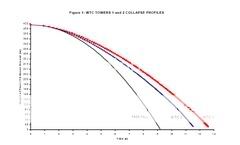
Starting at the same speed and then slowing is exactly what we should expect from the resistance as the collapse proceeded.
It seems to me that what you are presenting is totally unrealistic, and did not happen.
Sorry Bsbray.
[edit on 29-1-2006 by LeftBehind]
Originally posted by Phoenix
Ok, even with the flying debris calculated (on the high side IMHO) then the seemingly accepted number for weight of WTC 1 or 2 is around 300,000,000 Kg divided by 110 = roughly 2,720,000 Kg per floor then subtract 80% to arrive at an added 544,000 Kg's additional momentum per floor for each floor overtaken in addition to the total weight of how ever many floors were above the original collapse point.
That additional weight is not equivalent to a unified force of the same weight, but is scattered and fragmented, so it should really be equivalent to even less than 544k Kg's.
Sort of like dropping 50 pounds of gravel onto a car compared to dropping a 50-pound rock onto a car. Which would do the most damage to the structure of the car? (Hint: it wouldn't be equal.)
And remember that the buildings' safety factors don't apply to one floor and then go to 0 for each floor afterwards. I use floor as a unit for simplicity, but the columns weren't set up floor-by-floor, so I hope I'm not contributing to that ongoing misconception.
I am reasonably sure that a 1.2 million pound load dropped 12 feet onto any standard office structure would crush that structure as it were not even there due to its moment of energy.
Is this what they're saying? Because there was no unresisted 12-foot drop in either building.
I am very skeptical that 80% ejecta is even close to the true figure and agree with Valhal that a little common sense is in order. Visually the videos can not be relied upon for this figure most of that is a dust cloud of very much lighter weight particles - is there any expert evidence to support 80% or is that just a non-expert opinion formed from watching the video.
The figure was actually derived from the amount of debris (in weight) located within the footprints, vs. the amount of debris located without.
It shouldn't come as any surprise if you've seen the photos of Ground Zero:

external imageexternal image
I think the actual 80% figure is from researcher Jim Hoffman, which he uses, though he's also said it was along the lines of 80 to 90 percent. Either way, there was obviously a very large amount of weight that was not added to the falling, "driving" mass (the caps, which were in themselves disintegrating), and even the weight that was added was fragmentary and could be easily deflected by intact beams.
new topics
-
Thousands Of Young Ukrainian Men Trying To Flee The Country To Avoid Conscription And The War
Other Current Events: 56 minutes ago -
12 jurors selected in Trump criminal trial
US Political Madness: 3 hours ago -
Iran launches Retalliation Strike 4.18.24
World War Three: 3 hours ago -
Israeli Missile Strikes in Iran, Explosions in Syria + Iraq
World War Three: 4 hours ago -
George Knapp AMA on DI
Area 51 and other Facilities: 9 hours ago -
Not Aliens but a Nazi Occult Inspired and then Science Rendered Design.
Aliens and UFOs: 10 hours ago
top topics
-
BREAKING: O’Keefe Media Uncovers who is really running the White House
US Political Madness: 16 hours ago, 25 flags -
George Knapp AMA on DI
Area 51 and other Facilities: 9 hours ago, 25 flags -
Israeli Missile Strikes in Iran, Explosions in Syria + Iraq
World War Three: 4 hours ago, 13 flags -
Louisiana Lawmakers Seek to Limit Public Access to Government Records
Political Issues: 12 hours ago, 7 flags -
So I saw about 30 UFOs in formation last night.
Aliens and UFOs: 15 hours ago, 6 flags -
Iran launches Retalliation Strike 4.18.24
World War Three: 3 hours ago, 5 flags -
Not Aliens but a Nazi Occult Inspired and then Science Rendered Design.
Aliens and UFOs: 10 hours ago, 5 flags -
Do we live in a simulation similar to The Matrix 1999?
ATS Skunk Works: 16 hours ago, 4 flags -
The Tories may be wiped out after the Election - Serves them Right
Regional Politics: 13 hours ago, 3 flags -
12 jurors selected in Trump criminal trial
US Political Madness: 3 hours ago, 2 flags
active topics
-
Israeli Missile Strikes in Iran, Explosions in Syria + Iraq
World War Three • 52 • : WeMustCare -
Mandela Effect - It Happened to Me!
The Gray Area • 107 • : inflaymes69 -
Terrifying Encounters With The Black Eyed Kids
Paranormal Studies • 45 • : daskakik -
Not Aliens but a Nazi Occult Inspired and then Science Rendered Design.
Aliens and UFOs • 12 • : BeyondKnowledge3 -
Elites disapearing
Political Conspiracies • 31 • : Degradation33 -
MULTIPLE SKYMASTER MESSAGES GOING OUT
World War Three • 47 • : SchrodingersRat -
12 jurors selected in Trump criminal trial
US Political Madness • 21 • : VictorVonDoom -
British TV Presenter Refuses To Use Guest's Preferred Pronouns
Education and Media • 64 • : Degradation33 -
Iran launches Retalliation Strike 4.18.24
World War Three • 14 • : Cloudbuster1 -
Thousands Of Young Ukrainian Men Trying To Flee The Country To Avoid Conscription And The War
Other Current Events • 0 • : Consvoli