It looks like you're using an Ad Blocker.
Please white-list or disable AboveTopSecret.com in your ad-blocking tool.
Thank you.
Some features of ATS will be disabled while you continue to use an ad-blocker.

WTC Collapse - A Question of Fairness.
page: 3share:
Originally posted by HowardRoark
BSBay, NIST had limited samples to available to determine the temperatures of the steel.
Basic fire science indicates that fire temperatures in excess of 600 C were present. There is no way they could not have been. The steel trusses were the most susceptible to heat, they were the most exposed to the elevated temperatures at the ceilings of the fire floors, and the fireproofing on the trusses was the most susceptible to physical damage.
The fires likely hovered between 600 and 700 degrees Celsius, but this doesn't mean that the steel was that hot. In fact, as made obvious by the NIST steel samples, the steel wouldn't necessarily have to be heated anywhere near those temperatures, and for them to have been heated to the same temperatures of the fires would violate thermodynamic laws which hold that energy is always lost in transfer, etc. anyway.
Steel, again, is an excellent heat sink. There were, literally, tons of it in the WTC. Tons upon tons upon tons.
When one section of steel becomes hot, the heat is conducted throughout the length (or width, or both, however) of steel and spread out so that the length of steel remains relatively cool. Thus, you have no tested steel above 250 C or so. It would be illogical for the steel to have been much hotter. The fires weren't that bad, and they only covered a few floors (and not even whole floors at that).
As far as the trusses, I'm afraid I'll need to see the construction drawings before buying into a claim that they were designed so weak. And I reiterate that the FEMA report left some 32,000 tons of steel unaccounted-for. I can only imagine where that would have gone...
As for the image of the plane hitting the building, no it is probably not perfectly to scale, and the break up of the wings as they entered the building is at best approximate, but you fail to see the point.
The planes path would have impacted the core areas. The fuel in the left wing would not have exited the building, it would have hit the core area.
WTC1 was hit dead-on, and so some core damage could be expected there. WTC2, not so much. Keep in mind that the planes were busted up something awful by the perimeter columns anyway, and couldn't be expected to do much damage at all to the even thicker and more widely spaced core columns.
If I'm not mistaken, government reports themselves indicate that the only reasonable way the planes could have damaged the cores after the impacts would've been if the engines flew off in the right places and hit one of the columns each dead-on.
That's at most 2 core columns out of the better part of 50 in either tower. In all seriousness, you could not expect much damage to the cores of either tower by impact. Hell, only a small minority of the smaller and initially-hit perimeter columns were taken out. Common sense, Howie.
FEMA report left some 32,000 tons of steel unaccounted-for. I can only imagine where that would have gone...
Quite a bit was stolen if I remember corretly.
CLAIM: "We have been lied to," announces the Web site AttackOnAmerica.net. "The first lie was that the load of fuel from the aircraft was the cause of structural failure. No kerosene fire can burn hot enough to melt steel." The posting is entitled "Proof Of Controlled Demolition At The WTC."
FACT: Jet fuel burns at 800° to 1500°F, not hot enough to melt steel (2750°F). However, experts agree that for the towers to collapse, their steel frames didn't need to melt, they just had to lose some of their structural strength--and that required exposure to much less heat. "I have never seen melted steel in a building fire," says retired New York deputy fire chief Vincent Dunn, author of The Collapse Of Burning Buildings: A Guide To Fireground Safety. "But I've seen a lot of twisted, warped, bent and sagging steel. What happens is that the steel tries to expand at both ends, but when it can no longer expand, it sags and the surrounding concrete cracks."
"Steel loses about 50 percent of its strength at 1100°F," notes senior engineer Farid Alfawak-hiri of the American Institute of Steel Construction. "And at 1800° it is probably at less than 10 percent." NIST also believes that a great deal of the spray-on fireproofing insulation was likely knocked off the steel beams that were in the path of the crashing jets, leaving the metal more vulnerable to the heat.
But jet fuel wasn't the only thing burning, notes Forman Williams, a professor of engineering at the University of California, San Diego, and one of seven structural engineers and fire experts that PM consulted. He says that while the jet fuel was the catalyst for the WTC fires, the resulting inferno was intensified by the combustible material inside the buildings, including rugs, curtains, furniture and paper. NIST reports that pockets of fire hit 1832°F.
"The jet fuel was the ignition source," Williams tells PM. "It burned for maybe 10 minutes, and [the towers] were still standing in 10 minutes. It was the rest of the stuff burning afterward that was responsible for the heat transfer that eventually brought them down."
Why is it so hard to beleive this is what happened? Is it strictly denial or the need to want ot blame the government?
Originally posted by esdad71
FEMA report left some 32,000 tons of steel unaccounted-for. I can only imagine where that would have gone...
Quite a bit was stolen if I remember corretly.
While the buildings were still standing? Because that's what I'm talking about. The construction drawings, relevant to when the buildings were still standing.
Why is it so hard to beleive this is what happened? Is it strictly denial or the need to want ot blame the government?
I could ask you the same. It really isn't hard to throw stuff like that around.
And, if you don't mind, in the future, try to post something in response to what we're already discussing. Just a suggestion. Because these big quotes throw in as if they mean something, are just rehashing the same crap that people have been throwing out since day one.
Specifically relating to your quote, there is no evidence of steel heated above 250 C or so (no loss of integrity), and there's some logic behind this that your link isn't providing you, which involves steel as a conductor of heat, the amount of heat, and the temperatures and quantities of the fires. But if you really don't care to know this kind of stuff, then it might help to just stop posting here at all.
Originally posted by bsbray11
Specifically relating to your quote, there is no evidence of steel heated above 250 C or so (no loss of integrity), and there's some logic behind this that your link isn't providing you, which involves steel as a conductor of heat, the amount of heat, and the temperatures and quantities of the fires. But if you really don't care to know this kind of stuff, then it might help to just stop posting here at all.
You keep repeating that like a
But as some conspiracy theorists have pointed out the amount of steel they had to examine was limited, this aspect is used to promote the conspiracy as it is used as 'evidence' of information being concealed, like the use of thermite for instance.
Yes yes, I realise this is illogical as NIST being a Government agency and saying it is confident with it's findings are all lies and part of a cover up, so why would samples have to be concealed from someone 'in' on it I hear you ask - well beats me, I'm not the one that believes it! LOL
As it says here in the report (emphasis mine):
Page 88
Examination of the photographs showed that 16 of the exterior panels recovered from WTC 1 were exposed to fire prior to the building collapse. None of the nine recovered panels from within the fire floors of WTC 2 were directly exposed to fire. NIST used two methods to estimate the maximum temperatures that the steel members has reached:
* Observations of paint cracking due to thermal expansion. Of the more that 170 areas examined on 16 perimeter column panels, only three columns had evidence that the steel reached termperatures above 250 deg C: [...]
Only two core column specimens had sufficent paint remaining to make such an analysis, and their temperatures did not reach 250 deg C.
NIST did not generalise these results, since the examined columns represented only 3 percent of the perimeter columns and 1 percent of the core columns from the fire floors.
* [.........] Using metallographic analysis, NIST determined that there was no evidence that any of the samples had reached above 600 deg C.
wtc.nist.gov...
When you look at the number of samples they had and where they came from...
Page 85
Over a period of about 18 months, 236 pieces of steel were shipped to the NIST campus[..........]
These sample ranged in size and complexity from a nearly complete three column, three floor perimeter assembly to boltsd and fragments.
[........]
The remaining 229 samples represented roughly 0.25 percent to 0.5 percent of the 200,000 tons of structural steel used in the construction of the two towers.
[........]
In all, 42 exterior panels were positively identified: 26 from WTC 1 and 16 from WTC 2. Twelve core columns were positively identifed: eight from WTC 1 and four from WTC 2. Twenty-three pieces were identified as being parts of trusses, although is was not possible to identify their locations within the buildings.
It's not exactly a fair representaion. In their own words "NIST did not generalise these results, since the examined columns represented only 3 percent of the perimeter columns and 1 percent of the core columns from the fire floors".
You may be right in that they did not examine any physical evidence that showed temperature in excess of 250 degrees, but given the proportionally tiny amount of physical evidence they had to go on, they had to rely on scientific principles, simulations (both computer and practical) and their years of experience and education.
I know you don't like computer simulations, so here's a nice picture of one of the mock-ups they built and burned to analyse (and also help program the computer incidently).
Scientific research I think they call it.
I know you like to keep repeating that they found 'no evidence of steel heated above 250 C' in the hope that people will actually come to believe that the fires did not get hot enough to cause structural failure. But when you actually read the report, I think it's pretty clear you are misleading people. Though I might give you the benefit of the doubt and just assume you didn't read that section of the report yourself.
[edit on 21-1-2006 by AgentSmith]
Originally posted by AgentSmith
You keep repeating that like a
Cute.
But as some conspiracy theorists have pointed out the amount of steel they had to examine was limited, this aspect is used to promote the conspiracy as it is used as 'evidence' of information being concealed, like the use of thermite for instance.
There is evidence enough that the steel did not reach 600 C without NIST coming out and pooping its diaper in front of everyone with those tested samples. I could rehash it all again, but since you're too smart for facts, and like the sarcasm instead, I'll just marvel at how much those same findings go to provide evidence for your case. Because, after all, we know that those hydrocarbon fires varied greatly in their temperatures (oh, they always do), and we simultaneously like the ignore the movements of fire an thus the necessity of short periods of exposure of steel to fire. Oh, and the fact that steel is extremely conducive to heat. Hell, we threw that last fact in the trash years ago, as it was too obvious right from the start.
Yes yes, I realise this is illogical as NIST being a Government agency and saying it is confident with it's findings are all lies and part of a cover up, so why would samples have to be concealed from someone 'in' on it I hear you ask - well beats me, I'm not the one that believes it! LOL
What hits me as illogical is how you structured that sentence - because I can hardly make heads or tales of it, save the immense amount of sarcasm I can feel radiating from it. Maybe it has something to do with the fact that you seem to have tossed a rhetorical question into the middle of an informative statement! LOL
Using metallographic analysis, NIST determined that there was no evidence that any of the samples had reached above 600 deg C.
Wanna know something cool?
Steel heated to 600 C glows red. Very distinct and easy to see, especially for exterior columns.
Know how many columns were seen glowing red on 9/11? About... none.
NO perimeter columns were heated to 600 C, and I can tell you that for a fact simply because of the lack of glow. NIST doesn't mention that, though, expert as they are. It doesn't really help their case, you know.
The core columns were obviously not visible, but steel is steel, and for the same reasons that the perimeter columns did not heat to those temperatures (conduciveness to heat), the core columns would've been even less likely to heat to the same temperatures because of their greater sizes and thus greater resiliences to heat. Also note the relative lack of ventilation within the core, especially once the elevators and etc. were all shut down and closed off.
That is enough to tell you that the steel was not heated enough, provided you have any common sense about you.
NIST just drives in the point a little more, despite the sample size. 250 C is absolutely ridiculous in terms of integrity loss, and yet fits all the circumstantial evidence from the behavior of the fires (moving towards less efficiency, failing to spread to other floors, being hydrocarbon in nature, and thermodynamics laws don't allow that much easy energy transfer), the lack of glowing from the steel, and etc. that allow anyone without the NIST disease to realize it the steel was not heated to 600 C. It would be impossible in those conditions, in so short an amount of time, while the fires were roaming and dying out in various, constantly-changing areas of the floors, for steel to become so heated. And this impossibility is what brings you the fact that no steel was freaking glowing.
I know you don't like computer simulations, so here's a nice picture of one of the mock-ups they built and burned to analyse (and also help program the computer incidently).
This has been discussed earlier when Howard brought it up, and I can't remember the specifics without looking back over the actual report again, but suffice it to say that I don't trust NIST trying to justify its own claims with experiments that aren't reproducible.
Reproducibility is real science, anyway.
I know you like to keep repeating that they found 'no evidence of steel heated above 250 C' in the hope that people will actually come to believe that the fires did not get hot enough to cause structural failure. But when you actually read the report, I think it's pretty clear you are misleading people. Though I might give you the benefit of the doubt and just assume you didn't read that section of the report yourself.
Oh, ok. Since there is absolutely no evidence of steel being heated to 600 C, and NIST only found evidence of 250 C heating, it's misleading for me to say there's no evidence of critical heating.
And yet, from the same total lack of evidence, it's perfectly fine for you to suggest that there was enough heating.
Wtf?
By the same reasoning, if you bring up evidence that contradicts something that I say, and I have absolutely no evidence to back up my own claim, then I can claim that you're misleading people simply because I don't have any evidence, but then simultaneously suggest that I'm doing no such misleading myself.
Again, no steel was glowing at the site, man, and steel is KNOWN by smiths (not you, obviously, but people who work with steel), to glow at 600 C. No steel was glowing. Case closed. It was right in our faces. It wouldn't be hard to see if it were glowing.
Do you get that? You couldn't have possibly thought that last part through. Your posts are becoming more and more warped and dissociated from reasoning, man. That last bit was hyprocritical at best.
[edit on 21-1-2006 by bsbray11]
You keep repeating that`there was no evidence of steel being heated to more than 250 deg C' as if it's the final word on the maximum temperature any
of the metalwork in the building reached, but as I said the physical evidence they had from the affected area was too insignificant a proportion to
make a general assumption on.
Simple really..... Maybe you should ensure that you clarify this when touting it around like it's the final nail in the coffin.
Again...
wtc.nist.gov...
Now repeat... 'None of the tested samples which represented only 1 percent of the core columns and 3 percent of the perimeter columns reached the required temperatures to initiate collapse... No-one knows for sure about the rest of the core or even the perimeter columns because there were no samples to analyse. So assumptions have to be made using simulations and tests.'
Looking at images like this:
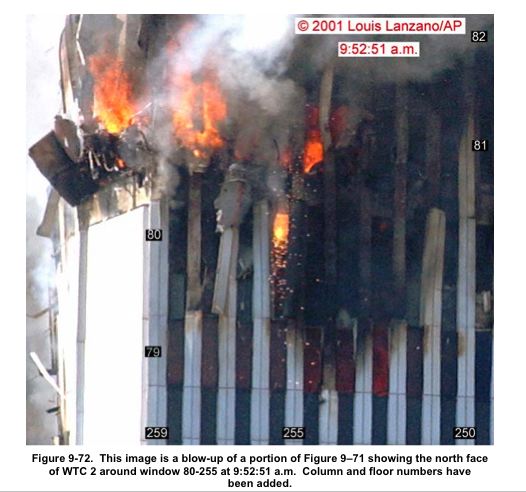
It looks like it's at least hot enough to melt aluminium, which does so at 660.37 deg C. That is assuming, of course, that whatever it is spilling from the building is in fact molten metal and not something else.
Wanna know something cool? You're wrong...
Let's look at the temperature chart again:
Oh yes I see what you mean, it does glow slightly at 600 degrees C.... Oh wait what's this?
www.westyorkssteel.com...
Oh dear, it seems to say that this chart applies in a dim or dark room, but the WTC was in direct sunlight?
I guess that what would be a very faint glow even in the dark, would be indistinguishable in bright daylight... Bummer...
I guess that explains why all those pictures you see of steel glowing away in steel mills are taken in the dark, or at least very dim light...
Come to think of it, I'm sure I remember in metalwork class years back, they actually showed us how glowing metal is indistinguishable to cold metal by sight when exposed to bright light, such as sunlight for instance. Obviously this has safety ramifications - hence the demonstration.
Yes well I think it's pretty safe to assume NIST didn't mention it due to the fact that your idea is wrong. If they had come out with something like that, then I would have to agree with you that they are incompetent.
I wonder if it's possible too, that the surface of the columns facing into the building may have been hotter than the surface on the outside, that would make sense considering the cool air on the outside and the furnace on the inside...
I guess all those temperature variations through the damaged zone probably didn't do much good...
Where are those pictures that show the exterior columns buckling again?
Ah yes.... Makes sense if you imagine the inner surface getting hotter than the exterior surface.. As it expands it would bow inwards, as we see in the image..
Heh... That is amusing now, isn't it? Well it is for me anyway...
You can reproduce it: get yourself a warehouse, buy up the required steel parts, concrete, etc to build a mock-up of a WTC office.. Get some office furniture to furnish it with... Then set it on fire and observe the results!
What else do you expect? Did you want them to show you how to do it with fairy liquid bottles and egg cartons?
Anyone can reproduce it with the required resources, but there is no 'cheap and easy' way for people to do it at home because it's not a 'cheap and easy' experiment to have to do. Another institution or even an individual with a large enough budget could easily reproduce all the experiments they carried out, so what is your point exactly?
Do you believe anti-matter and other particle related physics experiments are fraud too, because average Joe can't reproduce the experiment with a particle accelerator in his front room?
Look, I'll admit to you that my job revolves around IT and electrics/electronics. I'm not a physics professor or anything of the sort. That's my reason for being pretty clueless about some of this..
But as you seem to have problems with some of the simple stuff, then how the hell am I or anyone else supposed to trust you with the more complicated theories that you use to justify an argument that contradicts the expertise of a professional institution? Do you see the problem, why it's so hard for people like me to just take your word for it, or believe the things you state as facts are even true?
This is a very serious subject. As you say, to just accept the conclusions of an organisation such as NIST is foolhardy, but are we supposed to just accept yours?
I'm sorry about the sarcasm by the way, really I am.. I keep trying to stop, but nothing happens..
[edit on 22-1-2006 by AgentSmith]
Simple really..... Maybe you should ensure that you clarify this when touting it around like it's the final nail in the coffin.
Again...
* [.........] Using metallographic analysis, NIST determined that there was no evidence that any of the samples had reached above 600 deg C.
Only two core column specimens had sufficent paint remaining to make such an analysis, and their temperatures did not reach 250 deg C.
NIST did not generalise these results, since the examined columns represented only 3 percent of the perimeter columns and 1 percent of the core columns from the fire floors.
wtc.nist.gov...
Now repeat... 'None of the tested samples which represented only 1 percent of the core columns and 3 percent of the perimeter columns reached the required temperatures to initiate collapse... No-one knows for sure about the rest of the core or even the perimeter columns because there were no samples to analyse. So assumptions have to be made using simulations and tests.'
Looking at images like this:
It looks like it's at least hot enough to melt aluminium, which does so at 660.37 deg C. That is assuming, of course, that whatever it is spilling from the building is in fact molten metal and not something else.
Originally posted by bsbray11
Wanna know something cool?
Steel heated to 600 C glows red. Very distinct and easy to see, especially for exterior columns.
Know how many columns were seen glowing red on 9/11? About... none.
NO perimeter columns were heated to 600 C, and I can tell you that for a fact simply because of the lack of glow. NIST doesn't mention that, though, expert as they are. It doesn't really help their case, you know.
[.........]
Again, no steel was glowing at the site, man, and steel is KNOWN by smiths (not you, obviously, but people who work with steel), to glow at 600 C. No steel was glowing. Case closed. It was right in our faces. It wouldn't be hard to see if it were glowing.
Do you get that? You couldn't have possibly thought that last part through. Your posts are becoming more and more warped and dissociated from reasoning, man. That last bit was hyprocritical at best.
Wanna know something cool? You're wrong...
Let's look at the temperature chart again:
Oh yes I see what you mean, it does glow slightly at 600 degrees C.... Oh wait what's this?
The steel should be regarded in a dark or faintly lighted room and must not be exposes to direct light. The colour chart should be regarded in normal diffused daylight and not in sunlight or artificial light.
www.westyorkssteel.com...
Oh dear, it seems to say that this chart applies in a dim or dark room, but the WTC was in direct sunlight?
I guess that what would be a very faint glow even in the dark, would be indistinguishable in bright daylight... Bummer...
I guess that explains why all those pictures you see of steel glowing away in steel mills are taken in the dark, or at least very dim light...
Come to think of it, I'm sure I remember in metalwork class years back, they actually showed us how glowing metal is indistinguishable to cold metal by sight when exposed to bright light, such as sunlight for instance. Obviously this has safety ramifications - hence the demonstration.
NO perimeter columns were heated to 600 C, and I can tell you that for a fact simply because of the lack of glow. NIST doesn't mention that, though, expert as they are. It doesn't really help their case, you know.
Yes well I think it's pretty safe to assume NIST didn't mention it due to the fact that your idea is wrong. If they had come out with something like that, then I would have to agree with you that they are incompetent.
I wonder if it's possible too, that the surface of the columns facing into the building may have been hotter than the surface on the outside, that would make sense considering the cool air on the outside and the furnace on the inside...
In addition, the block's internal temperatures should be even throughout because gradients of more than approximately 100°C can cause critical problems that risk damaging the rolling mill. For instance, if the top surface is hotter than the bottom surface, the resulting plate won't be flat-it will bend.
www.comsol.com...
I guess all those temperature variations through the damaged zone probably didn't do much good...
Where are those pictures that show the exterior columns buckling again?
Ah yes.... Makes sense if you imagine the inner surface getting hotter than the exterior surface.. As it expands it would bow inwards, as we see in the image..
Do you get that? You couldn't have possibly thought that last part through. Your posts are becoming more and more warped and dissociated from reasoning, man.
Heh... That is amusing now, isn't it? Well it is for me anyway...
This has been discussed earlier when Howard brought it up, and I can't remember the specifics without looking back over the actual report again, but suffice it to say that I don't trust NIST trying to justify its own claims with experiments that aren't reproducible.
Reproducibility is real science, anyway.
You can reproduce it: get yourself a warehouse, buy up the required steel parts, concrete, etc to build a mock-up of a WTC office.. Get some office furniture to furnish it with... Then set it on fire and observe the results!
What else do you expect? Did you want them to show you how to do it with fairy liquid bottles and egg cartons?
Anyone can reproduce it with the required resources, but there is no 'cheap and easy' way for people to do it at home because it's not a 'cheap and easy' experiment to have to do. Another institution or even an individual with a large enough budget could easily reproduce all the experiments they carried out, so what is your point exactly?
Do you believe anti-matter and other particle related physics experiments are fraud too, because average Joe can't reproduce the experiment with a particle accelerator in his front room?
Look, I'll admit to you that my job revolves around IT and electrics/electronics. I'm not a physics professor or anything of the sort. That's my reason for being pretty clueless about some of this..
But as you seem to have problems with some of the simple stuff, then how the hell am I or anyone else supposed to trust you with the more complicated theories that you use to justify an argument that contradicts the expertise of a professional institution? Do you see the problem, why it's so hard for people like me to just take your word for it, or believe the things you state as facts are even true?
This is a very serious subject. As you say, to just accept the conclusions of an organisation such as NIST is foolhardy, but are we supposed to just accept yours?
I'm sorry about the sarcasm by the way, really I am.. I keep trying to stop, but nothing happens..
[edit on 22-1-2006 by AgentSmith]
Originally posted by AgentSmith
It looks like it's at least hot enough to melt aluminium, which does so at 660.37 deg C. That is assuming, of course, that whatever it is spilling from the building is in fact molten metal and not something else.
Thin aluminum coverings or plane hulls are not comparable to steel support columns.
Wanna know something cool? You're wrong...
Actually, not really.
The steel should be regarded in a dark or faintly lighted room and must not be exposes [sic] to direct light. The colour chart should be regarded in normal diffused daylight and not in sunlight or artificial light.
Source.
Ie, not in direct sunlight.
"Diffused daylight." (ie, side not facing direct sunlight)
external image
"Diffused daylight."
Originally posted by AgentSmith
Where are those pictures that show the exterior columns buckling again?
You mean the aluminum facades?
If you could judge the steel beneath based on those coverings, then those buildings would be pretty f'ed up.
NIST also uses misleading pictures in their buckling photos. Your eyes can be deceived in certain visual circumstances, such as below:
Those lines are all straight, but if that was a NIST buckling photo, and I told you that they were all straight, you probably wouldn't believe it. You'd have to take their pictures and put an even object against your monitor to compare to start with.
And then you should note that the aluminum panelings can come lose at the bottom OR top, and since NIST's buckling photos rely on columns that still have the aluminum attached and obscuring column view, a facade panel above the "buckling" column may be loose and sticking forward, while the one on the column is collapsed inward a few inches onto the steel column. Put short, there's no real evidence of any buckling until they show columns without the thin aluminum panels.
Heh... That is amusing now, isn't it? Well it is for me anyway...
No. You suggested that a lack of evidence to support your claim means that I'm misleading people when I point it out. If you have anything to show that the steel was heated to 600 C, then let's see it. Until then, I'm not going to stop pointing out that you guys have no evidence of this.
Look, I'll admit to you that my job revolves around IT and electrics/electronics. I'm not a physics professor or anything of the sort. That's my reason for being pretty clueless about some of this..
But as you seem to have problems with some of the simple stuff, then how the hell am I or anyone else supposed to trust you with the more complicated theories that you use to justify an argument that contradicts the expertise of a professional institution?
You're not.
But then, I don't see what the point would be in trusting them, either.
If the towers were brought down, government agencies would obviously be the last to tell you. Of course they would make crap up, and the reason no one steps forward is quite simply because you can't argue with those people on even ground with them.
At the same time, there are plenty of people running around saying nutty things that aren't with the government.
I don't see any reason to trust either group. And it shouldn't be thought of as black and white, either, as of course both "sides" could be wrong/deceptive on different points.
Do you see the problem, why it's so hard for people like me to just take your word for it, or believe the things you state as facts are even true?
This is a very serious subject. As you say, to just accept the conclusions of an organisation such as NIST is foolhardy, but are we supposed to just accept yours?
I do see the problem with that, but I've never asked anyone to take my word on any of this. You can gather the information yourself to look at. You seem to ave no problem gathering info when you respond to my posts.
Don't underestimate your own intelligence, and overestimate the intelligence of "professional" others who work for an agency overseen by the most powerful and corrupt institution in the world. "They" can't be that much smarter than you are. They've just been exposed to information that you haven't. If you're careful and thorough, you can teach yourself all of the crap relevant to the NIST reports and beyond without ever having to step into anything but a library or two (or maybe ordering books, or researching online: I've found an ebook copy of a credible structural steel engineering textbook, for example), and picking things up on your own from there.
Needless to say I don't have the same reverence for these guys as others do, or see any reason why anyone should. I've seen too many "credible" people blathering on about things, especially on TV, in which they are totally ignorant. Bush and his cabinet make a good example. Especially Rumsfeld. Half the time, that dude has no freaking idea what he's talking about. Better to just trust ourselves with this stuff.
Originally posted by bsbray11
Wanna know something cool? You're wrong...
Actually, not really.
The steel should be regarded in a dark or faintly lighted room and must not be exposes [sic] to direct light. The colour chart should be regarded in normal diffused daylight and not in sunlight or artificial light.
Source.
Ie, not in direct sunlight.
[...]
"Diffused daylight." (ie, side not facing direct sunlight)
Oops, I did it again....
Yes you did! Let's look at that again:
The steel should be regarded in a dark or faintly lighted room and must not be exposes [sic] to direct light. The colour chart should be regarded in normal diffused daylight and not in sunlight or artificial light.
The colour chart should be regarded in normal diffused daylight, not the steel!
Whoops!
The steel, as it says, should be regarded in a 'dark or faintly lighted[lit] room'. So my original point still stands I'm afraid.. sorry.... What happened there was you got confused between looking at the chart, and looking at the actual metal.. Twice now, but third time lucky ay?
Originally posted by AgentSmith
Where are those pictures that show the exterior columns buckling again?
You mean the aluminum facades?
If you could judge the steel beneath based on those coverings, then those buildings would be pretty f'ed up.
Well actually as the aluminium coverings were attached to the steel columns, one would deduce that the columns they were attached to had also bowed inwards. If nothing else just because it would not be possible for the aluminum to do it if the steel was 'in the way' so to speak..
NIST also uses misleading pictures in their buckling photos. Your eyes can be deceived in certain visual circumstances, such as below:
[...]
Those lines are all straight, but if that was a NIST buckling photo, and I told you that they were all straight, you probably wouldn't believe it. You'd have to take their pictures and put an even object against your monitor to compare to start with.
The drawn on line are straight, it's the columns that arn't I did put something flat against my flat TFT monitor (so there's no confusion).. The columns are bending in as described? Your point?
No. You suggested that a lack of evidence to support your claim means that I'm misleading people when I point it out. If you have anything to show that the steel was heated to 600 C, then let's see it. Until then, I'm not going to stop pointing out that you guys have no evidence of this.
Simulations and tests show that the steel was heated to those sorts of temperatures, what's your evidence to say it wasn't? I started this because I got fed up with you flaunting around the 250 deg C figure like it was the final word to prove that the fires didn't get the steel hot enough. I'm just pointing out that it is not proof of anything and not even a fair representation even in NISTs book!...
[edit on 22-1-2006 by AgentSmith]
Everyone here seems to be arguing about the two main buildings and completely overlooking WTC building 13 that also collapsed due to the same high
temperatures from this miraculous physics defying fire.
Let's say that I did buy into the b.s. about the planes damaging the infrastructure enough to weaken the beams to a point where the resulting fire could cause a collapse that left all other buildings around the towers untouched. That leaves one multi level building that collapsed because of fire makeing it the only building of it's kind to have collapsed for this reason ever.
Anyone buying into the governments story about what happened that day needs to reevaluate their logical reasoning skills. Buildings will only collapse like that through controlled demolition. On the scale of possibility, I will give you that one of the buildings may have been able to collapse with no collateral damage, but two is astronamically improbable, and three is impossible.
Let's say that I did buy into the b.s. about the planes damaging the infrastructure enough to weaken the beams to a point where the resulting fire could cause a collapse that left all other buildings around the towers untouched. That leaves one multi level building that collapsed because of fire makeing it the only building of it's kind to have collapsed for this reason ever.
Anyone buying into the governments story about what happened that day needs to reevaluate their logical reasoning skills. Buildings will only collapse like that through controlled demolition. On the scale of possibility, I will give you that one of the buildings may have been able to collapse with no collateral damage, but two is astronamically improbable, and three is impossible.
It's WTC 7, not 13, no big deal though. I mentioned it on the first page but some people don't seem to mind wasting time on non-discussions. Might
be their job...
Lumos See here the shortest ever complete rebuttal of a widely held misconception: WTC7
Originally posted by AgentSmith
The steel should be regarded in a dark or faintly lighted room and must not be exposes [sic] to direct light. The colour chart should be regarded in normal diffused daylight and not in sunlight or artificial light.
The colour chart should be regarded in normal diffused daylight, not the steel!
Whoops!
The steel, as it says, should be regarded in a 'dark or faintly lighted room'. So my original point still stands I'm afraid.. sorry.... What happened there was you got confused between looking at the chart, and looking at the actual metal.. Twice now, but third time lucky ay?
The color chart represents the colors steel will glow at the given temperatures. You do get that, right?
To avoid more idiocy regarding that particular source, I'll cut to another one, more explicit, for clarification:
Steel exhibits different colors depending on temperature. Temperatures above 800°F (427°C) produce incandescent colors; the atoms in the steel are so energized by heat that they give off photons. Temperatures below 800°F (427°C) produce oxidation colors. As the steel is heated, an oxide layer forms on the surface; its thickness (and thus the interference color as light is reflected) is a function of temperature. These colors may be used in tempering tool steel.
Source.
And that's why you can see this without the room being dim:
external image
And we can agree that the above photo was taken in a room that was NOT dim, correct? That's a normal lighting. Common sense. Look at it.
So are we ok now?
And look - I didn't even have to use cute pictures of birds or celebrities.
Well actually as the aluminium coverings were attached to the steel columns, one would deduce that the columns they were attached to had also bowed inwards. If nothing else just because it would not be possible for the aluminum to do it if the steel was 'in the way' so to speak..
The aluminum was not welded right on to the steel, obviously (this would cause a lot of corrosion anyway - thus space is needed), and you're again ignoring the fact that panels can come loose in more than one direction (sticking outwards can change the appearance of lower panels).
The front of a perimeter spandrel, without panels, for reference:
Showing "buckling" without showing the actual column is dishonest at best.
The drawn on line are straight, it's the columns that arn't I did put something flat against my flat TFT monitor (so there's no confusion).. The columns are bending in as described? Your point?
I wasn't referring to the lines they draw on. The edges of the aluminum panels form lines that appear to curve inward into the building, but if you take a straight edge to them, they continue to connect to the above panel.
Here's an example:
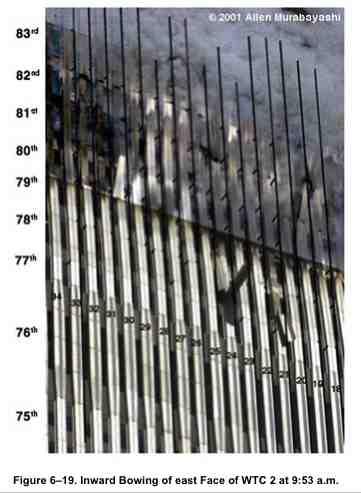
Oh noes! Buckling, right?
But look at this:


They just set it up to look like the columns were buckling inward by taking advantage of the appearance of the aluminum panels above the alleged buckling columns, the angle at which the photo was taken (and the angle at which the sides of the panels are portrayed), etc.
Btw, I didn't draw a line across the edge of that one paneling because something funky was going on with it hanging off the side there. Nonetheless, the columns aren't buckling. NIST is just playing with your eyes.
Simulations and tests show that the steel was heated to those sorts of temperatures, what's your evidence to say it wasn't?
The steel was not glowing, there was no widespread window shattering from heat (they would shatter from heat when heated to around 600 C, but, instead, windows were only opened/knocked out by victims, the impacts, and subsequent failures of a few of the aluminum panels that the glass rested on failed), and the fires did not spread to other floors (typical of intense office fires in skyscrapers, and would be especially expected if the trusses between floors were under extreme heat), for starters.
But really, you're asking me to prove a negative here.
It's your responsibility to prove that those fires WERE heating the steel to 600 C and beyond.
I started this because I got fed up with you flaunting around the 250 deg C figure like it was the final word to prove that the fires didn't get the steel hot enough. I'm just pointing out that it is not proof of anything and not even a fair representation even in NISTs book!...
And I'm pointing out that you guys have absolutely no evidence to back up your claims of failures from heat! And I can do that all I want until you come up with something. To expect roaming fires, that don't even stay in one place for very long, to heat 60% of the immense numbers of thick steel columns on a given floor to 600 C in less than an hour... isn't extremely logical.
******s you're right.. I wrote this lovely new sarcastic post with lots of good arguments, only in researching it I found this:
'Red, visible in sunlight--1077 degrees F (580.55 deg C)'
So while I doubt it would be as bright as your picture, which was probably 700 - 800 deg C. That site does say it would be visible actually in Sunlight..
Uh sorry.. :p
I shall iron my hands...
This'll be me then...
But is it possible that the inside of the exterior columns could be hotter than the outside?
And what about the core, too few samples were used for tests to ascertain a definate temperature based on physical evidence in such a way.
[edit on 23-1-2006 by AgentSmith]
Red, visible in dark---------752 degrees F
Red, visible in twilight----885 degrees F
Red, visible in daylight----975 degrees F
Red, visible in sunlight--1077 degrees F
user.netonecom.net...
'Red, visible in sunlight--1077 degrees F (580.55 deg C)'
So while I doubt it would be as bright as your picture, which was probably 700 - 800 deg C. That site does say it would be visible actually in Sunlight..
Uh sorry.. :p
I shall iron my hands...
This'll be me then...
But is it possible that the inside of the exterior columns could be hotter than the outside?
And what about the core, too few samples were used for tests to ascertain a definate temperature based on physical evidence in such a way.
[edit on 23-1-2006 by AgentSmith]
I have reread the threads, and it seems one thing keeps getting overlooked, and that is the fireproofing that was removed from teh steel. There is a
reason that it is there, to protect the steel in case of fire and the high temperatures that would be caused from the intense heat of the objects on
each floor, such as office equipment and carpeting in case of an office fire. Highly flammable.
I am sure that in 1972 they were not designing this thing to withstand an airplane striking the building. Earthquake proof and a palne sacking you at 560 mph 3/4 of the way up are 2 totally different things. They also designed them as two towers, with no structure leading up and making a base for the buildings, which may have saved other structures, such as the plane that hit the Empire State building. (the plane was much smaller also)
Again I ask, is there any evidence of controlled demolition? THis arguement about the color of steel is quite entertaining, however, I am pretty sure that that 1000's of gallons of jet fuel added to highly combustible office materials makes for one hell of a fire. It raged for close to an hour, and then it came down.
channel.nationalgeographic.com...
Take a look at that, those are some pretty heavy fires. Look at the color of the floors 'above the fire' and to me it looks like it is almost glowing from the heat. That is not a reflection.
I am sure that in 1972 they were not designing this thing to withstand an airplane striking the building. Earthquake proof and a palne sacking you at 560 mph 3/4 of the way up are 2 totally different things. They also designed them as two towers, with no structure leading up and making a base for the buildings, which may have saved other structures, such as the plane that hit the Empire State building. (the plane was much smaller also)
Again I ask, is there any evidence of controlled demolition? THis arguement about the color of steel is quite entertaining, however, I am pretty sure that that 1000's of gallons of jet fuel added to highly combustible office materials makes for one hell of a fire. It raged for close to an hour, and then it came down.
channel.nationalgeographic.com...
Take a look at that, those are some pretty heavy fires. Look at the color of the floors 'above the fire' and to me it looks like it is almost glowing from the heat. That is not a reflection.
Originally posted by AgentSmith
But is it possible that the inside of the exterior columns could be hotter than the outside?
Steel conducts heat extremely well (the heat would carry fast throughout the steel), and I think the columns were hollow.
At least, these diagrams suggest that:
And what about the core, too few samples were used for tests to ascertain a definate temperature based on physical evidence in such a way.
I don't think anyone is claiming a core failure caused the collapses anymore. Those things were beasts. Trusses maybe, but then we should've seen a hell of a lot of buckling if we are to believe that truss failure caused global collapse.
Esdad,
None of that is relevant, because if the steel was heated to any critical temperature in which fireproofing would be handy, it would've glowed, but none of the exterior columns did. If the trusses were heated to such critical temperatures, the fires should've jumped floors. Fireproofing is irrelevant when the steel is only 200 or 300 C.
Originally posted by bsbray11
I don't think anyone is claiming a core failure caused the collapses anymore. Those things were beasts.
Not really, they had transitioned into standard I-beams before the impact floors.
Originally posted by HowardRoark
Not really, they had transitioned into standard I-beams before the impact floors.
Oh, really? Even in WTC2?
I'd love to see the construction drawings showing that, Howard.
bsbray11
Your only arguement is the heat of the steel, which you have no conclusive proof to back. Where are you continuing to get the factoid that ALL the steel in the WTC only reached 200-300 degrees? Is it from the report that took samples from 1 % of the steel that remined.
Again, I ask, where is the proof of the controlled demolitions?
(crickets)
www.greatbuildings.com...
the central core takes only the gravity loads of the building...>Remember the line I had on gravity? If you take away that simple struture, there is nothing to hold the rest of the building up.
And this is also good, which explains heat and fire and how there were several things that contributed to the collapse. Fireproofing also made a difference
www.tms.org...
This is not a matter of conspiracy unless you can give me definitive proof of controlled demolition. I have provided more than enough 'credible' links to support my arguement, now it is time for some hard evidence on a controlled demolition.
Your only arguement is the heat of the steel, which you have no conclusive proof to back. Where are you continuing to get the factoid that ALL the steel in the WTC only reached 200-300 degrees? Is it from the report that took samples from 1 % of the steel that remined.
Again, I ask, where is the proof of the controlled demolitions?
(crickets)
The structural system, deriving from the I.B.M. Building in Seattle, is impressively simple. The 208-foot wide facade is, in effect, a prefabricated steel lattice, with columns on 39-inch centers acting as wind bracing to resist all overturning forces; the central core takes only the gravity loads of the building. A very light, economical structure results by keeping the wind bracing in the most efficient place, the outside surface of the building, thus not transferring the forces through the floor membrane to the core, as in most curtain-wall structures. Office spaces will have no interior columns. In the upper floors there is as much as 40,000 square feet of office space per floor. The floor construction is of prefabricated trussed steel, only 33 inches in depth, that spans the full 60 feet to the core, and also acts as a diaphragm to stiffen the outside wall against lateral buckling forces from wind-load pressures.
www.greatbuildings.com...
the central core takes only the gravity loads of the building...>Remember the line I had on gravity? If you take away that simple struture, there is nothing to hold the rest of the building up.
The additional problem was distortion of the steel in the fire. The temperature of the fire was not uniform everywhere, and the temperature on the outside of the box columns was clearly lower than on the side facing the fire. The temperature along the 18 m long joists was certainly not uniform. Given the thermal expansion of steel, a 150°C temperature difference from one location to another will produce yield-level residual stresses. This produced distortions in the slender structural steel, which resulted in buckling failures. Thus, the failure of the steel was due to two factors: loss of strength due to the temperature of the fire, and loss of structural integrity due to distortion of the steel from the non-uniform temperatures in the fire.
And this is also good, which explains heat and fire and how there were several things that contributed to the collapse. Fireproofing also made a difference
The World Trade Center was not defectively designed. No designer of the WTC anticipated, nor should have anticipated, a 90,000 L Molotov cocktail on one of the building floors. Skyscrapers are designed to support themselves for three hours in a fire even if the sprinkler system fails to operate. This time should be long enough to evacuate the occupants. The WTC towers lasted for one to two hours—less than the design life, but only because the fire fuel load was so large. No normal office fires would fill 4,000 square meters of floor space in the seconds in which the WTC fire developed. Usually, the fire would take up to an hour to spread so uniformly across the width and breadth of the building. This was a very large and rapidly progressing fire (very high heat but not unusually high temperature). Further information about the design of the WTC can be found on the World Wide Web.
www.tms.org...
This is not a matter of conspiracy unless you can give me definitive proof of controlled demolition. I have provided more than enough 'credible' links to support my arguement, now it is time for some hard evidence on a controlled demolition.
Originally posted by esdad71
the central core takes only the gravity loads of the building...>Remember the line I had on gravity? If you take away that simple struture, there is nothing to hold the rest of the building up.
Not true. The central core had it's own lateral supports. This would give the central core way more stability than NIST, FEMA, the government wants us to think. The lateral supports are even shown in NIST's little diagram of a typical floor. There is no way that those columns went 110 stories without lateral support. Which would give the core structure lateral strength.
Meaning that if it was the supports of the floors that failed, the floors would have fallen, leaving most of the core standing. We actually see this in tower 2 (I believe) until something brings the core down after the floors fell around it.
It amazes me that people do not read what is posted..
Please follow the links provided for more in depth explanation. It is actually very informative. I am sorry but I am taking a common sense approach to this rather than a conspiracy plot. You have a 100 story building, basically cut in half, and in the articles it expalins the buckinling inward whcihc is why it did not topple.
Again, if the heat did not cause the collapse, where is the evidence of controlled demolition?
This produced distortions in the slender structural steel, which resulted in buckling failures. Thus, the failure of the steel was due to two factors: loss of strength due to the temperature of the fire, and loss of structural integrity due to distortion of the steel from the non-uniform temperatures in the fire.
Please follow the links provided for more in depth explanation. It is actually very informative. I am sorry but I am taking a common sense approach to this rather than a conspiracy plot. You have a 100 story building, basically cut in half, and in the articles it expalins the buckinling inward whcihc is why it did not topple.
Again, if the heat did not cause the collapse, where is the evidence of controlled demolition?
If that last post is referring to me, I never said anything about demolitions. I said 'something'. Something could be demolitions, it could be
lateral forces from the already downed floors, it could be anything. I never speculated what IT was.
As far as your quotes about the fires distorting the trusses. That has nothing to do with the core columns, except the lateral forces (stresses) on the core. That is why I said that the core had it's own lateral bracing. Now, if the stresses were big enough to overcome the lateral resistance of the core, I do not know. Is anyone a metalurgist in here that could tell us the coefficient of heat transfer in steel and also the elongation coefficient? We could then calculate the elongation of the steel and see if that would be enough force to have any effect on the lateral stability of the core. This is only at the failure floors. The core falling after most of the tower is a different story. The core at the bottom was massive and would have taken an enormous amount to topple it. Whether the stresses from the already fallen debris was enough? I don't know and neither does anyone else.
Just so you know, there were also 'controll joints' in the supports of the floors, so lateral forces from elongation would at least have been minimized in my opinion.
[edit on 24-1-2006 by Griff]
As far as your quotes about the fires distorting the trusses. That has nothing to do with the core columns, except the lateral forces (stresses) on the core. That is why I said that the core had it's own lateral bracing. Now, if the stresses were big enough to overcome the lateral resistance of the core, I do not know. Is anyone a metalurgist in here that could tell us the coefficient of heat transfer in steel and also the elongation coefficient? We could then calculate the elongation of the steel and see if that would be enough force to have any effect on the lateral stability of the core. This is only at the failure floors. The core falling after most of the tower is a different story. The core at the bottom was massive and would have taken an enormous amount to topple it. Whether the stresses from the already fallen debris was enough? I don't know and neither does anyone else.
Just so you know, there were also 'controll joints' in the supports of the floors, so lateral forces from elongation would at least have been minimized in my opinion.
[edit on 24-1-2006 by Griff]
new topics
-
Tucker Carlson interviews Christian pastor from Bethlehem.
Middle East Issues: 1 hours ago -
Trump To Hold Dinner with President of Poland At Trump Tower Tonight
2024 Elections: 2 hours ago -
A family from Kansas with six children moved to the Moscow region
Other Current Events: 5 hours ago -
Revolution in advertising: the Russians launched a unique satellite
Science & Technology: 7 hours ago -
Echo & The Bunnymen - The Killing Moon!
Music: 10 hours ago
top topics
-
The US Supreme Court Appears to Side With the January 6th 2021 Capitol Protestors.
Political Conspiracies: 16 hours ago, 22 flags -
That which the "news" never talks about; Truth about election fraud
Mainstream News: 17 hours ago, 15 flags -
I Guess Cloud Seeding Works
Fragile Earth: 12 hours ago, 13 flags -
Biden doesnt want the votes of "Death to America" chanters
US Political Madness: 17 hours ago, 10 flags -
Canadian Forces bow out and loose interest in UFO’s
Aliens and UFOs: 13 hours ago, 6 flags -
Trump To Hold Dinner with President of Poland At Trump Tower Tonight
2024 Elections: 2 hours ago, 5 flags -
Revolution in advertising: the Russians launched a unique satellite
Science & Technology: 7 hours ago, 5 flags -
A family from Kansas with six children moved to the Moscow region
Other Current Events: 5 hours ago, 4 flags -
Echo & The Bunnymen - The Killing Moon!
Music: 10 hours ago, 3 flags -
Tucker Carlson interviews Christian pastor from Bethlehem.
Middle East Issues: 1 hours ago, 2 flags
active topics
-
Trump To Hold Dinner with President of Poland At Trump Tower Tonight
2024 Elections • 4 • : CriticalStinker -
How does my computer know
Education and Media • 30 • : BernnieJGato -
Anti-Israel Protesters in CHICAGO Chant 'Death to Israel and 'Death to America'
Social Issues and Civil Unrest • 47 • : namehere -
The US Supreme Court Appears to Side With the January 6th 2021 Capitol Protestors.
Political Conspiracies • 29 • : ImagoDei -
A family from Kansas with six children moved to the Moscow region
Other Current Events • 40 • : RussianTroll -
Echo & The Bunnymen - The Killing Moon!
Music • 9 • : JJproductions -
Tucker Carlson interviews Christian pastor from Bethlehem.
Middle East Issues • 5 • : NorthOS -
-@TH3WH17ERABB17- -Q- ---TIME TO SHOW THE WORLD--- -Part- --44--
Dissecting Disinformation • 498 • : Thoughtful3 -
Running Through Idiot Protestors Who Block The Road
Rant • 90 • : stu119 -
Revolution in advertising: the Russians launched a unique satellite
Science & Technology • 41 • : RussianTroll