It looks like you're using an Ad Blocker.
Please white-list or disable AboveTopSecret.com in your ad-blocking tool.
Thank you.
Some features of ATS will be disabled while you continue to use an ad-blocker.

New Generation Dogfighting Missiles
page: 2share:
I think America adopted the AIM 9X when they pulled out of the ASRAAM programme so it can be said to be broadly the same, some Americans will say the
AIM-9X is better, some Europerans will say it isn't but they're pretty much the same overall.
edit, thats a 'yes' by the way
[edit on 2-2-2006 by waynos]
edit, thats a 'yes' by the way
[edit on 2-2-2006 by waynos]
The K-30 is said to be the next Russian new gen dogfighting missile. The same is said to replace the R-73 and all its various variants. Again reports
are said to link it to India. Some other older reports link it to Ukraine.
The K-30 is said to be much more advanced than the R-74 developmental missile (nicknamed "digital R-73") - which was essentiallty a vastly improved R-73 M3 & R-73 EL. with a new and very effective seeker and 80 degree off-boresight ability in addition to gimballed rocket nozzle which reduces thrust vectoring losses and an improved propellant.
The Arsenal OKB of Kiev are said to have built a new seeker head for the R-73 - called the Mk-80, along with an extremely sensitive warhead with very notorious improvements. The range of the very variant is said to be 10km.
Some info on the K-30 is available in Slovakian language. Hopwfully matej or someone can help out with this.
P.S : The K-30 is said to be highly optimised for an internal carriage - and is said to be intended for a Indo-Russian 5th gen airplane.
I am told that a few rare pictures of it exist on Jane's - but i have no acess to them
Please dont ask me for sources about 'cause i cannot provide you with any.
[edit on 2-2-2006 by Stealth Spy]
The K-30 is said to be much more advanced than the R-74 developmental missile (nicknamed "digital R-73") - which was essentiallty a vastly improved R-73 M3 & R-73 EL. with a new and very effective seeker and 80 degree off-boresight ability in addition to gimballed rocket nozzle which reduces thrust vectoring losses and an improved propellant.
The Arsenal OKB of Kiev are said to have built a new seeker head for the R-73 - called the Mk-80, along with an extremely sensitive warhead with very notorious improvements. The range of the very variant is said to be 10km.
Some info on the K-30 is available in Slovakian language. Hopwfully matej or someone can help out with this.
V ruském tisku se nedávno objevily informace o tom, že firma Vympel NPO usilovnì pracuje na novém typu støely K-30, který má konkurovat svému pøedchùdci, svìtoznámé R-73 (AA-11 ARCHER). Není zvykem, aby jedna firma vyvíjela dva navzájem si konkurující typy. Pøedpokládá se, že K-30 by mohla být zavedena do výzbroje ruského vojenského letectva již v roce 2002. Je možné, že K-30 je uvádìno pouze jako projektové oznaèení pro jiným zpùsobem zdokonalenou verzi PLØS R-73. Støela K-30 je pravdìpodobnì vybavena speciálnì vyvinutou výstupní tryskou s extrémní vychylovací schopností v kombinaci s plynovým dynamickým øízením, která v porovnání s R-73 dává støele K-30 vynikající manévrovací schopnosti, vìtší pøizpùsobivost, dosah a stabilitu v širokém rozsahu rychlostí. Øízení výkyvnou výstupní tryskou je natolik úèinné, že konstruktéøi mohli upustit od pøedních stabilizaèních a øiditelných køidélek a vybavily ji pouze zadními malými øiditelnými køidélky. Zajímavostí je kvalitativnì nová dvourežimová pasivní radiolokaèní/zobrazovací infraèervená navádìcí soustava. Støelou K-30 budou s nejvìtší pravdìpodobností vyzbrojeny zejména bojové letouny MiG-29, MiG-31, Su-27 a snad i Su-35.
P.S : The K-30 is said to be highly optimised for an internal carriage - and is said to be intended for a Indo-Russian 5th gen airplane.
I am told that a few rare pictures of it exist on Jane's - but i have no acess to them
Please dont ask me for sources about 'cause i cannot provide you with any.
[edit on 2-2-2006 by Stealth Spy]
Japan is also said to be developing a short range air to air missile - the XAAM-5. Again there is not a lot of info available on this.
www.fas.org...
www.globalsecurity.org...
This is a picture of the very missile being test fired :
__________
In addition here's more on the Python-5
www.rafael.co.il...
Official Brochure >> www.rafael.co.il...
[edit on 2-2-2006 by Stealth Spy]
To effectively deal with the future air threats in the early next century, the XAAM-5 Short Range Air-to-Air Missile IR homing dog-fighting missile will give extended lock-on range, improved off bore-sight, and enhanced IRCCM capabilities.
www.fas.org...
www.globalsecurity.org...
This is a picture of the very missile being test fired :
__________
In addition here's more on the Python-5
Python 5 combines advanced new technologies with operationally proven Python 4 components. The missile incorporates a new dual waveband imaging seeker, advanced computer architecture, Inertial Navigation System (INS), sophisticated Infra-Red Counter-Counter-Measures (IRCCM) and sophisticated flight control algorithms.
Python 5 maintains Python 4’s unique aerodynamic airframe, INS, powerful rocket motor, warhead and proximity fuze.
Python 5 provides revolutionary full sphere competence, achieved by a combination of Lock-On-After-Launch (LOAL) and excellent acquisition and tracking capabilities. Its dual waveband Focal Plane Array (FPA) seeker and sophisticated algorithms enable acquisition of even small, low signature targets in Look-Down, adverse background and cloudy environments.
www.rafael.co.il...
Official Brochure >> www.rafael.co.il...
[edit on 2-2-2006 by Stealth Spy]
Orca,
>>
There are, of course, a number of companies that are working on the true next wave of unmanned aircraft. Dont be surprised if you see horrible little dictators and tyrants employ these more than we do at first.
>>
Not in this country. Not in a land where A-UAV weaponization of more than sailplanes is nothing less than a nightmare to be endlessly 'delayed' and fought off by those interested only in the largest discretionary budget segment (/every/ year) as a federal dole.
>>
I know of atleast one company that is going beyond just stealthy unmanned reconnasance and fighter aircraft which seem to be the vogue. Fancy aircraft are nice but theyre strategic value is inversely proportional to their unit price.
>>
If there are three most basic laws of Firepower-
1. Shoot, Shoot, Shoot.
With the cheapest, most enduring, platform. Because the more you are PRESENT to take shots, for any given SSPK, the more you will win.
2. Maneuver to Target, Not to Engage.
So that you may reserve your operational initiative by NOT coming into the briar patch as a predictably exposed ATO as much as force composite.
3. Never associate your Fires with your Targeting.
So that you do not compromise secure system databases or the bottom line with 'multirole' homogenization of performance and survivability beyond the value of the mission left undone.
Then there truly is no place for manned platforms. Because the payload loft penalty, even on the most COE-centric systems (TAV skip bombers and the like) is just so horrid for every 6X3ft 'hole' you put in the systems volume, that there is no point.
>>
Most UAV/UCAV projects are building on a very rough and early conception of these, almost as add-ons to existing military infrastructure. The key is to reform the military around the new technology. This is the real next wave. I wish I could tell you a little more about this. It's quite exciting.
>>
If you care to do so, leave me some kind of U2U and I will try to listen, objectively.
Realistic Patriot/Planeman,
>>
Great posts... you two sure know your missiles...I know this was brought up in another thread but i want to get your input CH on the AIM-54 Phoenix Missile...I know its really old but I always thought it was the US's best missile platform.. when they retired it along with the only airframe that carried it, i thought it was quite stupid. What are your thoughts?
>>
I like reach in more than fly in because I prefer wheels-in-well total control of an enemy baselane without having to come anywhere's near the target defenses. Sparrow doesn't really give you enough trajectory control to keep from having to point the nose down to satisfy gimbal limits on a conventional platform in the 15nm range. And while AMRAAM does better, it's longest ever shot was still a mere 21nm from a Dutch jet looking to bag a Serb Galeb doing roundabout orbits rather than (say) flushing away from it's nest only to come back at you as the strike package tries to egress.
This opinion will only get stronger as we move to glide-IAMs which no longer require us to cross much more than a 15nm BRL to get gliding impacts without extended laser designation orbit lags.
In any case, if you are facing an S-300 or better threat with vastly superior kinematics and potentially (9M96) a similar degree of LOAL (ARH+INS) allowing for a separate illuminator to use the battery as little more than a smart (landline LINK'd) launch box, you are better off not challenging the threat to get even a transient blip track from some bizarre aspect (or low bandwidth) and subsequently fling a Mach 5 weapon along the bearing from right under your ground track.
That said, see (below) my subsequent 'how I really feel' about the AIM-54 specifically and LRAAM in general to understand that if you make the missile cost as much as the airframe you need to loft it so that one or both can SEE a target 300-500km downrange, you have gained little or nothing when that (conventionally signatured) airframe is butchered coming into the F-22's turf.
Keep in mind folks, P3I is a /phased series of upgrade steps/ not any one variant of AMRAAM but many. In this, it is not unlike the 'MSIP' by which F-15/16 gained capabilities within separate block numbers of the same 'model' (A or C)airframe. As such, when they repackaged the AIM-120 guidance section and warhead using MMIC/VHSIC circuitry, along about the AIM-120C4, they effectively created _ELEVEN INCHES_ of dead space in the missile. Five of those inches were immediately taken up by the AIM-120C5 motor extension. The remaining 7 are still spacered-out. According to what I read, the AIM-120C6 is a USAF version which uses some of all of this area to support yet another 'enhanced' warhead system designed to accomodat the very fast missile velocities of a Supercruise (F-22) launch scenario. It is essentially a directed warhead that fires forward, along the missile vector. AIM-120C7 is the USN response to a need for an AMRAAM with more positive control of it's kinematics inherent to a new digital autopilot and GPS/INS navigator which provides more consistent downrange shot control (time of flight to Xnm) so that the F-18E/F are not completely outclassed by their slug-bug low PS numbers and non-existance acceleration, over the Mach. That leaves the AIM-120C8, which has occasionally been called the 'AIM-120D', to incorporate what we are all looking for in these missiles:
1. Digital Datalinks.
Allowing separate 'Illuminator/Spear Chucker' tactics, (based on you shoot, I drive midcourse guidance support). These will more or less provide robust time of flight parameters (as viewed on the pilots countdown clock) for any given shot conditions as well as allowing X to shoot closer than Y before /immediately/ turning away from continued closure. i.e. Finally a reason to have a 300km capable radar.
2. ERAAM level biplateau/throttleable solid or gel impulse.
So that we can tailor each shot to the 'is he FQ closing or is he tail-chase running away' for pole separation and overtake without totally compromising the missiles endgame performance. At the time (1993 or so) the U.S. was urgently lobbying Britain NOT to go with the BVRAAM, it was said that Raytheon's ERAAM (extended range AAM) could achieve 80% of it's projected performance for about 50% of the development cost by essentially sticking with the AIM-120 baseline and just using a new motor. The Brits wanted independent GCS/ECCM which we wouldn't yield on (they later got them through the AD4A seeker on the MICA) and in the end, BVRAAM was just plain better for what they need to do (max standoff with a conventionally signatured Typhoon that looks 'similar' to the F-22's BVR exchange ratio vs. other conventionally signatured threats like the Su-30. Without raising the principle-threat spectre of S2A vulnerability). AIM-120D or 'whatever comes next' is likely this missile. And while it will not allow a Super Horror to beat a Meteor equipped Eurofighter or Rafale, it will likely allow an F-22 to score 40-60nm wheel in well kills while playing 'sniper rifle in a shopping cart' (no supersonics to impale itself on the larger threat poles). Such being the case book definition of look-in/reach-in, IMO.
>>
quote: Novator R-172 The R-172,previouslydesignated the KS-172, is adeparture from the establishedfocus of Novator, designers ofthe S-300V (SA-12) system'slong range SAMs. Like the R-37,the R-172 was developed as an'AWACS killer'. The missile employs an active radar seeker and inertial midcourseguidance.Two configurations are known, with and without a booster pack.With the boosterthe missile is claimed to achieve a range of 215 NMI, without 160 NMI. Cited seekerperformance is similar to the R-37.While the R-172 is less mature than the R-37, India hasrecently negotiated an arrangement to fund final development and licence produce theweapon, not unlike the extant deal to licence the Yakhont as the BrahMos
>>
First off, it really should be Ks-172 which, if strictly parsed to the /original/ Russian designation system would mean 'komplex' or complete missile system including launcher and 'boosted' or 'plus stage'. This would be separate from an industry/MOD internal 'article' or Zdeliya number which has about six total fields defining who-what-does-how-when-in-series. The appropriate designators now being put forward for the 'Rakete' (literally) Rocket (missile itself) are actually R-72 and R-90.
Also worthy of note, the Russians have blown completely their system of not applying an 'in service' designator to both aircraft and missiles in a desparate attempt to 'promise the world' (you buy it, we'll call it real as we build it). Thus you have R-## weapons which are still testbeds and S-## which are being given design bureau codes (S-37 vs. Su-47 etc.).
In any case, while I don't know what the purpose of discussing LRAAM is in an 'new generation dogfighting missiles' thread, it helps if you don't screw things up anymore than the Russians already have: R-72 or R-90. NATO will of course remove the 'X' from the middle of the AA-13 or 14 designator as soon as it becomes clear whether this is both a production weapon and truly one of Russian intended service or merely technology coal bed which the Indians are mining for their own system (much as their ASTRA is basically AA-12 tech without the stupid GDV fins).
www.johnstonsarchive.net...
www.designation-systems.net...
I also believe that the association of the Ks-172 with the S-300V is in error. As the missile most noteably near-identical (as a function of size and performance envelope) to the AAM-L is in fact the (Almaz accredited but IMO, far more likely to be Novator) 9m96 weapon of the 'S-400' system. The S-300V (Antey 2500) upgrade weapon is based around the 9M82M missile which is most likely the 'Big Missile' that everyone has been talking about for the S-400.
The reason a certain kind of 'visual common sense' is important is simple.
9M96
www.military.cz...
PAC-3 ERINT
pvo.guns.ru...
www.kojii.net...
Ks-172
www.military.cz...
img58.exs.cx...
www.mipagina.cantv.net...
The first two (S2A) weapons systems are classed as 120km and 15-45km weapons against aircraft and missiles respectively. Indeed, PAC-3 is ONLY considered optimized for 'lower tier' ATBM work in support of the THAAD as a missile interceptor which is why it's range classification is generally looked at disbelievingly (Even though some publications put it's achieved Mach point at 5.7, or faster than the 9M96, which would indicate a very long loft). Yet there are two conditions here which are important.
1. Does it need to do better?
For S2A systems, it is actually quite hard to tailer an aeroballistic trajectory to get optimum downrange, time of flight and terminal behaviours from one parabolic arc. Something we have repeatedly discoverred in trying to engineer the Navy Excalibur/CLGP round and the SM.4/4a among others. Straight line trajectories are much easier to do, even though the achieved downrange distances are shorter, because they multiply weapon energy tremendously which in turn lowers time of flight and simplifies 'dropout' (negative lead as an altitude cube and fuzing effect) on the missile endgame kinematics compared to lofted rounds. When added to the tremendous Q penalty of low altitude firings the inevitable result is that a round which flies twice as fast as AMRAAM may not be _required_ to fly any further (20-22nm downrange).
2. Radar Horizoning and TOF.
Even with Mountain Top and similar 'Illuminator' (offboard guidance) networking construct experiments, you are lucky if the missile+midcourse system can see the target at more than about twice surface LOS or roughly 20nm for medium altitude targets and 40nm at high. Jamming effects aside, you are looking at a 25 and 53 seconds to these ranges which is quite aways. IF THE WEAPON CAN SUSTAIN MACH. And if the target remains in the WEZ which must, of necessity, include the tracking cube around the subject vehicle which is itself subject to various F-Pole maneuvers based on either detection of uplink and high PRF/dwell based tracking 'activity' indications (TWS is not itself an immunity from track warning) by an advanced RWR. Or via MAWS systems and indeed, even simple NVD on the helmet if the engagement is happening at night under suitable visibility conditions.
IMO, A2A has similar yet reversed conditional modifiers in that it's not how far downrange you can see them but how LONG they can see you. Where, to be effective against HVA/ISR type threats, you may be looking at LOS ranges that may well exceed 500km at height. Yet the LRAAM launch aircraft does not really provide significant improvement kinematics to overcome any range extension deficit (assuming the missile is itself capable of sustaining a Mach 7-8 midcourse and snapdown from near-vac loft of 100,000ft or more) because it cannot assuredly provide (survivable) midcourse guidance over the period of time required to 'get there', behind the missile. Indeed, with the /original/ (Ks-172) AAM-L spec'ing out to about 24ft long and 1,650lbs, it is questionable as to whether the launch aircraft could even function as a useful 'first stage' boost vehicle since carriage penalties would be considerable-
www.aircraftresourcecenter.com...
It is worth of noting that the Indian AF ideal for 'Mixed Fighter Force Concepts' or 'Cooperative Fighter Ops' employment of LRAAM would have you believe that even smaller aircraft (LCA= throwaway) would be the best choice for granting initial missile boost while the Su-30 remains 'firmly subsonic and a decent (say discrete) distance' stood off behind the lot.
www.indiadefence.com...
This might work in the sense of providing the Su-30 a speedbump of defensive escorts. But it would not be possible if a larger motor is the sole way to make the smaller fighter competitive in a netcentric engagement environment. And as soon as the Flanker commits to a sprint, there is not thing any screen can do to keep it from impaling itself (or running out of gas for the return trip).
Why is this time vs. range modfier so important? Because a Mach 5 TOF to even just 300km (163nm) is on the order of 208 seconds or approximately Three and a Half minutes. Three and a half minutes for even an E-3 AWACS is on the order of 24 miles worth of 'fall of shot' scatter adjustment on a lofted round. And particularly if your weapon homing is ARM based (but even really if it is just INS+ARH without constant updates to at least
>>
There are, of course, a number of companies that are working on the true next wave of unmanned aircraft. Dont be surprised if you see horrible little dictators and tyrants employ these more than we do at first.
>>
Not in this country. Not in a land where A-UAV weaponization of more than sailplanes is nothing less than a nightmare to be endlessly 'delayed' and fought off by those interested only in the largest discretionary budget segment (/every/ year) as a federal dole.
>>
I know of atleast one company that is going beyond just stealthy unmanned reconnasance and fighter aircraft which seem to be the vogue. Fancy aircraft are nice but theyre strategic value is inversely proportional to their unit price.
>>
If there are three most basic laws of Firepower-
1. Shoot, Shoot, Shoot.
With the cheapest, most enduring, platform. Because the more you are PRESENT to take shots, for any given SSPK, the more you will win.
2. Maneuver to Target, Not to Engage.
So that you may reserve your operational initiative by NOT coming into the briar patch as a predictably exposed ATO as much as force composite.
3. Never associate your Fires with your Targeting.
So that you do not compromise secure system databases or the bottom line with 'multirole' homogenization of performance and survivability beyond the value of the mission left undone.
Then there truly is no place for manned platforms. Because the payload loft penalty, even on the most COE-centric systems (TAV skip bombers and the like) is just so horrid for every 6X3ft 'hole' you put in the systems volume, that there is no point.
>>
Most UAV/UCAV projects are building on a very rough and early conception of these, almost as add-ons to existing military infrastructure. The key is to reform the military around the new technology. This is the real next wave. I wish I could tell you a little more about this. It's quite exciting.
>>
If you care to do so, leave me some kind of U2U and I will try to listen, objectively.
Realistic Patriot/Planeman,
>>
Great posts... you two sure know your missiles...I know this was brought up in another thread but i want to get your input CH on the AIM-54 Phoenix Missile...I know its really old but I always thought it was the US's best missile platform.. when they retired it along with the only airframe that carried it, i thought it was quite stupid. What are your thoughts?
>>
I like reach in more than fly in because I prefer wheels-in-well total control of an enemy baselane without having to come anywhere's near the target defenses. Sparrow doesn't really give you enough trajectory control to keep from having to point the nose down to satisfy gimbal limits on a conventional platform in the 15nm range. And while AMRAAM does better, it's longest ever shot was still a mere 21nm from a Dutch jet looking to bag a Serb Galeb doing roundabout orbits rather than (say) flushing away from it's nest only to come back at you as the strike package tries to egress.
This opinion will only get stronger as we move to glide-IAMs which no longer require us to cross much more than a 15nm BRL to get gliding impacts without extended laser designation orbit lags.
In any case, if you are facing an S-300 or better threat with vastly superior kinematics and potentially (9M96) a similar degree of LOAL (ARH+INS) allowing for a separate illuminator to use the battery as little more than a smart (landline LINK'd) launch box, you are better off not challenging the threat to get even a transient blip track from some bizarre aspect (or low bandwidth) and subsequently fling a Mach 5 weapon along the bearing from right under your ground track.
That said, see (below) my subsequent 'how I really feel' about the AIM-54 specifically and LRAAM in general to understand that if you make the missile cost as much as the airframe you need to loft it so that one or both can SEE a target 300-500km downrange, you have gained little or nothing when that (conventionally signatured) airframe is butchered coming into the F-22's turf.
Keep in mind folks, P3I is a /phased series of upgrade steps/ not any one variant of AMRAAM but many. In this, it is not unlike the 'MSIP' by which F-15/16 gained capabilities within separate block numbers of the same 'model' (A or C)airframe. As such, when they repackaged the AIM-120 guidance section and warhead using MMIC/VHSIC circuitry, along about the AIM-120C4, they effectively created _ELEVEN INCHES_ of dead space in the missile. Five of those inches were immediately taken up by the AIM-120C5 motor extension. The remaining 7 are still spacered-out. According to what I read, the AIM-120C6 is a USAF version which uses some of all of this area to support yet another 'enhanced' warhead system designed to accomodat the very fast missile velocities of a Supercruise (F-22) launch scenario. It is essentially a directed warhead that fires forward, along the missile vector. AIM-120C7 is the USN response to a need for an AMRAAM with more positive control of it's kinematics inherent to a new digital autopilot and GPS/INS navigator which provides more consistent downrange shot control (time of flight to Xnm) so that the F-18E/F are not completely outclassed by their slug-bug low PS numbers and non-existance acceleration, over the Mach. That leaves the AIM-120C8, which has occasionally been called the 'AIM-120D', to incorporate what we are all looking for in these missiles:
1. Digital Datalinks.
Allowing separate 'Illuminator/Spear Chucker' tactics, (based on you shoot, I drive midcourse guidance support). These will more or less provide robust time of flight parameters (as viewed on the pilots countdown clock) for any given shot conditions as well as allowing X to shoot closer than Y before /immediately/ turning away from continued closure. i.e. Finally a reason to have a 300km capable radar.
2. ERAAM level biplateau/throttleable solid or gel impulse.
So that we can tailor each shot to the 'is he FQ closing or is he tail-chase running away' for pole separation and overtake without totally compromising the missiles endgame performance. At the time (1993 or so) the U.S. was urgently lobbying Britain NOT to go with the BVRAAM, it was said that Raytheon's ERAAM (extended range AAM) could achieve 80% of it's projected performance for about 50% of the development cost by essentially sticking with the AIM-120 baseline and just using a new motor. The Brits wanted independent GCS/ECCM which we wouldn't yield on (they later got them through the AD4A seeker on the MICA) and in the end, BVRAAM was just plain better for what they need to do (max standoff with a conventionally signatured Typhoon that looks 'similar' to the F-22's BVR exchange ratio vs. other conventionally signatured threats like the Su-30. Without raising the principle-threat spectre of S2A vulnerability). AIM-120D or 'whatever comes next' is likely this missile. And while it will not allow a Super Horror to beat a Meteor equipped Eurofighter or Rafale, it will likely allow an F-22 to score 40-60nm wheel in well kills while playing 'sniper rifle in a shopping cart' (no supersonics to impale itself on the larger threat poles). Such being the case book definition of look-in/reach-in, IMO.
>>
quote: Novator R-172 The R-172,previouslydesignated the KS-172, is adeparture from the establishedfocus of Novator, designers ofthe S-300V (SA-12) system'slong range SAMs. Like the R-37,the R-172 was developed as an'AWACS killer'. The missile employs an active radar seeker and inertial midcourseguidance.Two configurations are known, with and without a booster pack.With the boosterthe missile is claimed to achieve a range of 215 NMI, without 160 NMI. Cited seekerperformance is similar to the R-37.While the R-172 is less mature than the R-37, India hasrecently negotiated an arrangement to fund final development and licence produce theweapon, not unlike the extant deal to licence the Yakhont as the BrahMos
>>
First off, it really should be Ks-172 which, if strictly parsed to the /original/ Russian designation system would mean 'komplex' or complete missile system including launcher and 'boosted' or 'plus stage'. This would be separate from an industry/MOD internal 'article' or Zdeliya number which has about six total fields defining who-what-does-how-when-in-series. The appropriate designators now being put forward for the 'Rakete' (literally) Rocket (missile itself) are actually R-72 and R-90.
Also worthy of note, the Russians have blown completely their system of not applying an 'in service' designator to both aircraft and missiles in a desparate attempt to 'promise the world' (you buy it, we'll call it real as we build it). Thus you have R-## weapons which are still testbeds and S-## which are being given design bureau codes (S-37 vs. Su-47 etc.).
In any case, while I don't know what the purpose of discussing LRAAM is in an 'new generation dogfighting missiles' thread, it helps if you don't screw things up anymore than the Russians already have: R-72 or R-90. NATO will of course remove the 'X' from the middle of the AA-13 or 14 designator as soon as it becomes clear whether this is both a production weapon and truly one of Russian intended service or merely technology coal bed which the Indians are mining for their own system (much as their ASTRA is basically AA-12 tech without the stupid GDV fins).
www.johnstonsarchive.net...
www.designation-systems.net...
I also believe that the association of the Ks-172 with the S-300V is in error. As the missile most noteably near-identical (as a function of size and performance envelope) to the AAM-L is in fact the (Almaz accredited but IMO, far more likely to be Novator) 9m96 weapon of the 'S-400' system. The S-300V (Antey 2500) upgrade weapon is based around the 9M82M missile which is most likely the 'Big Missile' that everyone has been talking about for the S-400.
The reason a certain kind of 'visual common sense' is important is simple.
9M96
www.military.cz...
PAC-3 ERINT
pvo.guns.ru...
www.kojii.net...
Ks-172
www.military.cz...
img58.exs.cx...
www.mipagina.cantv.net...
The first two (S2A) weapons systems are classed as 120km and 15-45km weapons against aircraft and missiles respectively. Indeed, PAC-3 is ONLY considered optimized for 'lower tier' ATBM work in support of the THAAD as a missile interceptor which is why it's range classification is generally looked at disbelievingly (Even though some publications put it's achieved Mach point at 5.7, or faster than the 9M96, which would indicate a very long loft). Yet there are two conditions here which are important.
1. Does it need to do better?
For S2A systems, it is actually quite hard to tailer an aeroballistic trajectory to get optimum downrange, time of flight and terminal behaviours from one parabolic arc. Something we have repeatedly discoverred in trying to engineer the Navy Excalibur/CLGP round and the SM.4/4a among others. Straight line trajectories are much easier to do, even though the achieved downrange distances are shorter, because they multiply weapon energy tremendously which in turn lowers time of flight and simplifies 'dropout' (negative lead as an altitude cube and fuzing effect) on the missile endgame kinematics compared to lofted rounds. When added to the tremendous Q penalty of low altitude firings the inevitable result is that a round which flies twice as fast as AMRAAM may not be _required_ to fly any further (20-22nm downrange).
2. Radar Horizoning and TOF.
Even with Mountain Top and similar 'Illuminator' (offboard guidance) networking construct experiments, you are lucky if the missile+midcourse system can see the target at more than about twice surface LOS or roughly 20nm for medium altitude targets and 40nm at high. Jamming effects aside, you are looking at a 25 and 53 seconds to these ranges which is quite aways. IF THE WEAPON CAN SUSTAIN MACH. And if the target remains in the WEZ which must, of necessity, include the tracking cube around the subject vehicle which is itself subject to various F-Pole maneuvers based on either detection of uplink and high PRF/dwell based tracking 'activity' indications (TWS is not itself an immunity from track warning) by an advanced RWR. Or via MAWS systems and indeed, even simple NVD on the helmet if the engagement is happening at night under suitable visibility conditions.
IMO, A2A has similar yet reversed conditional modifiers in that it's not how far downrange you can see them but how LONG they can see you. Where, to be effective against HVA/ISR type threats, you may be looking at LOS ranges that may well exceed 500km at height. Yet the LRAAM launch aircraft does not really provide significant improvement kinematics to overcome any range extension deficit (assuming the missile is itself capable of sustaining a Mach 7-8 midcourse and snapdown from near-vac loft of 100,000ft or more) because it cannot assuredly provide (survivable) midcourse guidance over the period of time required to 'get there', behind the missile. Indeed, with the /original/ (Ks-172) AAM-L spec'ing out to about 24ft long and 1,650lbs, it is questionable as to whether the launch aircraft could even function as a useful 'first stage' boost vehicle since carriage penalties would be considerable-
www.aircraftresourcecenter.com...
It is worth of noting that the Indian AF ideal for 'Mixed Fighter Force Concepts' or 'Cooperative Fighter Ops' employment of LRAAM would have you believe that even smaller aircraft (LCA= throwaway) would be the best choice for granting initial missile boost while the Su-30 remains 'firmly subsonic and a decent (say discrete) distance' stood off behind the lot.
www.indiadefence.com...
This might work in the sense of providing the Su-30 a speedbump of defensive escorts. But it would not be possible if a larger motor is the sole way to make the smaller fighter competitive in a netcentric engagement environment. And as soon as the Flanker commits to a sprint, there is not thing any screen can do to keep it from impaling itself (or running out of gas for the return trip).
Why is this time vs. range modfier so important? Because a Mach 5 TOF to even just 300km (163nm) is on the order of 208 seconds or approximately Three and a Half minutes. Three and a half minutes for even an E-3 AWACS is on the order of 24 miles worth of 'fall of shot' scatter adjustment on a lofted round. And particularly if your weapon homing is ARM based (but even really if it is just INS+ARH without constant updates to at least
You have voted ch1466 for the Way Above Top Secret award. You have two more votes this month.
ch1466,
Your post are like injections. I know they are good but i dont want to read it but i do anyway
ch1466,
Your post are like injections. I know they are good but i dont want to read it but i do anyway
external image
JANE'S MISSILES AND ROCKETS - MAY 01, 2004
India and Russia negotiate co-operation on KS-172 AAM
David C Isby
Russia and India are currently negotiating a long-range air-to-air missile (AAM) project as a follow-on to the joint Brahmos supersonic anti-ship cruise missile programme, writes David C Isby. The Novator Design Bureau in Yekaterinburg is developing a long-range missile designated the KS-172 or R-172 (see JMR March 2004, p1). The proposed negotiations would make available Indian investment and technical assistance.
Novator's proposed partner, India's Defence Research and Development Organisation (DRDO), is currently working on its own beyond-visual-range AAM, the Astra. A variant of the KS-172 could be used to arm India's Su-35 fighter force for use against high-value standoff targets such as radar surveillance aircraft and flight-refuelling tankers.
FORCE Mag .Volume 1 No 6 April 2004 , Page 55 .
Excerpts from the Article:
KS -172
- Joint Venture between India's DRDO and Russias NPO Novator.
SpeciFications :
- It is an ultra Long Range AAM with a Development Range of 400KMs To Target AEW/AWAC Type High Value Aircrafts.
- Sole Carrier in the Indian AF will be the Su-30MKI
Features ( Dimensions) :
- 1.4 Meter long Rocket Booster
- Weight 748Kgs
- Core Diameter 0.40 Meter , Total Lenght 6.01 Meters , Span .61 Meters
- Launched by a Solid-propellant Tandem Rocket Booster
- The KS 172 will attack its Targets with an adaptive high explosive ( HE) fragmentation warhead.
Guidance
- Secure Data-Linked Based inertial Navigation System for MidCourse Guidance ( This would probably be done by AWACS or the 2-3 MKIs Working in Tandem with their Mini AWACS Capability)
- Active Radar Homing for its Terminal Phase.
-The missile will be used against air targets flying at altitudes from 3m to 30km with speeds up to 4,000km/h and manoeuvring at up to 12g.
INDO-RUSSO CO-OPERATION
DRDO and NPO will jointly Develop:
- An Active Homing Radar Seeker with a Wide Lock-On Range Which is able to recieve targeting data from the launch AC.
- Design a combined Gas/AeroDynamic Control system with 3d TVC . Provides High Manoeuvrability irrespective of launch Conditions and allows for missle launch with AC in super Manoeuvrability flight mode.
- Create and Adaptive Rapid Reaction Autopilot Which Optimises with Missile Stabilization and control Parameters within the firing range.
- Development of Special Interaction Logic btween the KS-172 Explosive Fuse and Guidance system Which ( In addition to structural and config features) gurantees absolute immunity of the Warhead detonation system to Jamming
India, Russia negotiate partnership for a new missile
After their recent success in developing a supersonic cruise missile, Brahmos, India and Russia are negotiating a partnership for developing an ultra long range beyond-visual-range air to air missile.
The missile is at present being developed by the Russian guided weapons builder Novator and highly placed sources here indicated that India was involved in the project by way of investment and technical participation.The missile, designated so far as R-172, is being developed by the Russians to be integrated with the fifth generation aircraft, with New Delhi likely to be a customer for its export version.
The new missle, the sources said, was aimed at engaging high asset airborne targets such as AWACS aircraft, air to ground surveillance and mid air refullers, which normally operate from stand off distance during battles.
The proposed acquisition assumes significance in the wake of recent media reports that Pakistan was in the process of purchasing such a missile from western countries to counter India's moves to acquire Israeli AWACS and the recent induction of Uzbek IL-78 mid-air refuellers by the Indian Air Force.
Full Article >>
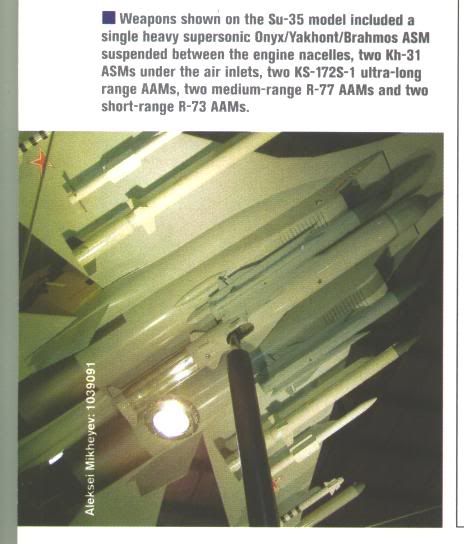
Sukhoi has displayed a model of the Su-35 multirole fighter carrying under its wings two KS-172S-1 ultra-long range air-to-air missiles, writes Piotr Butowski. The weapon is an export variant of a missile originally offered to the Russian Air Force by the Novator Company of Yekaterinburg.
Work on the KS-172 air-to-air missile began in 1991. Alternative designations 'Izdeliye 172 (K-172)' and the anglicised 'AAM-L' have also been reported. The basis of the new weapon was the second stage of the 3M83 surface-to-air missile used by the S-300V (SA-12 Gladiator) anti-aircraft system.
A full-scale mock-up of the KS-172 was shown in front of Su-27 fighter at Zhukovsky in August 1993. but over the next 10 years there was no further news of the project. The model shown late last year has a different shape to that of the mock-up shown in 1993. Both versions have a two-stage propulsion system, but in the current KS-172S-1 design the length of the tandem-mounted booster has been increased while its diameter has been reduced. The length of the missile without booster has been reduced so that the overall length of the complete round is unchanged.
According to Novator, the KS-172S-1 is 6.0m long and weighs 700kg, dimensions which are unchanged from those announced in 1993. Its diameter has been reported as 40cm.
In the 1993 design, the nose section of the missile was of smaller diameter than the rest of the fuselage, a configuration which proves additional internal volume for the rocket motor. In the current design, the fuselage is of constant diameter, and the tail-mounted cruciform control fins are of shorter span and longer chord.
Jane's :
The missile is guided to the target by a multi-mode guidance system typical for beyond-visual range missiles. In the first phase of flight, guidance is by inertial navigation with command updates in the mid-course phase. An active-radar seeker is used for terminal guidance. According to earlier reports, the missile carries a directional high-explosive (HE) fragmentation warhead, probably weighing about 50kg, and initiated by a radar proximity fuze. Maximum range of the KS-172 is 400km.The missile will be used against air targets flying at altitudes from 3m to 30km with speeds up to 4,000km/h and manoeuvring at up to 12g. Typical targets could include all types of aircraft (including AWACS or J-STARS platforms, tankers, reconnaissance and electronic-warfare aircraft), cruise missiles, as well as long and medium-range anti-aircraft missiles which pose a threat to the KS-172-armed fighter. Several test launches of the KS-172 have been made.
The Russian air force did not adopt the KS-172, but opted to back a competing K-37M missile offered by Vympel.
From an IDC Analysis :
Designed to fulfill the BVR (beyond visual range) role for “outer-air battles”, an aircraft usually of Sukhoi-27/30/35/37 “Flanker/Super Flanker” family, equipped with KS-172 (also referred to as Article 172) would be able to engage ultra-high-value airborne platforms like AWACS (airborne warning and control system), IFR (in-flight refuelling) and LRMP (long range maritime patrol) platforms, without necessarily having first to deal with their fighter escorts. Development of powerful radar like the formidable NIIP N-011M "Bars" (Snow Leopard) for the Sukhoi-30MKI “Super Flanker” of the IAF, would provide the necessary guidance to the ultra-long-range AAM. The Bars radar is capable of detection of airborne platforms with “generous” RCS (radar cross section) at ranges in excess of 300 km.
It is possible that an optimum combination of command, inertial and active-radar guidance would be used in the various phases of flight. Whereas IFF (identification friend or foe) remains a problem because of incorrect and absent returns and "spoofing", friendly AWACS platforms like Phalcon may be deployed for reconfirmation of enemy airborne targets at extended ranges. In the long term, development of Electro-optical seeker technology coupled with on-board threat database will let the KS-172 missiles themselves determine the legitimacy of a target.
Thus IAF Sukhoi-30MKI armed with KS-172 could be launched in co-ordination with other surface-strike missions and split at an appropriate time to head for the enemy AWACS. They could penetrate from above the scan zone of the AWACS, destroy or threaten it and force a retreat in the patrol pattern. Alternatively, Sukhoi-30MKIs could be guided by Phalcon AWACS platforms to enter hostile airspace at the altitude of the enemy AWACS at high-supersonic speeds and shoot it down.
KS-172 may also be developed into an ASAT (anti-satellite) weapon. The Sukhoi-30 in this case serves as the launch platform at high altitude while missile guidance is provided from ground stations.
Rare picture :
[edit on 10-2-2006 by Stealth Spy]
Originally posted by Stealth Spy
India, Russia negotiate partnership for a new missile
After their recent success in developing a supersonic cruise missile, Brahmos, India and Russia are negotiating a partnership for developing an ultra long range beyond-visual-range air to air missile.
The missile is at present being developed by the Russian guided weapons builder Novator and highly placed sources here indicated that India was involved in the project by way of investment and technical participation.The missile, designated so far as R-172, is being developed by the Russians to be integrated with the fifth generation aircraft, with New Delhi likely to be a customer for its export version.
The new missle, the sources said, was aimed at engaging high asset airborne targets such as AWACS aircraft, air to ground surveillance and mid air refullers, which normally operate from stand off distance during battles.
The proposed acquisition assumes significance in the wake of recent media reports that Pakistan was in the process of purchasing such a missile from western countries to counter India's moves to acquire Israeli AWACS and the recent induction of Uzbek IL-78 mid-air refuellers by the Indian Air Force.
Full Article >>
AWACS is another dying concept but there is a solution.
can the AIM-9X be used in other missions like air-to-ground...??
Originally posted by Figher Master FIN
can the AIM-9X be used in other missions like air-to-ground...??
It is a small air to air missile that is IR guided, so no. It may be testing on submarines for the SAM protection role in the future.
[edit on 2/11/06 by jetsetter]
jeez you people can write some long posts. It should not take 45 minutes to read a 2 page thread, when I made it through the first page in 10! (okay,
I exagerate.)
My 2 cents on the AIM-54
The missile cannot truely be evaluated on it's own merits alone. It was part of a greater weapons system, comprising the airframe (F-14s) and the radar. Within the limits of what the radar was realisticly capable of, it was an excellent missile for it's intended role of reaching out to touch someone. The Iranians during the Iran-Iraq war used the system to quite good effect, untill they simply ran out of missiles. (It seems we wouldn't give them any more after they torched our embassy) Afterwords, the best use they got out of thier limited stockpile of F-14s was to use them as AWACS. While not a role they could truely excel in, I'm pretty sure most any pilot in the world would prefer to engage unarmed E-3s instead. Even in a fighter-fighter engagement, the limitations of the AIM-54 are still worth the fuel of carrying it aloft. If I'm flying into the threat, and have one of those coming out to greet me, I know I'm dead if I just keep to whatever flight profile I've been using. I have to manuver, change altitude, go full afterburner, drop expendables, SOMETHING to keep from getting blown out of the sky. All well before I even got in range to shoot back. Granted, there are new missiles coming out that claim to be able to shoot just as far, or further, but that's kind of irrelevent now with the tomcats already out of service. It's like beating the last hand someone played in a poker game.
As for the Short range missiles, Thank you for those wonderful first two posts!
A missile is in every sence an unmanned airial vehicle. As such it can be made to turn tighter and fly faster than any manned aircraft in the world, without any pilot to go squishy or concerns about having enough gas to go home. Within these very limited performance variables, there is little to no need to upgrade any short ranged air to air missile system.
What DOES need upgrading is the electronic elements of the missile. better fusing to increase the likelyhood of actually killing your target when the warhead goes "Pop!". Better guidance packages to make good use of the available kinimatics without overshooting the target. And lastly but most importantly, better seekerheads to track the target in intense off boresight or crossing engagements, while differintiating it from the expendables it's dropping. In otherwords, even the first versions of the Sidewinder could physicly outfly anything flying today, the trick is knowing how to hit it.
My 2 cents on the AIM-54
The missile cannot truely be evaluated on it's own merits alone. It was part of a greater weapons system, comprising the airframe (F-14s) and the radar. Within the limits of what the radar was realisticly capable of, it was an excellent missile for it's intended role of reaching out to touch someone. The Iranians during the Iran-Iraq war used the system to quite good effect, untill they simply ran out of missiles. (It seems we wouldn't give them any more after they torched our embassy) Afterwords, the best use they got out of thier limited stockpile of F-14s was to use them as AWACS. While not a role they could truely excel in, I'm pretty sure most any pilot in the world would prefer to engage unarmed E-3s instead. Even in a fighter-fighter engagement, the limitations of the AIM-54 are still worth the fuel of carrying it aloft. If I'm flying into the threat, and have one of those coming out to greet me, I know I'm dead if I just keep to whatever flight profile I've been using. I have to manuver, change altitude, go full afterburner, drop expendables, SOMETHING to keep from getting blown out of the sky. All well before I even got in range to shoot back. Granted, there are new missiles coming out that claim to be able to shoot just as far, or further, but that's kind of irrelevent now with the tomcats already out of service. It's like beating the last hand someone played in a poker game.
As for the Short range missiles, Thank you for those wonderful first two posts!
A missile is in every sence an unmanned airial vehicle. As such it can be made to turn tighter and fly faster than any manned aircraft in the world, without any pilot to go squishy or concerns about having enough gas to go home. Within these very limited performance variables, there is little to no need to upgrade any short ranged air to air missile system.
What DOES need upgrading is the electronic elements of the missile. better fusing to increase the likelyhood of actually killing your target when the warhead goes "Pop!". Better guidance packages to make good use of the available kinimatics without overshooting the target. And lastly but most importantly, better seekerheads to track the target in intense off boresight or crossing engagements, while differintiating it from the expendables it's dropping. In otherwords, even the first versions of the Sidewinder could physicly outfly anything flying today, the trick is knowing how to hit it.
It is a small air to air missile that is IR guided, so no. It may be testing on submarines for the SAM protection role in the future.
Correct,
But out of interest i thought I might mention the AIM 9C sidewinder which admittedly was differant in that it was fitted with a semi active radar seeker head,and developed in to the AGM-122A Sidearm in 1981.
Basicly the narrow band seeker was replaced with a broad band one and a proximity fuse added et voila a small and capeable anti radar missile was created for use primarily by the USMC on their Cobras, it didn't last long though it was phased out when the AIM 9C stocks ran out(and not many of those were built ).
Also there is precidance going back through the years for IR guided sidewinders being developed in to AGM munitions the AGM-87 Focus was developed from the earlier AIM-9B variant, it was actually evaluated in combat for use against visable heat sources on the ground like vehicles in vietnam in 1969 and was supposedly quiet effective but was phased out shortly after, maybe because the IR seeker was not sensitive enough to be used in day time?
Im sure that with some tinkering with, the AIM 9-X could be used in an Air to ground situation though i dont think this is very likely attall and why would it be needed? but i thought id just mention some of the older variants that have been used in such a fashion.
good stuff on the history of sidewinder@
www.astronautix.com...
Article >>
By early 2004 it became apparent that after successful joint-development of the BrahMos Anti-Ship Cruise Missile (ASCM), Indo-Russian scientists and defence manufacturers had again teamed up to resurrect the formidable Russian Novator R-172/Ks-172 (AAM-L) ultra-long-range BVRAAM (Beyond Visual Range Air-to-Air Missile) project that remained "temporarily frozen" because of paucity in funding. Russia's NPO Novator's proposed partner is slated to be India’s Defence Research and Development Organisation (DRDO). This critical Indo-Russian partnership will make available much needed Indian investment, in addition to technical assistance especially in fields of micro-electronics and software. In Indian Air Force (IAF) service this formidable anti-AWACS (Airborne Warning & Control System) BVRAAM is to be carried by Su-30MKI air dominance fighters. Their future target appears to be the proposed Hawkeye 2000 or ERIEYE AEW & C platforms proposed for induction by the Pakistan Air Force and the A-50 "Mainstay" AWACS platforms of the Chinese People’s Liberation Army-Air Force (PLA-AF). The R-172 may also provide the basic design to be developed into a "lightweight" anti-satellite (ASAT) weapon - at least the potential remains. The Su-30MKI in this case serves as the launch platform at high altitude while missile guidance is provided from ground stations.
Hmmm...interesting info.
Originally posted by planeman
The AIM-54 is, in the modern context, nowhere near as effective as it is generally claimed by its many fans. People look at its maximum range and go “wow!”. But it was designed to hit slow moving non-maneuvering targets (Bombers) and is altogether less capable against smaller, faster or more agile targets. It is, in many respects obsolete hence the USN scrapping it.
Iran still uses it although numbers are open to question.
The closest missile is the Russian AA-9 Amos and its probable replacement (AA-13 if I recall right). Extended range versions of the AA-10 Alamo also have similar long ranges (India, Russia mainly).
The European Meteor missile will outdo the Phoenix in every respect, particularly lethality (IMO).
Correct me if I’m wrong, but plans to manufacture a long ranged variant of the AMRAAM have been shelved.
The Iran Air Force achieved 61 kills with AIM-54, including fighters and supersonic strike aircraft, as well as supersonic bombers. The Phoenix has max speed Mach 5, being designed to hit missiles as well
AIM-54 kills:
unidentified fighter - 4
MiG-21- 4
MiG-23 - 12
MiG-25 - 11
Mirage F1 - 12
Su-22 - 7
MiG-27 - 2
Tu-22 - 5
Xian H-6D - 1
Super Etendard - 1
SA321 Gazelle - 1
C-601 missile - 1
Python 5, followed by Python 4, are the most effective dogfight missiles in use today
www.youtube.com...
www.sci.fi...
www.youtube.com...
www.sci.fi...
new topics
-
Electrical tricks for saving money
Education and Media: 2 hours ago -
VP's Secret Service agent brawls with other agents at Andrews
Mainstream News: 4 hours ago -
Sunak spinning the sickness figures
Other Current Events: 4 hours ago -
Nearly 70% Of Americans Want Talks To End War In Ukraine
Political Issues: 4 hours ago -
Late Night with the Devil - a really good unusual modern horror film.
Movies: 6 hours ago -
Cats Used as Live Bait to Train Ferocious Pitbulls in Illegal NYC Dogfighting
Social Issues and Civil Unrest: 8 hours ago -
The Good News According to Jesus - Episode 1
Religion, Faith, And Theology: 10 hours ago
top topics
-
Cats Used as Live Bait to Train Ferocious Pitbulls in Illegal NYC Dogfighting
Social Issues and Civil Unrest: 8 hours ago, 8 flags -
Florida man's trip overseas ends in shock over $143,000 T-Mobile phone bill
Social Issues and Civil Unrest: 15 hours ago, 8 flags -
VP's Secret Service agent brawls with other agents at Andrews
Mainstream News: 4 hours ago, 8 flags -
Former Labour minister Frank Field dies aged 81
People: 17 hours ago, 4 flags -
HORRIBLE !! Russian Soldier Drinking Own Urine To Survive In Battle
World War Three: 12 hours ago, 3 flags -
Nearly 70% Of Americans Want Talks To End War In Ukraine
Political Issues: 4 hours ago, 3 flags -
Sunak spinning the sickness figures
Other Current Events: 4 hours ago, 3 flags -
Bobiverse
Fantasy & Science Fiction: 14 hours ago, 3 flags -
Electrical tricks for saving money
Education and Media: 2 hours ago, 3 flags -
Late Night with the Devil - a really good unusual modern horror film.
Movies: 6 hours ago, 2 flags
active topics
-
President BIDEN Vows to Make Americans Pay More Federal Taxes in 2025 - Political Suicide.
2024 Elections • 135 • : WeMustCare -
VP's Secret Service agent brawls with other agents at Andrews
Mainstream News • 30 • : ThatSmellsStrange -
Why to avoid TikTok
Education and Media • 19 • : Kaiju666 -
HORRIBLE !! Russian Soldier Drinking Own Urine To Survive In Battle
World War Three • 30 • : DaRAGE -
Spectrophilia - Women Who Have Had Affairs With Ghosts Say Spooks Are Better Lovers Than Real Men
Paranormal Studies • 32 • : burritocat -
Electrical tricks for saving money
Education and Media • 2 • : rickymouse -
-@TH3WH17ERABB17- -Q- ---TIME TO SHOW THE WORLD--- -Part- --44--
Dissecting Disinformation • 656 • : burritocat -
Cats Used as Live Bait to Train Ferocious Pitbulls in Illegal NYC Dogfighting
Social Issues and Civil Unrest • 18 • : Xtrozero -
VirginOfGrand says hello
Introductions • 6 • : TheMichiganSwampBuck -
How ageing is" immune deficiency"
Medical Issues & Conspiracies • 31 • : rickymouse