It looks like you're using an Ad Blocker.
Please white-list or disable AboveTopSecret.com in your ad-blocking tool.
Thank you.
Some features of ATS will be disabled while you continue to use an ad-blocker.

Full Video: Explosions Before Both WTC Collapses and before WTC7 Collapse - You Will Believe
page: 32share:
Here's an idea for those of you that think WTC 7 was "suspicious". Try looking up the accounts of the NYFD members that survived that day. It
will clear a few things up.
Captain Chris Boyle
Engine 94 - 18 years
Boyle: ... on the north and east side of 7 it didn't look like there was any damage at all, but then you looked on the south side of 7 there had to be a hole 20 stories tall in the building, with fire on several floors. Debris was falling down on the building and it didn't look good.
Deputy Chief Peter Hayden
Division 1 - 33 years
Hayden:...also we were pretty sure that 7 World Trade Center would collapse. Early on, we saw a bulge in the southwest corner between floors 10 and 13, and we had put a transit on that and we were pretty sure she was going to collapse. You actually could see there was a visible bulge, it ran up about three floors. It came down about 5 o'clock in the afternoon, but by about 2 o'clock in the afternoon we realized this thing was going to collapse.
Now, you might wonder why there was a 20 story hole in WTC 7......Thats because WTC 1 carved it out when it collapsed. It didnt "fall into its footprint", it collapsed and damaged several buildings around it, but WTC 7 took the brunt of it.
Captain Chris Boyle
Engine 94 - 18 years
Boyle: ... on the north and east side of 7 it didn't look like there was any damage at all, but then you looked on the south side of 7 there had to be a hole 20 stories tall in the building, with fire on several floors. Debris was falling down on the building and it didn't look good.
Deputy Chief Peter Hayden
Division 1 - 33 years
Hayden:...also we were pretty sure that 7 World Trade Center would collapse. Early on, we saw a bulge in the southwest corner between floors 10 and 13, and we had put a transit on that and we were pretty sure she was going to collapse. You actually could see there was a visible bulge, it ran up about three floors. It came down about 5 o'clock in the afternoon, but by about 2 o'clock in the afternoon we realized this thing was going to collapse.
Now, you might wonder why there was a 20 story hole in WTC 7......Thats because WTC 1 carved it out when it collapsed. It didnt "fall into its footprint", it collapsed and damaged several buildings around it, but WTC 7 took the brunt of it.
Originally posted by Swampfox46_1999
Now, you might wonder why there was a 20 story hole in WTC 7......Thats because WTC 1 carved it out when it collapsed. It didnt "fall into its footprint", it collapsed and damaged several buildings around it, but WTC 7 took the brunt of it.
You will notice the two accounts you posted contradict each other. One said they knew the building was going to fall because they saw a "bulge", the other, a gaping hole. So which is it?
There is no evidence to substantiate damage anywhere near that scale. I've seen pictures of damage, but not a hole that size. Certainly nothing that would cause a building housing the mayors fortified command bunker to collapse down perfectly in that way.
Originally posted by Code_Burger
There is no evidence to substantiate damage anywhere near that scale. I've seen pictures of damage, but not a hole that size.
I take that back. I looked at the pictures again, and the Gash was a bit bigger than I thought.
I stand by the rest of my post though, that damage would not have caused the building to collapse straight down, perfectly. Niether would the fires. It's just not possible. NIST are saying there was another huge gash in the center, and some structural damage to some primary columns there, but they haven't provided any evidence for their claims.
Forgive me for not posting the WHOLE interview with those two firemen. I simply picked two quotes about damage to the building. Every one of the
fireman accounts I have read ALL mention the tremendous damage (i.e. the huge hole in the building from the collapse of WTC 1) to WTC7.
Deputy Chief Nick Visconti
I don’t know how long this was going on, but I remember standing there looking over at building 7 and realizing that a big chunk of the lower floors had been taken out on the Vesey Street side.
Battalion Chief Tom Vallebuona
We thought 7 World Trade Center was going to fall and push the side of the World Trade Center that was still standing. (Before you jump on this one, this refers to the five story piece of exterior metalwork from WTC1)
Battalion Chief John Norman
From there, we looked out at 7 World Trade Center again. You could see smoke, but no visible fire, and some damage to the south face. You couldn’t really see from where we were on the west face of the building, but at the edge of the south face you could see that it was very heavily damaged.
There are more accounts. But it gets down to this....would you rather believe some BS demolition theory. Or would you rather listen to the brave men of the NYFD who were there that day and who realized that WTC7 was so severly damaged that it was going to collapse?
Deputy Chief Nick Visconti
I don’t know how long this was going on, but I remember standing there looking over at building 7 and realizing that a big chunk of the lower floors had been taken out on the Vesey Street side.
Battalion Chief Tom Vallebuona
We thought 7 World Trade Center was going to fall and push the side of the World Trade Center that was still standing. (Before you jump on this one, this refers to the five story piece of exterior metalwork from WTC1)
Battalion Chief John Norman
From there, we looked out at 7 World Trade Center again. You could see smoke, but no visible fire, and some damage to the south face. You couldn’t really see from where we were on the west face of the building, but at the edge of the south face you could see that it was very heavily damaged.
There are more accounts. But it gets down to this....would you rather believe some BS demolition theory. Or would you rather listen to the brave men of the NYFD who were there that day and who realized that WTC7 was so severly damaged that it was going to collapse?
Originally posted by bsbray11
Originally posted by HowardRoark
All columns will buckle if sufficient loads placed on them.
The loads didn't increase between impacts and collapses.
So all the junk you post about this is irrelevant in this situation.
Sheesh. Sometimes BS, you are as thick as a brick.
You have missed my point entirely.
The Euler equation predicts the maximum load a column will be able to bear, not what the load on it is.
The load stays the same, but increasing the effective length of the column will reduce the ability of that column to support that load.
Of course the loads didn't change, but the ability of the building to support those loads did.
Originally posted by bsbray11
Originally posted by HowardRoark
Thus the core walls did not have any lateral stability.
Then why did WTC1's core structure remain standing after the collapses of the trusses/perimeter columns as one can observe in the Hoboken video?
Show me a picture of the core standing after the collapse was complete.
And what exactly was its collapse mechanism, since it fell straight down too? Are we to believe that the massive core columns couldn't support their own weight, and were crushed straight downwards like a soda can by the elevators and stairwells built around them?
That's what happened.
Originally posted by HowardRoark
Show me a picture of the core standing after the collapse was complete.
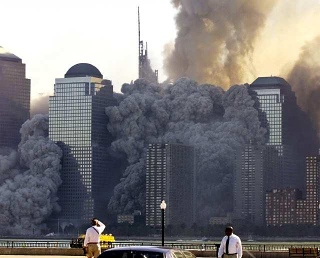
Here's a video clip of that (WTC1). Another version of the still photo.
From another view:

And another video clip.
It can also be seen in the video taken from Hoboken. I was going to post a GIF composed of frames from that video but it was over 2 MB. So I guess if you want to see that you have to watch 9/11 Eyewitness.
And no matter what that is, Howard, it is most obviously NOT supporting the weight of ANY floors, and yet it still falls straight down upon itself just like a conventional demo, and totally unlike any natural collapse of anything so tall and slender that happens to be made of anything other than legos or jinga blocks. But I'm sure you won't disappoint with some kind of bs that sounds half plausible until someone actually thinks about it.
That's what happened.
And what's amazing about this, besides that you're (very hypocritically) not a structural engineer, and that not even NIST could come up with this genius conclusion that you've provided us with, is that you aren't sharing this with the rest of the world. Why don't you submit this for peer review somewhere, Howie?
Originally posted by HowardRoark
Did it remain standing? no.
I rest my case.
Wtf? I'm asking how on Earth it fell straight down. I'm not saying it didn't fall.
Aren't you going to at least give me credit for giving you the pics you asked for? Or anything?
Originally posted by HowardRoarkWithout the floors providing the nessessary rigidity, what would prevent the exterior walls from buckling?
Without floors transfering the nessessay lateral stability from the exterior walls, what would prevent the core columns from folding over?
The exterior was stainless and other steels, designed to be very strong. There was posts on 39 inch centers (I think that measure was correct), all around the perimeter thus making a wall. The exterior was designer to not only hold itself up and part of the floor weight and load on the floors but take a big part of the wind load against it. The perimeter could have stood on its own like a literal piece on tubing on end with no difficulty. At most it would bend but I don't remember it doing that. In fact it came down nice and cleanly.
The core housing shafts elevators and stairs was heavy concrete Howard, I know the floors were only a few inches thick on a steel sheet on the trusses. The tendency of the core would be to stay standing even if floors were falling down as the trusses pulled away. The inner core of the building contained a lot of concrete which is fire resistant.
Originally posted by HowardRoark
The load stays the same, but increasing the effective length of the column will reduce the ability of that column to support that load.
Of course the loads didn't change, but the ability of the building to support those loads did.
But then why would the columns buckle to begin with? You're one to be talking about being dense; circular arguments don't make sense Howard.
A brief recap for those who weren't just paying attention:
I said: the columns wouldn't buckle one way or another from where they stood unless additional force was applied to them.
Howard said: a load too heavy would cause that.
I said: the loads stayed the same (if not decreased); that is to say, no reason to buckle from the loads.
Howard said: but the same loads can't be carried when the columns are already buckled!
And then after giving us the master class of a lifetime on begging the question, ie circular logic, he calls me dense.
I just wish this could be easily compacted into a sig line. I would so adopt this as my sig.
The sagging floors will pull inward on the columns.
But even without that inward pull, the columns can still buckle on their own with no outside force on them if the loads exceed the critical buckling load.
But even without that inward pull, the columns can still buckle on their own with no outside force on them if the loads exceed the critical buckling load.
Originally posted by denythestatusquo
Originally posted by HowardRoarkWithout the floors providing the nessessary rigidity, what would prevent the exterior walls from buckling?
Without floors transfering the nessessay lateral stability from the exterior walls, what would prevent the core columns from folding over?
The exterior was stainless and other steels, designed to be very strong.
The exterior columns were stainless steel? What are you smoking?
The core housing shafts elevators and stairs was heavy concrete Howard,
. .
The inner core of the building contained a lot of concrete which is fire resistant.
Please spend some time researching this subject before you spam the board again with this nonsense.
Why keep going in circles Howard? Did we not just cover this a couple posts ago?
This is it and I let it stand as is, and you can keep repeating it until you think we're all finally starting to buy it.
The hypothetical "sagging floors" would've put no more of a load on the exterior columns than they did before they sagged.
Which they would have had no reason to if they weren't buckled in the first place. There were no additional loads after the impacts.
This is it and I let it stand as is, and you can keep repeating it until you think we're all finally starting to buy it.
Originally posted by HowardRoark
The sagging floors will pull inward on the columns.
The hypothetical "sagging floors" would've put no more of a load on the exterior columns than they did before they sagged.
But even without that inward pull, the columns can still buckle on their own with no outside force on them if the loads exceed the critical buckling load.
Which they would have had no reason to if they weren't buckled in the first place. There were no additional loads after the impacts.
Originally posted by HowardRoark
The exterior columns were stainless steel? What are you smoking?
Please spend some time researching this subject before you spam the board again with this nonsense.
Howard: the exterior as this link points out was primarily high grade steel with stainless steel used as trim especially at ground level.
Frankly your arrogance and attitude are spam.
WTC construction
"In order to make each tower capable of withstanding this wind load, the architects selected a lightweight “perimeter tube” design consisting of 244 exterior columns of 36 cm square steel box section on 100 cm centers (see Figure 3). This permitted windows more than one-half meter wide. Inside this outer tube there was a 27 m × 40 m core, which was designed to support the weight of the tower. It also housed the elevators, the stairwells, and the mechanical risers and utilities. Web joists 80 cm tall connected the core to the perimeter at each story. Concrete slabs were poured over these joists to form the floors. In essence, the building is an egg-crate construction that is about 95 percent air, explaining why the rubble after the collapse was only a few stories high."
"The egg-crate construction made a redundant structure (i.e., if one or two columns were lost, the loads would shift into adjacent columns and the building would remain standing). Prior to the World Trade Center with its lightweight perimeter tube design, most tall buildings contained huge columns on 5 m centers and contained massive amounts of masonry carrying some of the structural load. The WTC was primarily a lightweight steel structure; however, its 244 perimeter columns made it “one of the most redundant and one of the most resilient” skyscrapers.1"
Asbestos in WTC?
"The Trade Tower design – the one referred to as able to resist the crash of a Boeing 707 – specified the use of asbestos insulation on the supporting columns," said chemistry professor Art Robinson, writing in the September edition of Access to Energy, a monthly science and technology newsletter.
"This was used on all columns up to the 64th floors. Then, however, in 1971 when the Trade Center Towers were still under construction, New York City banned this use of asbestos," Robinson, who is also a founder of the Oregon Institute of Science and Medicine, said.
Heat, fire weakens towers' columns
Robinson said the Twin Towers were designed to withstand a raging four-hour fire before its steel beam infrastructure lost enough of its strength and collapsed. In the intervening time frame, experts believed that tower visitors and workers below the fire level would have ample opportunity to escape, while those trapped in floors above the fire would be plucked from the roof by helicopter.
However, Tower One collapsed one hour and 40 minutes after it was struck by the first airliner; Tower Two collapsed after 56 minutes of fire.
"Had the towers stood for four hours, an estimated 5,000 people would still be alive, and the buildings would probably still be proudly standing – with large gashes in their upper floors," Robinson said.
In making his case, Robinson quoted the designer of the asbestos steel-beam coating procedure banned in New York City during the construction of the towers.
The inventor, Herbert Levine, often said during the final phases of WTC construction in the 1970s: "If a fire breaks out above the 64th floor, that building will fall down."
Robinson pointed out that skyscrapers like the Empire State Building have their steel columns insulated with concrete – which is expensive and difficult to use.
But, "in the late 1940s, Herbert Levine invented a spray fireproofing composed of asbestos and mineral wool. This invention was instrumental in allowing the construction of large steel-framed buildings," he said.
Levine's company did not get the contract to insulate the steel beams of the Twin Towers, but he had confidence in the company that did win the contract until New York banned asbestos and forced the winning contractor to use a "jury-rigged substitute insulation."
Still, other experts believe the collapse of the buildings may have been inevitable, given the circumstances.
"The impact of aircraft of more than 100 tons, at a velocity of several hundred miles per hour, with a fire load of thousands of gallons of kerosene are not things we contemplate for our clients on a day-to-day basis," said John A. Hill, president of the UK-based Institution of Structural Engineers. He believes that a willful terrorist can always find a way to demolish any structure.
Others say the heat of the fires generated by the planes took its toll on the steel beams supporting the towers.
"It was the fire that killed the buildings – nothing on earth could survive those temperatures with that amount of fuel burning," said Chris Wise, another British structural engineer. "The columns would have melted, the floors would have melted, and eventually they would have collapsed one on top of each other."
Robinson says the jet fuel-laden fires did not generate an unusual amount of heat, instead only generating the amount of heat such fires would normally produce. The difference, he insists, was that the towers "were not properly insulated, causing them to become weak by the heat of a sustained fire."
"It's notable that Mr. Levine didn't make his comments after the attacks, but instead made them 30 years ago," Robinson told WND. "And he was the world's expert on insulating steel columns."
Robinson also said he was "certain" that had the columns been insulated with asbestos, the towers would have remained standing "long enough" for many more people to have escaped.
"Whether that means both buildings would currently still be standing, that's a question," he said. "But we wouldn't be lookin
Originally posted by denythestatusquo
Howard: the exterior as this link points out was primarily high grade steel with stainless steel used as trim especially at ground level.
No it doesn't.
Nor does it say that the core columns were constructed with concrete.
Only spammers C&P an entire article.
[edit on 6-5-2006 by HowardRoark]
For those of you who say the explosions were gas lines...
How the hell did gas lines get damaged AT OR BELOW GROUND LEVEL when the planes hit the twins MUCH HIGHER than that?
How the hell did gas lines get damaged AT OR BELOW GROUND LEVEL when the planes hit the twins MUCH HIGHER than that?
bsbray11 - You make good arguments You have my support.
This message was sponsored by "Fight for the Truth".
[edit on 5/6/2006 by Masisoar]
This message was sponsored by "Fight for the Truth".
[edit on 5/6/2006 by Masisoar]
telling testimony and text in the professor jones canon
ie.
[edit on 6-5-2006 by billybob]
ie.
"CANON 5.
g. Engineers shall not maliciously or falsely, directly or indirectly, injure the professional reputation, prospects, practice or employment of another engineer or indiscriminately criticize another's work."
[edit on 6-5-2006 by billybob]
Originally posted by billybob
telling testimony and text in the professor jones canon
Some very interesting stuff in there.
www.911blogger.com...
Email to Prof Jones from a structural engineer in Texas:
I am surprised how few of my colleagues have expressed public disbelief at the official line which lurches from theory to theory as the shortcomings of each became apparent. I guess they have run out of ideas on Building 7.
You nailed the biggest problem when you focused on the symmetry of collapse in comparison to the asymmetry of the damage... Steel high rises are designed (and overdesigned) as cantilever beams on end. There is so much redundant steel in these buildings because they have to resist hurricane force winds. Was there a hurricane in New York on Sept 11?
If steel framed structures designed by world class engineers (who are still being commissioned to design high rises elsewhere in the world) can collapse with so little provocation, I should send my diploma back and take up fortune telling.
From another structural engineer:
• “A couple of months back I examined [Jones] claims in detail. Initially I was a bit incredulous… so I downloaded all the official reports basically expecting to find holes in the good prof's hypothesis.
• I'm a professional civil engineer with a lot of experience in the construction of major structures and I was just astounded at what I found. In my COO days if my staff had put up reports like that relating to a disaster on my patch, there is no way they would have been accepted and I would have been asking some very tough questions: The [official] reports are not at all convincing.
• That they are not is a serious worry.
new topics
-
God's Righteousness is Greater than Our Wrath
Religion, Faith, And Theology: 4 hours ago -
Electrical tricks for saving money
Education and Media: 7 hours ago -
VP's Secret Service agent brawls with other agents at Andrews
Mainstream News: 8 hours ago -
Sunak spinning the sickness figures
Other Current Events: 9 hours ago -
Nearly 70% Of Americans Want Talks To End War In Ukraine
Political Issues: 9 hours ago -
Late Night with the Devil - a really good unusual modern horror film.
Movies: 11 hours ago
top topics
-
VP's Secret Service agent brawls with other agents at Andrews
Mainstream News: 8 hours ago, 9 flags -
Cats Used as Live Bait to Train Ferocious Pitbulls in Illegal NYC Dogfighting
Social Issues and Civil Unrest: 12 hours ago, 8 flags -
Electrical tricks for saving money
Education and Media: 7 hours ago, 4 flags -
HORRIBLE !! Russian Soldier Drinking Own Urine To Survive In Battle
World War Three: 16 hours ago, 3 flags -
Nearly 70% Of Americans Want Talks To End War In Ukraine
Political Issues: 9 hours ago, 3 flags -
Sunak spinning the sickness figures
Other Current Events: 9 hours ago, 3 flags -
Late Night with the Devil - a really good unusual modern horror film.
Movies: 11 hours ago, 2 flags -
The Good News According to Jesus - Episode 1
Religion, Faith, And Theology: 14 hours ago, 1 flags -
God's Righteousness is Greater than Our Wrath
Religion, Faith, And Theology: 4 hours ago, 0 flags
active topics
-
SETI chief says US has no evidence for alien technology. 'And we never have'
Aliens and UFOs • 46 • : yuppa -
God's Righteousness is Greater than Our Wrath
Religion, Faith, And Theology • 1 • : andy06shake -
Sunak spinning the sickness figures
Other Current Events • 7 • : xWorldxGonexMadx -
HORRIBLE !! Russian Soldier Drinking Own Urine To Survive In Battle
World War Three • 33 • : Degradation33 -
How ageing is" immune deficiency"
Medical Issues & Conspiracies • 34 • : angelchemuel -
Nearly 70% Of Americans Want Talks To End War In Ukraine
Political Issues • 13 • : Freeborn -
Mood Music Part VI
Music • 3101 • : ThatSmellsStrange -
VP's Secret Service agent brawls with other agents at Andrews
Mainstream News • 41 • : ThatSmellsStrange -
New whistleblower Jason Sands speaks on Twitter Spaces last night.
Aliens and UFOs • 55 • : baablacksheep1 -
Cats Used as Live Bait to Train Ferocious Pitbulls in Illegal NYC Dogfighting
Social Issues and Civil Unrest • 20 • : Asher47