It looks like you're using an Ad Blocker.
Please white-list or disable AboveTopSecret.com in your ad-blocking tool.
Thank you.
Some features of ATS will be disabled while you continue to use an ad-blocker.

Physics Prof Says Bombs not Planes brought down wtc
page: 2share:
Originally posted by LeftBehind
Bsbray are you honestly trying to say that 767's crashing into the building only caused minor damage?
I posted the figures. The WTC was massive. Put the damage in perspective. It wasn't as much as you'd think. Again, I posted the figures from the gov. agencies themselves above.
Originally posted by Master Wu
Let me ask you this then Shadow, why then didn't it collapse right away? According to this way of thinking the building should have collapsed fairly quickly.
They were designed to take the impact of a plane just not one the size of a 767 and one full of fuel.
The Towers were designed and built very well for their time. They were created to withstand the impact of 707. Its hard to design the building for a impact of a large 767 when that plane had not even been invented yet. Also they never thought they would have to be dealing with a plane full of fuel. The scenario the builders invisoned of a plane impact was of one heading for a landing at a NYC airport and getting some how lost in adverse weather at night. In that scenario the plane would not be full with jet fuel like in the 9-11 attacks. Planning for a accidental hit on the Towers of a plane talking off from a NYC airport was never planned for because it would never happen in their minds.
The builders couldn't invisoned a terrorist attack with a plane the size of the 767 since a commerical plane of that size wasnt even flying at the time . All the force of impact would have to do is weaken the structure enough to allow the fire that raged to to the rest.
Originally posted by Master Wu
And here is one more question you should ask yourself. Why DIDN'T the towers collapse sideways or in a 'leaning' manner (or even partially sideways or partially leaning)? Maybe coincidentally one tower would fall that way, but TWO? O.K. the odds are already millions to 1 that both would fall that way
I dont have to ask myself since I know the answer. Because I know how it was designed and how forces like inertia and gravity work, as you clearly dont. First, the building is not solid; it is 95 percent air and, hence, can implode onto itself. Second, there is no lateral load, even the impact of a speeding aircraft, which is sufficient to move the center of gravity one hundred feet to the side such that it is not within the base footprint of the structure. Third, given the near free-fall collapse, there was insufficient time for portions to attain significant lateral velocity. To summarize all of these points, a 500,000 t structure designed like the WTC has too much inertia to fall in any direction other than nearly straight down.
It had a redundant design that allows for loss of one primary structural member, such as a column. However, when multiple members fail, the shifting loads eventually overstress the adjacent members and the collapse occurs like a row of dominoes falling down.
Maybe this will help you understand how the floors in the towers were created. Those floors had a 1,300 t design capacitythey could not support the roughly 45,000 t of ten floors (or more) above crashing down on these angle clips. This started the domino effect that caused the buildings to collapse within ten seconds.
This might be a bit much for you to take in though
www.tms.org...
I too like the skeptics wondered, 'well how did they sneak those bombs in'?
hmm, looks like we may have the answer:
www.911blogger.com...
A lucky break that the head of an IT network forced to help power down the WTC 2 has come forward to say that for 36 hours the WTC 2 was rendered helpless and anyone could come through. This, for the first time in decades.
Ouch.
And then what about William Rodriguez' testimony, why would a 20 year employee of the WTC lie about explosives going off in the subbasement? Why would so many FBI agents, Firefighter authorities and fighters themselves they believe explosives were used to bring down the WTC?
It seems to me that even just to prove these 'theories' inaccurate , the penel would have tried to clear all this up. The WTC 7 anomaly, the controlled demolition theory, etc.
hmm, looks like we may have the answer:
www.911blogger.com...
A lucky break that the head of an IT network forced to help power down the WTC 2 has come forward to say that for 36 hours the WTC 2 was rendered helpless and anyone could come through. This, for the first time in decades.
Ouch.
And then what about William Rodriguez' testimony, why would a 20 year employee of the WTC lie about explosives going off in the subbasement? Why would so many FBI agents, Firefighter authorities and fighters themselves they believe explosives were used to bring down the WTC?
It seems to me that even just to prove these 'theories' inaccurate , the penel would have tried to clear all this up. The WTC 7 anomaly, the controlled demolition theory, etc.
Quote from ShadowXIX: "I dont have to ask myself since I know the answer. Because I know how it was designed and how forces like inertia and gravity
work, as you clearly dont.
Maybe this will help you understand how the floors in the towers were created.
This might be a bit much for you to take in though"
Whoa, and here i was thinking we had a healthy and intelligent debate going on with intelligent participants. Why the condescending attitude? Have i said something that demands that i be patrinized? Just who do you think you are speaking to, a child? Quite the opposite. I have a Civil Engineering degree, Do you?
Review of videotape recordings of the collapse taken from various angles indicates that the transmission tower on top of the structure began to move downward and laterally slightly before movement was evident at the exterior walls. This suggests that collapse began with one or more failures in the central core area of the building.
FEMA claims in their conclusion:
The fire-performance of steel trusses with spray-applied fire protection, and with end restraint conditions similar to those present in the two towers, is not well understood, but is likely critical to the building collapse.
www.serendipity.li...
In a Nutshell, FEMA is claiming trusses that supported the floors were not solidly attached to their end supports, the exterior wall and the interior core structure. Just heat from the alleged burning fuel caused the trusses to expand falling off their supports resulting in the 'collapse' of the North Tower. Many have seen warehouses with their steel trusses supporting the roof. These trusses may or may not be attached to their supporting walls. HOWEVER, the North Tower is a 110 story skyscraper not a warehouse!
The design concept of tubular framing (the so-called tube within a tube architecture) has been employed in the construction of many of the world's tallest buildings. These include the John Hancock Center (1105 ft), the Standard Oil of Indiana Building (1125 ft), the World Trade Center Towers (1350 ft), and the Sears Tower (1450 ft). In fact, most modern skyscrapers use this design, a design which uses a specially reinforced perimeter wall to resist all lateral loading and some of the gravity loading, and a heavily reinforced central core to resist the bulk of the gravity loading. The lateral loading (horizontal force) on the building, is mainly due to the wind while the gravity loading (downward force) is due to the weight of the building (i.e., due to gravity).
In the tube within a tube architecture, it is of vital importance that the horizontal forces on one wall be transfered to the other walls, so that the entire structure will bend to the minimum extent possible. It is also of vital importance that these horizontal forces be transfered to the central core so that the entire structure bends uniformly as one unit.
This is achieved by the use of a composite flooring system, which is designed to act (in essence) as one super-large beam. The idea is to connect the steel joists supporting the concrete slab, to the slab,
The combined steel joist-concrete slab, has sufficient strength to transfer the lateral loading to the core and the other walls, so that the building bends as little as possible, but when it does bend, it bends as a unit.
The Sixty State Street Building (Bosten) has solid steel beams spanning the gap (of up to 40 feet) between the central core and perimeter wall.
TO TOPPLE THE TOWER cutter charges would be placed: 1) on the exterior columns, 2) at the intersection of the floor assembly to the wall, and 3) on the inner core support columns and cross beams. Video analysis indicates that one floor was taken out simultaneously with the whole core structure being blasted to pieces.
I have plenty of pictures and diagrams to go with all this, i just don't know how to post them. Any help would be appreciated.
[edit on 12-11-2005 by Master Wu]
[edit on 12-11-2005 by Master Wu]
Maybe this will help you understand how the floors in the towers were created.
This might be a bit much for you to take in though"
Whoa, and here i was thinking we had a healthy and intelligent debate going on with intelligent participants. Why the condescending attitude? Have i said something that demands that i be patrinized? Just who do you think you are speaking to, a child? Quite the opposite. I have a Civil Engineering degree, Do you?
Review of videotape recordings of the collapse taken from various angles indicates that the transmission tower on top of the structure began to move downward and laterally slightly before movement was evident at the exterior walls. This suggests that collapse began with one or more failures in the central core area of the building.
FEMA claims in their conclusion:
The fire-performance of steel trusses with spray-applied fire protection, and with end restraint conditions similar to those present in the two towers, is not well understood, but is likely critical to the building collapse.
www.serendipity.li...
In a Nutshell, FEMA is claiming trusses that supported the floors were not solidly attached to their end supports, the exterior wall and the interior core structure. Just heat from the alleged burning fuel caused the trusses to expand falling off their supports resulting in the 'collapse' of the North Tower. Many have seen warehouses with their steel trusses supporting the roof. These trusses may or may not be attached to their supporting walls. HOWEVER, the North Tower is a 110 story skyscraper not a warehouse!
The design concept of tubular framing (the so-called tube within a tube architecture) has been employed in the construction of many of the world's tallest buildings. These include the John Hancock Center (1105 ft), the Standard Oil of Indiana Building (1125 ft), the World Trade Center Towers (1350 ft), and the Sears Tower (1450 ft). In fact, most modern skyscrapers use this design, a design which uses a specially reinforced perimeter wall to resist all lateral loading and some of the gravity loading, and a heavily reinforced central core to resist the bulk of the gravity loading. The lateral loading (horizontal force) on the building, is mainly due to the wind while the gravity loading (downward force) is due to the weight of the building (i.e., due to gravity).
In the tube within a tube architecture, it is of vital importance that the horizontal forces on one wall be transfered to the other walls, so that the entire structure will bend to the minimum extent possible. It is also of vital importance that these horizontal forces be transfered to the central core so that the entire structure bends uniformly as one unit.
This is achieved by the use of a composite flooring system, which is designed to act (in essence) as one super-large beam. The idea is to connect the steel joists supporting the concrete slab, to the slab,
The combined steel joist-concrete slab, has sufficient strength to transfer the lateral loading to the core and the other walls, so that the building bends as little as possible, but when it does bend, it bends as a unit.
The Sixty State Street Building (Bosten) has solid steel beams spanning the gap (of up to 40 feet) between the central core and perimeter wall.
TO TOPPLE THE TOWER cutter charges would be placed: 1) on the exterior columns, 2) at the intersection of the floor assembly to the wall, and 3) on the inner core support columns and cross beams. Video analysis indicates that one floor was taken out simultaneously with the whole core structure being blasted to pieces.
I have plenty of pictures and diagrams to go with all this, i just don't know how to post them. Any help would be appreciated.
[edit on 12-11-2005 by Master Wu]
[edit on 12-11-2005 by Master Wu]
Originally posted by Master Wu
I have plenty of pictures and diagrams to go with all this, i just don't know how to post them. Any help would be appreciated.
To post a picture you just have to click that little icon that looks like a (paint palette and computer screen) Then just copy and paste the url address of the picture you want to post. To find the URL address of any picture simply right click on the picture and select properties and you will see its URL.
Also try to use the quote tab found on the post you are trying to reply too when quoting someone. It puts it into a neat little box and makes the post easier to read.
Originally posted by 8bitagent
I too like the skeptics wondered, 'well how did they sneak those bombs in'?
hmm, looks like we may have the answer:
www.911blogger.com...
A lucky break that the head of an IT network forced to help power down the WTC 2 has come forward to say that for 36 hours the WTC 2 was rendered helpless and anyone could come through. This, for the first time in decades.
Ouch.
This is not the first time this rumor has been passed around. Scott Forbes' existence has yet to be established.
I like how both blogs reference a story that is from April 19th 2004, and try to pass it off as news.
www.serendipity.li...
No one has been able to confirm the truth of this story who's only source is Scott Forbes. Unless you believe the author of George Washington's blog who says that he has met the man.
Even 9-11 review has called the Forbes story a hoax.
911review.com...
After being posted on scores of websites for over a year, this story has failed to elicit any corroborating reports, even about the identity of 'Scott Forbes'. Aside from the fact that the sourcing of the story doesn't meet the most basic journalistic standards, its content is thoroughly implausible.
It makes no sense that the perpetrators would do something so obvious as powering down half of a tower so shortly before the attack. This would create a profound disruption of business for dozens of companies, and would be noticed by thousands of people. Thousands of e-mails would have been broadcast and a great deal of work would have been done by scores of employees to prepare for the outage.
It makes less sense that they would take such a drastic action but only for one half of one tower. Why was the disruption only necessary for the upper floors of the South Tower, or how would similar power-downs of the other sections have gone unnoticed?
Powering down for cabling upgrades is laughable as a cover story for demolition preparation work. Cabling upgrades for data bandwidth do not require interrupting AC power at all. Even if the AC wiring were being upgraded, the new wiring would have been installed and powered up in parallel with the old wiring. Any interruptions would be minimized to a few minutes. Powering down large portions of a tower, and for 36 hours, would have generated numerous protests from tenants.
Contrary to the e-mail's assertion, security cameras are designed to use independent uninterruptible power supplies. If power to the security systems were interrupted, many doors would remain unopenable except by key.
Here is a more detailed picture of the floor, I am not supporting this site just using there image so I linked to it
I might add the translation does not do it justice, sorry
German Engineer's Help USA


[edit on 12/11/2005 by Sauron]
I might add the translation does not do it justice, sorry
German Engineer's Help USA
[edit on 12/11/2005 by Sauron]
It is correct that the high temperature of jet fuel combustion would not continue throughout a jet fuel fire. Typical temperatures woud be at max, in
the 1600F-1700F range. Starved for oxygen, the temperatures could fall to 1200F-1300F.
Still too high for steel in general. Steel structures will fail, and fall.
Steel - Critical Temperatures
Columns - 1,000 F (538 C)
Beams - 1,100 F (593 C)
Open Web Steel Joists - 1,100 F (593 C)
Reinforcing Steel - 1,100 F (593 C)
Prestressed Steel - 800 F (426 C)
Aluminum burns at over 4,100 K (6920°F), which is two-thirds the temperature at the surface of the Sun.
Magnesium is also flammable, burning at a temperature of approximately 4000 °F (2500 K) (2200 °C).
The Boeing 767-200ER is a max 395,000 lb (179,170 kg) of aluminum, magnesium, and hydrocarbons (plastics and jet fuel).
The Boeing 757-200 is a max 255,000 lb (115,680 kg) of aluminum, magnesium, and hydrocarbons (plastics and jet fuel).
The question will always be, did anything weaken or destroy enough of the core beams to result in a collapse?
And since I love a good conspiracy, I give you links to both sides. Here's one of the MIT analysis essays, and a forum rebutal to the MIT analysis that has some very good points.
MIT essays on WTC collapse
Good forum rebutal of MIT essays
And one more, a picture of REAL demolition squibs detonating:
Picture of demolition squibs igniting
Notice that the multiple blasts are from the middle of columns, spread across each floor, in a horizontal pattern. Not from a window, not a single blast, and not a vertical series (unless it's planned to fall on it's side).
And just a bit of calculations, a proper demolition of a 110 floor building would require approximately 975,927,727 holes drilled, 24,593,583 pounds of explosives, 116,432,086 blasting caps, and 501,304,813 feet of detonating cord.
Still too high for steel in general. Steel structures will fail, and fall.
Steel - Critical Temperatures
Columns - 1,000 F (538 C)
Beams - 1,100 F (593 C)
Open Web Steel Joists - 1,100 F (593 C)
Reinforcing Steel - 1,100 F (593 C)
Prestressed Steel - 800 F (426 C)
Aluminum burns at over 4,100 K (6920°F), which is two-thirds the temperature at the surface of the Sun.
Magnesium is also flammable, burning at a temperature of approximately 4000 °F (2500 K) (2200 °C).
The Boeing 767-200ER is a max 395,000 lb (179,170 kg) of aluminum, magnesium, and hydrocarbons (plastics and jet fuel).
The Boeing 757-200 is a max 255,000 lb (115,680 kg) of aluminum, magnesium, and hydrocarbons (plastics and jet fuel).
The question will always be, did anything weaken or destroy enough of the core beams to result in a collapse?
And since I love a good conspiracy, I give you links to both sides. Here's one of the MIT analysis essays, and a forum rebutal to the MIT analysis that has some very good points.
MIT essays on WTC collapse
Good forum rebutal of MIT essays
And one more, a picture of REAL demolition squibs detonating:
Picture of demolition squibs igniting
Notice that the multiple blasts are from the middle of columns, spread across each floor, in a horizontal pattern. Not from a window, not a single blast, and not a vertical series (unless it's planned to fall on it's side).
And just a bit of calculations, a proper demolition of a 110 floor building would require approximately 975,927,727 holes drilled, 24,593,583 pounds of explosives, 116,432,086 blasting caps, and 501,304,813 feet of detonating cord.
* The three buildings collapsed nearly symmetrically, falling down into their footprints, a phenomenon associated with "controlled demolition" - and
even then it's very difficult, he says. "Why would terrorists undertake straight-down collapses of WTC-7 and the Towers when 'toppling over' falls
would require much less work and would do much more damage in downtown Manhattan?" Jones asks. "And where would they obtain the necessary skills and
access to the buildings for a symmetrical implosion anyway? The 'symmetry data' emphasized here, along with other data, provide strong evidence for
an 'inside' job."
* No steel-frame building, before or after the WTC buildings, has ever collapsed due to fire. But explosives can effectively sever steel columns, he says.
* WTC 7, which was not hit by hijacked planes, collapsed in 6.6 seconds, just .6 of a second longer than it would take an object dropped from the roof to hit the ground. "Where is the delay that must be expected due to conservation of momentum, one of the foundational laws of physics?" he asks. "That is, as upper-falling floors strike lower floors - and intact steel support columns - the fall must be significantly impeded by the impacted mass. . . . How do the upper floors fall so quickly, then, and still conserve momentum in the collapsing buildings?" The paradox, he says, "is easily resolved by the explosive demolition hypothesis, whereby explosives quickly removed lower-floor material, including steel support columns, and allow near free-fall-speed collapses." These observations were not analyzed by FEMA, NIST nor the 9/11 Commission, he says.
* With non-explosive-caused collapse there would typically be a piling up of shattering concrete. But most of the material in the towers was converted to flour-like powder while the buildings were falling, he says. "How can we understand this strange behavior, without explosives? Remarkable, amazing - and demanding scrutiny since the U.S. government-funded reports failed to analyze this phenomenon."
* Horizontal puffs of smoke, known as squibs, were observed proceeding up the side the building, a phenomenon common when pre-positioned explosives are used to demolish buildings, he says.
* Steel supports were "partly evaporated," but it would require temperatures near 5,000 degrees Fahrenheit to evaporate steel - and neither office materials nor diesel fuel can generate temperatures that hot. Fires caused by jet fuel from the hijacked planes lasted at most a few minutes, and office material fires would burn out within about 20 minutes in any given location, he says.
* Molten metal found in the debris of the World Trade Center may have been the result of a high-temperature reaction of a commonly used explosive such as thermite, he says. Buildings not felled by explosives "have insufficient directed energy to result in melting of large quantities of metal," Jones says.
* Multiple loud explosions in rapid sequence were reported by numerous observers in and near the towers, and these explosions occurred far below the region where the planes struck, he says.
I still have seen no explaination for WTC-7. Anyone have any ideas?
* No steel-frame building, before or after the WTC buildings, has ever collapsed due to fire. But explosives can effectively sever steel columns, he says.
* WTC 7, which was not hit by hijacked planes, collapsed in 6.6 seconds, just .6 of a second longer than it would take an object dropped from the roof to hit the ground. "Where is the delay that must be expected due to conservation of momentum, one of the foundational laws of physics?" he asks. "That is, as upper-falling floors strike lower floors - and intact steel support columns - the fall must be significantly impeded by the impacted mass. . . . How do the upper floors fall so quickly, then, and still conserve momentum in the collapsing buildings?" The paradox, he says, "is easily resolved by the explosive demolition hypothesis, whereby explosives quickly removed lower-floor material, including steel support columns, and allow near free-fall-speed collapses." These observations were not analyzed by FEMA, NIST nor the 9/11 Commission, he says.
* With non-explosive-caused collapse there would typically be a piling up of shattering concrete. But most of the material in the towers was converted to flour-like powder while the buildings were falling, he says. "How can we understand this strange behavior, without explosives? Remarkable, amazing - and demanding scrutiny since the U.S. government-funded reports failed to analyze this phenomenon."
* Horizontal puffs of smoke, known as squibs, were observed proceeding up the side the building, a phenomenon common when pre-positioned explosives are used to demolish buildings, he says.
* Steel supports were "partly evaporated," but it would require temperatures near 5,000 degrees Fahrenheit to evaporate steel - and neither office materials nor diesel fuel can generate temperatures that hot. Fires caused by jet fuel from the hijacked planes lasted at most a few minutes, and office material fires would burn out within about 20 minutes in any given location, he says.
* Molten metal found in the debris of the World Trade Center may have been the result of a high-temperature reaction of a commonly used explosive such as thermite, he says. Buildings not felled by explosives "have insufficient directed energy to result in melting of large quantities of metal," Jones says.
* Multiple loud explosions in rapid sequence were reported by numerous observers in and near the towers, and these explosions occurred far below the region where the planes struck, he says.
I still have seen no explaination for WTC-7. Anyone have any ideas?
When calling the WTC a controlled demolition, it's irrelevant to sight other controlled demolitions as proof of required planning and as a time
factor for installing the bombs needed for a proper demolition.
The WTC had to come down, it didn't have to come down as perfect as a commercial controlled demolition.
There was plenty of time to plan the installation of the bombs on a computer using the plans which are now unobtainable by Port Authority and FEMA (only an undated FEMA plan is available, which was also used for the 9/11 Commission).
They had to plan for bringing it down, they didn't have to plan for making the most efficient and tidy mess afterwards as a proper controlled demolition will try it's best to do.
This cuts down the planning, installation and amount of bombs needed.
We shouldn't even expect industry standard explosives to have been used.
This was a huge event orchestrated by parties with bottomless funds and resources, including those inside US agencies and also from other countries.
The line seperating 'us and them' is non-existant at the highest levels, only on our level - the one controlled by the media who are fed by 'them' - are we given this illusion that there's two sides fighting each other, rather than one ideal achieving one goal that's being sold as two opposing forces in a 'struggle'.
The WTC had to come down, it didn't have to come down as perfect as a commercial controlled demolition.
There was plenty of time to plan the installation of the bombs on a computer using the plans which are now unobtainable by Port Authority and FEMA (only an undated FEMA plan is available, which was also used for the 9/11 Commission).
They had to plan for bringing it down, they didn't have to plan for making the most efficient and tidy mess afterwards as a proper controlled demolition will try it's best to do.
This cuts down the planning, installation and amount of bombs needed.
We shouldn't even expect industry standard explosives to have been used.
This was a huge event orchestrated by parties with bottomless funds and resources, including those inside US agencies and also from other countries.
The line seperating 'us and them' is non-existant at the highest levels, only on our level - the one controlled by the media who are fed by 'them' - are we given this illusion that there's two sides fighting each other, rather than one ideal achieving one goal that's being sold as two opposing forces in a 'struggle'.
the original post was about how bombs or controlled demolition charges brought down the towers. WHY? were the owners of the wtc in financial trouble?
did they want to "torch" the buildings to get out from under. sounds a bit extreme. many a small buisness owner has taken a few gallons of gas and
burned his failing buisness to the ground to collect the insurance money. is that what we're getting at here? mind you i am just a lowly machinist
from Ct. but i dont need a buch of computer generated crap to tell me what happened. these "squibs" or as described puffs of smoke, they couldn't
be the air being forced out of the lower floors by the upper ones collapsing on top of them could they? theres no doubt that that the preparations to
blow the building could have been done secretly. when the engineer that designed the citi bank building discovered after reviewing his work that a
hurricaine could take down his building, a team of welders where working every night to correct the problem in total secrecy to avoid public panic. so
it could be done but why? it's not simple enough that a bunch of religious zealots got on planes and ran them into the buildings and the damage
caused them to collapse? what has been left out of the whole thing is who planned the whole thing. ossama bin laden a highly educated structural
engineer. before i say whats next let me tell you all that i would take great pleasure in personally putting a bullet through mr bin ladens turbin.
anyway was it a controlled demolition of the wtc? well sort of. bin laden was just thinking out of the box. why truck in the tons of explosives
required to do the job when you can just fly them in. as stated in a previous post a planes fuel isn't the only flammable thing on a plane. i was on
a helicopter carrier in the navy and my job during flight quarters was to stand by on a rough terrain forklift incase of an aircraft fire. why?
because once the metals in an aircraft get burning there is no putting them out so my job was to push the flaming wreck overboard. why? because if you
just continue dumping water on it, its burning a hole through the STEEL deck. (see where i'm going with this?) it's not just the thousands of
gallons of jet fuel but also the thousands of pounds of flammable metal capable of burning through steel faster than a cutting torch. titainium,
magnesium, aluminum. grey smoke, black smoke. anyone ever see a metal fire? grey smoke. petroleum fire black smoke. think bin laden didn't take all
of these factors into account. is he nuts? absolutely. is he smart? maybe, but some pretty smart people have been trying to catch him and nothing so
far. theres a $25 million reward for his capture problem is nobody over there knows what $25 million is or what it can get them. 70 virgins when they
get to heaven huh. show some of those guys what 25 mil will get you here and we'll have bin laden handcuff to a lamp post in times square in under a
week
Bush, Silverstein, Neocons etc. had lots of reasons to bring down the WTCs .... considering that SIlverstein had only 200 million invested in the
complex with insurance set at 3.2-3.5 Billion (incidently he got twice the amount because he claimed 2 planes = 2 terrorist strikes = 2 insurance
payouts) ............. Bush needed a reason to go invade Iraq and Cheney wanted Haliburton to make him billions with no-bid contracts .... and Israel
wanted the big U.S. military to fight a battle against the arabs to eradicate them. Also the WTC towers were filled formaldyhide/asbestos and needed a
billion renovation to remove it .... total collapse would help this problem.
Based on the 200 million investment by Silverstein ... he a 3500% increase in profit in one day ... not a bad investment.
Based on the 200 million investment by Silverstein ... he a 3500% increase in profit in one day ... not a bad investment.
Originally posted by TheShroudOfMemphis
The WTC had to come down, it didn't have to come down as perfect as a commercial controlled demolition.
They had to plan for bringing it down, they didn't have to plan for making the most efficient and tidy mess afterwards as a proper controlled demolition will try it's best to do.
This cuts down the planning, installation and amount of bombs needed.
This is just wrong
That would cut down on planning and installation but it would not, I repeat would not cut down on amounts of explosives needed. It would infact increase the amount of explosives needed. Thanks to all the prep work that goes into a building before demolition drilling holes cutting beams etc.. it greatly reduces the amuont of explosives needed. By doing that stuff demo guys get a much better effect for the amount of explosives they use.
You cut out all that work they do and the amount of explosives you need increases it does not decrease. I dont know where you got that from.
Originally posted by ZPE StarPilot
And just a bit of calculations, a proper demolition of a 110 floor building would require approximately 975,927,727 holes drilled, 24,593,583 pounds of explosives, 116,432,086 blasting caps, and 501,304,813 feet of detonating cord.
I'd like to see what type of 110-floor building you are basing this on, the types of explosives you are assuming were used, and what methods you are assuming were used. And then I'd like to see how assumptions are scientific.
ShadowXIX, why do you remind me so much of Howard?
I didn't know if there had been an update on the Scott Forbes story. I find it imperative to debunk false conspiracy theories as it is to find out
the truth behind "official stories".
Did the CIA really meet with bin Laden in July 2001? Was NORAD truly running war games simulating a 9/11 like attack on sept 11? Was CIA linked drug money and Pakistani ISI funds behind the attacks? These are things that are still out there, lingering.
For the skeptics of conspiracy theories surrounding 9/11, notice they never try to defend WTC7, only the explosions in WTC1&2 story.
Did the CIA really meet with bin Laden in July 2001? Was NORAD truly running war games simulating a 9/11 like attack on sept 11? Was CIA linked drug money and Pakistani ISI funds behind the attacks? These are things that are still out there, lingering.
For the skeptics of conspiracy theories surrounding 9/11, notice they never try to defend WTC7, only the explosions in WTC1&2 story.
8bitagent.
Skeptics do indeed try to debunk WTC7 but the other two towers are posted about much more often.
Also there are many more photos and video of the first two towers, leaving much more room for speculation.
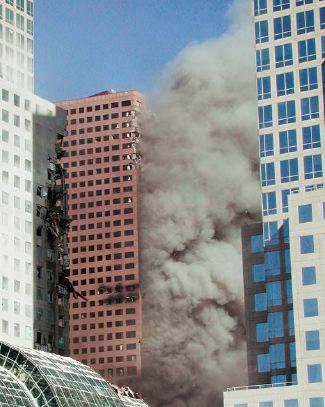
Here is a great picture of WTC7 entirely covered with smoke on one side. You probably won't see this one on sites dedicated to the demo theory.
Skeptics do indeed try to debunk WTC7 but the other two towers are posted about much more often.
Also there are many more photos and video of the first two towers, leaving much more room for speculation.
Here is a great picture of WTC7 entirely covered with smoke on one side. You probably won't see this one on sites dedicated to the demo theory.
Originally posted by 8bitagent
Was NORAD truly running war games simulating a 9/11 like attack on sept 11?
Actually, this isn't really much to speculate on anymore, as the Pentagon itself has confirmed such war games were going on. However, I don't think the number of war games, nor their contents have been released, and the Pentagon has been trying to portray the war games as some coincidence that simply helped them respond.
What's that saying? When the government says something, the opposite is true?
LeftBehind,
What about that picture shows that the Building 7 is about to fall straight down into its footprint?
Originally posted by bsbray11
What about that picture shows that the Building 7 is about to fall straight down into its footprint?
That picture is meant to show that the claims of minor damage to WTC7 have been greatly exagerated.
The building was extremely damaged and not that stable to begin with.
The fact that it fell into it's own footprint is not "proof" that it was blown up with demo charges. The problem of "when and where" in regards to the actual smuggling of bombs into the building, applies as much to WTC7 as it does to the other two.
That picture is meant to show that the claims of minor damage to WTC7 have been greatly exagerated.
Well then this picture is just to show that the claims of Building 7 being "extremely damaged" are greatly exaggerated:
I wouldn't exactly call that extreme.
And I certainly wouldn't expect that to fall straight down onto its footpring as a result.
The fact that it fell into it's own footprint is not "proof" that it was blown up with demo charges. The problem of "when and where" in regards to the actual smuggling of bombs into the building, applies as much to WTC7 as it does to the other two.
There is no evidence as to the "when and where" the universe was created; only theories based on circumstantial evidence. But I would say that we exist; wouldn't you?
The problem of how the buildings must have been set up, the logistics for it all, is no reasonable counter to the amount of scientific evidence there is against a gravity-driven collapse. Those buildings have absolutely no scientific evidence going for them to favor a gravity collapse over a demolition, and seemingly unlikely logistics, unfortunately, is not scientific evidence against demolition.
Using the logistics as an excuse for not accepting the legitimate points showing the collapse as stated by NIST, etc. is impossible, seems kind of naive to me. We're talking about the most powerful nation in the world, with by far the most advanced military, with the most advanced military and explosive technology, with the most money invested into these sorts of researches, with completely monster corporations working for it (or we should say the US is working for the corporations), and you will not look the science of the event in the face because you do not think this lone world superpower would be capable of pulling it off?
Well, regardless of whether or not we know how they did it, we still have the evidence that they did do it. I wouldn't be too concerned with the how: you'd be surprised what human beings can accomplish when they have the means and the determination.
[edit on 13-11-2005 by bsbray11]


new topics
-
Are you ready for the return of Jesus Christ? Have you been cleansed by His blood?
Religion, Faith, And Theology: 2 seconds ago -
Chronological time line of open source information
History: 1 hours ago -
A man of the people
Diseases and Pandemics: 2 hours ago -
Ramblings on DNA, blood, and Spirit.
Philosophy and Metaphysics: 2 hours ago -
4 plans of US elites to defeat Russia
New World Order: 4 hours ago -
Thousands Of Young Ukrainian Men Trying To Flee The Country To Avoid Conscription And The War
Other Current Events: 7 hours ago -
12 jurors selected in Trump criminal trial
US Political Madness: 10 hours ago -
Iran launches Retalliation Strike 4.18.24
World War Three: 10 hours ago -
Israeli Missile Strikes in Iran, Explosions in Syria + Iraq
World War Three: 11 hours ago
top topics
-
George Knapp AMA on DI
Area 51 and other Facilities: 16 hours ago, 26 flags -
Israeli Missile Strikes in Iran, Explosions in Syria + Iraq
World War Three: 11 hours ago, 17 flags -
Thousands Of Young Ukrainian Men Trying To Flee The Country To Avoid Conscription And The War
Other Current Events: 7 hours ago, 6 flags -
Iran launches Retalliation Strike 4.18.24
World War Three: 10 hours ago, 6 flags -
Not Aliens but a Nazi Occult Inspired and then Science Rendered Design.
Aliens and UFOs: 17 hours ago, 5 flags -
12 jurors selected in Trump criminal trial
US Political Madness: 10 hours ago, 4 flags -
4 plans of US elites to defeat Russia
New World Order: 4 hours ago, 2 flags -
Chronological time line of open source information
History: 1 hours ago, 2 flags -
Ramblings on DNA, blood, and Spirit.
Philosophy and Metaphysics: 2 hours ago, 1 flags -
A man of the people
Diseases and Pandemics: 2 hours ago, 1 flags
active topics
-
Are you ready for the return of Jesus Christ? Have you been cleansed by His blood?
Religion, Faith, And Theology • 0 • : TheGoodNews -
12 jurors selected in Trump criminal trial
US Political Madness • 30 • : RazorV66 -
Thousands Of Young Ukrainian Men Trying To Flee The Country To Avoid Conscription And The War
Other Current Events • 5 • : JAY1980 -
Meet Catturd who has been swatted 3 times
General Conspiracies • 22 • : 7dayhome -
A man of the people
Diseases and Pandemics • 6 • : PrivateAngel -
In the Beginning was the Word, and the Word was with God, and the Word was God
Religion, Faith, And Theology • 28 • : TheGoodNews -
Biden--My Uncle Was Eaten By Cannibals
US Political Madness • 48 • : CarlLaFong -
The Truth About Jesus
Conspiracies in Religions • 270 • : TheGoodNews -
Russia Flooding
Fragile Earth • 18 • : Hakaiju -
Fossils in Greece Suggest Human Ancestors Evolved in Europe, Not Africa
Origins and Creationism • 64 • : Xtrozero