It looks like you're using an Ad Blocker.
Please white-list or disable AboveTopSecret.com in your ad-blocking tool.
Thank you.
Some features of ATS will be disabled while you continue to use an ad-blocker.

Fireproofing key to Twin Towers' collapse
page: 1share:
Ineffective fireproofing and a shortage of staircases are highlighted in a preliminary federal safety report into the attacks on the World Trade
Center, issued by the US National Institute of Standards and Technology (NIST) on Tuesday. The study is likely to have a significant effect on the
future design of skyscrapers and on building regulations in the US.
The NIST report concludes that a combination of factors caused both buildings to collapse shortly after terrorists flew hijacked commercial airliners into them on 11 September 2001. "
www.newscientist.com...
This article has some video of computer simulations. Looks pretty good. Always knew about the lack o fireproofing issue. There was none about the 64th floors due to the enviro-nuts back during construction. Anti-asbestos thingy.
The NIST report concludes that a combination of factors caused both buildings to collapse shortly after terrorists flew hijacked commercial airliners into them on 11 September 2001. "
www.newscientist.com...
This article has some video of computer simulations. Looks pretty good. Always knew about the lack o fireproofing issue. There was none about the 64th floors due to the enviro-nuts back during construction. Anti-asbestos thingy.
I have serious doubts how objective these investigations and reports are.
How many times are they gonna change the story? I don't know what's worse, this or the fact that people actually buy each new version of it.
And I agree, I'm not sure how independent this group is, but I hope they're more independent than the 9/11 commission...
Well to begin with, the NIST report does not say that the fireproofing was inadequate, it states that it was damaged by the impact.
That is also totally wrong. The entire building was fireproofed. (well actually I don’t think the undersides of the floor slabs were, but that would have been consistent with the codes at the time the building was built).
The presence or lack of asbestos in the fireproofing has nothing to do with the issue.
Originally posted by DrHoracid
Always knew about the lack o fireproofing issue. There was none about the 64th floors due to the enviro-nuts back during construction. Anti-asbestos thingy.
That is also totally wrong. The entire building was fireproofed. (well actually I don’t think the undersides of the floor slabs were, but that would have been consistent with the codes at the time the building was built).
The presence or lack of asbestos in the fireproofing has nothing to do with the issue.
Originally posted by motionknight
I have serious doubts how objective these investigations and reports are.
Given that the reports will be pored over by thousands of engineers and scientists responsible for designing new and safer buildings, how do you suppose that any non-objectivity would not be noticed and commented on?
Two days after 9/11, I had to evacuate from the 44 floor of the building in midtown Manhattan where I was working at that time, due to a fire
alarm.
There were a few staircases, but you know what? I think the main obstacle is that it's just so damn hard to quickly descend. I was in a decent physical shape at that time and I virtually ran downstairs. It took me between 12 and 15 of actual running and my knees were shaky. A peerson older or in a worse shape would have lots more problems.
As to the fireproofing, I don't buy this argument wither. It has never been established what exactly the temperature was when the fuel was burning. There is an argument that the black smoke was an indication that the flames were oxygen-starved (I believe that), therefore the temperature was moderate and the steel didn't reach the critical point.
There were a few staircases, but you know what? I think the main obstacle is that it's just so damn hard to quickly descend. I was in a decent physical shape at that time and I virtually ran downstairs. It took me between 12 and 15 of actual running and my knees were shaky. A peerson older or in a worse shape would have lots more problems.
As to the fireproofing, I don't buy this argument wither. It has never been established what exactly the temperature was when the fuel was burning. There is an argument that the black smoke was an indication that the flames were oxygen-starved (I believe that), therefore the temperature was moderate and the steel didn't reach the critical point.
Originally posted by truthseeka
How many times are they gonna change the story?
Truthseeka, If you had bothered to follow this subject by actually reading the NIST reports instead of the opinions presented on the conspiracy sites, you would have noticed that they have not changed the story at all, rather they have developed the probable collapse scenario bit by bit, building off of each new finding as it was revealed.
In and of itself, the physical impact of the airplanes was not sufficient to bring down the towers. With no fire they probably would have survived.
But the fact is, there was a fire.
The fires, jet fuel fed and all, probably would not have been enough to bring down the towers by themselves, if the existing structure and the passive and active fireproofing systems were not compromised as a result of the impact.
But the fact is, they were.
The fireproofing was wiped off the columns and beams by the debris surge from the impact of the planes. Those columns and beams in the path of that debris that were not bent or cut were stripped of the fireproofing necessary to protect them. Furthermore, the sprinkler risers were wiped out, rendering the sprinkler system inoperative.
This scenario is entirely consistent with what has been presented all along.
Originally posted by truthseeka
How many times are they gonna change the story? I don't know what's worse, this or the fact that people actually buy each new version of it.
Untill they find one that most of us believe.
Originally posted by Aelita
As to the fireproofing, I don't buy this argument wither. It has never been established what exactly the temperature was when the fuel was burning. There is an argument that the black smoke was an indication that the flames were oxygen-starved (I believe that), therefore the temperature was moderate and the steel didn't reach the critical point.
The argument that the fire did not reach high temperatures because it was oxygen limited is false. I think that this misunderstanding originated when some people misapplied the behavior of welding gasses to a structural fire situation.
The amount of heat measured in joules, released by a given reaction is fixed. If one of those reactants is limited, then the total number of joules release will be limited by that factor.
The thing to remember here is that the amount of fuel on the floor was HUGE. You are talking about thousands of gallons of jet fuel, thousands of pounds of paper, plastics, wood, etc. The fire was less oxygen starved as it was fuel rich. I know that sounds like a petty distinction, but consider the huge holes in the side of the building and the breached shaft walls in the core. There was plenty of oxygen to release a tremendous amount of heat. There wasn’t enough to burn ALL of the fuel efficiently, but there was enough heat being released to cause the fire to spread many floors up the building in a short span of time.
One of the problems is that when comparing this type of situation with say a welding torch, or even when considering the adiabatic flame temperature of the fuel, people tend to forget that those situations are based on the conditions that the fuel temperature (i.e. welding gas, or the ideal adiabatic flame value) is at 20 C.
In a structural fire, The fuel heats up also.
As the temperature of the material increases, the oxygen level required for ignition decreases. And the temperature produced by it combustion increases.
Finally If the fire was oxygen limited, then it would have produced large amounts of partially pyrolized gasses as well as hot carbon monoxide. These are flammable and can explode reach a condition known as flashover. This is very common in structure fires and will result in a huge heat release.
Originally posted by HowardRoark
The amount of heat measured in joules, released by a given reaction is fixed. If one of those reactants is limited, then the total number of joules release will be limited by that factor.
True! But the rate of reaction, and therefore the temperatures reached, would be affected by the rate at which on og the agents was made available, in this case 02. So eventually you would burn all of the fuel, but at a slower rate and at a lower temp.
I like your obviously expert post. Thanks. Glaf to hear form somebody who knows the stuff.
I work as a textile analyst in the UK testing not just for the UK, but world wide including the US.
I have to say that the fire proofing thing has to be a load of bull. No office or any public building etc will have combustible furniture in them. This includes carpets /curtains/ desks/ chairs etc. I test these before they are allowed to be used.
They are more fire retardant than what you have in your own homes.
Obviously everything will burn given the right temperature, but i can assure any of you that the furniture in the world trade centers have undergone extensive fire testing before hand.
I cannot say how fire retardant the building materials were, but can say most of the peripherals were fire retardant based on the ASTTM specifications. This is the standard that America uses to verify that all its office and public furniture meets its requirements.
The UK has similar, but even more stringent tests.
I hope this may help some of you.
I have to say that the fire proofing thing has to be a load of bull. No office or any public building etc will have combustible furniture in them. This includes carpets /curtains/ desks/ chairs etc. I test these before they are allowed to be used.
They are more fire retardant than what you have in your own homes.
Obviously everything will burn given the right temperature, but i can assure any of you that the furniture in the world trade centers have undergone extensive fire testing before hand.
I cannot say how fire retardant the building materials were, but can say most of the peripherals were fire retardant based on the ASTTM specifications. This is the standard that America uses to verify that all its office and public furniture meets its requirements.
The UK has similar, but even more stringent tests.
I hope this may help some of you.
Originally posted by Aelita
True! But the rate of reaction, and therefore the temperatures reached, would be affected by the rate at which on og the agents was made available, in this case 02. So eventually you would burn all of the fuel, but at a slower rate and at a lower temp.
It would be a lower temp only if both the oxygen and the fuel remain at 20 C prior to combustion. In reality, in a structure fire, the fuel, and to a lesser degree, the oxygen heat up as a result of the fire prior to the combustion, thus increasing the temperature of the combustion.
Originally posted by Bikereddie
No office or any public building etc will have combustible furniture in them. This includes carpets /curtains/ desks/ chairs etc. I test these before they are allowed to be used.
Fire testing: like this?
[img]http://www.thedossier.ukonline.co.uk/Web%20Pages/NEW%20YORK%20POST_Test%20Fire%20Sheds%20Light%20on%20WTC%20Destruction_files/web08310308.jpg[/im g]
edit I don't know why that image link isn't working. Oh, well, just go to the source below for a nice picture of a burning ofice cubicle.
August 31, 2003 -- The fiery hell that raged inside the World Trade Center on 9/11 has been recreated in a test that highlights how today's office space can be dangerously flammable, as these dramatic pictures show.
Using a cubicle based on the offices of insurance firm Marsh & McLennan - a north tower tenant that lost 295 employees - federal fire experts conclude it was more likely the heat of burning office materials brought down the tower, rather than jet-fuel-fed flames.
This test, conducted by National Institute of Standards and Technology last month, showed the fuel from the plane that crashed into the tower burned out quickly - but the fire it created grew in intensity by up to another 300 degrees as it consumed office products and structures.
The computers, cubicle walls, furniture, files and paper - recreated on detailed information supplied by the insurance company on the exact materials used in their offices - blazed at temperatures that reached 1,200 degrees, the NIST test found.
The test fire burned for 33 minutes before the 386 pounds of material were consumed and reduced mostly to ash and gases.
source
[edit on 7-4-2005 by HowardRoark]
[edit on 7-4-2005 by HowardRoark]
Has there been pictures published to the public showing parts of steel from the Twin Towers that were melted from the heat?
Has there been pictures published to the public showing parts of steel from the Twin Towers that were melted from the heat?
Originally posted by mfourl
Has there been pictures published to the public showing parts of steel from the Twin Towers that were melted from the heat?
Actually there are reports of molten aluminum streaming from the south tower minutes before the collapse.
You have to realize that the collapse was not caused by melting steel. The steel would have failed long before it reached its melting point.
After the collapse, the debris pile acted like an enormous refractory oven, holding in the heat and allowing it to build up. There was tons of fuel of all sorts present in that pile, paper, fuel oil, plastic, etc.
Originally posted by Aelita
There is an argument that the black smoke was an indication that the flames were oxygen-starved (I believe that), therefore the temperature was moderate and the steel didn't reach the critical point.
Hmmm...interesting...
So is this fire also oxygen-starved ?
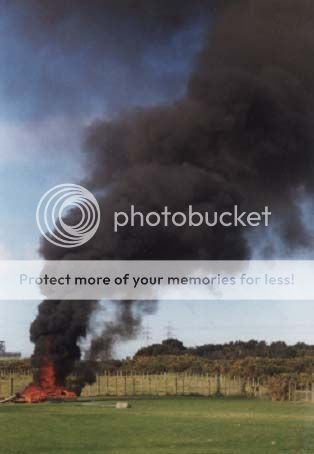
It's also producing black smoke...
How exactly did they come to these conclusions when all the evidence was removed and shipped for recycling to Asia and the Middle East, while
engineers were suing to get access to the evidence for observation and study?
Originally posted by Legalizer
How exactly did they come to these conclusions when all the evidence was removed and shipped for recycling to Asia and the Middle East, while engineers were suing to get access to the evidence for observation and study?
Exactly, Legalizer. Any examination of the steel wreckage would have put to rest all arguments concerning whether it melted or didn't. Then again, the same thing would have happened with the Pentagon had the Feds not confiscated the tapes from surrounding gas stations and such...
I thought that you leave all evidence just as it is as much as possible when examining a crime scene. Imagine if the po po started extracting bullets and taking knives/guns/bats/crowbars from crime scenes. It would be REALLY hard to solve the crime, wouldn't it?? "Um, this guy was clearly shot by a Blood from Texas, even though we have no murder weapon or bullets..."
Will someone PLEASE tell me why this was the FIRST time in history that a steel building collapsed from fire??? I'd be willing to bet that you can't without refuting the "official" story.
Originally posted by Legalizer
How exactly did they come to these conclusions when all the evidence was removed and shipped for recycling to Asia and the Middle East, while engineers were suing to get access to the evidence for observation and study?
Yeah, it's true. This is really quite suspicious -- one of the most dramatic engineering disasters was followed with such cover-up. They could have held the metal for much longer. This does look like destruction of evidence to me, and I'm not a big fan of conspiracies.
new topics
-
Supreme Court Oral Arguments 4.25.2024 - Are PRESIDENTS IMMUNE From Later Being Prosecuted.
Above Politics: 23 minutes ago -
Krystalnacht on today's most elite Universities?
Social Issues and Civil Unrest: 32 minutes ago -
Chris Christie Wishes Death Upon Trump and Ramaswamy
Politicians & People: 59 minutes ago -
University of Texas Instantly Shuts Down Anti Israel Protests
Education and Media: 3 hours ago -
Any one suspicious of fever promotions events, major investor Goldman Sachs card only.
The Gray Area: 5 hours ago -
God's Righteousness is Greater than Our Wrath
Religion, Faith, And Theology: 9 hours ago
top topics
-
VP's Secret Service agent brawls with other agents at Andrews
Mainstream News: 14 hours ago, 11 flags -
Nearly 70% Of Americans Want Talks To End War In Ukraine
Political Issues: 15 hours ago, 5 flags -
Sunak spinning the sickness figures
Other Current Events: 14 hours ago, 5 flags -
Electrical tricks for saving money
Education and Media: 12 hours ago, 4 flags -
Late Night with the Devil - a really good unusual modern horror film.
Movies: 16 hours ago, 3 flags -
Krystalnacht on today's most elite Universities?
Social Issues and Civil Unrest: 32 minutes ago, 3 flags -
Any one suspicious of fever promotions events, major investor Goldman Sachs card only.
The Gray Area: 5 hours ago, 2 flags -
University of Texas Instantly Shuts Down Anti Israel Protests
Education and Media: 3 hours ago, 2 flags -
Supreme Court Oral Arguments 4.25.2024 - Are PRESIDENTS IMMUNE From Later Being Prosecuted.
Above Politics: 23 minutes ago, 1 flags -
Chris Christie Wishes Death Upon Trump and Ramaswamy
Politicians & People: 59 minutes ago, 0 flags
active topics
-
University of Texas Instantly Shuts Down Anti Israel Protests
Education and Media • 45 • : CriticalStinker -
Nearly 70% Of Americans Want Talks To End War In Ukraine
Political Issues • 67 • : Consvoli -
Truth Social goes public, be careful not to lose your money
Mainstream News • 129 • : matafuchs -
Krystalnacht on today's most elite Universities?
Social Issues and Civil Unrest • 2 • : marg6043 -
Remember These Attacks When President Trump 2.0 Retribution-Justice Commences.
2024 Elections • 56 • : WeMustCare -
Candidate TRUMP Now Has Crazy Judge JUAN MERCHAN After Him - The Stormy Daniels Hush-Money Case.
Political Conspiracies • 743 • : WeMustCare -
British TV Presenter Refuses To Use Guest's Preferred Pronouns
Education and Media • 148 • : Consvoli -
VP's Secret Service agent brawls with other agents at Andrews
Mainstream News • 44 • : ByeByeAmericanPie -
New whistleblower Jason Sands speaks on Twitter Spaces last night.
Aliens and UFOs • 59 • : baablacksheep1 -
1980s Arcade
General Chit Chat • 27 • : alwaysbeenhere2